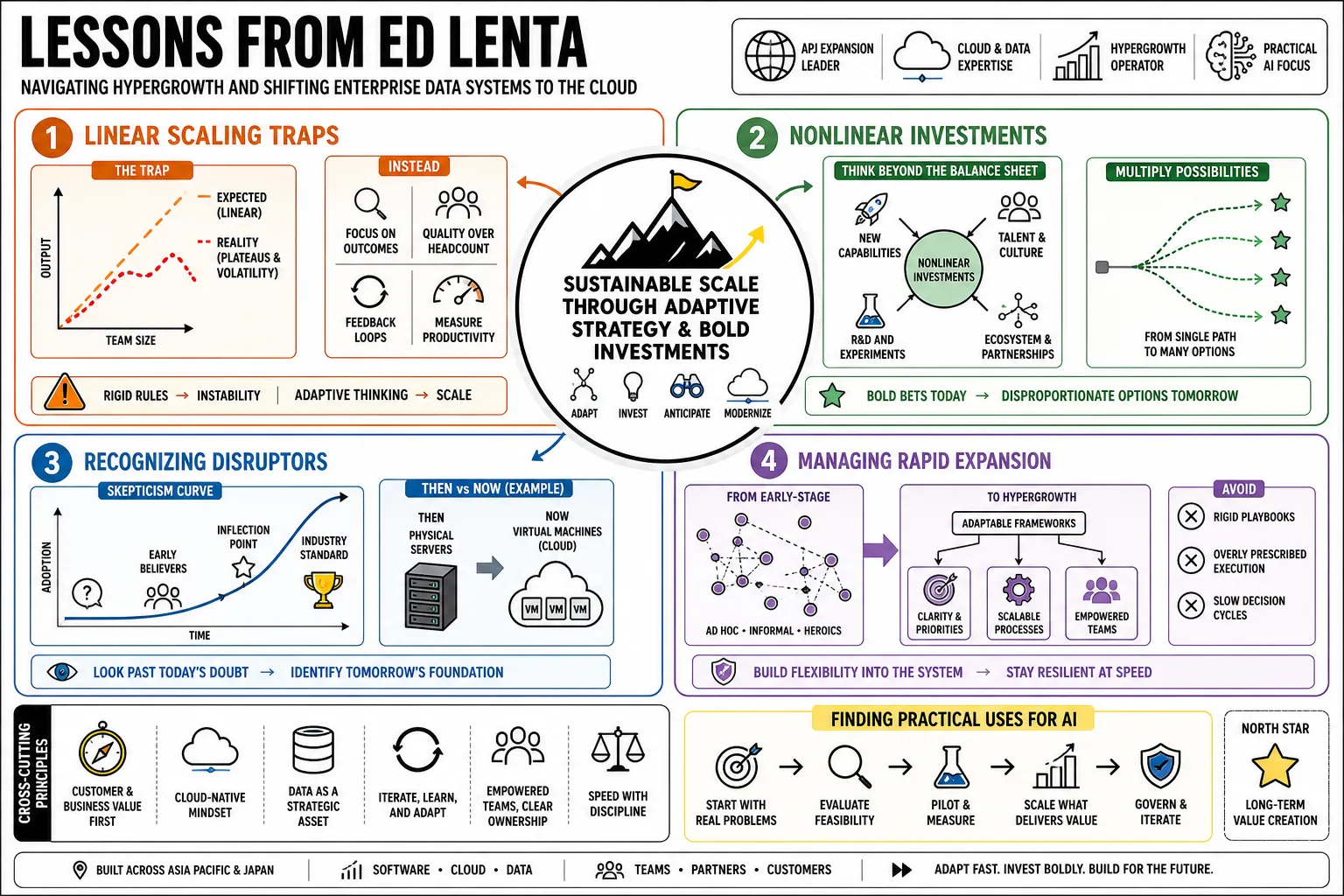
Lessons from Ed Lenta
Ed Lenta led Asia Pacific and Japan expansion for software companies like VMware, Amazon Web Services, Databricks, and ClickHouse. This profile collects his perspectives on managing rapid growth and shifting enterprise data systems to modern cloud architectures. He also details his approach to finding practical uses for AI.
Part 1: Navigating Hypergrowth and Scaling
- On Linear Scaling Traps: "Treating growth as a simple, linear math equation (such as assigning a rigid number of salespeople to a productivity metric) often leads to instability rather than sustainable scale." — Source: [SaaStr]
- On Nonlinear Investments: "Scaling successfully requires companies to think beyond the balance sheet and make nonlinear investments that open up a broader mix of possibilities." — Source: [SaaStr]
- On Recognizing Disruptors: "The most transformative technologies often face initial skepticism, much like early virtual machines compared to physical servers, before becoming foundational industry standards." — Source: [SaaStr]
- On Managing Rapid Expansion: "When moving from early-stage to hypergrowth, leadership must focus on building adaptable frameworks rather than rigid, overly prescribed execution models." — Source: [SaaStr]
- On Avoiding Tech Layoffs: "Over-hiring based on linear productivity assumptions is a common trap that hypergrowth companies must avoid to prevent the cycle of mass layoffs." — Source: [SaaStr]
- On Scaling Sales Teams: "Expanding a go-to-market organization requires understanding the nuance of different regions rather than applying a universal productivity formula." — Source: [SaaStr]
- On Early-Stage Growth: "In the earliest phases of scaling, the focus should be on proving the core value proposition in the market rather than over-optimizing internal processes." — Source: [SaaStr]
- On Maintaining Agility: "As organizations grow larger, preserving the ability to make rapid, nonlinear decisions becomes a core competitive advantage." — Source: [SaaStr]
- On the Challenge of Hype: "The transition from market hype to operational reality requires a company to double down on practical customer outcomes." — Source: [SaaStr]
- On Building for the Long Term: "True hypergrowth is about setting a foundation that supports sustained expansion over multiple technological cycles, rather than capturing immediate market share." — Source: [SaaStr]
Part 2: The Evolution of Cloud Infrastructure
- On Cloud Adoption: "The shift to cloud infrastructure requires enterprises to rethink both where their data lives and how their entire organization interacts with it." — Source: [IT Brief]
- On Legacy System Constraints: "Older, on-premises systems often act as a bottleneck, restricting a business's ability to innovate and respond to new market conditions." — Source: [theCUBE]
- On Infrastructure as an Enabler: "Modern cloud platforms should be viewed primarily as drivers of business agility rather than simple cost-saving measures." — Source: [IT Brief]
- On the Pace of Migration: "Organizations that hesitate to migrate core workloads to the cloud risk falling permanently behind competitors who operate with greater elasticity." — Source: [Analytics India Magazine]
- On Vendor Ecosystems: "The most successful cloud strategies rely on a cohesive ecosystem of partners rather than attempting to build every capability in-house." — Source: [theCUBE]
- On Data Gravity: "As data accumulates in cloud environments, it naturally attracts more applications and services, creating a powerful center of gravity for enterprise operations." — Source: [IT Brief]
- On Operational Efficiency: "Cloud infrastructure allows businesses to shift resources away from basic maintenance and toward engineering tasks that differentiate them in the market." — Source: [Analytics India Magazine]
- On Multi-Cloud Strategies: "Enterprises are increasingly adopting architectures that prevent lock-in and allow them to route workloads to the most effective environments." — Source: [IT Brief]
- On the Shift in Mindset: "Moving from a legacy mindset to a cloud-native one requires a fundamental change in how engineering teams view risk and experimentation." — Source: [theCUBE]
Part 3: The Lakehouse Architecture Paradigm
- On the Lakehouse Concept: "We're seeing incredible response from customers around this concept of the lakehouse; they understand that if they can bring data warehouse capabilities to a data lake architecture, they can do some pretty amazing things." — Source: [Computer Weekly]
- On Data Silos: "The historical divide between data lakes and data warehouses created artificial barriers that prevented organizations from accessing the full value of their information." — Source: [Computer Weekly]
- On Unifying Workloads: "A modern data architecture must be able to support business intelligence and advanced machine learning on a single, unified platform." — Source: [Databricks]
- On Open Standards: "Enterprises are demonstrating a growing demand to adopt open, modern architectures that accelerate their overarching cloud data strategies." — Source: [Databricks]
- On Cost-Performance: "By eliminating the need to duplicate data across multiple systems, the lakehouse dramatically improves both query performance and overall infrastructure costs." — Source: [Computer Weekly]
- On Democratizing Data: "When you remove the friction between different data silos, you empower more teams across the business to make data-driven decisions." — Source: [Databricks]
- On Real-Time Capabilities: "Modern business moves too fast for overnight batch processing; the architecture must support near real-time ingestion and analysis." — Source: [Computer Weekly]
- On Simplified Governance: "A unified data platform simplifies the complex task of securing and governing data across massive enterprise environments." — Source: [theCUBE]
- On the End of the Traditional Warehouse: "The vast majority of the world's data sits in lakes today, making the standalone enterprise data warehouse obsolete for modern AI workloads." — Source: [Computer Weekly]
- On Accelerating Time-to-Insight: "The primary advantage of converging these architectures is the drastic reduction in the time it takes to move from raw data to actionable business intelligence." — Source: [Databricks]
Part 4: Artificial Intelligence and Practical Applications
- On Beyond the AI Hype: "Companies are looking past the initial hype cycle of artificial intelligence and focusing heavily on practical, grounded applications that drive actual productivity." — Source: [Dynamic Business]
- On AI Readiness: "You cannot build effective AI models if the underlying data architecture is fragmented and inaccessible." — Source: [theCUBE]
- On Agentic Workloads: "As agentic workloads scale, enterprises are rethinking their data architecture around both speed and efficiency to support autonomous systems." — Source: [ClickHouse]
- On AI in Finance: "Financial institutions are utilizing AI to fundamentally personalize the customer experience at scale alongside traditional risk mitigation." — Source: [theCUBE]
- On Data Quality for AI: "The outputs of any machine learning model are only as reliable as the quality and freshness of the data feeding into it." — Source: [Dynamic Business]
- On Empowering Teams with AI: "The true value of AI lies in its ability to augment human teams, removing repetitive tasks and allowing engineers to focus on higher-level problem solving." — Source: [ClickHouse]
- On Security in AI: "Deploying AI securely requires strict governance models that control data access without stifling innovation and exploration." — Source: [theCUBE]
- On Predictive Analytics: "Moving from descriptive reporting to predictive analytics requires a fundamental shift in how an organization trusts and deploys machine learning models." — Source: [Dynamic Business]
- On the AI Era's Infrastructure: "The AI era demands foundational data infrastructure that can process and serve information with unprecedented speed and efficiency." — Source: [ClickHouse]
Part 5: Modernizing Legacy Data Environments
- On Data Flowing Like Electricity: "The ultimate goal of modernizing an enterprise data stack is to make data flow like electricity through the organization, available instantly wherever it is needed." — Source: [theCUBE]
- On Legacy Migrations: "Migrating off decades-old systems, like early Teradata warehouses, is complex but absolutely necessary for survival in a data-centric economy." — Source: [theCUBE]
- On Configuration over Coding: "Modern platforms allow organizations to shift their focus from complex, bespoke coding to streamlined, scalable configurations." — Source: [theCUBE]
- On Strategic Partnerships: "Transforming a legacy environment is rarely successful as a solo endeavor; it requires deep, strategic partnerships and alignment on shared goals." — Source: [theCUBE]
- On Minimizing Disruption: "The key to a successful migration is executing the transition in phases that deliver immediate value while minimizing disruption to ongoing business operations." — Source: [Analytics India Magazine]
- On Overcoming Technical Debt: "Maintaining aging legacy systems carries a massive opportunity cost in the form of technical debt that stifles new product development." — Source: [theCUBE]
- On Compliance and Modernization: "Modernizing data infrastructure often improves compliance postures by providing better visibility and automated governance controls." — Source: [theCUBE]
- On Cultural Resistance: "The biggest hurdle in moving away from legacy environments is often cultural rather than technical; teams must be willing to abandon familiar but inefficient workflows." — Source: [Analytics India Magazine]
- On Measuring Modernization Success: "The success of a data modernization project should be measured by the speed at which the business can launch new, data-driven features." — Source: [theCUBE]
Part 6: Leadership and Organizational Building
- On Building Regional Teams: "Expanding into new territories requires hiring local leadership that understands the unique market dynamics rather than imposing a distant corporate culture." — Source: [IT Brief]
- On Cross-Functional Alignment: "Scaling a technology company successfully requires strict alignment between product engineering, sales, and customer success teams." — Source: [SaaStr]
- On Focusing on Customer Outcomes: "Leadership must continuously steer the organization away from internal metrics and back toward tangible outcomes for the end customer." — Source: [SaaStr]
- On Adapting to Change: "The best leaders in high-growth technology sectors are those who remain comfortable operating in states of constant ambiguity and rapid change." — Source: [SaaStr]
- On Developing Partnerships: "I am always excited to build the teams and partnerships that help organizations unlock the full power of new technological capabilities." — Source: [ClickHouse]
- On Recognizing Talent: "In a hypergrowth environment, you need to identify individuals who scale faster than the company itself." — Source: [SaaStr]
- On the Role of the General Manager: "Running a massive region like APJ means balancing global corporate strategy with highly localized tactical execution." — Source: [IT Brief]
- On Fostering Innovation: "Leaders must create environments where teams feel secure enough to propose nonlinear ideas without fear of immediate failure." — Source: [SaaStr]
- On Managing Scale: "As a company scales across dozens of countries, leadership must transition from managing daily operations to managing frameworks and cultural guardrails." — Source: [Analytics India Magazine]
Part 7: Expanding in the Asia Pacific and Japan (APJ) Market
- On the APJ Opportunity: "The strategic opportunity across Asia Pacific and Japan is enormous, as enterprises rapidly modernize to adopt AI and real-time infrastructure." — Source: [ClickHouse]
- On Regional Diversity: "The APJ region is not a monolith; success requires tailoring go-to-market strategies for the distinct regulatory and economic environments of countries like Japan, India, and Australia." — Source: [IT Brief]
- On the Korean Market: "As one of the largest markets in the Asia Pacific region, Korea represents a natural expansion and reflects the growing demand for modern data architectures." — Source: [Databricks]
- On Fast-Growing Hubs: "Markets like India and Southeast Asia are leapfrogging legacy systems entirely, moving straight to advanced cloud and AI infrastructure." — Source: [Analytics India Magazine]
- On Local Talent: "Investing in the APJ region means committing heavily to developing local technical talent and engineering communities." — Source: [IT Brief]
- On Government and Public Sector: "Public sector organizations in the APJ region are becoming increasingly aggressive in their adoption of open-source and cloud-native data platforms." — Source: [ClickHouse]
- On Enterprise Readiness in APJ: "Enterprises across Japan and Australia are moving past proof-of-concept phases and demanding enterprise-grade, scalable deployments of AI technologies." — Source: [theCUBE]
- On Channel Partners: "A strong network of regional system integrators and channel partners is essential to scaling operations across the diverse APJ market." — Source: [IT Brief]
- On Regulatory Compliance: "Navigating data sovereignty and privacy regulations is a primary driver for how cloud architectures are designed and deployed in the APJ region." — Source: [Databricks]
- On Long-Term Commitment: "Winning in Asia Pacific requires a long-term investment horizon; companies cannot expect overnight success without building deep, localized trust." — Source: [Analytics India Magazine]
Part 8: The Future of Real-Time Analytics
- On Real-Time Infrastructure: "ClickHouse is emerging as the foundational data infrastructure for the AI era because organizations require analytics that operate in true real-time." — Source: [ClickHouse]
- On Cost-Performance Metrics: "Technologies that outperform traditional data warehouses by orders of magnitude on cost-performance metrics are the ones that become category-defining." — Source: [ClickHouse]
- On Speed and Efficiency: "Enterprises are fundamentally rethinking their data architectures because the AI era demands a unique combination of extreme speed and operational efficiency." — Source: [ClickHouse]
- On Open-Source Adoption: "The enterprise adoption of open-source database technologies is accelerating because they offer the flexibility and performance required for massive scale." — Source: [IT Brief]
- On Streaming Data: "The future of analytics relies on the ability to query streaming data as it arrives, rather than waiting for scheduled batch loads to complete." — Source: [Computer Weekly]
- On Analytics at Scale: "Organizations must unlock the full power of real-time analytics at scale to remain competitive in environments where milliseconds dictate business outcomes." — Source: [ClickHouse]
- On Defining New Categories: "When a technology solves the dual problem of high performance and low cost, it replaces older systems and defines an entirely new category of infrastructure." — Source: [ClickHouse]
- On Customer Expectations: "End-users now expect applications to reflect data changes instantly; data infrastructure must evolve to meet this baseline expectation of immediacy." — Source: [IT Brief]
- On the Horizon of Data: "We are moving toward a future where analytical queries are executed concurrently against petabytes of data without any perceptible latency to the end business user." — Source: [Analytics India Magazine]