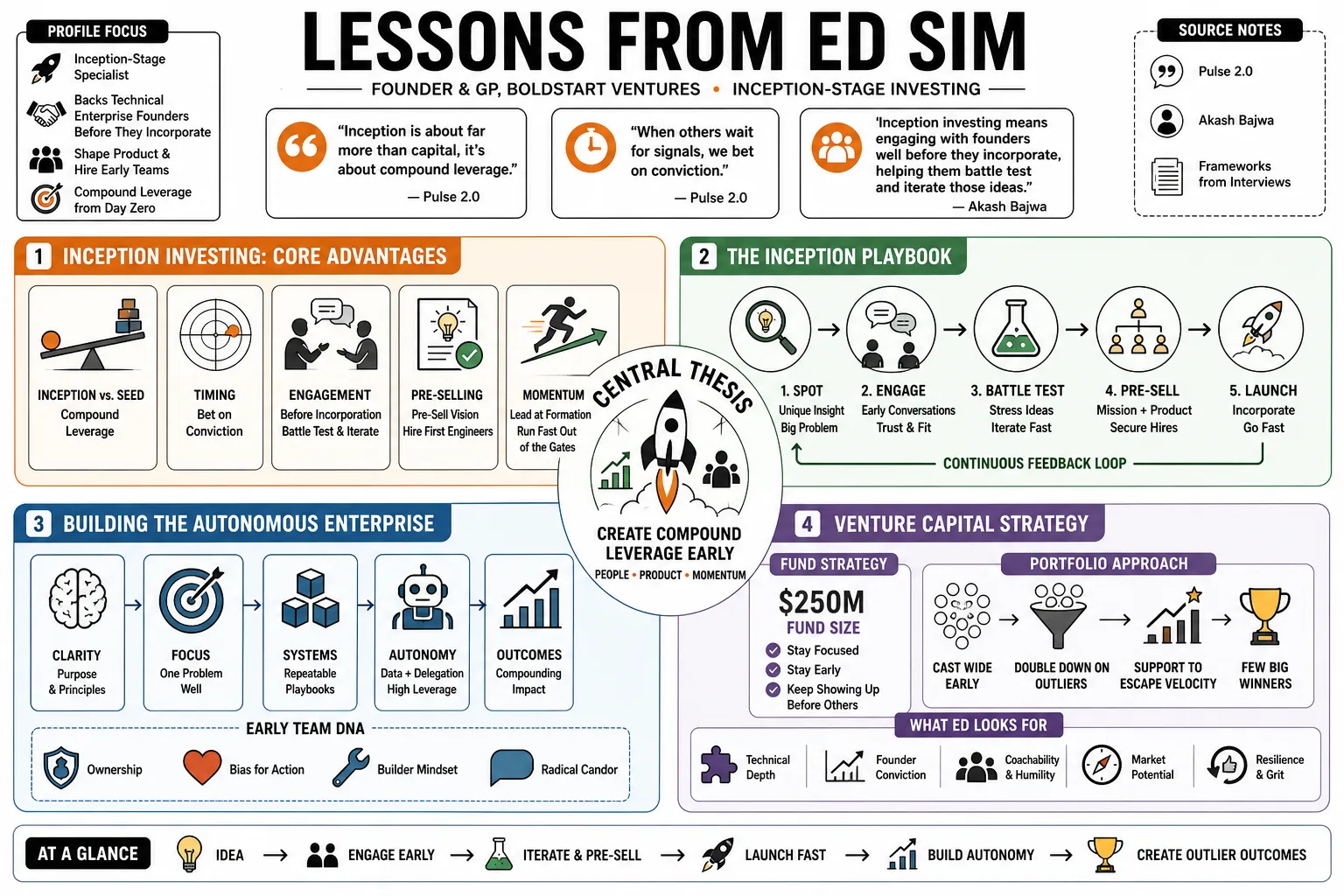
Ed Sim is the founder and general partner of Boldstart Ventures, an investment firm that specializes in "inception-stage" funding. He backs technical enterprise founders before they incorporate, working with them to shape products and hire early teams. This profile compiles his frameworks on early-stage company building, the transition to the autonomous enterprise, and venture capital strategy.
Part 1: Inception Investing
- On Inception vs. Seed: "Inception is about far more than capital, it's about compound leverage." — Source: Pulse 2.0
- On Timing: "When others wait for signals, we bet on conviction." — Source: Pulse 2.0
- On Engagement: "Inception investing means engaging with founders well before they incorporate, helping them battle test and iterate those ideas." — Source: Akash Bajwa
- On Pre-Selling: A key part of inception is helping founders pre-sell their vision to secure the initial engineering hires. — Source: Akash Bajwa
- On Momentum: The goal of leading rounds at company formation is so founders can run fast out of the gates. — Source: Akash Bajwa
- On Fund Strategy: "Staying at $250 million lets us stay focused, stay early, and keep showing up for founders before the rest of the world believes." — Source: Pulse 2.0
- On Early Support: Investors should work side by side with technical founders to unlock first customers and architect the conditions for breakout. — Source: Pulse 2.0
- On Operating: "That's where Boldstart operates best, before the noise, before the signal." — Source: Pulse 2.0
- On The 5 Ps: Sim uses the 5 Ps as a way to pressure-test very early enterprise ideas before a clean market map exists. — Reference: The Split episode on the 5 Ps of inception-stage investing
- On Partnership: Sim's inception model makes the investor a company-building partner before incorporation, not just a check after the company is already formed. — Reference: Sim essay on inception investing
Part 2: The Autonomous Enterprise
- On System Transitions: The fundamental shift in software is moving from human-in-the-loop to machine-in-the-loop systems. — Source: Business Wire
- On Rebuilding: "The autonomous enterprise won't be retrofitted from SaaS; it will be rebuilt from scratch." — Source: Business Wire
- On Future Software: The next decade belongs to the builders reimagining the operating system of the enterprise. — Source: Pulse 2.0
- On Machine Agency: In the future of enterprise software, agents and machines will plan and act on our behalf. — Source: Pulse 2.0
- On New Paradigms: "This isn't about optimizing yesterday's stack. It's about building the operating system for the intelligent enterprise." — Source: Pulse 2.0
- On Core Infrastructure: The new operating system must be wired for autonomy and secured from day one. — Source: Pulse 2.0
- On Automation Timelines: "It will not happen overnight. But over the next decade, humans will do less and less." — Source: Boldstart Ventures
- On AI Capabilities: Software will eventually move past data retrieval to actually think, plan, and execute tasks. — Source: Boldstart Ventures
- On Design: True autonomous platforms are "AI-native, agent-powered, and autonomous by design." — Source: Boldstart Ventures
- On Legacy Workflows: AI-native development requires a total departure from legacy SaaS business models. — Source: Medium
Part 3: Artificial Intelligence and the Next Decade
- On Feature Costs: "When shipping new features cost near zero, every company becomes every company." — Source: Wave
- On Switching Costs: A zero-cost switching environment completely changes the long-term winners in enterprise software. — Source: Wave
- On Company Building: "I think that we are in a totally different type of company building paradigm that we have barely wrapped our heads around." — Source: Wave
- On Leadership Requirements: "AI-native leadership is now a survival requirement, not a nice to have." — Source: GTMnow
- On Market Opportunities: Sim sees AI as a platform shift big enough for technical founders to rebuild workflows, not merely add incremental features. — Reference: Turpentine VC episode on AI platform shifts
- On Software Economics: AI fundamentally alters the marginal cost of producing and maintaining complex enterprise systems. — Source: The Sequence Chat
- On Vertical AI: The most successful AI applications will solve deep vertical problems rather than broad horizontal workflows. — Source: What's Hot in Enterprise IT/VC
- On AI Security: Securing the intelligent enterprise from day one will be the primary constraint on large-scale corporate AI adoption. — Source: The Sequence Chat
- On The End of SaaS: Sim's AI-era software view is that old hypergrowth assumptions are weakening as AI changes products, workflows, and the economics of building. — Reference: The Split episode on AI and the death of hypergrowth software
- On Agentic Frameworks: Sim's autonomous-enterprise thesis centers on agents changing how work crosses enterprise systems and how companies operate. — Reference: GTMnow episode on AI agents and the autonomous enterprise
Part 4: Board Membership and Founder Support
- On The 3 Cs: Sim's board framework balances three modes: cheer the founder, challenge the assumptions, and chill when the team needs room to execute. — Reference: The Split episode on the 3 Chs of board support
- On Cheering: Sim's first board mode is support: founders need investors who can keep belief high during the normal turbulence of company building. — Reference: The Split episode on board support
- On Challenging: Sim's challenge mode is about testing assumptions hard enough that founders can stay ahead of market and technology shifts. — Reference: GTMnow episode on board support and AI shifts
- On Chilling: Sim's chill mode recognizes that an active board member also has to know when to step back and let operators operate. — Reference: The Split episode on how board roles change
- On Honest Feedback: True founder-first advice often means giving difficult and entirely unfiltered feedback before problems compound. — Source: Boldstart Ventures
- On VCs as Therapists: In the modern venture landscape, early-stage investors must act as part-therapist and part-operator. — Source: Trends With Friends
- On Board Dynamics: The most effective startup boards are kept small and optimized for high-speed decision making. — Source: Driving Alpha
- On Long-Term Alignment: Sim's day-one investor posture depends on staying steady through the long company-building arc, not only the first financing. — Reference: The Data Minute episode index on venture and founder partnership
- On Supporting Vision: Board members must protect the founder's original vision while simultaneously helping them adapt to harsh market realities. — Source: Driving Alpha
Part 5: Developer-First Product Strategy
- On Developer Friction: The most successful developer-first tools focus entirely on reducing installation and usage friction for the end-user. — Source: What's Hot in Enterprise IT/VC
- On Security Tools: Companies like Snyk succeeded by making security a developer-first motion rather than a top-down executive mandate. — Source: What's Hot in Enterprise IT/VC
- On Fortune 500 Strategy: Legacy companies are increasingly adopting developer portals to expose internal services and create new revenue streams. — Source: Medium
- On Product Moats: The concept of traditional moats is dying; execution and speed remain the only reliable advantages. — Source: BeyondVC
- On Feature Companies: Single-product and single-feature companies face an uphill battle in today's crowded procurement environment. — Source: What's Hot in Enterprise IT/VC
- On Product Selling: SaaS founders should be highly cautious about selling their products before the core workflow is heavily tested. — Source: SaaStr Podcast
- On Open Source: Open source is a targeted go-to-market strategy rather than a standalone business model. — Source: BeyondVC
- On Product Expansion: Moving from a single developer tool to a broad platform requires a fundamental shift in company engineering DNA. — Source: BeyondVC
- On User Adoption: The best enterprise software is adopted bottom-up by practitioners but sold top-down to budget holders. — Source: Transistor.fm
Part 6: Navigating the Venture Capital Landscape
- On The VC Barbell: Sim describes venture as barbelled between huge multistage funds and focused specialists, with Boldstart choosing inception-stage enterprise focus. — Reference: Turpentine VC episode on the venture barbell
- On Seed Competition: The seed stage has become incredibly crowded, forcing true early-stage investors to move earlier to the inception phase. — Source: 20VC
- On Valuations: Higher pricing in the private markets is driven by the sheer velocity of capital chasing a scarcity of proven technical founders. — Source: 20VC
- On Capital as a Commodity: Sim's edge is not capital alone; it is helping technical founders build customer relationships, hire early, and de-risk the company from inception. — Reference: The Split episode on customer relationships and inception investing
- On Specialization: Generalist funds will struggle to evaluate deep technical infrastructure at the earliest possible stages of formation. — Source: Driving Alpha
- On Fund Sizing: A smaller fund size enforces financial discipline and aligns the investor's incentives directly with early-stage outcomes. — Source: Pulse 2.0
- On Market Maps: Sim likes investing before there is a market map because the best enterprise categories can look strange before customers and language catch up. — Reference: The Split episode on investing before market maps
- On Follow-on Capital: Sim designs inception rounds so founders can start fast, then graduate from discovery to classic or jumbo rounds as evidence compounds. — Reference: Sim essay on discovery, classic, and jumbo inception rounds
- On Venture Returns: Sim's return logic is to be first with the strongest technical founders, building conviction and future-round position before consensus forms. — Reference: Sim essay on the race to be first
Part 7: Go-To-Market and Early Traction
- On First Customers: Sim's enterprise GTM lesson is that early customers come from hands-on selling and learning loops, not a polished scalable machine on day one. — Reference: GTMnow episode on early enterprise GTM
- On Customer Feedback: Sim treats early customer relationships as part of product formation, where design partners help expose what the company must actually build. — Reference: The Split episode on customer relationships
- On Sales Motions: Product-led growth works best when paired with an enterprise sales motion early in the company journey. — Source: SaaStr Podcast
- On Pricing: Founders consistently underprice their early enterprise software; price acts as a strong signal of value. — Source: SaaStr Podcast
- On Selling Vision: At the inception stage, you are selling the vision and the technical team rather than a finished product. — Source: BeyondVC
- On Community: Building a developer community requires authentic, sustained technical engagement over basic marketing tactics. — Source: Transistor.fm
- On The Sales Playbook: The traditional SaaS playbook is changing; founders must adapt to widespread software buyer fatigue. — Source: GTMnow
- On Category Creation: If you are creating a new category, your biggest competitor is the status quo rather than another startup. — Source: BeyondVC
- On Early Hires: The first sales hire should be a pathfinder who can write the playbook from scratch, omitting executives who expect an existing system. — Source: BeyondVC
Part 8: Founder Mindset and Building Teams
- On Core Traits: The most defining characteristics of successful technical founders are courage and unyielding conviction. — Source: What Got You There
- On Founder Therapy: Building a company from scratch takes a severe emotional toll; founders require a dedicated support system. — Source: Trends With Friends
- On Hiring Technical Talent: The best engineers are motivated by solving hard, undocumented problems rather than standard compensation packages. — Source: What's Hot in Enterprise IT/VC
- On Delegation: A founder's job transitions from building the product to building the machine that builds the product. — Source: BeyondVC
- On Resilience: Sim's own Boldstart story shows the resilience needed for inception investing: years of fundraising grind before the model becomes obvious. — Reference: The Split episode on building Boldstart
- On Technical Debt: Early technical decisions compound rapidly; founders must balance speed to market with strict architectural integrity. — Source: The Sequence Chat
- On Culture: Company culture is established entirely by the behavior of the first ten employees, omitting any corporate mission statements. — Source: Driving Alpha
- On Ambition: Sim looks for founders aiming at the AI jet stream, where the idea may sound early but the market shift is large enough to justify the ambition. — Reference: GTMnow episode on AI-native founders
- On The Founder-Market Fit: Technical founders have a distinct advantage when they are building tools to solve their own daily pain points. — Source: BeyondVC