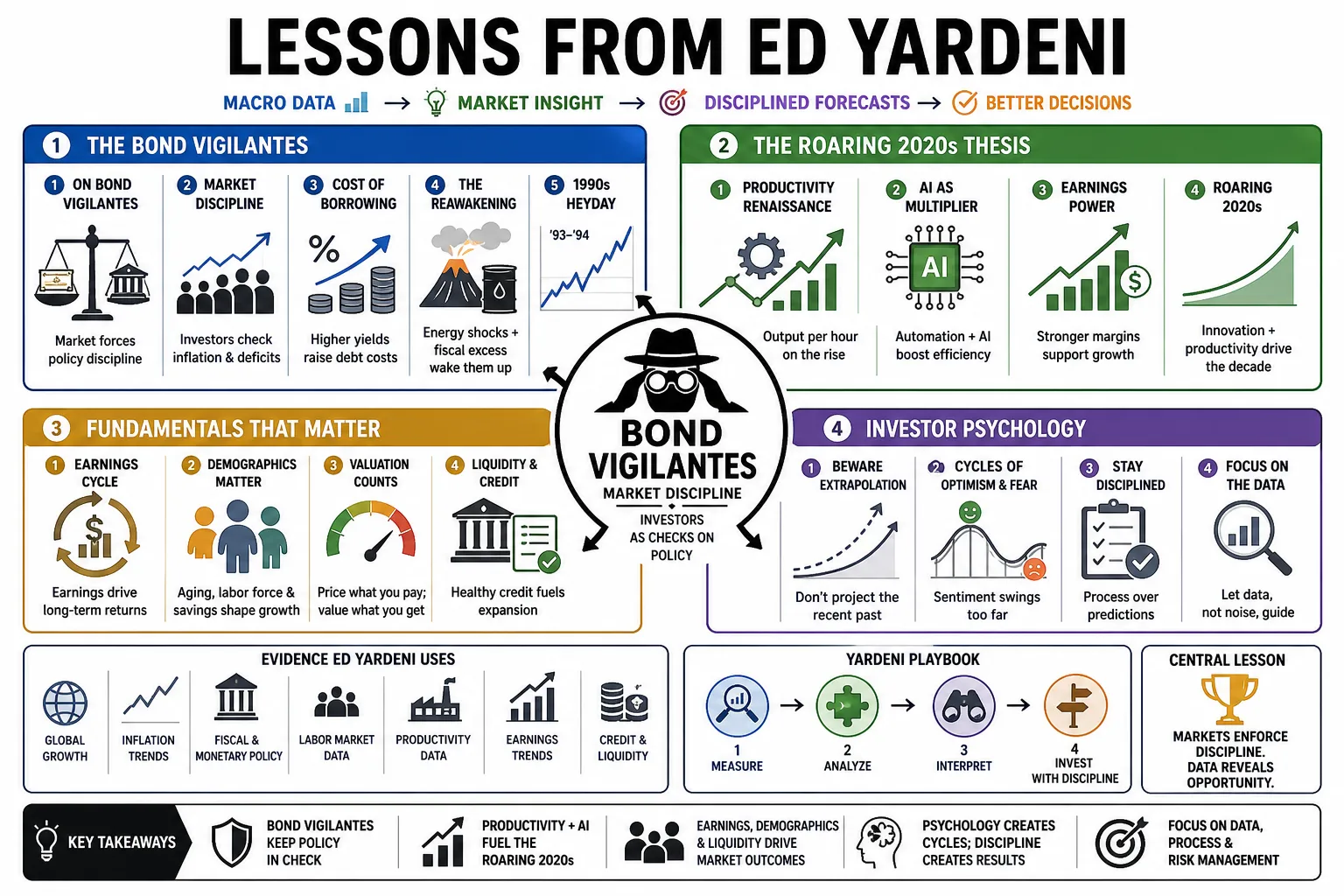
Lessons from Ed Yardeni
Economist and investment strategist Ed Yardeni is best known for coining the term "bond vigilantes" in the 1980s. At Yardeni Research, he uses macroeconomic data to forecast markets, most recently arguing that productivity and AI are driving a "Roaring 2020s." This collection covers his views on capital markets, earnings, demographics, and investor psychology.
Part 1: The Bond Vigilantes
- On Bond Vigilantes: "If the fiscal and monetary authorities won't regulate the economy, the bond market will." — Source: Yardeni Research
- On Market Discipline: "Investors act as a check on government policy; when they sense inflation or reckless deficits, their selling of bonds drives up yields and forces policymakers to adjust." — Source: Schwab
- On the Cost of Borrowing: "Spiking yields effectively increase the cost of debt, creating an immediate, market-driven consequence for undisciplined government spending." — Source: Wikipedia
- On the Reawakening: "The bond vigilantes can slumber during periods of low inflation, but they return aggressively in response to energy shocks and unchecked fiscal expansion." — Source: MacroMicro
- On the 1990s Heyday: "The 1993 to 1994 period remains the textbook example of how sudden spikes in the 10-year Treasury yield can mandate fiscal restraint from the government." — Source: PIMCO
- On Central Bank Credibility: "The Federal Reserve often faces intense pressure to raise interest rates to appease bond investors, particularly when inflation proves sticky." — Source: CXC
- On Nominal GDP and Yields: "Bond yields tend to track the growth rate of nominal GDP over the long run, but sharp divergences signal major inflection points in policy or market sentiment." — Source: Yardeni Research
- On Sovereign Debt: "No government is entirely immune to market forces; excessive issuance of debt eventually triggers a buyer's strike from those demanding higher risk premiums." — Source: EconLib
- On Economic Trajectories: "Market discipline enforced through higher yields often redirects broader economic trajectories away from worst-case inflationary spirals." — Source: Wikipedia
Part 2: The Roaring 2020s and Economic Optimism
- On the Roaring 2020s: "The current decade is positioned for immense prosperity, mirroring the 1920s through strong growth, productivity gains, and technological innovation." — Source: Hamilton ETFs
- On Perma-Bull Status: "Maintaining a long-term optimistic outlook is less about blind faith and more about recognizing the historical resilience of the U.S. economy." — Source: Wealth Professional
- On Recessions: "Credit crunches, not political cycles or geopolitical noise, are the primary drivers of actual economic recessions and bear markets." — Source: Hamilton ETFs
- On Stock Market Targets: "Continual upward revisions in long-term index targets reflect the compounding power of solid corporate earnings rather than speculative mania." — Source: Forbes
- On Resilience: "Even amidst bond market volatility and rising yields, the underlying bull market in equities remains insulated if corporate margins hold strong." — Source: Yardeni QuickTakes
- On Rising Prices: "The cure for high prices is high prices and vice versa." — Source: Meb Faber
- On Ignore the Noise: "Investors often undermine their own returns by letting political headlines distract them from the fundamental strength of labor and capital markets." — Source: CNBC
- On Crisis Fatigue: "Markets have developed a remarkable ability to absorb rolling crises without derailing the broader structural growth narrative." — Source: Bloomberg
- On Buying Opportunities: "A backup in yields or short-term panic often presents a strategic window to acquire strong equities at a discount." — Source: Yardeni QuickTakes
- On American Exceptionalism: "The U.S. economy consistently outperforms pessimistic forecasts because of its unique capacity for rapid corporate adaptation." — Source: Yardeni Research
Part 3: Inflation and Central Banks
- On Fed Watching: "Tracking the Federal Reserve's moves is essential for investors, but it requires parsing actual policy shifts from mere rhetorical signaling." — Source: Goodreads
- On Sticky Inflation: "When inflation embeds itself into services and wages, central banks lose the luxury of accommodating growth and must prioritize price stability." — Source: StockTwits
- On the Yield Curve: "While an inverted yield curve is a famous recession indicator, it must be read in context; it sometimes merely predicts a necessary cooling of growth." — Source: Yardeni Research
- On Policy Mistakes: "The greatest risk to a bull market is often a central bank tightening too late and then overcompensating by raising rates too far." — Source: Bloomberg
- On Hawkish Leadership: "Changes in Federal Reserve personnel, such as shifts toward more hawkish board members, can immediately reset the market's expectations for liquidity." — Source: Yardeni Research
- On the Pandemic Response: "The massive monetary intervention during the COVID-19 crisis prevented an immediate collapse but sowed the seeds for subsequent years of complex inflationary cleanup." — Source: Goodreads
- On Real Rates: "The transition from zero-interest-rate policy to positive real yields forces a healthier, more disciplined allocation of capital across the economy." — Source: CNBC
- On Financial Conditions: "The stock market itself acts as an easing or tightening mechanism; rising equities can offset the Fed's attempts to slow the economy." — Source: Top Traders Unplugged
- On Liquidity Withdrawals: "Quantitative tightening is an unprecedented experiment, but corporate America has proven surprisingly adept at operating with less abundant central bank liquidity." — Source: Yardeni QuickTakes
Part 4: Corporate Earnings and Market Momentum
- On the Profit Motive: "In praise of profits! The pursuit of corporate earnings is the fundamental engine that drives hiring, innovation, and market returns." — Source: Goodreads
- On FEMO: "Fabulous Earnings Momentum is the true undercurrent of a sustained bull market, overriding macroeconomic anxieties." — Source: CNBC
- On Margins: "Companies have become remarkably skilled at defending their profit margins against inflation by passing costs through to consumers and optimizing operations." — Source: Seeking Alpha
- On Stock Buybacks: "Share repurchases are frequently misunderstood; they are a legitimate and efficient way to return excess capital to shareholders when internal investment opportunities are scarce." — Source: Goodreads
- On Valuations: "A high price-to-earnings ratio is not inherently dangerous if it is supported by a genuinely higher long-term growth rate in underlying earnings." — Source: Yardeni QuickTakes
- On Sector Rotation: "Earnings strength rarely stays concentrated in one sector forever; capital naturally rotates toward industries demonstrating the best relative profit growth." — Source: Yardeni Research
- On the Pandemic's Impact: "The global health crisis forced corporations to permanently streamline their cost structures, leading to structurally higher profitability in the aftermath." — Source: Goodreads
- On Capital Expenditure: "When companies invest heavily in their own infrastructure and technology, it is a leading indicator of future productivity and earnings expansion." — Source: Seeking Alpha
- On the S&P 500: "The index is effectively an actively managed portfolio of the world's most ruthlessly efficient profit-generating machines." — Source: CNBC
Part 5: Forecasting and Market Cycles
- On Learning from Markets: "The financial markets provide a never-ending continuing education course." — Source: Goodreads
- On Economic Models: "Do not get hung up with learning from somebody who is selling a model that explains everything." — Source: Ritholtz
- On Visualizing Data: "Complex economic relationships are best understood and communicated through clear, real-time charts rather than dense academic jargon." — Source: Yardeni Research
- On Avoiding Sensationalism: "Effective market analysis requires a no-nonsense approach that filters out the daily panic generated by the financial press." — Source: Yardeni QuickTakes
- On Historical Context: "You cannot predict the markets without a deep fluency in past economic cycles and how previous generations of investors reacted to stress." — Source: Goodreads
- On Independent Research: "Wall Street sell-side research often carries inherent biases; truly actionable strategy requires independent, objective data interpretation." — Source: Yardeni Research
- On Leading Indicators: "Traditional economic indicators frequently lag the stock market, which is itself the most aggressive forward-looking pricing mechanism in existence." — Source: Top Traders Unplugged
- On Consumer Surveys: "What consumers do with their wallets is infinitely more predictive of economic health than what they tell pollsters about their mood." — Source: Bloomberg
- On Tracking Earnings: "The aggregate path of forward earnings estimates is the most reliable compass for navigating a volatile equity market." — Source: CNBC
- On Forecasting Humility: "Every forecaster will eventually be wrong; the key is adjusting your thesis quickly when the data visibly changes direction." — Source: Traders Union
Part 6: Demographics and the G-Shaped Economy
- On the G-Shaped Economy: "The current landscape is not a K-shaped divergence of rich and poor, but rather a G-shaped generational economy driven by the immense accumulated wealth of older cohorts." — Source: Yardeni Research
- On Baby Boomer Spending: "Retired Boomers with significant assets in homes and stock portfolios are acting as a massive, stabilizing force for aggregate consumer spending." — Source: Yardeni Research
- On the Wealth Effect: "When the stock market and housing values rise together, the resulting feeling of financial security dramatically insulates the economy from traditional recession triggers." — Source: Forbes
- On Labor Shortages: "Demographic aging inherently tightens the labor market, shifting bargaining power back to workers and demanding higher corporate efficiency." — Source: Yardeni QuickTakes
- On Generational Wealth Transfer: "The impending transfer of trillions of dollars from Boomers to younger generations will reshape investment flows and consumption patterns for decades." — Source: Bloomberg
- On Healthcare Economics: "An aging demographic guarantees persistent, structural demand for healthcare services, making it a uniquely resilient sector of the economy." — Source: CNBC
- On Housing Supply: "The reluctance of older generations to downsize, combined with a decade of underbuilding, has created a permanent floor under real estate prices." — Source: Yardeni Research
- On Consumer Resilience: "The American consumer is routinely written off as overextended, yet consistently defies expectations due to underlying demographic tailwinds." — Source: Wealth Professional
- On Saving Rates: "Fluctuations in the personal saving rate are less alarming when viewed alongside the massive net worth sitting on household balance sheets." — Source: Yardeni QuickTakes
Part 7: Productivity, AI, and Innovation
- On AI Investment: "The massive capital being deployed by hyperscalers into data centers is not a speculative bubble, but a necessary buildout for the next phase of economic growth." — Source: Seeking Alpha
- On Productivity Gains: "Artificial intelligence is the catalyst needed to unlock a new era of worker productivity, offsetting the inflationary pressures of a shrinking labor pool." — Source: Hamilton ETFs
- On the 1920s Parallel: "Just as electrification and the automobile transformed the 1920s, AI and automation are the physical and digital infrastructure driving the Roaring 2020s." — Source: Hamilton ETFs
- On Tech Volatility: "Short-term fluctuations in semiconductor and hardware stocks do not invalidate the long-term structural demand for processing power." — Source: Seeking Alpha
- On Margin Expansion through Tech: "Companies that successfully integrate automation will permanently lower their operating costs, driving margin expansion even in slow-growth environments." — Source: Yardeni Research
- On the CapEx Cycle: "We are in the early stages of a profound capital expenditure super-cycle driven by the need to upgrade technological infrastructure across all industries." — Source: CNBC
- On Disinflationary Tech: "Technology acts as a powerful disinflationary force in the economy, constantly driving down the cost of goods and services over time." — Source: Top Traders Unplugged
- On Software as a Utility: "Software and cloud computing have transitioned from discretionary tech spending to mandatory utilities required to keep any modern business functioning." — Source: Yardeni QuickTakes
- On Innovation Surprises: "The most impactful economic developments are rarely modeled by economists; they emerge organically from the messy, unpredictable process of technological innovation." — Source: Yardeni Research
Part 8: Contrarian Investing and Behavioral Finance
- On Market Consensus: "The crowd is often wrong at major turning points; maintaining skepticism toward a uniformly accepted narrative is essential for long-term survival." — Source: Hamilton ETFs
- On the Wall of Worry: "Bull markets historically climb a wall of worry; if there is nothing for the market to fret about, a peak is likely near." — Source: Bloomberg
- On Pessimism as a Trap: "Permanent pessimism sounds intellectually rigorous, but it is fundamentally a losing strategy in a capitalist system designed to grow." — Source: Wealth Professional
- On Ignoring Politics: "Investors consistently damage their portfolios by allowing their personal political anxieties to dictate their asset allocation." — Source: CNBC
- On Media Sensationalism: "The financial media's business model relies on generating anxiety; an investor's job is to tune out the hyperbole and focus on corporate fundamentals." — Source: Yardeni QuickTakes
- On Sentiment Indicators: "When extreme bearish sentiment aligns with strong underlying corporate earnings, it presents one of the most reliable buy signals in the market." — Source: Yardeni Research
- On Patience: "The most difficult discipline in investing is holding onto strong positions during periods of intense, news-driven volatility." — Source: Ritholtz
- On the Danger of "This Time is Different": "While technology changes, human psychology regarding fear and greed remains identical to what it was a century ago." — Source: Goodreads
- On Market Timing: "Attempting to jump in and out of the market based on macroeconomic guesses usually results in missing the sharpest periods of compounding growth." — Source: Top Traders Unplugged
- On Optimism as an Edge: "In a world overly focused on systemic risks, a structurally optimistic view on human ingenuity and corporate adaptability is a definitive competitive advantage." — Source: Traders Union