Lessons from Edward Bernays
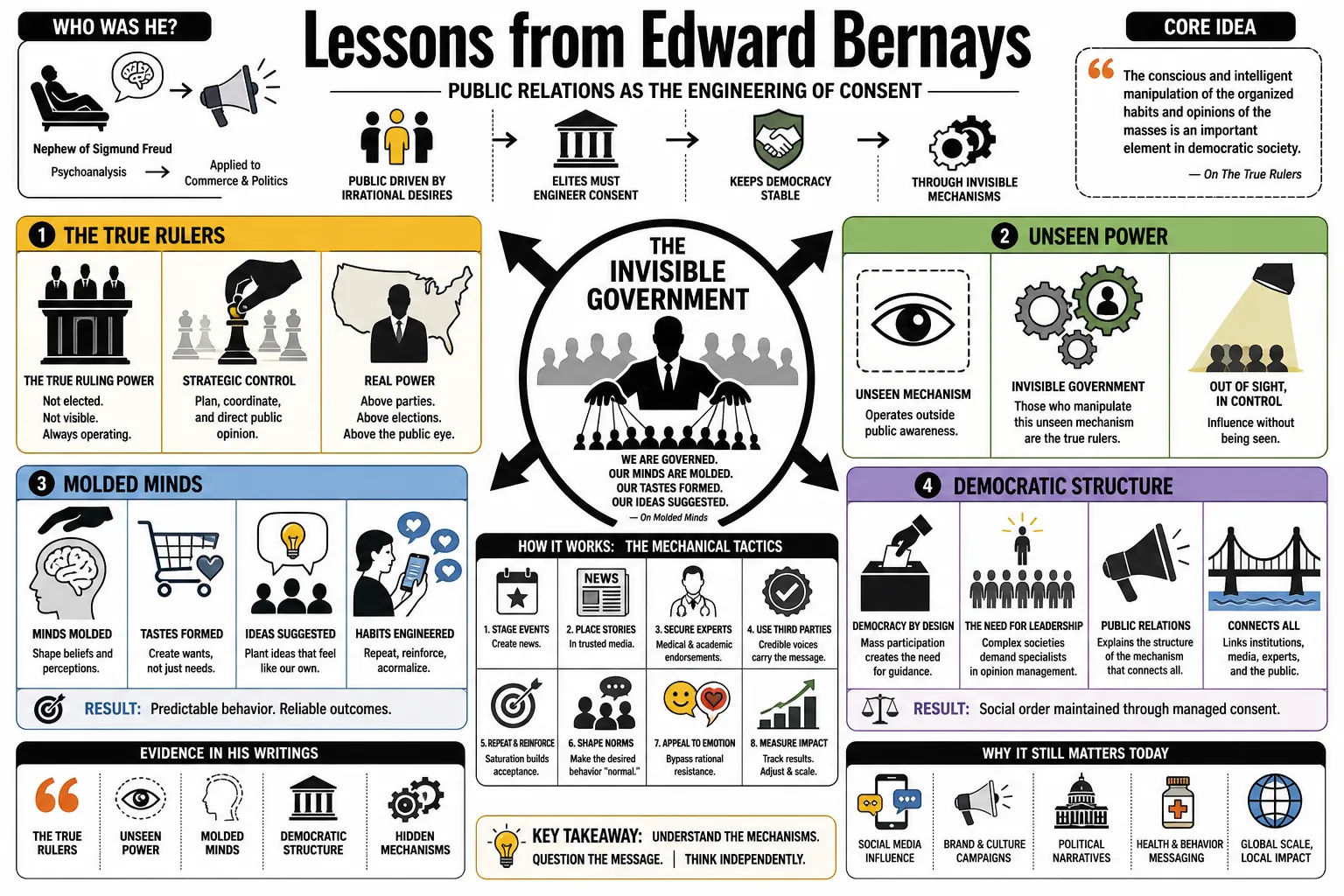
Edward Bernays helped build the modern public relations industry by applying the psychoanalytic theories of his uncle, Sigmund Freud, to commerce and politics. He argued that because the public is driven by irrational desires, elites must actively engineer mass consent to keep democracy stable. His writings detail the exact mechanical tactics, like staging news events and securing medical endorsements, that campaigns still use to shape behavior today.
Part 1: The Invisible Government
- On The True Rulers: "The conscious and intelligent manipulation of the organized habits and opinions of the masses is an important element in democratic society." — [Source: Propaganda)]
- On Unseen Power: "Those who manipulate this unseen mechanism of society constitute an invisible government which is the true ruling power of our country." — [Source: Propaganda)]
- On Molded Minds: "We are governed, our minds are molded, our tastes formed, our ideas suggested, largely by men we have never heard of." — [Source: Propaganda)]
- On Democratic Structure: "This is a logical result of the way in which our democratic society is organized." — [Source: Propaganda)]
- On Hidden Mechanisms: It is the purpose of public relations to explain the structure of the mechanism which controls the public mind, and to tell how it is manipulated. — [Source: Propaganda)]
- On Necessary Leadership: Society relies on a relatively small number of individuals to organize chaos into a functioning system. — Source: Biography of an Idea
- On Executive Control: "Propaganda is the executive arm of the invisible government." — [Source: Propaganda)]
- On Group Motives: The systematic study of mass psychology revealed the potentialities of invisible government by manipulating the motives which actuate man in the group. — Source: American Journal of Sociology
- On Regimentation: If we understand the mechanism and motives of the group mind, it is possible to regiment the masses according to our will without them knowing it. — [Source: Propaganda)]
- On Elite Cooperation: The invisible government is not a formal organization, but an emergent property of elites acting in their own interests across various sectors. — Source: Crystallizing Public Opinion
Part 2: The Psychology of the Masses
- On Real Motives: "Men are rarely aware of the real reasons which motivate their actions." — [Source: Propaganda)]
- On Outside Influences: "In actual fact his judgment is a melange of impressions stamped on his mind by outside influences which unconsciously control his thought." — [Source: Propaganda)]
- On Inertia: "The great enemy of any attempt to change men's habits is inertia." — [Source: Propaganda)]
- On Accustomed Channels: "People accept the facts which come to them through existing channels. They like to hear new things in accustomed ways." — Source: Crystallizing Public Opinion
- On Unconscious Drives: By tapping into unconscious desires and fears, as described by psychoanalysis, a counsel can redirect public behavior toward desired outcomes. — Source: The Century of the Self
- On the Illusion of Literacy: "Universal literacy was supposed to educate the common man to control his environment... But instead of a mind, universal literacy has given him rubber stamps, rubber stamps inked with advertising slogans." — [Source: Propaganda)]
- On the Herd Instinct: Man is by nature a herd animal, constantly seeking the approval and guidance of his peers and perceived superiors. — Source: Crystallizing Public Opinion
- On Emotional Appeals: Facts alone are insufficient to move a crowd; one must appeal to their underlying emotional architecture. — Source: Biography of an Idea
- On Changing Attitudes: "It is sometimes possible to change the attitudes of millions but impossible to change the attitude of one man." — Source: Biography of an Idea
- On Rationalization: What the individual believes to be independent thought is often merely the rationalization of an impulse implanted by a skilled propagandist. — [Source: Propaganda)]
Part 3: The Mechanics of Propaganda
- On Core Functions: The three main elements of public relations are informing people, persuading people, or integrating people with people. — Source: Public Relations
- On the Cure for Propaganda: The best defense against propaganda is more propaganda, utilized by opposing forces to balance the scales of public opinion. — Source: Biography of an Idea
- On Mass Distribution: "In this age, too, there must be a technique for the mass distribution of ideas." — Source: American Journal of Sociology
- On Created Events: A good campaign does not merely react to the news; it creates circumstances that the media is forced to report as news. — Source: Crystallizing Public Opinion
- On Third-Party Endorsements: The most effective way to sell a product or idea is to have someone else, seemingly independent, advocate for it on your behalf. — Source: Biography of an Idea
- On Reframing Issues: A successful campaign shifts the context of a debate, turning a commercial proposition into a matter of public health, rights, or patriotism. — Source: The Engineering of Consent
- On the Special Pleader: It is the propagandist who acts as the special pleader, seeking to create public acceptance for a particular idea or commodity through calculated orchestration. — [Source: Propaganda)]
- On Symbolism: Words are often less important than the visual symbols and dramatic actions that communicate directly with the public's unconscious mind. — Source: The Century of the Self
- On Continuous Adaptation: Propaganda must constantly adapt to the shifting moods and currents of the society it seeks to influence. — [Source: Propaganda)]
Part 4: The Torches of Freedom Campaign
- On Breaking Taboos: To expand a market, a public relations counsel must identify the social taboos suppressing consumption and systematically dismantle them. — Source: Biography of an Idea
- On Psychoanalytic Consultation: By consulting psychoanalyst A.A. Brill, the underlying psychological significance of cigarettes as a symbol of male power was identified and exploited. — Source: The Father of Spin
- On Symbolic Rebellion: Framing cigarettes as "Torches of Freedom" transformed a simple act of smoking into a public declaration of female emancipation. — Source: Biography of an Idea
- On Orchestrated Spectacle: The 1929 Easter Sunday Parade was selected not by chance, but as a highly visible stage guaranteed to draw maximum press attention to the staged protest. — Source: The Century of the Self
- On Media Amplification: Ensuring photographers were present to capture the women lighting up guaranteed that the visual message would be distributed globally as news rather than advertising. — Source: The Father of Spin
- On Linking Causes: By tying a commercial product to the feminist cause, the campaign enlisted passionate advocates who believed they were fighting for equality, not corporate profits. — Source: Biography of an Idea
- On Normalizing Behavior: The ensuing media coverage normalized the behavior, eroding the social stigma and permanently altering the demographic of consumers. — Source: The Father of Spin
- On Color Coordination: When green became the color of the Lucky Strike package, a campaign was launched to make green the fashionable color of the season, ensuring the product matched the prevailing aesthetic. — Source: Biography of an Idea
- On Indirect Marketing: The most effective marketing sells a lifestyle or a social movement, allowing the product to be consumed as a byproduct of that identity. — [Source: Propaganda)]
Part 5: The American Breakfast and Bacon
- On Modifying Habits: To increase the consumption of bacon, one does not sell the bacon itself; one sells the concept of a hearty breakfast, of which bacon is a natural component. — Source: Biography of an Idea
- On Medical Authority: Recognizing that Americans deferred to doctors on matters of health, the campaign sought the endorsement of the medical establishment to validate its claims. — Source: The Father of Spin
- On Internal Experts: Utilizing an internal physician on the payroll to solicit the opinions of thousands of independent doctors created a veneer of objective scientific consensus. — Source: Biography of an Idea
- On Polling for Persuasion: Sending letters to 4,500 physicians asking if a heavy breakfast was healthier was not research; it was a mechanism to generate headlines. — Source: The Father of Spin
- On Manufactured News: Publishing the results under the headline "4,500 Physicians Urge Americans to Eat Heavy Breakfasts" transformed a marketing survey into urgent public health news. — Source: Biography of an Idea
- On Associative Marketing: By constantly pairing the recommendation for a heavy breakfast with images and mentions of bacon and eggs, the specific products became inextricably linked to the doctors' advice. — Source: The Father of Spin
- On Permanent Cultural Shifts: The campaign was so successful that it did not just boost temporary sales; it permanently defined the traditional American breakfast. — Source: Biography of an Idea
- On Bypassing Defenses: When a message comes from a trusted authority figure like a doctor, the public's natural skepticism toward advertising is effectively bypassed. — [Source: Propaganda)]
- On the Architecture of Demand: True demand generation involves re-architecting the daily routines and nutritional philosophies of the population. — Source: The Engineering of Consent
Part 6: Influencing the Influencers
- On Swaying Leaders: "If you can influence the leaders, either with or without their conscious cooperation, you automatically influence the group which they sway." — [Source: Propaganda)]
- On Network Theory: Society is structured as a series of overlapping groups, each with its own leaders and authoritative voices; manipulating these nodes controls the entire network. — Source: Crystallizing Public Opinion
- On the Authority Principle: People are overwhelmed by information and rely heavily on the judgments of designated authorities to make decisions for them. — [Source: Propaganda)]
- On Invisible Cooperation: The most effective leaders to co-opt are those who do not realize they are part of a campaign, maintaining their genuine authenticity. — Source: Biography of an Idea
- On Intersecting Interests: The key to enlisting a leader is to find the point where their genuine interests align seamlessly with the objectives of your campaign. — Source: The Engineering of Consent
- On Front Groups: Establishing independent-sounding committees allows a sponsor to project their message through a chorus of respected, seemingly neutral experts. — Source: The Father of Spin
- On Trickle-Down Opinion: Ideas do not bubble up from the masses; they trickle down from the intellectual, social, and political elites who set the parameters of acceptable thought. — [Source: Propaganda)]
- On Identifying Authorities: A practitioner must possess a sociologist's understanding of a community to correctly identify who actually holds sway over its opinions. — Source: Crystallizing Public Opinion
- On Managing Perception: A leader's power rests entirely on public perception, and that perception can be systematically managed and directed by a skilled counsel. — Source: Biography of an Idea
Part 7: Ethics, Truth, and the Public Interest
- On the Morality of Propaganda: "Propaganda becomes vicious and reprehensive only when its authors consciously and deliberately disseminate what they know to be lies." — [Source: Propaganda)]
- On Prejudicial Aims: Propaganda is equally destructive when it aims at effects which its authors know to be prejudicial to the common good. — [Source: Propaganda)]
- On Inevitability: "To admit that it exists, but expect that it shall not be used, is unreasonable." — [Source: Propaganda)]
- On Public Awareness: "Undoubtedly the public is becoming aware of the methods which are being used to mold its opinions and habits." — [Source: Propaganda)]
- On Receptive Audiences: "If the public is better informed about the processes of its life, it will be so much the more receptive to reasonable appeals to its own interests." — [Source: Propaganda)]
- On Earning Trust: "Public relations is not a bag of tricks. It is a long-term effort to earn public trust." — Source: Public Relations
- On Destructive Misuse: "Goebbels... was using my book Crystallizing Public Opinion as a basis for his destructive campaign against the Jews of Germany. This shocked me." — Source: Biography of an Idea
- On Professional Responsibility: The public relations counsel must deal with the fact that they possess a powerful tool that can organize chaos or amplify destruction. — Source: Biography of an Idea
- On the Limits of Spin: No amount of public relations can permanently sustain a fundamentally flawed product or a fundamentally corrupt institution. — Source: Crystallizing Public Opinion
Part 8: The Engineering of Consent
- On Democratic Essence: "The engineering of consent is the very essence of the democratic process, the freedom to persuade and suggest." — Source: The Engineering of Consent
- On the Engineering Approach: Like the engineering profession, public relations must utilize scientific principles and rigorous planning to construct public support. — Source: The Engineering of Consent
- On Organizing Action: The goal is not merely to inform, but to attempt, by information, persuasion, and adjustment, to engineer public support for a specific activity or movement. — Source: The Engineering of Consent
- On the Necessity of Consent: Because modern society is too complex for every citizen to evaluate every issue, engineered consent provides the cohesion necessary for a functioning state. — Source: The Engineering of Consent
- On Calculated Outcomes: True public relations is not a matter of instinct, but a calculated discipline focused on achieving predetermined behavioral outcomes. — Source: The Engineering of Consent
- On the Professional Counsel: The role of the public relations counsel is to act as a social scientist, diagnosing the public mind and prescribing interventions. — Source: Crystallizing Public Opinion
- On Systemic Adjustment: When an institution's actions fall out of alignment with public sentiment, it is the job of the counsel to advise systemic changes within the institution itself, not just alter its messaging. — Source: Crystallizing Public Opinion
- On the Permanence of Propaganda: "Propaganda will never die out. Intelligent men must realize that propaganda is the modern instrument by which they can fight for productive ends." — [Source: Propaganda)]
- On Bringing Order: When utilized ethically, the techniques of mass persuasion are the mechanism by which society brings order out of chaos. — [Source: Propaganda)]
- On the Future of Persuasion: As long as humans remain social creatures driven by unconscious motives, the engineering of consent will remain the fundamental operating system of public life. — Source: The Century of the Self