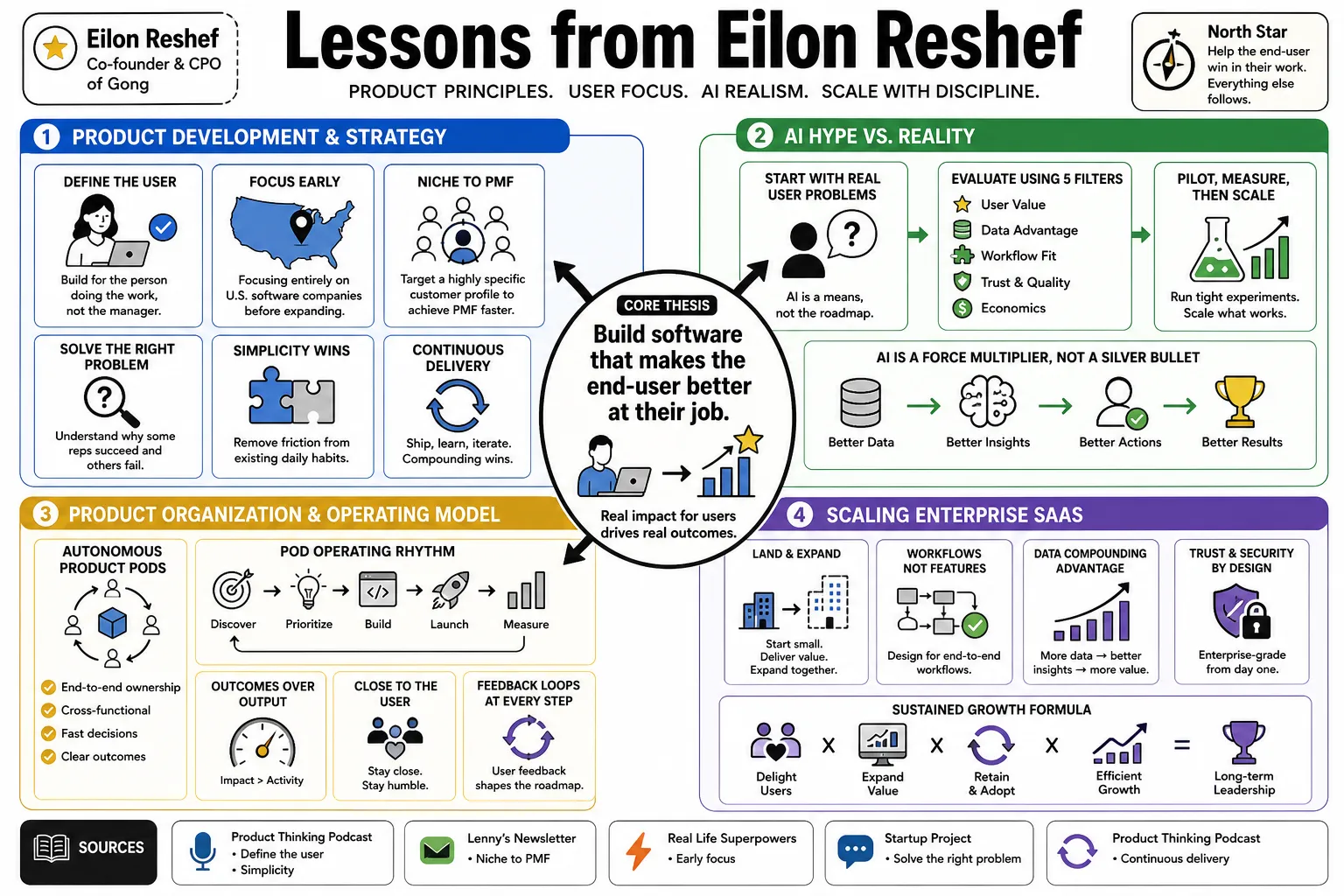
Lessons from Eilon Reshef
Eilon Reshef is the co-founder and CPO of Gong, a revenue intelligence platform that analyzes customer interactions. He is known for running autonomous product pods and designing software that serves the end-user before management. This profile collects his frameworks on product development, navigating AI hype, and scaling enterprise SaaS.
Part 1: Product Development & Strategy
- On defining the user: "Build for the person doing the work, rather than the manager tracking it." — Source: Product Thinking Podcast
- On product-market fit: "Target a highly specific customer profile early on to achieve product-market fit faster." — Source: Lenny's Newsletter
- On early focus: "Focusing entirely on U.S. software companies allowed us to deeply understand a single market before expanding." — Source: Real Life Superpowers
- On solving the right problem: Authority Magazine reports that Gong began with the problem of understanding customer-salesperson communication at scale, not with transcription as an end in itself. — Reference: Authority Magazine interview with Eilon Reshef
- On simplicity: "The most effective product features are often the ones that remove friction from existing daily habits." — Source: Product Thinking Podcast
- On continuous delivery: "Ship value incrementally but consistently, so the user feels the product is always getting smarter." — Source: Gong Tech Blog
- On the spiral method: "Master complex domains by spiraling inward: start broad, then progressively deepen your understanding of specific user needs." — Source: Lenny's Newsletter
- On feature bloat: "Avoid building features just because a competitor has them. Build what drives your specific user's success." — Source: Innovative Revenue Leader
- On product outcomes: "A product is only successful if it changes user behavior in a way that generates measurable results." — Source: Innovative Revenue Leader
- On long-term vision: Startup Project frames Gong's evolution as a move from conversation intelligence toward an AI operating system for revenue teams. — Reference: Startup Project interview with Eilon Reshef
Part 2: AI Reality vs Hype
- On AI expectations: "Separate the hype of artificial intelligence from the reality of what it can actually execute reliably today." — Source: Innovative Revenue Leader
- On human augmentation: "Technology should augment human collaboration and decision-making, rather than trying to entirely replace it." — Source: Product Thinking Podcast
- On AI agents: Gong's AI-agent guidance quotes Reshef saying agents should augment people rather than replace them, taking drudgery away while letting the profession move to higher-order work. — Reference: Gong article on AI agents for revenue teams
- On AI product design: "Don't build AI for the sake of AI. Build it because it solves a painful workflow problem faster than a human could." — Source: Gong Tech Blog
- On practical AI: "The best AI features are often invisible to the user; they simply make the software feel magical and effortless." — Source: Product Thinking Podcast
- On data moats: VentureBeat reports that Reshef sees Gong's moat less in any one model and more in the underlying Revenue Graph, the proprietary layer built from customer interactions. — Reference: VentureBeat interview with Eilon Reshef
- On automation limits: "We automate the administrative tasks so humans can focus on relationship building, which machines cannot do." — Source: Innovative Revenue Leader
- On AI accuracy: "In enterprise SaaS, an AI model that is eighty percent accurate might be entirely useless if the user loses trust in the outputs." — Source: Gong Tech Blog
- On the future of revenue AI: VentureBeat describes Mission Andromeda as Gong's push beyond surfacing insights toward changing how revenue teams work through coaching, assistants, account tools, and interoperability. — Reference: VentureBeat interview with Eilon Reshef
Part 3: Organizational Design & Pods
- On the pod structure: "Cross-functional pods containing product, design, and engineering must have full ownership of a specific job-to-be-done." — Source: Lenny's Newsletter
- On autonomy: "Give pods a clear outcome to achieve, rather than a prescriptive list of features to build." — Source: Lenny's Newsletter
- On rejecting Scrum: "Traditional Scrum can sometimes force teams into a rigid factory mindset rather than an outcome-oriented mindset." — Source: Lenny's Newsletter
- On OKRs: "We moved away from strict OKRs because they often created unnecessary overhead without actually improving alignment." — Source: Lenny's Newsletter
- On pod leadership: "A successful pod operates like a mini-startup within the company, with its own dedicated resources and distinct mission." — Source: Product Thinking Podcast
- On engineering involvement: "Engineers need to understand the customer's pain as deeply as the product manager does." — Source: Gong Tech Blog
- On scaling teams: "As you scale, the goal is to add more pods to tackle new domains, rather than making existing pods larger and slower." — Source: Lenny's Newsletter
- On flexible planning: "Planning should be continuous and adaptable, rather than locked into rigid quarterly cycles that ignore changing market realities." — Source: Lenny's Newsletter
- On cross-functional friction: "Healthy tension between design, product, and engineering usually leads to a stronger final feature." — Source: Gong Tech Blog
- On accountability: "When a pod owns a domain end-to-end, they naturally take pride in the quality and adoption of what they ship." — Source: Lenny's Newsletter
Part 4: Customer Feedback & Design Partners
- On design partners: "Work closely with a small group of early design partner customers to validate a concept before writing significant code." — Source: Lenny's Newsletter
- On listening to customers: "Customers are experts in their own problems, but rarely experts in the optimal software solutions." — Source: Product Thinking Podcast
- On fast iterations: "Put rough prototypes in front of users quickly. Their reactions to a mockup are more valuable than abstract feature requests." — Source: Lenny's Newsletter
- On selecting partners: "Choose design partners who feel the pain acutely and are willing to invest their time to help you get the solution right." — Source: Product Thinking Podcast
- On ignoring noise: "You have to be willing to ignore feature requests from large prospects if those requests misalign with your core product vision." — Source: Real Life Superpowers
- On qualitative feedback: "Data shows you what users are doing, but direct conversations tell you why they are doing it." — Source: Lenny's Newsletter
- On feedback loops: Gong's agent guidance says revenue teams should define inputs, outputs, preview behavior, monitor agents, and align them with business processes before deployment. — Reference: Gong article on AI agents for revenue teams
- On beta testing: "A successful beta is not one with zero bugs; it is one where users refuse to give the software back when the trial ends." — Source: Innovative Revenue Leader
- On validation: "If a design partner isn't using the feature daily, it isn't ready for general release." — Source: Lenny's Newsletter
Part 5: Leadership & Management
- On Hanlon's Razor: "Never attribute to malice that which is adequately explained by stupidity. Assume good intent and look for knowledge gaps." — Source: Medium
- On resolving conflict: "When things go wrong, focus on fixing the systemic skill or knowledge gap rather than blaming the individual." — Source: Medium
- On leading engineers: "Great engineers want to solve hard business problems, rather than be handed a list of technical specs to execute." — Source: Gong Tech Blog
- On decision making: "Make decisions quickly based on the available data, and be willing to course-correct immediately if new data proves you wrong." — Source: Real Life Superpowers
- On founder transitions: "Moving from a founder who builds to an executive who scales requires letting go of the day-to-step details of the code." — Source: Real Life Superpowers
- On managing PMs: "A strong product manager operates through influence and deep customer empathy, not through formal authority over the engineering team." — Source: Product Thinking Podcast
- On culture: Authority Magazine quotes Reshef on honesty and directness, saying leaders should tell teams the good, bad, and ugly so people can reciprocate with trust. — Reference: Authority Magazine interview with Eilon Reshef
- On hiring: "Hire for curiosity and resilience. The specific technical skills can often be learned, but the drive to understand the user cannot." — Source: Innovative Revenue Leader
- On delegation: "If you are making every product decision yourself, you have become the primary bottleneck to your company's growth." — Source: Lenny's Newsletter
Part 6: Sales & Revenue Intelligence
- On seller adoption: "If you build a tool that only benefits the VP of Sales, the reps will find every excuse not to use it." — Source: Product Thinking Podcast
- On the reality of sales: Startup Project says Gong was built around moving sales from gut feel and art toward hard data captured from video, email, phone calls, and customer interactions. — Reference: Startup Project interview with Eilon Reshef
- On the Revenue Graph: Startup Project describes the Revenue Graph as Gong's proprietary data model and a key frontier for enterprise AI, built from the reality of customer interactions. — Reference: Startup Project interview with Eilon Reshef
- On CRM limitations: Authority Magazine reports that sellers were expected to manually update CRM data, leaving customer data outdated, biased, and incomplete before Gong focused on autonomous capture. — Reference: Authority Magazine interview with Eilon Reshef
- On coaching: "The highest return on investment activity for a sales manager is coaching, yet without call visibility, they are coaching completely blind." — Source: Innovative Revenue Leader
- On forecasting: "Accurate forecasting comes from analyzing the raw signals of customer engagement, not from interrogating the sales team." — Source: Innovative Revenue Leader
- On sales engagement: Gong's agent guidance argues that revenue AI should fit into existing seller workflows and use high-quality context to create targeted, useful action rather than generic automation. — Reference: Gong article on AI agents for revenue teams
- On deal risks: VentureBeat says Mission Andromeda includes account tools that unify customer activity, risk signals, and next steps for sales and post-sales teams. — Reference: VentureBeat interview with Eilon Reshef
- On value creation: "Our platform succeeded because it helped individual reps close more deals and make more commission, driving organic adoption." — Source: Product Thinking Podcast
- On market evolution: Authority Magazine reports that Gong grew from recording and storing customer conversations into a suite of revenue intelligence applications across the revenue lifecycle. — Reference: Authority Magazine interview with Eilon Reshef
Part 7: Navigating Downturns & Resilience
- On market corrections: "During a tech downturn, the companies that survive are the ones that provide undeniable, measurable ROI to their customers." — Source: Innovative Revenue Leader
- On engineering retention: "Prioritize retaining your core engineering team during a downturn. Their institutional knowledge is your fastest engine for recovery." — Source: Innovative Revenue Leader
- On R&D investment: "When competitors cut their R&D budgets to survive, that is the exact moment to accelerate your product development to capture market share." — Source: Innovative Revenue Leader
- On fundamental merit: "If the core product solves a deep, painful problem, the business can weather macroeconomic storms." — Source: Real Life Superpowers
- On launching in down markets: "We launched Forecasting and Sales Engagement during a tight market because customers wanted to consolidate tools and save money." — Source: Innovative Revenue Leader
- On focus during crises: Gong's AI-agent guidance says teams should start with the outcome they want, target the highest-impact revenue problems, and avoid easy pilots that do not drive profitable growth. — Reference: Gong article on AI agents for revenue teams
- On organizational agility: "The ability to quickly pivot your product messaging from growth to efficiency is required when the economic environment shifts." — Source: Product Thinking Podcast
- On resilience: "Startup survival isn't about avoiding mistakes; it is about identifying them quickly and having the structural resilience to adapt." — Source: Real Life Superpowers
- On customer retention: VentureBeat reports that Gong's account tools bring customer activity, risk signals, and next steps into one view for sales and post-sales teams, linking AI work to retention-oriented account management. — Reference: VentureBeat interview with Eilon Reshef
Part 8: Engineering Culture & SaaS Architecture
- On tech debt: "Treat technical debt like financial debt: some is necessary for speed, but if you don't pay it down, it will eventually bankrupt your roadmap." — Source: Gong Tech Blog
- On cloud architecture: "Building a reliable SaaS application requires designing for multi-tenant isolation and absolute data security from day one." — Source: Gong Tech Blog
- On data processing: "Processing millions of audio streams in real-time requires an architecture that can elastically scale without degrading the user experience." — Source: Gong Tech Blog
- On patents: "Patents are less about aggressive litigation and more about protecting your engineering team's freedom to operate and innovate." — Source: Medium
- On remote engineering: "Successfully managing a distributed engineering team requires over-communicating the 'why' behind a feature, rather than only the 'what'." — Source: Gong Tech Blog
- On the Revenue Harness: "We built a centralized Revenue Harness architecture to ingest diverse data streams (emails, calls, CRM updates) into a single unified timeline." — Source: Gong Tech Blog
- On building for scale: "An architecture that works for ten customers will break at a thousand. You have to continually rewrite core systems as you grow." — Source: Gong Tech Blog
- On engineering speed: "The speed of product delivery is directly proportional to the quality and automation of your continuous integration pipelines." — Source: Gong Tech Blog
- On innovation: "The best engineering cultures encourage developers to spend a portion of their time experimenting with new technologies outside the core roadmap." — Source: Gong Tech Blog