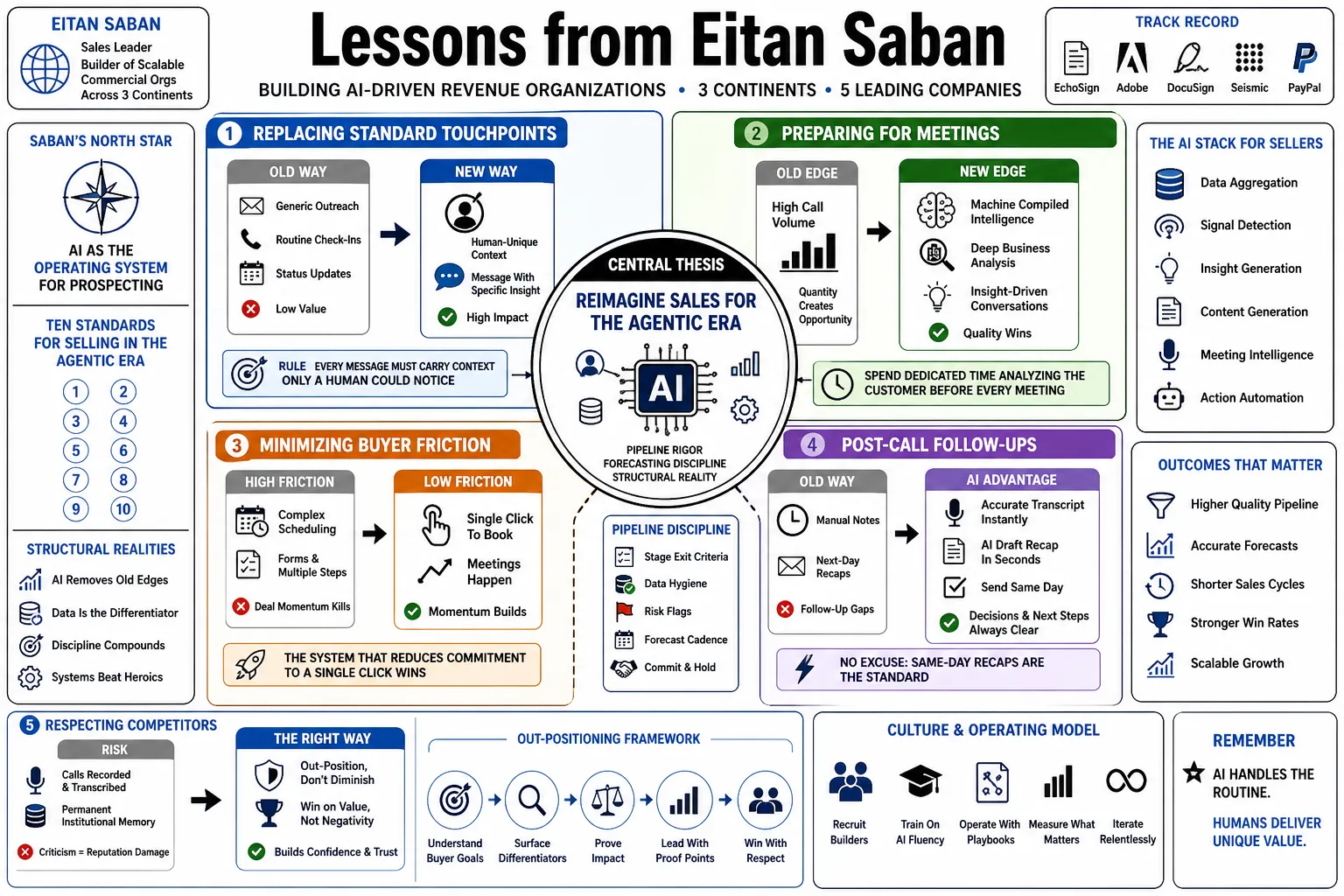
Eitan Saban is a sales leader who has built and scaled commercial organizations across three continents for companies like EchoSign, Adobe, DocuSign, Seismic, and PayPal. He is known for redesigning traditional revenue teams into AI-driven businesses, arguing that artificial intelligence should act as the operating system for prospecting rather than a bolted-on tool. This profile is worth reading to understand his pragmatic approach to pipeline rigor, forecasting discipline, and the structural realities of modern sales.
Part 1: Sales in the AI Era
- On replacing standard touchpoints: In an environment where automated agents handle outreach, manual check-ins lose all value; a seller's message must carry specific context that only a human could notice. — Reference: Ten Standards for Selling in the Agentic Era
- On preparing for meetings: Because AI systems have eliminated the advantage of high call volumes, a seller's remaining edge is spending dedicated time analyzing a customer's business using machine-compiled intelligence. — Reference: Ten Standards for Selling in the Agentic Era
- On minimizing buyer friction: Systems that book meetings consistently do so by reducing the commitment to a single click, proving that complex scheduling demands kill deal momentum. — Reference: Ten Standards for Selling in the Agentic Era
- On post-call follow-ups: AI can generate accurate transcripts and draft recaps instantly, meaning sellers have no excuse for failing to send same-day summaries detailing decisions and next steps. — Reference: Ten Standards for Selling in the Agentic Era
- On respecting competitors: Because calls are recorded and transcribed, criticizing a competitor permanently damages a seller's reputation in the institutional memory; out-positioning them is the only safe strategy. — Reference: Ten Standards for Selling in the Agentic Era
- On mastering discovery: While algorithms can summarize a conversation accurately, they cannot ask the layered questions necessary to uncover the true budget and motivation behind a deal. — Reference: Ten Standards for Selling in the Agentic Era
- On retaining relationship details: Software assistants maintain perfect notes on past vendor migrations and personal details, meaning a seller who forgets important context is actively choosing to be unprepared. — Reference: Ten Standards for Selling in the Agentic Era
Part 2: Operating Systems vs. Tools
- On transforming the sales motion: Adopting AI means shifting the entire prospecting function to an agentic layer so that sellers only attend scheduled meetings, rather than giving human reps more software to juggle. — Reference: The AI Agent as Operating System
- On shifting performance metrics: When automated agents scale outreach capacity significantly, organizations must replace traditional pipeline and deal count goals with transaction margin as the primary metric. — Reference: The AI Agent as Operating System
- On interpreting win rate drops: A temporary decline in conversion rates during a rollout should trigger deep data analysis of lead quality and handoff timing rather than a retreat to old methods. — Reference: The AI Agent as Operating System
- On building an AI business: A serious deployment enforces increased operational rigor when metrics dip, whereas a team merely testing software will pause their experiments when the quarter gets tough. — Reference: The AI Agent as Operating System
- On managing the narrative around metrics: Leaders must contextualize data drops by imposing root-cause analyses and reinstating update meetings, otherwise their team will write a story of failure. — Reference: The AI Agent as Operating System
- On the required mandate for AI: True agentic transformation cannot happen as a side project; it requires a dedicated leader with a specific profit and loss statement to make the workflow successful. — Reference: The AI Tool vs. AI Business Distinction
- On committing to the new model: The divide in the market is no longer about who possesses the technology, but which leaders are willing to implement the new operating model instead of presenting theoretical strategy decks. — Reference: The First AI-Assisted Close
Part 3: Pipeline and Forecasting Rigor
- On the cost of padded pipelines: Holding onto silent deals provides a false sense of security but ultimately damages the quarter's forecast. — Reference: Ten Standards for Selling in the Agentic Era
- On protecting your forecast: In an environment with transparent dashboards, unexpected misses are highly visible and permanently damage a leader's credibility. — Reference: Ten Standards for Selling in the Agentic Era
- On listening to the buyer: Conversation data proves that winning deals feature the buyer speaking more; talking over an objection only delays the issue until contract signing. — Reference: Ten Standards for Selling in the Agentic Era
- On confronting inflated pipelines: Most sales leaders recognize when their numbers are artificial, but they delay purging inactive opportunities until external pressure forces the issue. — Reference: Killing 81%
- On the trust cost of delayed pipeline cuts: When a leader waits too long to remove dead deals, the team questions whether the leader lacked the capability to see the problem or the integrity to fix it. — Reference: Killing 81%
- On defining focus in the pipeline: True focus is the discipline to identify and eliminate well-intentioned work before the team experiences inevitable disappointment. — Reference: Killing 81%
- On the hidden tax of dilutive work: Running too many legitimate workstreams simultaneously acts as a focus tax that halves conversion rates and creates a busy but unproductive organization. — Reference: The Focus Tax
- On shutting down good initiatives: The most difficult decision for a commercial leader is stopping smart people from working on sponsored projects when the scale mechanics do not add up. — Reference: The Focus Tax
Part 4: Building vs. Optimizing Sales Orgs
- On the limits of optimization: Refining current sequences and tightening productivity metrics only improves an existing model, which fails when the market dictates that a completely new motion is required. — Reference: The Sales Builder’s Edge
- On engineering for the future: Rebuilding a sales engine requires stepping away from the immediate quarter to design a machine suited for upcoming market conditions and new buyer behaviors. — Reference: The Sales Builder’s Edge
- On the danger of sacrificing the build phase: When targets become difficult, organizations often cut building initiatives to save the current quarter, which ensures they will eventually rely on an outdated strategy. — Reference: The Sales Builder’s Edge
- On hiring for building capacity: It is more valuable to hire a single representative who can construct a new sales play than to employ several who can only execute an existing one. — Reference: The Sales Builder’s Edge
- On achieving true competitive advantage: The market rewards teams that have already constructed the next sales motion, rather than those who are running yesterday's playbook slightly faster. — Reference: The Sales Builder’s Edge
- On building escape velocity: Breaking away from operational inertia is achieved through consistent daily disciplines, like running identical pipeline reviews every week, rather than dramatic quarterly pushes. — Reference: Escape Velocity Is Built, Not Declared
- On using pain as a signal: Exceptional operators do not wait for theoretical needs; they use acute operational pain, like slipped deals or broken manual processes, as the trigger to fix hygiene and tooling. — Reference: Escape Velocity Is Built, Not Declared
- On solving internal blockers: Sellers who use no-code tools to bypass organizational friction will fundamentally outpace those who wait in line for internal teams to deliver resources. — Reference: Escape Velocity Is Built, Not Declared
Part 5: Leadership and Managing Culture
- On managing back-to-back departures: While a single leader's exit can be managed with a transition plan, multiple departures force the remaining team to question the organization's stability. — Reference: Change Happens in Pairs
- On controlling the internal narrative: If a leader does not proactively explain organizational changes directly and honestly, anxiety will fill the vacuum and the team will write their own story of failure. — Reference: Change Happens in Pairs
- On building trust through truth: Addressing team concerns without spin or performative optimism demonstrates that a leader is reliable and will not hide during uncomfortable moments. — Reference: Change Happens in Pairs
- On protecting the culture: An organization chart is temporary, but the cultural impact of how a leader handles transitions is permanent and must be guarded carefully. — Reference: Change Happens in Pairs
- On moving without permission: The most effective sales leaders initiate structural changes to their teams' operating models without asking for higher approval. — Reference: The First AI-Assisted Close
Part 6: Career Building and Immigration
- On the immigrant advantage: The American professional system operates on a core agreement that rewards showing up and putting in the work, regardless of family background or pedigree. — Reference: I Chose Here
- On earning a place: Choosing to build a life in a new country requires sacrificing default belonging and earning a place through consistent execution, closing hard quarters, and building teams. — Reference: I Chose Here
- On building across borders: Scaling an international career requires an inherent ambition that drives immigrants to out-prepare everyone else in the room. — Reference: I Chose Here
Part 7: Operating Discipline and Scale
- On habits over heroics: Sales organizations do not escape operational inertia through rallies or quarter-end pushes; they do it through routines that managers execute consistently every week. — Reference: Escape Velocity Is Built, Not Declared
- On treating discipline as infrastructure: A repeatable pipeline review deserves more respect than a single spectacular deal because its effects compound across every seller and every quarter. — Reference: Escape Velocity Is Built, Not Declared
- On hiring from demonstrated pain: Leaders should add capacity when an operating constraint is already producing visible damage, not because a future need sounds plausible in a planning meeting. — Reference: Escape Velocity Is Built, Not Declared
- On self-service operations: A seller who can connect CRM, conversation, and actuals data with no-code tools can prepare for a business review in hours instead of waiting days for an operations ticket. — Reference: Escape Velocity Is Built, Not Declared
- On acting immediately after a pipeline correction: Once inflated pipeline is exposed, leaders should change the operating cadence the next day rather than treating the cleanup as a one-time accounting exercise. — Reference: Killing 81%
- On recycling silent opportunities: Deals with no meaningful customer contact for months should be closed or returned to prospecting so that activity does not masquerade as qualified demand. — Reference: Killing 81%
- On honest deal values: Using nominal placeholders for unqualified opportunities is more useful than assigning optimistic six-figure values that make the forecast look healthier than the evidence supports. — Reference: Killing 81%
- On using constraints to unlock capacity: Reducing an automated email cadence from ten touches to six increased daily lead capacity by 70 percent, showing that subtraction can scale a system faster than adding resources. — Reference: The AI Agent as Operating System
- On designing for infrastructure limits: Operating near a platform's sending limit requires deliberate headroom; the constraint should shape cadence and architecture before it becomes an outage. — Reference: The AI Agent as Operating System
- On connecting every operating choice: Changes to cadence affect capacity, capacity changes the right success metrics, and new metrics require better analysis infrastructure; an AI motion must be managed as one connected system. — Reference: The AI Agent as Operating System
- On dividing work between agents and sellers: The durable model gives agents responsibility for outreach, qualification, and scheduling while human sellers concentrate on discovery, judgment, and execution inside the meeting. — Reference: The AI Agent as Operating System
- On catching bad patterns early: Pipeline corrections are unavoidable, but leaders preserve trust by recognizing unsupported velocity before the team has spent months watching leadership endorse numbers that do not convert. — Reference: Killing 81%
Part 8: Deploying AI Inside PayPal
- On finding the real revenue stall: PayPal's visibility problem was not simply whether a merchant signed; deals were stalling between signature and the moment the merchant began processing payments, which directly created forecast slippage. — Reference: Leading from the Front
- On detecting hesitation early: Conversation intelligence can identify merchant behaviors associated with later stalls, trigger automated deal alerts, and guide sellers toward the appropriate follow-up before the delay reaches the forecast. — Reference: Leading from the Front
- On measuring orchestration by revenue outcomes: Embedding AI into PayPal's revenue workflow produced a 22 percent improvement in time to revenue and a 17 percent increase in forecast accuracy, making business outcomes more useful than simple adoption metrics. — Reference: Leading from the Front
- On orchestrating the next action: The next stage of revenue AI is not another layer of analysis; it is coordinating the specific actions required to progress a deal and delivering them at the right moment. — Reference: Leading from the Front
- On leading adoption from the front: AI deployment becomes an operating change only when leaders model the new behavior, accept that old processes may need to break, and make the technology part of the team's normal workflow. — Reference: Leading from the Front
- On starting with neglected demand: PayPal directed its agent toward roughly 8,000 monthly leads that human sellers could not cover, making unused demand a practical proving ground for automation. — Reference: PayPal Boosts Sales with Agentforce and Automation
- On designing persistent outreach: The agent ran a ten-touch cadence that continued through weekends, applying consistent coverage to a segment that previously received no attention. — Reference: PayPal Boosts Sales with Agentforce and Automation
- On moving from pilot to production: Within 14 weeks, the workflow reached production across a 200-rep organization and generated meeting conversion about 50 percent higher than the earlier human-only process. — Reference: PayPal Boosts Sales with Agentforce and Automation
- On learning before the data is perfect: Incomplete data should not automatically delay deployment; a constrained agent can begin with product and website knowledge, then reveal which data gaps are actually worth repairing. — Reference: PayPal Boosts Sales with Agentforce and Automation
- On treating agents like employees: Agents need onboarding, tuning, explicit goals, and quotas, while API- and Slack-based workflows let the CRM function as infrastructure for agents rather than a form-filling destination for humans. — Reference: PayPal Boosts Sales with Agentforce and Automation