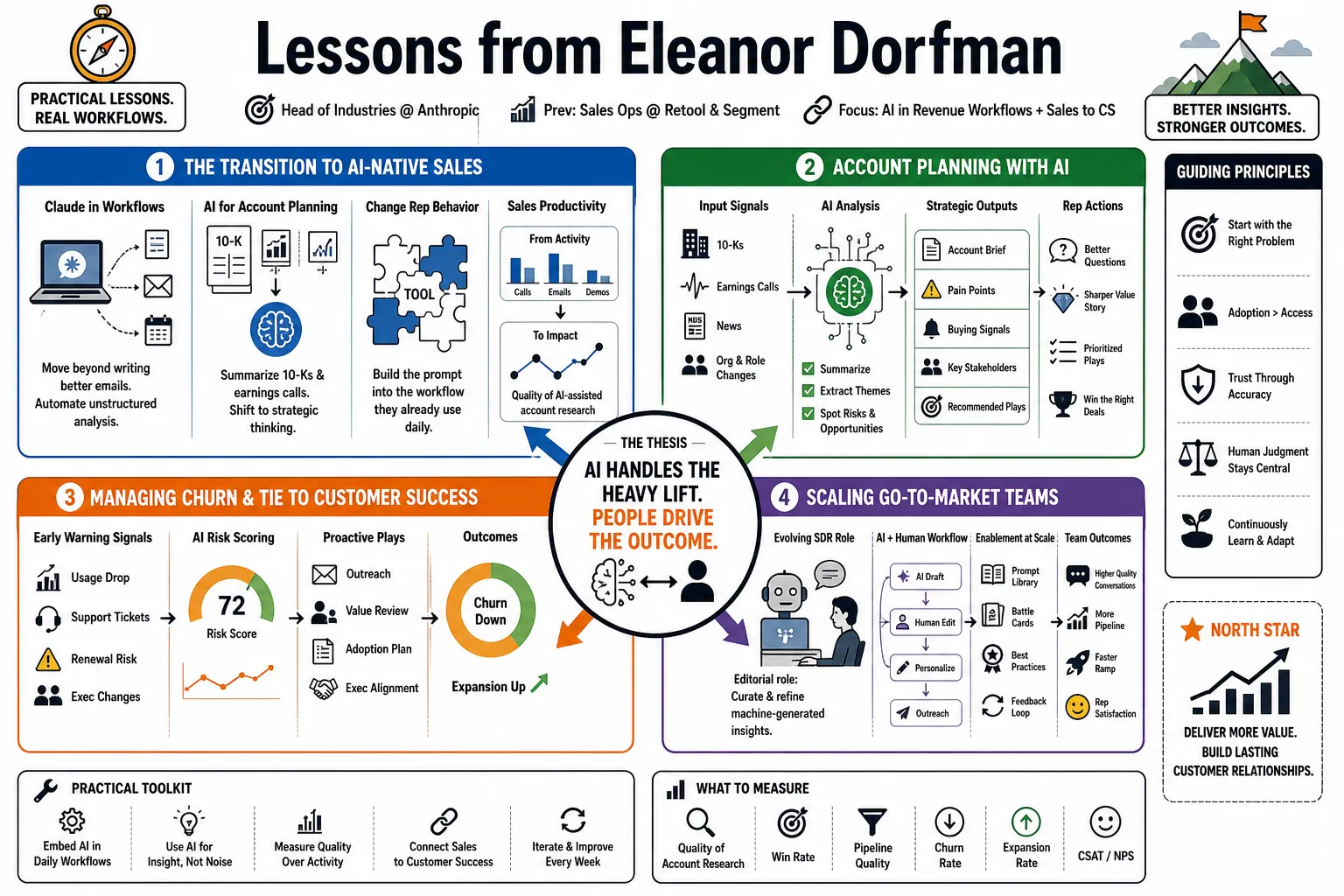
Lessons from Eleanor Dorfman
Eleanor Dorfman is the Head of Industries at Anthropic and previously ran sales operations at Retool and Segment. She focuses on applying AI to revenue workflows and tying enterprise sales to customer success. This profile breaks down her practical advice on account planning, managing churn, and scaling go-to-market teams.
Part 1: The Transition to AI-Native Sales
- On Claude in workflows: "The goal is to move past writing better emails and directly automate the unstructured data analysis that consumes a rep's afternoon." — Source: [SaaStr]
- On AI for account planning: "When reps use models to summarize 10-Ks and earnings calls, they shift from data gathering to actual strategic thinking." — Source: [Tech in Asia]
- On changing rep behavior: "You cannot simply hand a sales team an AI tool and expect adoption. You have to build the prompt into the workflow they already use daily." — Source: [The Twenty Minute VC]
- On sales productivity: "We are moving away from measuring activity metrics like call volume toward measuring the quality of AI-assisted account research." — Source: [Office Hours]
- On the future of SDRs: "The role of the outbound rep is evolving into an editorial position where they curate and refine machine-generated account strategies." — Source: [SaaStr]
- On AI and CRM data: "Models are only as useful as the context they have. Clean CRM hygiene is now a prerequisite for AI-native sales." — Source: [The Twenty Minute VC]
- On conversational intelligence: "Instead of simply transcribing calls, we use AI to instantly identify gaps in the discovery process and suggest follow-up questions." — Source: [Tech in Asia]
- On reducing deal cycle time: "By automating the generation of custom security questionnaires and proposals, we cut administrative drag out of the closing sequence." — Source: [Office Hours]
- On coaching with AI: "Managers can use AI to synthesize call transcripts across a team to instantly identify which reps are missing the new product messaging." — Source: [SaaStr]
- On the limits of automation: "AI handles preparation and synthesis, but the actual negotiation and relationship building remain highly dependent on human empathy." — Source: [The Twenty Minute VC]
Part 2: Managing Customer Success and Churn
- On structural churn: "Sometimes churn is a feature of the market segment you are selling into, rather than a failure of your customer success team." — Source: [Churn.fm]
- On early warning signs: "The best indicator of churn is a change in the champion's behavior during quarterly business reviews." — Source: [The Twenty Minute VC]
- On owning retention: "Sales teams cannot toss a closed-won deal over the fence. The account executive needs to stay attached through initial onboarding." — Source: [Churn.fm]
- On health scoring: "Most health scores are reactive. We look at feature adoption depth rather than seat utilization alone to gauge true stickiness." — Source: [SaaStr]
- On executive alignment: "If you lack multi-threaded relationships at the executive level within the first ninety days, the account is already at risk." — Source: [Office Hours]
- On the role of CS: "Customer success should operate as a revenue-generating function through expansion, not merely as a support function trying to save accounts." — Source: [Churn.fm]
- On down-market churn: "When selling to SMBs, accept that a certain percentage will go out of business. Focus retention efforts on the cohorts that can actually scale." — Source: [The Twenty Minute VC]
- On feedback loops: "Customer success must have a direct line to product management. Churn interviews are the most valuable data a product team can receive." — Source: [SaaStr]
- On commercial handoffs: "The transition from sales to CS should feel seamless to the buyer. Any friction in that handover reduces time-to-value." — Source: [Churn.fm]
- On saving accounts: "You cannot save an account by offering a discount if the underlying business problem remains unsolved by your software." — Source: [Office Hours]
Part 3: Go-to-Market Strategy and Scaling
- On PLG and Enterprise: "Product-led growth gets you the initial footprint, but you need an enterprise sales motion to consolidate those rogue instances into a site-wide license." — Source: [The Twenty Minute VC]
- On defining the ICP: "Your ideal customer profile should be narrow enough that it actively disqualifies 80% of your inbound leads." — Source: [SaaStr]
- On scaling from zero to one: "In the early days, you lack the need for a scalable sales process. You need a founder-led process that uncovers the actual buying triggers." — Source: [Office Hours]
- On market positioning: "If your sales team has to spend the first twenty minutes explaining the category, your marketing strategy is failing them." — Source: [Tech in Asia]
- On pricing models: "Usage-based pricing aligns your revenue with the customer's success, but it makes forecasting much harder for the sales leadership." — Source: [The Twenty Minute VC]
- On territory planning: "Assign territories based on account potential and intent signals rather than geographic lines alone." — Source: [SaaStr]
- On multi-product transitions: "When you add a second product, the sales motion changes completely. You have to train reps to cross-sell without confusing the core value proposition." — Source: [Office Hours]
- On evaluating new markets: "Before entering a new vertical, test the messaging with a small pod of specialized reps rather than training the entire floor." — Source: [Tech in Asia]
- On competitive intelligence: "Avoid selling against the competitor's feature sheet. Sell against their implementation timeline and total cost of ownership." — Source: [SaaStr]
- On GTM alignment: "Marketing, sales, and CS need to share the same revenue target. If marketing is measured on MQLs and sales on ARR, you will build a dysfunctional pipeline." — Source: [The Twenty Minute VC]
Part 4: Leading and Coaching Sales Teams
- On hiring profiles: "I look for curiosity over a polished pitch. The best reps are the ones who ask the second and third layer of diagnostic questions." — Source: [Office Hours]
- On onboarding ramps: "A rep's ramp time is determined by how quickly they experience their first failure and receive coaching on it, rather than how many videos they watch." — Source: [SaaStr]
- On 1-on-1 meetings: "Pipeline reviews and coaching sessions must be separate meetings. You cannot effectively coach a skill while simultaneously interrogating a forecast." — Source: [The Twenty Minute VC]
- On managing underperformance: "Provide a clear and specific plan for improvement. If the rep fails to hit the leading indicators within two weeks, make the hard decision early." — Source: [Common Room]
- On promoting from within: "The best SDR does not automatically make the best AE. You have to test their ability to manage a complex deal cycle before promoting them." — Source: [SaaStr]
- On team culture: "A winning culture is a relentless, shared commitment to understanding the customer's business." — Source: [Office Hours]
- On forecasting accuracy: "I expect reps to know exactly why a deal might slip. Hope is a terrible strategy, and saying a prospect went dark is an unacceptable update." — Source: [The Twenty Minute VC]
- On continuous learning: "The market changes every six months. If your enablement materials are a year old, your team is selling a product that no longer exists in the buyer's mind." — Source: [Common Room]
- On celebrating wins: "Acknowledge the entire pod, including the sales engineer and the legal team, rather than only the rep who signed the contract." — Source: [SaaStr]
Part 5: Navigating Enterprise and Self-Serve Models
- On the hybrid motion: "Balancing a self-serve funnel with an enterprise sales team requires clear rules of engagement so reps avoid cannibalizing organic revenue." — Source: [The Twenty Minute VC]
- On self-serve limitations: "Self-serve works for individual contributors, but procurement and security teams always require a human-led enterprise motion." — Source: [SaaStr]
- On usage signals: "We use product telemetry to trigger sales outreach. A sudden spike in API calls is a better intent signal than downloading a whitepaper." — Source: [Tech in Asia]
- On moving upmarket: "Moving upmarket means your buyer is no longer the end-user. You are selling to a VP who cares about governance and ROI instead of UI features." — Source: [Office Hours]
- On freemium economics: "A freemium tier is a marketing expense. It works only if you have a defined path to monetization." — Source: [The Twenty Minute VC]
- On enterprise procurement: "Reps need to map the procurement process during discovery. If you wait until verbal approval to ask about legal review, you lose the quarter." — Source: [SaaStr]
- On security reviews: "Bring your security posture into the conversation early. Never let a missing compliance certification derail a six-month deal cycle." — Source: [Tech in Asia]
- On custom terms: "Standardize your enterprise contracts extensively. Every custom term operates as a tax on your future ability to scale operations." — Source: [Office Hours]
- On executive sponsors: "In enterprise deals, if your sponsor leaves the company before implementation, the deal is effectively dead unless you are multi-threaded." — Source: [The Twenty Minute VC]
Part 6: Building the Deal Desk
- On the purpose of a deal desk: "The deal desk should operate as a strategic partner that helps structure complex deals to maximize long-term value." — Source: [SaaStr]
- On discount authority: "Empower reps with predefined discount bounds. If they need to go deeper, they must trade for favorable terms like upfront payment or a multi-year commitment." — Source: [Office Hours]
- On contract flexibility: "Give the customer options that alter the scope or support level, rather than dropping the price immediately." — Source: [Common Room]
- On margin preservation: "The deal desk is the guardian of your gross margin. They ensure that non-standard support SLAs do not quietly erode profitability." — Source: [The Twenty Minute VC]
- On turnaround times: "A slow deal desk kills momentum. Establish SLAs for how quickly legal and finance must respond to non-standard requests." — Source: [SaaStr]
- On standardizing edge cases: "When the deal desk sees the same custom request three times, it needs to become a standard package option." — Source: [Common Room]
- On cross-functional alignment: "The deal desk brings sales, finance, and legal into a single room. It forces alignment before a contract ever reaches the customer." — Source: [Office Hours]
- On handling objections: "Use the deal desk to build business cases that address common CFO objections regarding ROI and payback periods." — Source: [The Twenty Minute VC]
- On post-sale impact: "A poorly structured deal at the desk becomes a massive headache for the customer success team a year later." — Source: [SaaStr]
Part 7: Expansion Sales and Retention
- On identifying upsell opportunities: "The best upsell happens when the customer reaches a natural limit in their current tier and the upgrade directly unlocks their next business goal." — Source: [Churn.fm]
- On renewal timelines: "Start the renewal conversation six months out. If you wait until month eleven, you are defending the account instead of growing it." — Source: [The Twenty Minute VC]
- On expansion metrics: "Net dollar retention is the ultimate metric of product-market fit. If it falls below 110% in enterprise, your land-and-expand motion is broken." — Source: [SaaStr]
- On the land-and-expand strategy: "Get the product installed, prove value in one department, and use that success to sell the enterprise-wide deal." — Source: [Office Hours]
- On cross-selling: "Cross-selling requires the rep to map out adjacent workflows. You have to show how the new product connects to what they already use." — Source: [Common Room]
- On customer advocacy: "Turn your successful champions into references. A peer-to-peer conversation between buyers is worth ten times more than a marketing case study." — Source: [SaaStr]
- On pricing increases: "When rolling out a price increase, communicate the added value delivered since the last contract rather than pointing to inflation adjustments." — Source: [The Twenty Minute VC]
- On aligning sales and CS on expansion: "Determine clearly who owns the upsell number. If both sales and CS claim it, the customer gets a disjointed experience." — Source: [Churn.fm]
- On tracking utilization: "Unused seats are future churn. Expansion efforts must pause if the current deployment remains unutilized." — Source: [Office Hours]
Part 8: The Intersection of Product and Sales
- On product-led sales: "Sales teams should use product usage data to know exactly when to call a user. It changes the conversation from a cold pitch to a targeted consultation." — Source: [SaaStr]
- On roadmap promises: "Never sell a feature that is more than one quarter away. It creates technical debt for the product team and trust debt with the customer." — Source: [The Twenty Minute VC]
- On feature requests: "When a customer asks for a feature, reps must uncover the underlying workflow problem. Often, the existing product can solve it differently." — Source: [Common Room]
- On Beta programs: "Use beta programs as a closing tool for strategic accounts. It gives them early access and makes them feel invested in the product direction." — Source: [Office Hours]
- On handling bugs in the sales cycle: "Be transparent about known limitations. Buyers respect honesty much more than a rep who overpromises system capabilities." — Source: [Tech in Asia]
- On product marketing's role: "Product marketing translates technical releases into business value. If reps fail to understand the reasoning behind a feature, they fail to sell it." — Source: [SaaStr]
- On closing the feedback loop: "Create a formal process for sales to feed market rejections back to product. Lost deals hold the roadmap's missing pieces." — Source: [The Twenty Minute VC]
- On competing with internal builds: "Your biggest competitor is often the client's engineering team. You have to prove that building it themselves is a distraction from their core business." — Source: [Common Room]
- On AI integration in products: "Adding an AI chat interface is insufficient. The AI must alter how the user achieves their outcome to be worth an enterprise premium." — Source: [Office Hours]