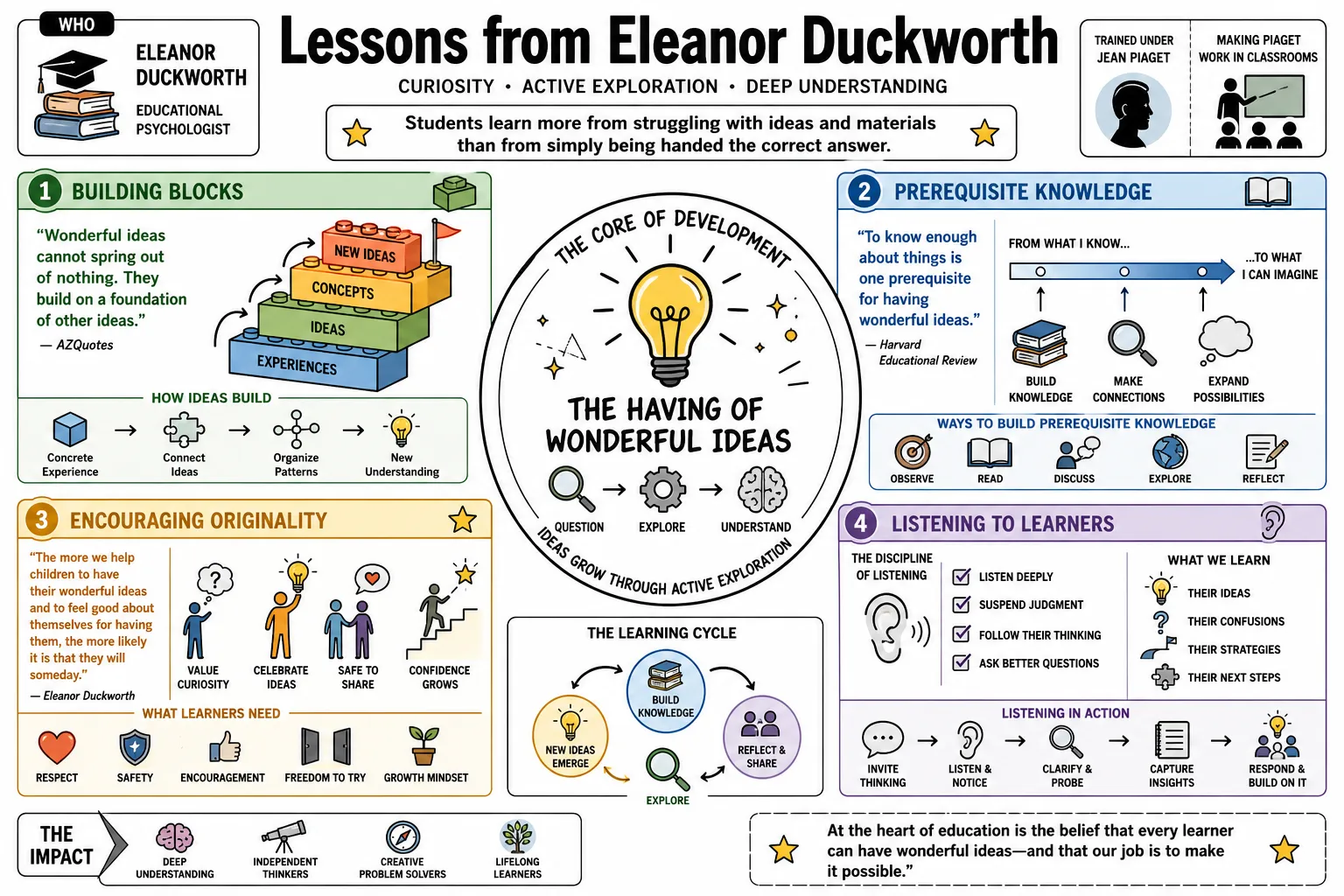
Educational psychologist Eleanor Duckworth trained under Jean Piaget and spent her career figuring out how his theories should actually work in a classroom. She built her methods around "the having of wonderful ideas"—the premise that students learn more from struggling with physical materials and their own confusion than from simply being handed the correct answer. This profile covers her approach to critical exploration, curriculum design, and the strict discipline of actually listening to learners.
Part 1: The Having of Wonderful Ideas
- On the Core of Development: "The having of wonderful ideas is what I consider to be the essence of intellectual development." — Source: The Having of Wonderful Ideas Book
- On Building Blocks: "Wonderful ideas cannot spring out of nothing. They build on a foundation of other ideas." — Source: AZQuotes
- On Prerequisite Knowledge: "To know enough about things is one prerequisite for having wonderful ideas." — Source: Harvard Educational Review
- On Encouraging Originality: "The more we help children to have their wonderful ideas and to feel good about themselves for having them, the more likely it is that they will someday happen upon wonderful ideas that no one else has happened upon before." — Source: The Having of Wonderful Ideas Book
- On Intellectual Courage: "Having confidence in one's ideas does not mean 'I know my ideas are right'; it means 'I am willing to try out my ideas.'" — Source: SciSpace
- On Restructuring Beliefs: "All of us, from children to scientists, have difficulty accepting data that go against our firmly held beliefs. We have to restructure too much of our intellectual framework to assimilate such surprises." — Source: Goodreads Quotes
- On Personal Construction: "Meaning is not given to us in our encounters, but given by us – constructed by us, each in our own way." — Source: Tell Me More Book
- On the Uniqueness of Experience: "No experience – even the most simple – has the same meaning for any two people, though much of the meaning may be shared." — Source: Karger Publications
- On Recognizing Progress: A wonderful idea does not have to be correct by adult standards; it simply needs to be a creative leap in the learner's own understanding. — Source: LEARNing Landscapes
Part 2: Critical Exploration and The Art of Listening
- On the Teacher as Researcher: The educator's job is to explore the student's thinking simultaneously as the student explores the subject matter. — Source: Wikipedia: Critical Exploration
- On Neutral Inquiry: Asking "Tell me more" requires the teacher to maintain strict neutrality, keeping the learner focused on their own logic rather than seeking adult approval. — Source: Tell Me More Book
- On the Ineffectiveness of Explaining: "Telling, explaining, play a very small part in helping people learn." — Source: AZQuotes
- On Listening to Learn: "The emphasis... is on looking at what happens when teachers engage learners directly with the subject matter... and then they, the teachers, do the listening while learners explain their own thoughts." — Source: Tell Me More Book
- On Honoring the Learner: True listening signals a profound respect for the learner's mind, assuming their current understanding is a necessary step in their intellectual development. — Source: Ethical Schools Podcast
- On Avoiding Correction: Intervening too early to correct a student deprives them of the chance to discover the contradiction in their own logic. — Source: Rabbithole Podcast
- On Self-Correction: When prompted to elaborate on their ideas, students often uncover the flaws in their reasoning and correct themselves naturally. — Source: Harvard Educational Review
- On Deferring Judgment: The teacher must suppress the urge to validate correct statements so that the student remains responsible for their own intellectual validation. — Source: Tell Me More Book
- On Designing the Good Project: The first half of critical exploration is developing an activity compelling enough that students want to figure it out; the second half is inviting them to explain what they see. — Source: The Active Learner Interview
Part 3: The Pedagogy of Confusion and "Wrong" Answers
- On the Nature of Learning: "Learning is messy." — Source: Goodreads Quotes
- On Allowing Confusion: "Teachers are often, and understandably, impatient for their students to develop clear and adequate ideas. But putting ideas in relation to each other isn't a simple job." — Source: QuoteFancy
- On Time and Processing: "It's confusing and this confusion does take time. All of us need time for our confusion if we are to build the breadth and depth that give significance to our knowledge." — Source: The Having of Wonderful Ideas Book
- On the Child's Struggle: "It's not the pressure of data that gives rise to the understanding. It's, on the contrary, the child's own struggle to make sense of the data." — Source: AZQuotes
- On Wrong Answers: An incorrect answer is often more informative than a correct one because it reveals the exact state of the student's internal logic. — Source: Wikipedia: Critical Exploration
- On Enduring Misconceptions: "It is far less costly, at least for a time, to keep the framework and deny the fact." — Source: Goodreads Quotes
- On Frustration: "Real learning, attentive, real learning, deep learning, is playful and frustrating and joyful and discouraging and exciting and sociable and private all the time, which is what makes it great." — Source: QuoteFancy
- On Shifting Paradigms: "I learned that you can't change what children believe by telling them to drop that and believe something else... you can't change what ANYONE believes by telling them to drop that and believe something else." — Source: Harvard Educational Review
- On the Value of Impasse: Reaching a point where a student feels completely stuck is often the necessary precursor to a breakthrough in understanding. — Source: Ethical Schools Podcast
Part 4: Beyond the "Right Answer"
- On the Passivity of Accuracy: "Of all the virtues related to intellectual functioning, the most passive is the virtue of knowing the right answer." — Source: AZQuotes
- On Thoughtless Answers: "Knowing the right answer requires no decisions, carries no risks, and makes no demands. It is automatic. It is thoughtless." — Source: The Having of Wonderful Ideas Book
- On the Trap of Memorization: When students focus entirely on retrieving the correct answer from memory, they cease evaluating the logic of the problem before them. — Source: Tell Me More Book
- On Pleasing the Teacher: Asking for the right answer trains students to read the teacher's cues rather than the data in front of them. — Source: LEARNing Landscapes
- On Intellectual Risk: True education requires students to take risks with their thinking, which is impossible if the environment punishes being wrong. — Source: Ethical Schools Podcast
- On Diagnostic Blind Spots: A correct answer can mask a profound lack of understanding if the student arrived at it through an unrelated mechanism or rote habit. — Source: Wikipedia: Critical Exploration
- On Meaning over Metrics: Educational systems err when they prioritize countable right answers over the invisible process of making meaning. — Source: Rabbithole Podcast
- On Premature Resolution: Giving students the answer too quickly robs them of the cognitive workout required to build permanent mental structures. — Source: Harvard Educational Review
- On Authentic Assessment: The best test of knowledge is observing how a learner navigates an unfamiliar problem, rather than checking if they can reproduce a previously given solution. — Source: Tell Me More Book
Part 5: The Role of the Teacher
- On the Goal of Teaching: "Getting people to think about what they think, and asking them questions about it, is the best way I know how to teach." — Source: AZQuotes
- On Setting the Stage: "I consider it the essence of pedagogy to give the student the occasion to have his wonderful ideas and to let him feel good about himself for having them." — Source: The Having of Wonderful Ideas Book
- On Defining the Profession: "Helping people learn" is my definition of teaching. — Source: Dokumen
- On Teacher as Observer: "If as a researcher one is interested in how people build their understanding, then the way to gain insight is to watch them do it, and try to make sense of it as it happens." — Source: Karger Publications
- On Stepping Back: Teaching effectively requires the adult to renounce their intellectual prerogatives and engage with the student on an equal footing. — Source: MIT Press
- On Resisting Delivery: A teacher's primary instinct is usually to deliver information; critical exploration demands checking that instinct in favor of sustained observation. — Source: Tell Me More Book
- On Asking Authentic Questions: The questions a teacher asks should stem from genuine curiosity about how the student is thinking, not as a disguised hint. — Source: LEARNing Landscapes
- On Designing Encounters: The heavy lifting of teaching happens before the class begins, in the meticulous selection of materials that will provoke thought. — Source: Ethical Schools Podcast
- On Sustaining Attention: A teacher's attention to a student's idea is often the precise catalyst that encourages the student to take their own thought process seriously. — Source: Harvard Educational Review
Part 6: Uncovering the Curriculum
- On Curriculum Pacing: "You don't want to cover a subject; you want to uncover it." — Source: AZQuotes
- On Deep Exploration: Breadth of curriculum often sacrifices the depth required for a student to actually reconstruct the knowledge for themselves. — Source: QuoteFancy
- On the Moon Study: A multi-year study asking teachers to observe the moon without consulting reference books proved that direct observation yields deeper astronomical understanding than textbooks. — Source: LEARNing Landscapes
- On Standardized Acceleration: Trying to accelerate children through developmental stages defeats the purpose of learning by prioritizing speed over structural integrity. — Source: Tufts University Publications
- On the Illusion of Instruction: Just because a teacher has covered a topic on the syllabus does not mean the material has been assimilated by the classroom. — Source: The Having of Wonderful Ideas Book
- On Open-Ended Projects: A strong curriculum relies on projects that possess multiple entry points, allowing students of varying developmental levels to engage simultaneously. — Source: The Active Learner Interview
- On Topic Integration: Real-world phenomena naturally cross disciplinary boundaries; forcing subjects into isolated silos artificializes the learning process. — Source: Harvard Educational Review
- On Revisiting Ideas: Learning is recursive; a curriculum should allow students to return to the same phenomena repeatedly, each time with more sophisticated questions. — Source: Tell Me More Book
- On Following the Interest: When a student introduces a variation or a new variable to a classroom activity, the curriculum must be flexible enough to accommodate that tangent. — Source: Ethical Schools Podcast
- On Adult Learners: The principles of uncovering a subject apply equally to adults and teacher candidates; adults also need time to play with materials and build their own understanding. — Source: Rabbithole Podcast
Part 7: Science, Materials, and Tangible Reality
- On Direct Engagement: "In the case of science in particular, the stuff is the authority. You don't need some other person in between you and the things." — Source: Eleanor Duckworth TEDx Talk
- On Tangible Experience: "Science was of the world; it wasn't words about the world." — Source: QuoteFancy
- On Material Intelligence: Providing children with physical objects like batteries and bulbs grounds their abstract reasoning in verifiable reality. — Source: Tell Me More Book
- On Textbooks vs. Reality: Reading a scientific conclusion in a book bypasses the cognitive work of scientific inquiry entirely. — Source: LEARNing Landscapes
- On Trusting the Environment: If a student makes a false assumption about physical materials, the teacher does not need to correct them; the materials will provide the necessary correction. — Source: Harvard Educational Review
- On Expressing Through Action: An effort must be made to let the child express their answer by manipulating objects, and not solely express themselves through language. — Source: Wikipedia: Critical Exploration
- On Epistemological Humility: The physical world does not negotiate. Interacting with materials teaches learners how to adapt their mental models to stubborn facts. — Source: Karger Publications
- On Designing the Milieu: The art of the science classroom is setting up the physical environment so that it continuously provokes the "what if" reflex in students. — Source: The Active Learner Interview
- On Concrete Referents: Abstract discussion must always be anchored to a concrete event or object present in the room to prevent students from hiding behind memorized jargon. — Source: Tell Me More Book
- On the Process of Inquiry: Learning science is less about acquiring established facts and more about experiencing the exact process scientists use to generate those facts. — Source: Ethical Schools Podcast
Part 8: Constructivism and Piaget’s Legacy
- On the American Rediscovery: Her 1964 translation work was responsible for bridging the gap between Piaget's theoretical French texts and the practical realities of North American classrooms. — Source: ScienceDirect Archive
- On Misinterpreting Stages: She corrected the common American assumption that Piagetian developmental stages were a rigid curriculum to be accelerated, framing them instead as a natural process to be supported. — Source: Wikipedia: Eleanor Duckworth
- On Genetic Epistemology: She emphasized that Piaget's primary interest was in the genesis of knowledge itself, rather than creating a timeline of childhood milestones. — Source: Tufts University Publications
- On the Clinical Interview: Duckworth identified that Piaget's research method of observing logic without correcting it was actually the perfect model for classroom instruction. — Source: Karger Publications
- On Assimilation: Her definition of "wonderful ideas" stemmed directly from the Piagetian concept of assimilation—fitting new, unexpected data into existing mental structures. — Source: The Having of Wonderful Ideas Book
- On the Dilemma of Application: She warned against simply teaching children Piagetian tasks, noting that teaching the outcome bypasses the logic required to understand it. — Source: Wikipedia: Critical Exploration
- On Translation Nuances: She frequently clarified that English translations often confused the French terms schème (action structure) and schéma (mental image), which stripped Piaget's theory of its active nature. — Source: Harvard Educational Review
- On Action as Root: She reinforced Piaget's foundational assertion that all thinking is fundamentally rooted in physical or mental action upon the world. — Source: Ovid Research
- On Mutual Understanding: Following Piaget's lead, she argued that effective teaching requires an equal footing between adult and child, grounded entirely in mutual understanding rather than authority. — Source: MIT Press
- On the Legacy of Constructivism: She cemented the constructivist view that knowledge cannot be transferred intact from speaker to listener; it must be rebuilt entirely from scratch by every new mind. — Source: Tell Me More Book