Lessons from Eli Schwartz
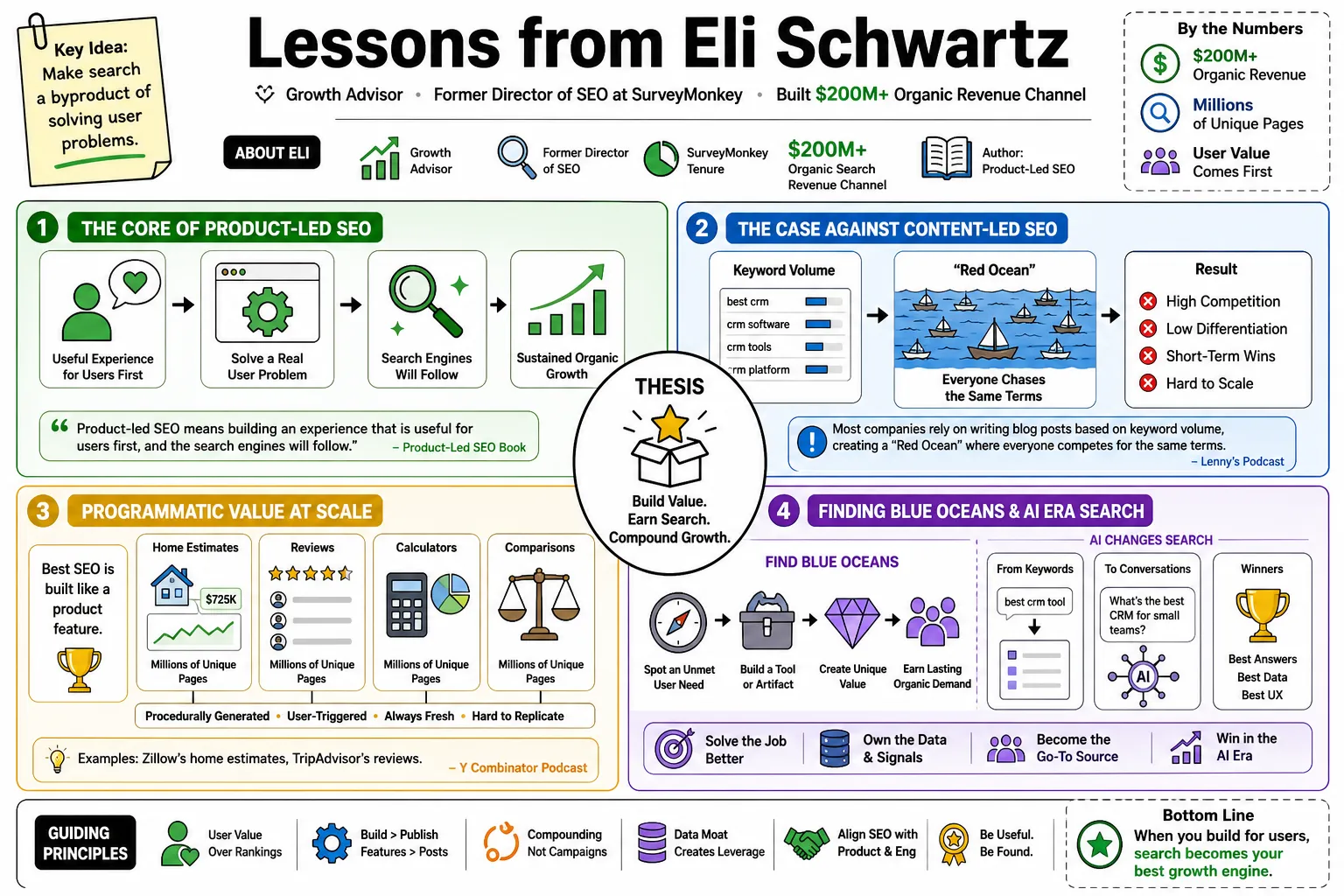
Eli Schwartz is a growth advisor and former Director of SEO at SurveyMonkey, where he helped turn organic search into a $200 million revenue channel. His book Product-Led SEO argues that search traffic should be a byproduct of solving user problems instead of an isolated marketing tactic. This profile covers his case against chasing algorithms, his approach to syncing SEO with product engineering, and his read on how AI changes search.
Part 1: The Core of Product-Led SEO
- On the definition: "Product-led SEO means building an experience that is useful for users first, and the search engines will follow." — Source: Product-Led SEO Book
- On the flaw of content-led SEO: Most companies rely on writing blog posts based on keyword volume, creating a "Red Ocean" where everyone competes for the exact same terms. — Source: Lenny's Podcast
- On programmatic value: The best SEO is built like a product feature. Examples include Zillow’s home estimates or TripAdvisor’s reviews, which generate millions of unique pages procedurally. — Source: Y Combinator Podcast
- On finding blue oceans: True organic growth comes from identifying an unmet user need and building a tool or artifact to solve it, rather than writing another article about it. — Source: Product-Led SEO Book
- On the broker analogy: "Google is the broker, but the user is the buyer. You want to satisfy the broker so they bring the buyer, but the buyer is who you are ultimately building for." — Source: The Intelligent Marketer
- On integration: SEO should not be a siloed marketing add-on; it must be an integral part of the product development process from day one. — Source: Search Engine Journal
- On the ultimate goal: The objective isn't to trick a search engine into ranking your site, but to present such a good answer that the search engine is forced to rank it. — Source: SearchPilot
- On user intent: Content-led SEO asks "what are people searching for?" Product-led SEO asks "what are people trying to accomplish?" — Source: Product-Led SEO Substack
- On sustainability: Products built for users maintain their search visibility through algorithm updates because they satisfy the fundamental goal of the search engine. — Source: The SaaS SEO Show
- On engineering effort: Product-led SEO requires engineering and design resources to build calculators, directories, or templates, moving the cost from writers to developers. — Source: Lenny's Podcast
Part 2: Strategic vs. Tactical SEO
- On tactics: Tactical SEO focuses on fixing things—like 404 errors, meta tags, or backlink profiles—without asking if the underlying page is actually valuable. — Source: Product-Led SEO Book
- On strategy: "If you can't articulate the goal, then you're not really doing anything." Strategic SEO starts with the business objective, not the keyword. — Source: befreed.ai
- On the order of operations: Tactics are obsolete if they are not guided by a strategy that aligns with the customer’s actual buying journey. — Source: Search Engine Journal
- On expertise: "Everyone thinks they can drive a boat, but nobody thinks that they can fly a plane." People assume reading one SEO article makes them a strategist. — Source: befreed.ai
- On reactive SEO: Tactical teams wait for Google to announce a new rule and react to it. Strategic teams build for the user and let Google catch up. — Source: OpenView Partners
- On unique fingerprints: "I think of organic as a puzzle. There is no rule book… You really have to figure out the unique fingerprint of each site." — Source: The SaaS SEO Show
- On checklists: Relying on standard SEO audit checklists often distracts teams from doing the high-impact work that actually drives revenue. — Source: Search For Hire
- On the "Why" vs "How": Strategic SEO asks why a user needs this page. Tactical SEO asks how to squeeze the keyword onto the page three more times. — Source: blogpascher.com
- On competitive advantage: You cannot build a defensible moat using the same generic tactical checklist your competitors downloaded from the internet. — Source: Complete AI Training
- On resource allocation: Strategic leaders spend their time convincing product teams to build scalable assets, not begging writers to adjust H2 tags. — Source: Tyler Roberts
Part 3: Growth at SurveyMonkey
- On early mistakes: When he joined SurveyMonkey, the site was available in 16 languages, but international pages weren't indexed because of missing server-side redirects. — Source: Spicy Margarita
- On solving prospect problems: Instead of chasing "survey maker," he analyzed onboarding data to see why users joined—finding niche use cases like customer churn and patient feedback. — Source: Spicy Margarita
- On scaling templates: SurveyMonkey captured long-tail traffic by programmatically generating thousands of landing pages for specific, highly-targeted survey templates. — Source: Y Combinator Podcast
- On literal translations: He famously argued against translating keywords directly, noting that locals search differently, such as the cultural difference between a "poll" and a "questionnaire". — Source: Search Engine Journal
- On site architecture: He overhauled SurveyMonkey’s structure so bots could discover every template, mimicking how Amazon structures its vast product categories. — Source: Y Combinator Podcast
- On the growth funnel: Organic search drove free top-of-funnel sign-ups, which the CRM and growth teams then retargeted to trigger paid upgrades. — Source: Spicy Margarita
- On revenue impact: By shifting from blogging to product-led landing pages, the organic channel eventually generated an estimated $200 million in annual revenue. — Source: Lenny's Podcast
- On international expansion: His strategy involved hiring local researchers to understand the actual terminology used in specific regions rather than relying on translation software. — Source: SEMRush
- On ignoring high volume: The team realized that high-volume keywords often had the lowest conversion rates, prompting a shift entirely toward intent-driven queries. — Source: Spicy Margarita
Part 4: Rethinking Metrics and Vanity KPIs
- On vanity metrics: Traffic and rankings are meaningless if they do not convert. High traffic from the wrong audience is just an expense on your server. — Source: Product-Led SEO Substack
- On keyword rank checking: Tracking exact keyword positions is obsolete because search results are highly personalized and localized for every user. — Source: Product-Led SEO Book
- On the ultimate KPI: Revenue and ROI are the only true measures of an SEO campaign's success. — Source: Marketing Speak
- On unit economics: SEO should have a defined Customer Acquisition Cost (CAC)—factoring in engineering and headcount—measured against the Lifetime Value (LTV) of organic users. — Source: Product-Led SEO Substack
- On leading indicators: Impression count in Search Console is a better early signal than rankings, as it shows Google is testing your content against relevant queries. — Source: Tyler Roberts
- On cohort analysis: Organic users should be segmented to see if they activate, stick around longer, or spend more compared to users acquired via paid channels. — Source: Product-Led SEO Substack
- On Share of Citations: In the AI era, tracking how often your brand is cited as a source by LLMs is becoming more vital than traditional SERP positions. — Source: AirOps
- On the trap of reporting: If an agency only reports on traffic growth but cannot show revenue tied to that traffic, they are hiding behind vanity numbers. — Source: Product-Led SEO Book
- On search-market fit: Before tracking any metrics, companies must validate if their target audience even uses search to solve their specific problem. — Source: Marketing Speak
Part 5: Ignoring "Best Practices" and Myths
- On algorithm updates: Chasing Google's algorithm updates is a losing game. If you build what users want, you are naturally aligned with what the algorithm is trying to reward. — Source: The SaaS SEO Show
- On the "Helpful Content" era: The recent AI-driven shift in search is like a pandemic for SEOs; suddenly, everyone is scrambling to adapt because their generic best practices stopped working. — Source: The Intelligent Marketer
- On blog length: The idea that a blog post must be 2,000 words to rank is a myth. If a user’s question can be answered in a bulleted list, give them the list. — Source: Product-Led SEO Substack
- On keyword density: Shoving keywords into headers and paragraphs makes content unreadable and signals to search engines that the page is over-optimized slop. — Source: Product-Led SEO Book
- On SEO for the sake of SEO: Creating pages solely because a keyword research tool showed search volume—without having a real product solution—is a waste of resources. — Source: Lenny's Podcast
- On technical audits: Many technical audits highlight hundreds of minor errors that have absolutely zero impact on a site's ability to rank or generate revenue. — Source: Product-Led SEO Book
- On the herd mentality: If a practice is labeled an "industry best practice," it means your competitors are already doing it, stripping it of any competitive advantage. — Source: Complete AI Training
- On domain authority: Domain Authority is a third-party metric invented by software companies, not a metric used by Google, and obsessing over it limits strategic thinking. — Source: Search For Hire
- On writing for clarity: AI models are excellent at parsing direct, scannable information. Stop burying the answer under five paragraphs of preamble. — Source: Product-Led SEO Substack
Part 6: B2B SEO Realities
- On the B2B delusion: He argues that many B2B software companies should never have invested in SEO, as their buyers do not search for software using generic terms. — Source: Refound AI
- On the wrong keywords: A B2B company selling a $100,000 enterprise platform wasting money to rank for "what is cloud computing" is fundamentally misunderstanding their buyer. — Source: OpenView Partners
- On brand as the moat: In B2B, brand marketing is the strongest SEO strategy. You want users to search directly for your company name when they have a problem. — Source: AirOps
- On mid-funnel focus: B2B SEO should focus heavily on comparison pages, pricing information, and specific use-case documentation rather than top-of-funnel definitions. — Source: AirOps
- On validating demand: If your product solves a completely new problem, there will be zero search volume for it. SEO cannot create demand; it can only capture it. — Source: Marketing Speak
- On the role of PR: Digital PR and third-party reviews are critical for B2B, as search engines and AI models rely on external citations to gauge software authority. — Source: AirOps
- On buying cycles: B2B purchases take months and involve multiple stakeholders. SEO content must serve as enablement material for a buyer trying to convince their boss. — Source: SearchPilot
- On the limits of content marketing: Writing endless blog posts rarely influences an enterprise software purchase; buyers look for case studies, integrations, and technical specs. — Source: Refound AI
- On Answer Engine Optimization (AEO): For B2B, making sure ChatGPT recommends your software when asked "what is the best tool for X" is the new frontier of organic visibility. — Source: befreed.ai
Part 7: Career and Team Integration
- On the SEO role: The modern SEO professional needs to act more like a Product Manager, bridging the gap between marketing, engineering, and user experience. — Source: Lenny's Podcast
- On in-house vs. agency: For SEO to truly be product-led, it must be handled by full-time, in-house team members who have a seat at the table in product meetings. — Source: Product-Led SEO Book
- On stakeholder management: The ability to communicate the business value of SEO to executives is more important than knowing how to optimize a robots.txt file. — Source: Search For Hire
- On the THRICE framework: He recommends prioritizing work based on Time, Headcount, Reach, Impact, Confidence, and Effort to avoid "exciting" but low-return projects. — Source: AirOps
- On transitioning to advising: For practitioners wanting to consult, he suggests moonlighting to build client management and sales skills before leaving a full-time role. — Source: Refound AI
- On cross-functional empathy: Successful SEOs must understand the goals of the engineering team. You cannot demand immediate fixes without understanding their sprint capacity. — Source: The SaaS SEO Show
- On automated tasks: As AI takes over technical audits and basic content creation, human SEOs must double down on strategy, user research, and complex problem-solving. — Source: Podwise
- On the problem with agencies: Many agencies fail because they are incentivized to deliver a list of recommendations, not to ensure those recommendations are actually built and generate revenue. — Source: Product-Led SEO Book
- On building trust: Start by fixing small, highly visible issues that generate immediate wins to earn the political capital necessary to propose massive, product-led overhauls. — Source: SearchPilot
Part 8: The Future of Search and AI
- On the AI interface shift: AI is not killing SEO; it is an evolution of the user interface. The core job of connecting users with answers remains the same. — Source: OpenView Partners
- On top-of-funnel death: AI tools like Perplexity and ChatGPT will completely dominate broad, top-of-funnel discovery, making informational blog posts largely obsolete. — Source: AirOps
- On AEO (Answer Engine Optimization): "I think the entire concept of AEO was invented by people looking to sell something additional to SEO." It is essentially just good brand marketing. — Source: befreed.ai
- On the mid-funnel moat: SEO must shift to the mid-funnel, providing the specific comparisons, pricing, and deep data that AI models cannot confidently synthesize. — Source: AirOps
- On Google's dilemma: Google's biggest competitor is its own legacy ad model. Platforms like Meta can embed AI search freely, while Google must protect its ad inventory. — Source: Product-Led SEO Substack
- On off-site signals: AI models learn from the entire web. To be recommended by an LLM, your brand must be discussed in forums, reviews, and news articles, not just on your own site. — Source: AirOps
- On zero-click searches: Search engines will increasingly provide the answer directly on the results page. Your value must lie in the product experience users click through to get. — Source: The SaaS SEO Show
- On slop detection: AI makes it easier to produce content, but algorithms are becoming equally adept at identifying and ignoring low-effort, AI-generated filler. — Source: Product-Led SEO Substack
- On hardware integration: The future of search extends beyond browsers into wearables like smart glasses, shifting queries from text-based to environmental and conversational. — Source: OpenView Partners
- On the rebirth of SEO: Stripped of cheap tricks and spammy content, SEO will finally become what it was always meant to be: building the best possible digital product for the user. — Source: OpenView Partners