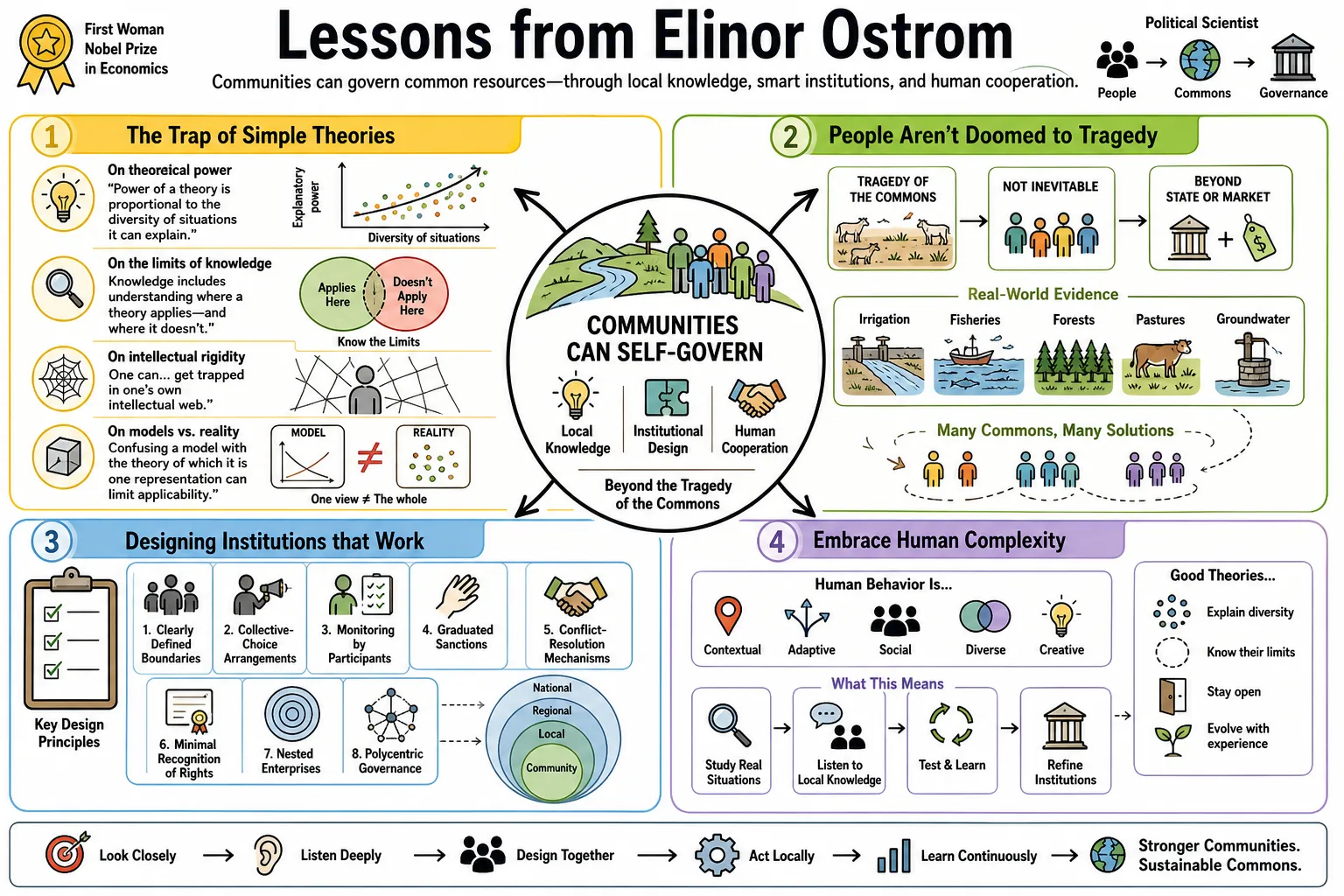
Political scientist Elinor Ostrom, the first woman to win the Nobel Prize in Economics, spent her career studying how communities manage shared resources. Her work showed that people are not inevitably trapped in a "tragedy of the commons" requiring state control or privatization. This profile outlines her research on local knowledge, institutional design, and human cooperation.
Part 1: The Trap of Simple Theories
- On theoretical power: "The power of a theory is exactly proportional to the diversity of situations it can explain." — Source: [Goodreads]
- On the limits of knowledge: "Scientific knowledge is as much an understanding of the diversity of situations for which a theory or its models are relevant as an understanding of its limits." — Source: [Goodreads]
- On intellectual rigidity: "One can… get trapped in one's own intellectual web." — Source: [Goodreads]
- On conflating models with reality: "Confusing a model—such as that of a perfectly competitive market—with the theory of which it is one representation can limit applicability still further." — Source: [Goodreads]
- On embracing human complexity: "The complexity of human social and economic behavior is something to be analyzed, understood and appreciated, not feared or denied." — Source: [WFHB]
- On when simple models fail: "When the world we are trying to explain and improve, however, is not well described by a simple model, we must continue to improve our frameworks and theories so as to be able to understand complexity and not simply reject it." — Source: [Wikiquote]
- On the usefulness of simplicity: "We should continue to use simple models where they capture enough of the core underlying structure." — Source: [Wikiquote]
- On academic narrowness: "If we stay with our current narrow ways of thinking about the world... I'm very discouraged." — Source: [OECD]
- On interdisciplinary collaboration: "I don't want to get rid of the disciplines entirely but it is then that people learn how to work together... there are very substantial disincentives to do interdisciplinary work." — Source: [Big Think]
Part 2: The Reality of the Commons
- On shattering established convictions: "If this study does nothing more than shatter the convictions of many policy analysts that the only way to solve CPR problems is for external authorities to impose full private property rights or centralized regulation, it will have accomplished one major purpose." — Source: [SuperSummary]
- On the missing tool in policy: "What is missing from the policy analyst's tool kit—and from the set of accepted, well-developed theories of human organization—is an adequately specified theory of collective action whereby a group of principals can organize themselves voluntarily to retain the residuals of their own efforts." — Source: [Lib Quotes]
- On moral responsibility: "We are neither trapped in inexorable tragedies nor free of moral responsibility." — Source: [Goodreads]
- On the efficacy of common ownership: "It's not a panacea but much more effective than our common understanding." — Source: [Nobel Prize]
- On the nature of subtractability: "If I take out a ton of fish, that ton of fish is not available to other fishermen." — Source: [OECD]
- On the presumption of helplessness: "Until a theoretical explanation—based on human choice—for self-organized and self-governed enterprises is fully developed and accepted, major policy decisions will continue to be undertaken with a presumption that individuals cannot organize themselves and always need to be organized by external authorities." — Source: [Goodreads]
- On organizing as an active process: "Organizing is a process; an organization is the result of that process." — Source: [Goodreads]
- On the definition of the state: "As long as a single center has a monopoly on the use of coercion, one has a state rather than a self-governed society." — Source: [QuoteFancy]
- On the core goal of public policy: "Extensive empirical research leads me to argue that instead, a core goal of public policy should be to facilitate the development of institutions that bring out the best in humans." — Source: [Wikiquote]
- On avoiding global panaceas: "A single-unit approach internationally is not feasible, and would likely be counterproductive at the national or subnational levels." — Source: [MDPI]
Part 3: Polycentricity and Distributed Governance
- On the definition of polycentricity: "We should continue to use the term 'polycentric' to characterize a system of governance in which many centers of decision making which are formally independent of each other." — Source: [The CGO]
- On the inherent advantages of polycentric systems: "No governance system is perfect, but polycentric systems have considerable advantages given their mechanisms for mutual monitoring, learning, and adaptation of better strategies over time." — Source: [The CGO]
- On the value of distributed experiments: "The advantage of a polycentric approach is that it encourages experimental efforts at multiple levels, as well as the development of methods for assessing the benefits and costs of particular strategies adopted in one type of ecosystem and comparing these with results obtained in other ecosystems." — Source: [MDPI]
- On assessing diverse institutions: "We need to ask how diverse polycentric institutions help or hinder the innovativeness, learning, adapting, trustworthiness, levels of cooperation of participants, and the achievement of more effective, equitable, and sustainable outcomes at multiple scales." — Source: [FutureLearn]
- On moving past single solutions: "We need to get away from the idea that there is only one solution on the global scale. There are many, many levels in between. So we need to take action on smaller levels." — Source: [FutureLearn]
- On the danger of waiting for global consensus: "Waiting for a single worldwide 'solution' to emerge from global negotiations is not likely to address the time-sensitive nature of mitigating greenhouse gas emissions." — Source: [RePEc]
- On action at every scale: "There is a lot that can be done at a household level, at a community level, at a regional level." — Source: [Escotet]
- On linked governance units: "Building such a commitment, and the trust that others are also taking responsibility, can be more effectively undertaken in small- to medium-scale governance units that are linked through information networks and monitoring at all levels." — Source: [MDPI]
- On matching rules to local contexts: "Appropriation rules restricting time, place, technology, and/or quantity of resource units are related to local conditions and to provision rules requiring labor, material, and/or money." — Source: [Brian D. Colwell]
- On rejecting the presumption of imposed design: "Instead of presuming that optimal institutions can be designed easily and imposed at low cost by external authorities, I argue that 'getting institutions right' is a difficult, time-consuming, and conflict-invoking process." — Source: [SuperSummary]
Part 4: Trust, Reciprocity, and Human Nature
- On our complex motivational structure: "Humans have a more complex motivational structure and more capability to solve social dilemmas than posited in earlier rational-choice theory." — Source: [Wikiquote]
- On the primacy of trust: "Trust is the most important resource. If a community has been forbidden from managing its resources for a long time, the main obstacle to overcome is the lack of trust and the effort to get organized in the first place." — Source: [Escotet]
- On the emergence of unforced cooperation: "When individuals are well informed about the problem they face and about who else is involved, and can build settings where trust and reciprocity can emerge, grow, and be sustained over time, costly and positive actions are frequently taken without waiting for an external authority to impose rules, monitor compliance, and assess penalties." — Source: [Brian D. Colwell]
- On the inadequacy of trust alone: "Few long-surviving resource regimes rely primarily on endogenous levels of trust and reciprocity among appropriators to keep rule breaking levels down." — Source: [Brian D. Colwell]
- On the power of conditional reciprocity: "...conditional reciprocity can lead to cooperation to overcome social dilemmas." — Source: [Goodreads]
- On identifying strong reciprocators: "These norm-followers {strong reciprocators} can flourish in face of rational egoists as long as they can identify each other." — Source: [Protevi]
- On the shared struggle of climate change: "It's not me against you. It's all of us against ourselves, if we don't act." — Source: [Spiegel]
- On the foundational step of defining membership: "If a group of users can determine their own membership—including those who agree to use the resource according to their agreed-upon rules and excluding those who do not agree to these rules—the group has made an important first step toward limiting access and developing greater trust and reciprocity." — Source: [Brian D. Colwell]
- On the purpose of institutions: "Institutions are among the tools that fallible humans use to change incentives to enable fallible humans to overcome social dilemmas." — Source: [Brian D. Colwell]
Part 5: Rules-in-Use and Local Knowledge
- On the people on the spot: "There is no reason to believe that bureaucrats and politicians, no matter how well meaning, are better at solving problems than the people on the spot, who have the strongest incentive to get the solution right." — Source: [AZ Quotes]
- On the asymmetry of information: "Bureaucrats sometimes do not have the correct information, while citizens and users of resources do." — Source: [AZ Quotes]
- On defining rules-in-use: "Rules-in-use are how the local community understands the rules..." — Source: [EconTalk]
- On accountability without privatization: "When you don't have the technology to parcel out the land or the ocean into private plots, we get rules-in-use which limit access, which forces accountability." — Source: [EconTalk]
- On bounding the commons: "Defining the boundaries of the CPR… can be thought of as a first step in organizing for collective action." — Source: [Brian D. Colwell]
- On the danger of disconnected rule-making: "If the individuals who are crafting and modifying rules do not understand how particular combinations of rules affect actions and outcomes in a particular ecological and cultural environment, rule changes may produce unexpected and, at times, disastrous outcomes." — Source: [Goodreads]
- On the limitation of good rules: "The presence of good rules… does not ensure that appropriators will follow them." — Source: [Brian D. Colwell]
- On the logic of strategic compliance: "Strategic actors are willing to comply with a set of rules… when (1) they perceive that the collective objective is achieved, and (2) they perceive that others also comply." — Source: [Goodreads]
- On the necessary diversity of rules: "The specific rules-in-use differ markedly from one case to the next... Given the diversity of biological scales involved, Ashby's law of requisite variety commends a variety of institutional arrangements at diverse scales." — Source: [Cambridge University Press]
Part 6: Crafting Resilient Institutions
- On defining design principles: "By 'design principles' I mean an essential element or condition that helps to account for the success of these institutions in sustaining the CPRs and gaining the compliance of generation after generation of appropriators to the rules-in-use." — Source: [Brian D. Colwell]
- On monitoring as a prerequisite for rules: "Without monitoring, there can be no credible commitment; without credible commitment, there is no reason to propose new rules." — Source: [Brian D. Colwell]
- On self-monitoring: "In these robust institutions, monitoring and sanctioning are undertaken not by external authorities but by the participants themselves." — Source: [SuperSummary]
- On managing opportunistic behavior: "In some settings, however, rampant opportunistic behavior severely limits what can be done jointly without major investments in monitoring and sanctioning arrangements." — Source: [Goodreads]
- On the necessity of graduated sanctions: "Users who violate rules-in-use are likely to receive graduated sanctions (depending on the seriousness and context of the offense) from other users, from officials accountable to these users, or from both." — Source: [Brian D. Colwell]
- On the right to self-organize: "The rights of appropriators to devise their own institutions are not challenged by external governmental authorities." — Source: [Brian D. Colwell]
- On resolving conflicts locally: "Appropriators and their officials have rapid access to low-cost local arenas to resolve conflicts among appropriators or between appropriators and officials." — Source: [Brian D. Colwell]
- On the principle of collective choice: "Most individuals affected by the operational rules can participate in modifying the operational rules." — Source: [Heinrich Böll Foundation]
- On nesting institutions for large systems: "Appropriation, provision, monitoring, enforcement, conflict resolution, and governance activities are organized in multiple layers of nested enterprises." — Source: [Brian D. Colwell]
- On the accountability of monitors: "Monitors, who actively audit CPR conditions and appropriator behavior, are accountable to the appropriators or are the appropriators." — Source: [Brian D. Colwell]
Part 7: Environmental Crises and Climate Action
- On the urgency of local action: "We can't just sit around waiting for the global solution." — Source: [Escotet]
- On recognizing the gravity of global warming: "The melting of the glaciers, rising sea levels, extreme storms, and the many other impacts of global warming are grave and need to be considered among the major environmental problems of our era." — Source: [EconTalk]
- On balancing global and local awareness: "We should not, however, ignore environmental problems facing local communities and regions throughout the world." — Source: [EconTalk]
- On taking individual responsibility: "Building a strong commitment to find ways of reducing individual emissions is an important element for coping with this problem..." — Source: [MDPI]
- On treating climate as a polycentric problem: "Polycentricity is a useful analytical approach for understanding and improving efforts to reduce the threat of climate change." — Source: [FutureLearn]
- On rethinking what it means to live well: "We have to think through how to choose a meaningful life where we're helping one another in ways that really help the Earth." — Source: [Escotet]
- On mindless consumption: "Some of the homes that have been built in the last 10 years just appall me. Why do humans need huge homes?" — Source: [AZ Quotes]
- On the illusion of a single treaty: "A single-unit approach internationally is not feasible, and would likely be counterproductive at the national or subnational levels." — Source: [MDPI]
- On the time-sensitivity of emissions: "Waiting for a single worldwide 'solution' to emerge from global negotiations is not likely to address the time-sensitive nature of mitigating greenhouse gas emissions." — Source: [RePEc]
Part 8: The Work and the Life
- On discovering her life's work: "I was studying the commons from the beginning, but I didn't know it." — Source: [Nobel Prize]
- On overcoming academic sexism: "Having lived through an era, where I was thinking of going to graduate school and was strongly discouraged because I would never be able to do anything but teach in a city college… Ah ha ha, life has changed!" — Source: [Nobel Prize]
- On her early socioeconomic background: "I was born poor and I didn't know you bought clothes at anything but the Goodwill until I went to college." — Source: [AZ Quotes]
- On the enduring lessons of the Great Depression: "I think being raised during the depression is a very important thing in my generation. I think it meant that I had to learn very early how to work hard and how to be independent... the world isn't going to come with you with all sorts of gifts." — Source: [Big Think]
- On retaining a sense of humor in academia: "Adam Smith, what a name! I'm sorry, you're kidded a lot, I'm sure." — Source: [Nobel Prize]
- On the danger of academic isolation: "If we stay with our current narrow ways of thinking about the world... I'm very discouraged." — Source: [OECD]
- On theoretical inquiry vs. reality: "Theoretical inquiry involves a search for regularities. It involves abstraction from the complexity of a field setting, followed by the positing of theoretical variables that underlie observed complexities." — Source: [QuoteFancy]
- On studying 'ordinary' people: "It was a struggle because so many of my political science colleagues didn't like what we were doing... They found it strange that we were interested in farmers and peasants and people organizing water. But it was worth it." — Source: [Brian D. Colwell]
- On accrued learning: "None [of the robust institutions] have been designed in one single step. Rather, accrued learning and knowledge have led those with good information about participants, strategies, ecological conditions... to craft sustainable institutions." — Source: [Brian D. Colwell]