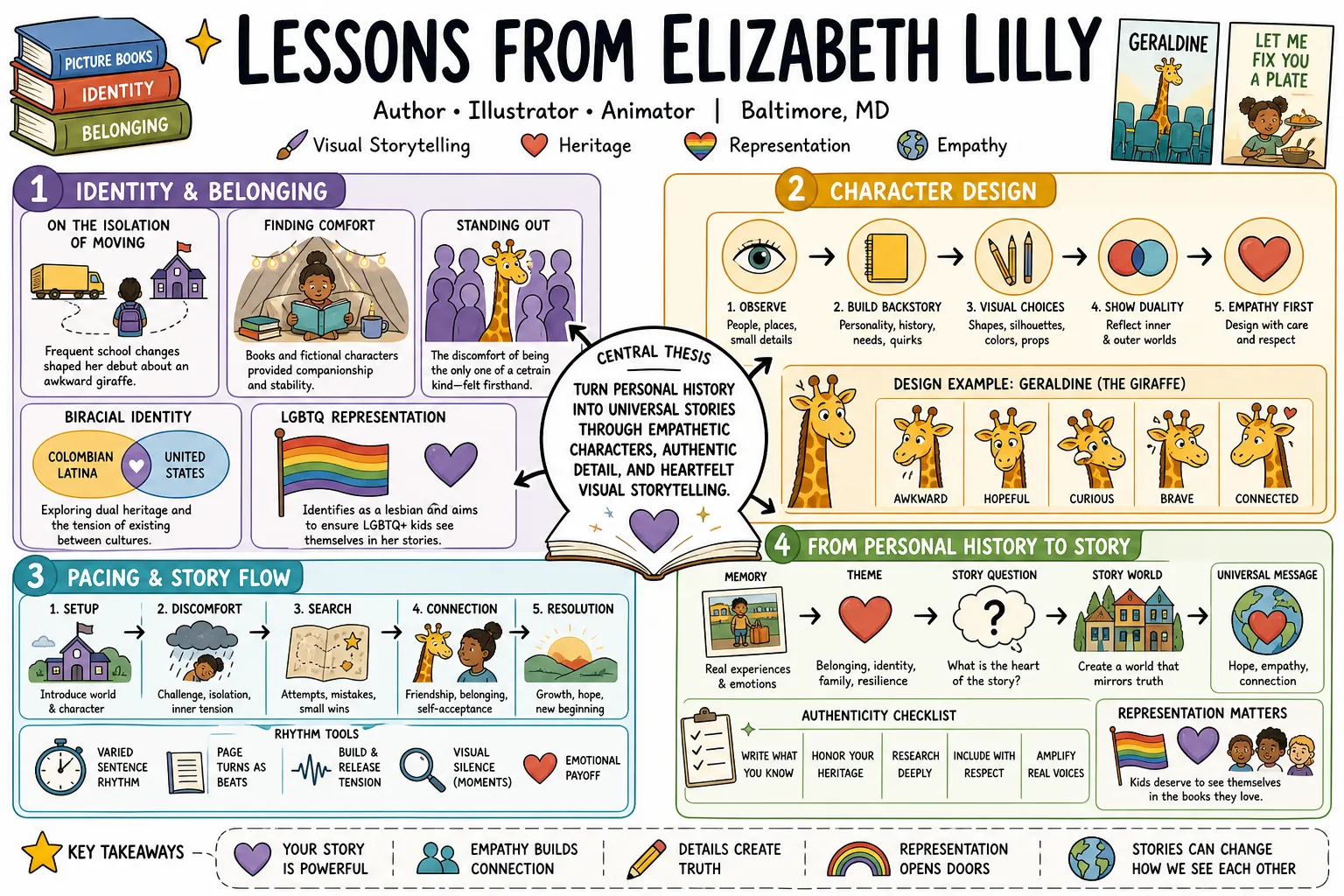
Lessons from Elizabeth Lilly
Baltimore-based author, illustrator, and animator Elizabeth Lilly grounds her best-known picture books, Geraldine and Let Me Fix You a Plate, in her biracial Latina heritage and a childhood spent constantly moving. This collection breaks down her practical methods for character design and pacing, alongside the exact ways she translates personal history into visual storytelling.
Part 1: Identity and Belonging
- On the isolation of moving: "She frequently changed schools as a child, an experience that heavily influenced her debut book about an awkward giraffe trying to fit in." — Source: [Deborah Kalb Q&A]
- On finding comfort: "During lonely periods as the new kid, she relied on books and fictional characters for companionship and stability." — Source: [Cynthia Leitich Smith’s Blog]
- On standing out: "Her work addresses the intense discomfort of being the only one of a certain kind in a new environment, a feeling she experienced firsthand." — Source: [The Children’s Book Podcast]
- On biracial identity: "As a Colombian Latina who grew up in the United States, she uses picture books to explore the duality of her heritage and the tension of existing between cultures." — Source: [Las Musas Books]
- On LGBTQ representation: "She identifies as a lesbian and aims to create stories where individuality and diverse identities are celebrated rather than hidden." — Source: [Elizabeth Lilly Official Site]
- On making space: "A recurring theme in her writing is the importance of communities deliberately making room for outsiders and latecomers." — Source: [The Children’s Book Podcast]
- On the immigrant experience: "She modeled the personality of Geraldine, her giraffe protagonist, directly on the feelings of alienation common to immigrant children." — Source: [Deborah Kalb Q&A]
- On authenticity: "Her narratives suggest that trying to blend in is less effective than simply finding friends who appreciate genuine oddities." — Source: [Play On Words]
- On self-discovery: "She views the process of growing up as a continuous struggle to understand and ultimately love the weirdest parts of oneself." — Source: [Elizabeth Lilly Official Site]
- On vulnerability: "She believes that children relate most strongly to characters who openly display their insecurities and fears." — Source: [Baltimore's Child]
Part 2: The Creative Process
- On early drafts: "She begins most of her projects by doodling loose, unstructured sketches of people and animals in her notebook before writing any words." — Source: [Baltimore's Child]
- On finding the emotional core: "Before outlining a plot, she relies heavily on journaling and talking with family to pin down the specific feeling she wants a book to convey." — Source: [Baltimore's Child]
- On the grueling nature of revision: "She has spoken openly at universities about the intense, repetitive revision cycles required to get a picture book ready for publication." — Source: [JHU Newsletter]
- On writing dialogue: "Despite being an author-illustrator, she typically leaves the specific lines of dialogue and narration as the very last step in her process." — Source: [Baltimore's Child]
- On simultaneous development: "She develops the text and the visual storyboard at the same time, treating them as dependent halves of a single narrative mechanism." — Source: [Baltimore's Child]
- On observation: "A key part of her idea-generation phase involves sitting in public spaces and drawing strangers, looking for quirks in posture or expression." — Source: [Baltimore's Child]
- On pacing a draft: "She emphasizes the need to understand how a story feels mechanically before committing to a rigid narrative arc." — Source: [Baltimore's Child]
- On creative block: "She views periods of stagnation as necessary downtime for the subconscious to sort out complex story problems." — Source: [The Illustration Conference]
- On knowing when to stop: "She relies on feedback from trusted peers and loved ones to tell her when a manuscript has reached its final form." — Source: [Baltimore's Child]
Part 3: Visual Storytelling and Illustration
- On line work: "Her signature style relies on loose, concise pen-and-ink lines that prioritize energy and movement over strict anatomical accuracy." — Source: [Elizabeth Lilly Official Site]
- On avoiding vagueness: "Reviewers praise her art for its droll realism, noting that her characters wear their emotions plainly rather than hiding behind ambiguous expressions." — Source: [Penguin Random House]
- On Quentin Blake's influence: "Her gestural illustration style is frequently compared to Quentin Blake, sharing a similar focus on rapid, expressive character work." — Source: [Play On Words]
- On color palettes: "She uses specific color choices to communicate temperature and atmosphere, distinguishing different locations in her books through distinct palettes." — Source: [JHU Newsletter]
- On drafting the visual arc: "She uses thumbnails and storyboards heavily to map out the visual rhythm before moving to final artwork." — Source: [Baltimore's Child]
- On mixed media: "In addition to ink, she frequently incorporates painted watercolor backgrounds to give her settings a warm, lived-in texture." — Source: [Elizabeth Lilly Official Site]
- On conveying emotion: "She believes that a single well-placed gestural line can communicate more about a character's internal state than paragraphs of descriptive text." — Source: [Picture Book Builders]
- On page turns: "She structures her illustrations carefully around the physical act of turning the page, using the gutter to build tension or reveal punchlines." — Source: [The Illustration Conference]
- On character consistency: "Keeping a loose drawing style visually consistent across thirty-two pages requires maintaining the exact same emotional headspace throughout the drawing process." — Source: [Baltimore's Child]
Part 4: Heritage and Family History
- On the concept of two kitchens: "Her book Let Me Fix You a Plate contrasts her mother's Colombian kitchen with her father's Appalachian kitchen, using food to explore dual heritage." — Source: [JHU Newsletter]
- On site-specific research: "To ensure authenticity, she physically traveled back to her family's homes in West Virginia and Florida to study the exact lighting and layout of their kitchens." — Source: [JHU Newsletter]
- On sensory memories: "She focuses on capturing the specific temperature and ambient noise of family gatherings to ground her stories in reality." — Source: [Seven Impossible Things Before Breakfast]
- On food as a unifier: "She views the act of preparing and serving meals as a universal language that bridges cultural divides within families." — Source: [Elizabeth Lilly Official Site]
- On capturing atmosphere: "She altered her artistic techniques between the two halves of Let Me Fix You a Plate to visually separate the snowy mountains of Appalachia from the humid warmth of Florida." — Source: [JHU Newsletter]
- On honoring grandparents: "Her work serves as a tangible record of her grandparents' habits, routines, and specific ways of showing affection." — Source: [Elizabeth Lilly Official Site]
- On multicultural households: "She aims to validate the experiences of children who grow up navigating wildly different cultural norms depending on which side of the family they are visiting." — Source: [Las Musas Books]
- On linguistic differences: "She subtly weaves regional slang and Spanish phrases into her text to reflect the natural cadence of her family's conversations." — Source: [JHU Newsletter]
- On the permanence of tradition: "She illustrates family recipes not simply as food, but as inherited artifacts that survive geographic displacement." — Source: [Elizabeth Lilly Official Site]
Part 5: Developing Characters
- On spontaneous ideas: "The character of Geraldine arrived fully formed in her head as a depressed, awkward giraffe while she was studying at art college." — Source: [Deborah Kalb Q&A]
- On animal avatars: "She frequently uses animal characters as stand-ins for human children, allowing readers to project their own insecurities onto the protagonist." — Source: [Baltimore's Child]
- On character flaws: "She refuses to write perfect protagonists, preferring characters who make embarrassing mistakes and struggle with social cues." — Source: [Deborah Kalb Q&A]
- On body language: "She designs her characters' postures to reflect their emotional state, drawing them hunched over when sad and expansive when confident." — Source: [Picture Book Builders]
- On finding the voice: "She experiments with different narrative points of view until a character's internal monologue feels distinct and lived-in." — Source: [Baltimore's Child]
- On visual evolution: "The final design of a character is usually the result of dozens of iterations, slowly stripping away unnecessary details to focus on expressiveness." — Source: [Baltimore's Child]
- On vulnerability in design: "She intentionally leaves her character sketches looking slightly unpolished to make them feel more accessible and human to young readers." — Source: [The Illustration Conference]
- On supporting casts: "She believes that side characters must have their own implied backstories and motivations, even if they only appear on a single page." — Source: [Baltimore's Child]
- On naming characters: "She selects character names that sound slightly out of place or old-fashioned to emphasize their feelings of isolation." — Source: [Deborah Kalb Q&A]
- On emotional arcs: "She structures her stories so that the character's internal emotional shift is visually mirrored by a change in the book's color palette." — Source: [Baltimore's Child]
Part 6: Animation and Movement
- On 2D animation: "She has a background in frame-by-frame animation, a discipline that heavily informs her understanding of momentum in picture books." — Source: [Las Musas Books]
- On software tools: "For her short film projects, such as Takeoff and Landing, she relies on software like TVPaint to manage complex animation sequences." — Source: [Elizabeth Lilly Official Site]
- On the illusion of motion: "She applies animation principles, like squash and stretch, to her static illustrations to make characters feel alive and kinetic on the page." — Source: [The Illustration Conference]
- On rhythm: "She views a picture book as a time-based medium, where the reader controls the frame rate through the speed of their page turns." — Source: [Las Musas Books]
- On visual continuity: "Her training as an animator taught her the rigorous discipline required to keep a character's volume and proportions consistent from every angle." — Source: [The Illustration Conference]
- On storyboarding: "She utilizes standard animation storyboarding techniques to plot out the camera angles and extreme close-ups for her books." — Source: [Baltimore's Child]
- On directing the eye: "She uses the implied motion of her characters to physically guide the reader's eye toward the text or the edge of the page." — Source: [Picture Book Builders]
- On short films: "She views independent animation as a parallel avenue for storytelling, allowing her to explore narratives that rely more on sound and timing than text." — Source: [Elizabeth Lilly Official Site]
- On cross-pollination: "She frequently imports techniques developed during her animation projects into her book illustration process, such as layering digital textures over traditional ink." — Source: [Elizabeth Lilly Official Site]
Part 7: The Life of an Educator
- On teaching: "She serves as an adjunct professor at the Maryland Institute College of Art, where she instructs students in illustration and storytelling." — Source: [MICA Directory]
- On guiding students: "She emphasizes the importance of helping young artists find their own specific voice rather than mimicking current industry trends." — Source: [MICA Directory]
- On the value of critique: "In her classrooms, she fosters environments where rigorous critique is used to strengthen a story's emotional center rather than its technical execution." — Source: [The Illustration Conference]
- On balancing roles: "She actively manages the dual demands of maintaining a freelance illustration career while fulfilling her responsibilities as an educator." — Source: [Dream Gardens Podcast]
- On pedagogical influence: "Her experience breaking down narratives for her students has naturally made her own storytelling more structured and intentional." — Source: [Las Musas Books]
- On finding community: "She stresses to her students that surviving in the arts requires building a strong network of peers for emotional and professional support." — Source: [The Illustration Conference]
- On continuous learning: "She views teaching as an opportunity to constantly re-evaluate her own artistic assumptions, rather than a one-way transfer of knowledge." — Source: [MICA Directory]
- On practical skills: "Beyond theory, she teaches her students the practical realities of storyboarding and pitching a book to publishers." — Source: [The Illustration Conference]
- On artistic instincts: "A primary goal of her teaching is to help students trust their initial, messy instincts before the pressure of perfectionism sets in." — Source: [Dream Gardens Podcast]
Part 8: Navigating the Publishing Industry
- On debuts: "Her first book, Geraldine, received significant critical acclaim and taught her the sheer volume of promotion required for a successful launch." — Source: [Publishers Weekly]
- On collaboration: "When illustrating texts written by other authors, such as Jonathan Stutzman's Soon, Your Hands, she focuses on finding a visual subtext that complements the author's words without repeating them." — Source: [Elizabeth Lilly Official Site]
- On industry recognition: "Her work has been honored by the Junior Library Guild and received starred reviews, validating her focus on highly personal, specific narratives." — Source: [Elizabeth Lilly Official Site]
- On podcasts: "She frequently co-hosts and guests on podcasts like Paintbrush In My Coffee Cup, using the medium to demystify the daily reality of being a working illustrator." — Source: [Podcast Addict]
- On author visits: "She visits schools to speak directly with children, viewing these interactions as vital reality checks for whether her stories are actually connecting with their intended audience." — Source: [The Children’s Book Podcast]
- On dealing with rejection: "She openly discusses the rejections and false starts that precede any published book, aiming to normalize failure for aspiring creators." — Source: [Cynthia Leitich Smith’s Blog]
- On advocating for diversity: "Through organizations like Las Musas, she actively works to amplify the voices of other Latinx creators in the children's literature space." — Source: [Las Musas Books]
- On the author-illustrator duality: "She finds that having control over both the text and the art allows for a cohesive final product, though it increases the solitary workload." — Source: [Dream Gardens Podcast]
- On professional endurance: "She describes a career in publishing as a marathon that requires patience and a high tolerance for ambiguity." — Source: [The Illustration Conference]
- On defining success: "Ultimately, she measures the success of a book by whether it accurately captures the specific, true feeling she set out to convey, rather than by its sales figures." — Source: [Baltimore's Child]