As Netflix's Chief Product and Technology Officer, Elizabeth Stone runs the engineering, data, and design teams behind the platform's global scale. A former economist and trader who previously led technical teams at Nuna and Lyft, she applies strict economic principles to system architecture and resource allocation. This profile explores how she handles live broadcasting, AI, and Netflix's culture of extreme talent density.
Part 1: Product Strategy and the Entertainment Experience
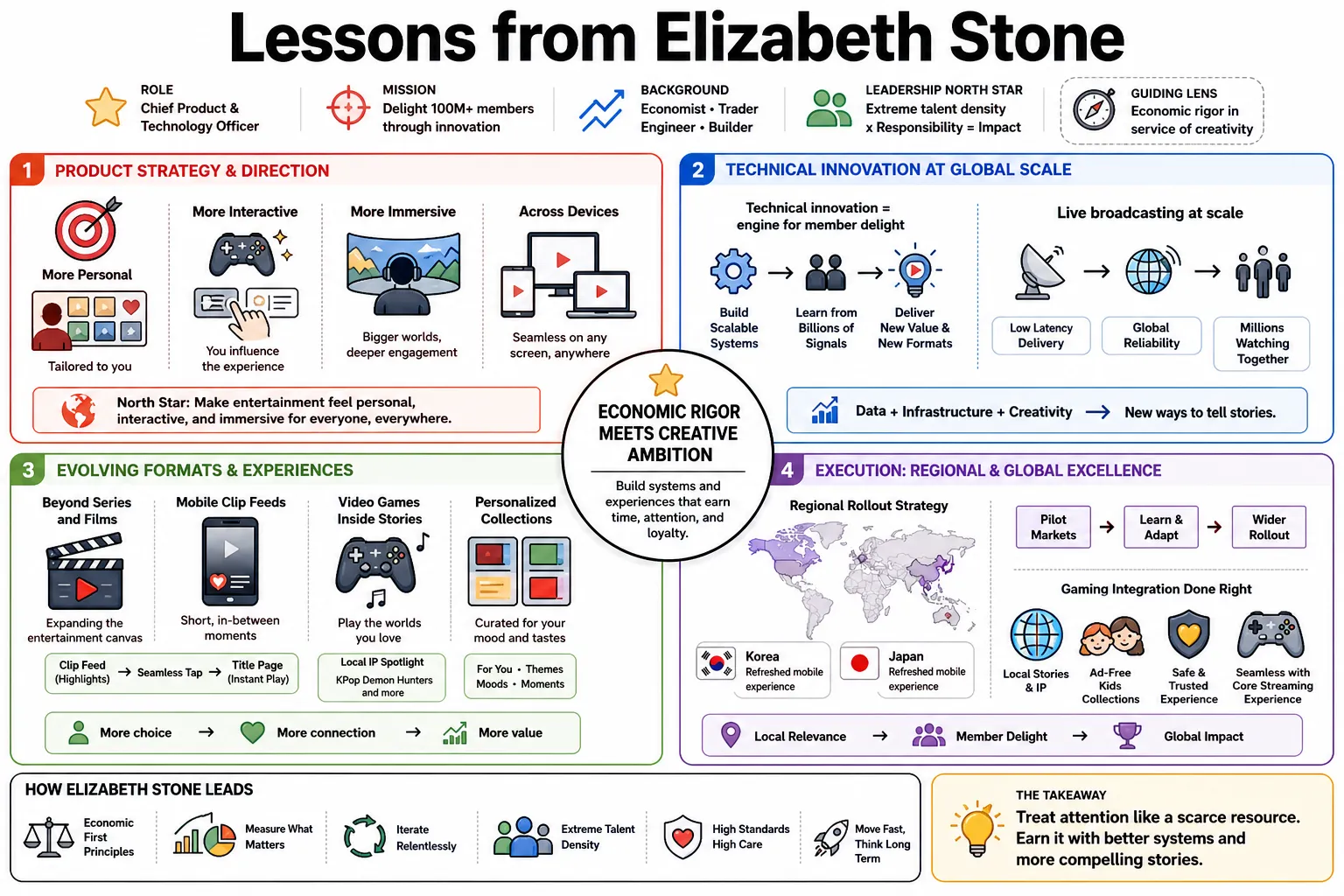
- On the direction of streaming: Netflix is focusing on making entertainment feel more personal, interactive, and immersive across different devices. — Reference: About Netflix
- On technical innovation: Because entertainment scales to hundreds of millions of people globally, technical innovation acts as the primary engine for meeting member preferences and opening up new narrative formats. — Reference: About Netflix
- On evolving formats: Entertainment has expanded beyond series and films, with new additions like mobile gaming and vertical clip feeds giving subscribers new ways to experience stories. — Reference: About Netflix
- On mobile clip feeds: A vertical video feed of show highlights caters to brief, in-between moments of the day while seamlessly integrating with title pages for immediate playback. — Reference: About Netflix
- On regional product execution: Deploying major interface updates requires strategic rollouts tailored to specific markets, such as introducing the refreshed mobile experience to Korea and Japan before wider expansion. — Reference: About Netflix
- On gaming integration: Expanding into video games allows members to play inside stories they love, featuring localized IP like KPop Demon Hunters and ad-free kids collections. — Reference: About Netflix
- On personalized collections: Content discovery is enhanced through curated hubs tied to specific moods, regional holidays, or interests, mimicking a tailored recommendation from a close friend. — Reference: About Netflix
Part 2: Navigating Artificial Intelligence
- On the AI transition period: "Any time a new technology comes along, you go through a storming phase before you go through the forming phase of things. We are in the middle of that right now." — Source: Lenny's Podcast Transcript
- On generative models: The recent wave of generative AI acts as a step function in technical capability, offering new methods to improve member experiences and support creative visions. — Reference: Variety
- On empowering storytellers: New production tools should expand the choices available to filmmakers rather than attempting to replace their vision or human judgment. — Reference: About Netflix
- On shifting constraints: Because AI allows for near-infinite output, the primary bottleneck in product development moves away from raw creation and toward strict quality control and decision-making. — Reference: LinkedIn
- On protecting quality: When output becomes cheap to produce, competitive advantage belongs to teams that exercise restraint and carefully curate what actually ships to users. — Reference: LinkedIn
- On AI fluency: Familiarity with artificial intelligence tools is treated as a universal baseline expectation across the entire company, rather than a specialized skill limited to specific job levels. — Reference: Lenny's Podcast Transcript
- On human accountability for AI: Models intended for artistic application must include deliberate restraints that preserve creative intent and keep final judgment firmly in the hands of the artists. — Reference: About Netflix
Part 3: Systems Thinking and Problem Solving
- On the rise of systems thinkers: The most important skill in the current technical era is the ability to examine multiple business domains and abstract them into reusable building blocks. — Reference: Lenny's Podcast Transcript
- On broadening perspective: You can practice systems thinking by taking an immediate problem and stepping back one layer to evaluate the underlying assumptions about the broader environment. — Reference: Lenny's Podcast Transcript
- On evaluating downstream effects: Instead of simply asking if a feature can be built, teams must evaluate whether that piece should exist at all and how it will impact interconnected systems. — Reference: LinkedIn
- On preferring generalists: Many technical roles are collapsing narrow execution tasks, leading organizations to seek generalists who understand the entire workflow from signal to final delivery. — Reference: LinkedIn
- On making complexity invisible: Engineering teams succeed when they can mask massive catalog sizes and intricate algorithms behind an interface where discovery feels effortless and intuitive to the end user. — Reference: Variety
- On preserving craft expertise: Despite the blurring of traditional roles and the speed of AI generation, deep, specialized mastery in engineering and data science remains scarce and essential for building reliable products. — Reference: Lenny's Podcast Transcript
Part 4: Economics and Strategic Trade-offs
- On career transitions: A foundational background in economic consulting and financial trading provides a rigorous analytical framework for later executive roles leading technical organizations at Nuna, Lyft, and Netflix. — Reference: Lenny's Podcast
- On resource allocation: Because resources are always finite, product teams must focus their time, energy, and capital entirely on projects that drive the highest business impact. — Reference: Variety
- On defining constraints: Complex problems should be framed by establishing a clear objective, identifying controllable levers, and mapping out the constraints that cannot be changed. — Reference: Uncanny Valley | WIRED
- On continuous prioritization: Everyone from individual contributors to executives should frequently ask if they are working on the single most impactful task available to them. — Reference: The Data Chief
- On taking calculated risks: Teams should use analytical frameworks and hard data to make informed decisions without becoming too fearful to place significant strategic bets. — Reference: The Data Chief
- On combining data with intuition: Machine learning recommendations require a blend of algorithmic sorting and authentic human understanding to make content discovery feel natural. — Reference: About Netflix
- On economics and incentives: Formal training in economics provides a unique lens for understanding human behavior, allowing leaders to structure incentives that align individual work with the company's broader goals. — Reference: Lenny's Podcast
Part 5: Engineering Culture and Talent Density
- On excellence as an operating system: Maintaining high performance means feeling comfortable with the discomfort of rejecting standard bureaucratic processes used by older enterprises. — Reference: Lenny's Podcast Transcript
- On the necessity of talent density: Foundational principles like radical candor and deep autonomy are impossible to implement unless you start with a highly concentrated group of exceptional employees. — Reference: Lenny's Podcast Transcript — spoken.md
- On resisting process creep: "In cases where things are not going well, not assume that process is going to fix it." — Source: Lenny's Podcast Transcript
- On the Keeper Test: Managers should evaluate their direct reports by continually asking themselves if they would fight to keep that employee if they received an outside offer. — Reference: Lenny's Podcast
- On performance reviews: Rather than assigning rigid ratings, organizations benefit more from ongoing daily feedback and annual 360-degree reviews focused strictly on personal improvement. — Reference: Lenny's Podcast
- On AI lab culture: The fundamental practices of early Netflix, including extreme autonomy and top-of-market compensation, are now the standard operating procedures for the world's top AI labs. — Reference: Lenny's Podcast Transcript
- On open-door leadership: Establishing a culture where employees feel welcome to share ideas and concerns directly with executives requires intentional, continuous effort to maintain accessibility. — Reference: Lenny's Podcast
Part 6: Leadership and Organizational Scale
- On normalizing candor: Direct feedback becomes much easier to deliver and receive when everyone in the company participates, creating a mutual investment in each other's success. — Reference: Variety
- On aligning large teams: As a company scales, executives should broadcast their top-of-mind priorities to give teams structure for independent alignment, avoiding heavy-handed mandates. — Reference: Variety
- On radical transparency: Leaders can build trust and community by openly sharing their meeting notes, reflections on failures, and current strategic challenges with the entire organization. — Reference: Lenny's Podcast
- On empowering human judgment: Because algorithms cannot predict creative success with perfect accuracy, companies must hire for and trust individual judgment across all levels of the org chart. — Reference: The Data Chief
- On centralized data teams: Keeping data and analytics teams centralized allows them to maintain deep functional expertise while providing objective insights to different product groups. — Reference: Lenny's Podcast
- On setting expectations: Clear, real-time conversations about performance standards prevent surprises and ensure that both managers and reports are aligned on what success looks like. — Reference: Lenny's Podcast
- On junior talent and mentorship: While the industry shifts rapidly with AI, organizations must deliberately cultivate environments where junior employees can develop true craft mastery through mentorship from experienced leaders. — Reference: Lenny's Podcast Transcript
Part 7: Execution and Managing Complexity
- On scaling into executive roles: Moving from a domain-specific VP to a CTO role requires navigating a massive increase in context switching and learning entirely unfamiliar technical problem spaces. — Reference: Lenny's Podcast Transcript — spoken.md
- On the complexity of live events: Delivering high-quality live video at a global scale remains exceptionally difficult and cannot be solved with the same architecture used for video-on-demand. — Reference: Variety
- On learning from outages: Early failures in live broadcasting provide the necessary operational lessons and architectural improvements required to securely stream massive events like NFL games. — Reference: Variety
- On finishing strong: "It's the last 5% that really matters. And don't treat anything as in the bag or you're going to coast or 95% is good enough." — Source: Uncanny Valley | WIRED
- On interactive discovery: Machine learning is currently being used to prototype new interfaces that organize massive catalogs by reshaping how the product interprets exactly what a subscriber wants to watch. — Reference: Variety
- On distilling consumer research: Centralized data teams leverage machine learning and causal inference to synthesize complex experimentation and consumer research into actionable product insights. — Reference: The Data Chief
- On staying close to teams: Executives should maintain proximity to the daily realities of product development, ensuring they understand the practical challenges their engineering teams face on the ground. — Reference: Lenny's Podcast
Part 8: Career Advancement and Personal Sustainability
- On career advancement: Professionals looking to grow should focus on continuous learning and taking ownership of business outcomes rather than narrowly optimizing for their next title. — Reference: Lenny's Podcast
- On avoiding burnout: Sustaining a demanding career requires recognizing physical and mental limits, building deliberate boundaries, and treating recovery with the same seriousness as work. — Reference: Lenny's Podcast
- On being present: True effectiveness in leadership comes from giving your complete attention to the current conversation or task, rather than letting the volume of responsibilities fracture your focus. — Reference: Lenny's Podcast