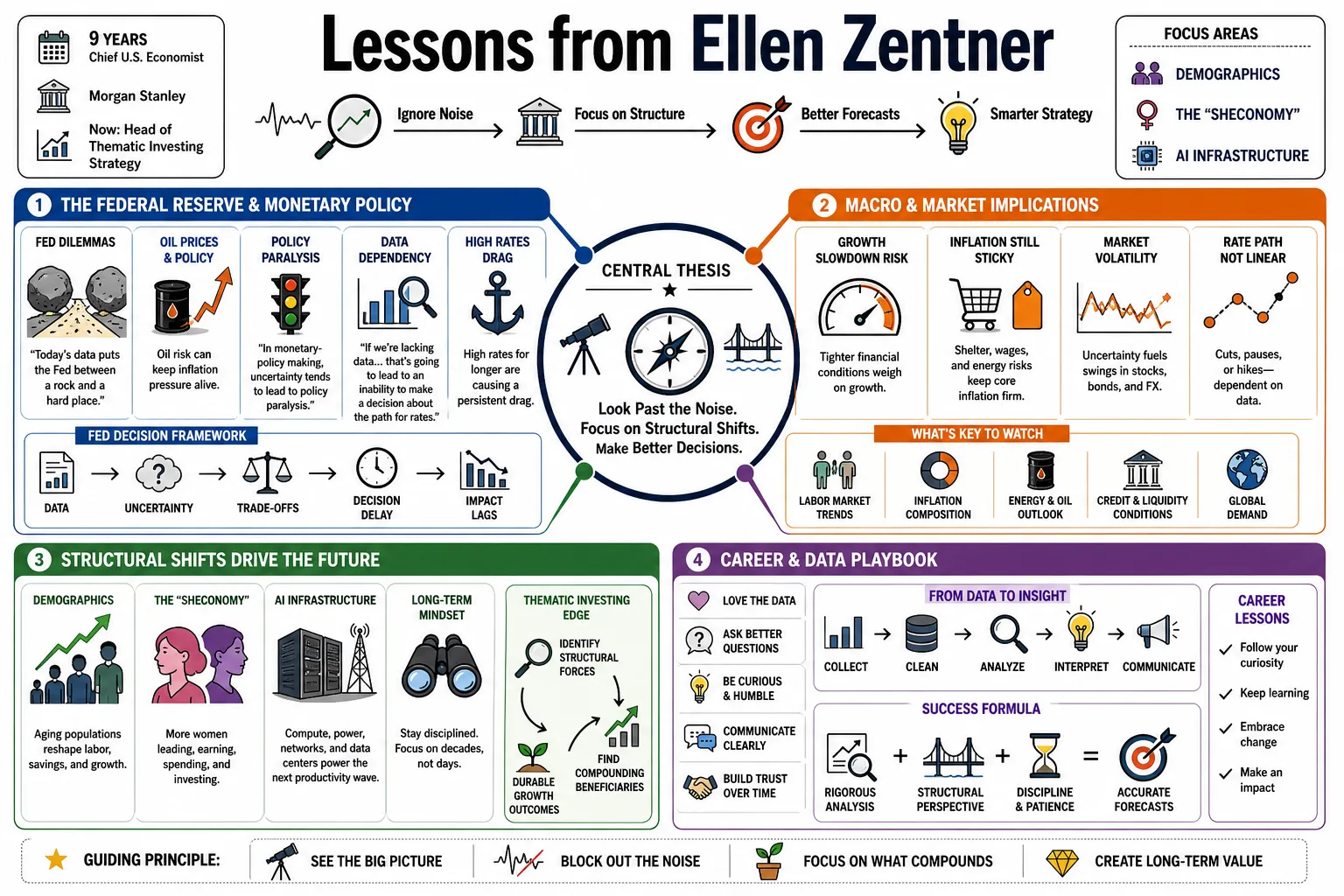
Lessons from Ellen Zentner
Ellen Zentner spent nine years as Morgan Stanley's Chief U.S. Economist before moving to head the firm's thematic investing strategy. She built her reputation for accurate forecasting by ignoring short-term market noise to focus on structural shifts like demographics, the "SHEconomy," and AI infrastructure. This collection details her approach to macroeconomic policy, consumer behavior, and building a career in data.
Part 1: The Federal Reserve & Monetary Policy
- On Fed Dilemmas: "Today's data puts the Fed between a rock and a hard place." — Source: TradingKey
- On Oil Prices and Policy: While a weakening labor market could support rate cuts, the Fed may have to stand pat due to the risk of long-term high oil prices triggering a new round of inflation. — Source: TradingKey
- On Policy Paralysis: Bloomberg's recap of Zentner's Fed interview says that when policymakers lose confidence in the incoming data, they usually default to waiting rather than forcing a rate move, especially in a shutdown-driven information blackout. — Reference: Bloomberg podcast recap of Ellen Zentner on Fed uncertainty and shutdown risk
- On Data Dependency: In Bloomberg's summary of the same interview, Zentner argues that if the Fed lacks official data it can "sink its teeth into," that missing evidence itself becomes a reason not to change the path for rates. — Reference: Bloomberg podcast recap quoting Zentner on the Fed needing official data
- On High Rates Drag: In Morgan Stanley's 2024 outlook episode, Zentner says high rates for longer are a persistent drag that pushes growth below potential, tying restrictive policy directly to a slower multi-year expansion path. — Reference: Apple Podcasts transcript of Zentner's 2024 U.S. Economic Outlook
- On Independence: The independence of the Federal Reserve is critical for long-term economic stability and ensuring that monetary policy decisions are insulated from short-term political pressures. — Source: Ritholtz
- On Early Cuts: Cutting rates prematurely runs the risk of reigniting inflationary pressures that the Fed has worked hard to suppress. — Source: Fox Business
- On Holding Patterns: Strong economic growth combined with inflation hovering above target will keep the Fed on hold until conditions decisively allow for a cut. — Source: Fox Business
- On the Cost of Money: The persistent era of higher interest rates necessitates a fundamental rethinking of how capital is allocated across the broader economy. — Source: Morgan Stanley
- On Forward Guidance: Providing clear forward guidance is challenging when incoming data continuously surprises policymakers on both the upside and downside. — Source: Fox Business
Part 2: Inflation & Prices
- On Target Deficits: "Today's data is a reminder that inflation remains well above target and growth remains solid." — Source: Fox Business
- On Market Reminders: "Today's data once again remind the market that inflation remains well above the policy target." — Source: Futu
- On Stubborn vs. Resurgent: "While 'stubborn' isn't the same as 'resurgent,' as long as oil prices remain near their four-year highs, inflation will remain front of mind in the markets and keep the Fed on the sidelines." — Source: Forbes
- On Energy Costs: Energy prices, particularly oil, play an outsized role in shaping the psychological expectations of inflation among consumers and markets alike. — Source: Forbes
- On Wage Pressures: Wage growth is a critical component of the inflation puzzle; if wages outpace productivity, it becomes much harder to return inflation to the 2% target. — Source: Morgan Stanley
- On Supply Shocks: The inflation spikes of recent years highlight the vulnerability of global supply chains and the need for greater domestic resilience. — Source: Morgan Stanley
- On Services vs. Goods: While goods inflation can correct relatively quickly as supply chains normalize, services inflation tends to be much stickier and harder to dislodge. — Source: Morgan Stanley
- On Consumer Tolerance: Consumers eventually reach a breaking point where they push back against higher prices by altering their purchasing habits, acting as a natural brake on inflation. — Source: Business Insider
- On Shelter Costs: The lag in how shelter costs are calculated means that official inflation metrics can often overstate real-time price pressures in the housing market. — Source: Ritholtz
- On Structural Inflation: Long-term structural forces like demographic shifts and deglobalization suggest that the baseline level of inflation may be higher in the future than it was in the pre-pandemic era. — Source: IIF
Part 3: The Hard Landing & Economic Cycles
- On the Inevitable Landing: "We will have a hard landing at some point. I guarantee you that. We're all wondering: When does that come?" — Source: Business Insider
- On Policy Lags: The effects of monetary tightening operate with long and variable lags, meaning the true impact of rate hikes is often felt long after the hikes have ceased. — Source: Business Insider
- On Soft Landing Probabilities: A true soft landing is historically rare because the very actions needed to slow the economy often carry too much momentum to stop precisely at the edge of recession. — Source: Business Insider
- On Resilience: The U.S. economy has displayed remarkable resilience, repeatedly defying expectations of an imminent downturn despite aggressive tightening. — Source: Morgan Stanley
- On Consumer Buffers: Excess savings accumulated during the pandemic served as a critical shock absorber, delaying the onset of a traditional economic contraction. — Source: Ritholtz
- On Corporate Balance Sheets: Many corporations locked in low interest rates before the Fed began tightening, which has insulated them from the immediate pain of higher borrowing costs. — Source: Morgan Stanley
- On the Business Cycle: Morgan Stanley's housing conversation shows Zentner treating housing as a leading cyclical signal, arguing that when housing weakens meaningfully it usually points to broader economic softness rather than an isolated sector wobble. — Reference: Morgan Stanley housing-market transcript with Ellen Zentner and James Egan
- On Recessions as Cleansing Mechanisms: While painful, recessions eventually serve a necessary function in clearing out malinvestment and reallocating resources to more productive uses. — Source: Ritholtz
- On Fiscal Support: Unprecedented government spending has altered the traditional mechanics of the business cycle, making it harder for central banks to engineer a slowdown. — Source: Morgan Stanley
- On Market Timing: Attempting to time the exact onset of a recession is a fool's errand, as the precise catalyst is usually unforeseen. — Source: Business Insider
Part 4: The Labor Market & Employment
- On Reemployment: "I want to know how long it is taking people to get reemployed once they lose a job. It's taking longer and longer." — Source: Seeking Alpha
- On Employee Leverage: "This is just not a very favorable labor market for employees, prospective employees, and it's not getting better." — Source: Seeking Alpha
- On NFP Volatility: "If economists get this month's NFP number right, it was probably an accident." — Source: Ritholtz
- On Benefit Disincentives: "It appears that generous unemployment benefits are likely no more of a factor than other impediments, including childcare, transportation and health concerns, to workplace re-entry." — Source: Forbes
- On Disentangling Factors: "Stripping out the disincentive effect of unemployment benefits on the labor market recovery is not simple." — Source: Forbes
- On Lower-Wage Workers: "Faster employment and wage growth for those at the bottom... would help lift consumer spending, the biggest part of the economy." — Source: American Progress
- On Labor Hoarding: Companies have engaged in labor hoarding, holding onto workers despite economic uncertainty due to the intense difficulty they faced in hiring post-pandemic. — Source: Morgan Stanley
- On Remote Work: The shift to remote and hybrid work models has permanently altered labor force participation dynamics, particularly for women and caregivers. — Source: St. Louis Fed
- On Participation Rates: A rising labor force participation rate is one of the most effective ways to organically cool wage inflation without destroying jobs. — Source: Morgan Stanley
Part 5: Housing & Real Estate
- On Housing and the Cycle: "Housing is also a really interest rate sensitive sector, so you know, I like to say as goes housing, so goes the business cycle." — Source: Morgan Stanley
- On Renting vs. Owning: In Morgan Stanley's housing transcript, Zentner says the buy-versus-rent shift is partly about households still wanting single-family space, with rentership preserving some of the square-footage demand even when ownership is out of reach. — Reference: Morgan Stanley housing-market transcript on single-family renting and square footage
- On the Lock-In Effect: Current homeowners are effectively locked into their properties by the low mortgage rates they secured years ago, severely constraining existing home inventory. — Source: Morgan Stanley
- On New Construction: The lack of existing home inventory has forced prospective buyers into the new construction market, artificially buoying homebuilder confidence. — Source: Morgan Stanley
- On Affordability: Business Insider's interview with Zentner says housing affordability remained historically low even as conditions stabilized, with mortgage rates, prices, and incomes still constraining how quickly activity could recover. — Reference: Business Insider interview on Zentner's housing affordability outlook
- On Wealth Generation: The inability of younger generations to access homeownership threatens a traditional and vital pathway to wealth accumulation in the United States. — Source: Ritholtz
- On Demographic Demand: Millennials entering their prime home-buying years guarantee a baseline level of demographic demand for housing, regardless of where interest rates sit. — Source: Morgan Stanley
- On Regional Divergence: The national housing market masks severe regional disparities, as migration patterns drastically reshape demand in the Sunbelt versus coastal cities. — Source: Morgan Stanley
- On Commercial Real Estate: The commercial real estate sector faces a painful, long-term adjustment period as property valuations slowly reflect higher capitalization rates and shifting work habits. — Source: Morgan Stanley
Part 6: The "SHEconomy" & Demographics
- On the Power of the SHEconomy: The rising economic power of women—through increased earnings and wealth control—is fundamentally reshaping capital flows and long-term financial priorities. — Source: Morgan Stanley
- On Financial Independence: Morgan Stanley's SHEconomy research says women are contributing more household income, acting as primary breadwinners more often, and controlling a larger share of consumer spending, which supports a more independent wealth-building role. — Reference: Morgan Stanley SHEconomy research on women's income and spending power
- On Healthcare Demographics: The aging population and increasing longevity represent a long-duration investment theme with massive implications for healthcare spending and financial planning. — Source: Commercial Observer
- On the Silver Tsunami: The retirement of the Baby Boomer generation will continue to constrain labor supply while simultaneously driving a massive intergenerational wealth transfer. — Source: Morgan Stanley
- On Consumer Preferences: As women control a larger share of household wealth, investment capital will naturally flow toward sectors that align with their distinct consumer preferences and values. — Source: Morgan Stanley
- On Policy Impacts: Demographic shifts mean that macroeconomic policy must increasingly account for an older, less labor-active population. — Source: NABE
- On the Care Economy: The demand for both childcare and eldercare is an unresolved structural bottleneck that limits economic output by keeping potential workers on the sidelines. — Source: St. Louis Fed
- On Longevity Risk: Investors must increasingly plan for the "longevity risk" of outliving their assets, requiring more sophisticated, long-term thematic investment strategies. — Source: Morgan Stanley
- On Changing Demographics: You cannot understand the future trajectory of consumer spending without first understanding the changing demographic composition of the consumer base. — Source: Morgan Stanley
Part 7: AI & Thematic Investing
- On Thematic Frameworks: Thematic investing succeeds when it identifies long-term trends backed by policy demand and structural, binding constraints. — Source: Morgan Stanley
- On Generative AI: The diffusion of artificial intelligence will have profound implications for economic productivity, potentially offsetting the drag of demographic decline. — Source: Morgan Stanley
- On the AI Value Chain: The most immediate economic impact of AI is not in the software itself, but in the massive physical infrastructure and energy requirements needed to support its development. — Source: Morgan Stanley
- On Resource Nationalism: The geopolitical shift toward "resource nationalism" means that securing critical supply chains is now a dominant theme for corporate capital expenditure. — Source: Morgan Stanley
- On Energy Demand: The energy needs of the AI revolution will force a reevaluation of power grid capacity and the speed of the transition to renewable energy sources. — Source: Morgan Stanley
- On Secular Trends: In her Masters in Business transcript, Zentner describes housing as a longer-run structural theme that can still fall in and out of favor cyclically, reinforcing the need to separate durable secular demand from short-term macro swings. — Reference: Ritholtz transcript of Ellen Zentner on housing as a structural theme with cyclical setbacks
- On the US-China AI Race: The technological competition between the U.S. and China is a structural economic reality that will dictate global capital flows for a generation. — Source: Morgan Stanley
- On Infrastructure Investment: The necessity of rebuilding aging infrastructure, combined with the demands of new technology, guarantees a sustained cycle of fixed investment. — Source: Morgan Stanley
- On Identifying Constraints: The best thematic investments are often found by identifying the bottlenecks in the global economy and investing in the companies tasked with solving them. — Source: Morgan Stanley
Part 8: Career Advice & Forecasting Realities
- On Working Hard: "I realized that keeping your head down and working hard was not going to get you that far, because you need to get recognized for that." — Source: St. Louis Fed
- On Career Misconceptions: "We go into our careers believing that if you work hard, keep your head down, work hard, nose to the grind, that you will be recognized and you will move ahead, and that [is not always the case]." — Source: St. Louis Fed
- On Visibility: High-quality work only translates into career advancement if you are willing to advocate for yourself and ensure your contributions are visible to decision-makers. — Source: St. Louis Fed
- On Mentorship: Cultivating strong relationships and finding mentors who will speak for you in closed rooms is as critical as mastering the technical aspects of your job. — Source: St. Louis Fed
- On Forecasting Humility: Economic forecasting is inherently flawed; the goal is not perfect precision, but providing a rigorously defensible framework for decision-making. — Source: Ritholtz
- On Data Integrity: Zentner's Masters in Business transcript says economists have to watch response rates, shutdown disruptions, and collection quality closely, because weakening survey integrity can distort the labor-market story before the revisions arrive. — Reference: Ritholtz transcript of Ellen Zentner on BLS data integrity and response rates
- On Being Wrong: The mark of a good economist is the willingness to update one's priors immediately when the incoming facts contradict the established forecast. — Source: Ritholtz
- On Communicating Complexity: Morgan Stanley's profile of Zentner explicitly frames her work as translating a complex economic picture into early, usable market signals for investors, which is the practical craft behind strong macro communication. — Reference: Morgan Stanley overview of Ellen Zentner translating economics for investors
- On the Economics Profession: Increasing diversity within the economics profession is not just a social goal, but an intellectual necessity to prevent groupthink and widen the lens of research. — Source: St. Louis Fed