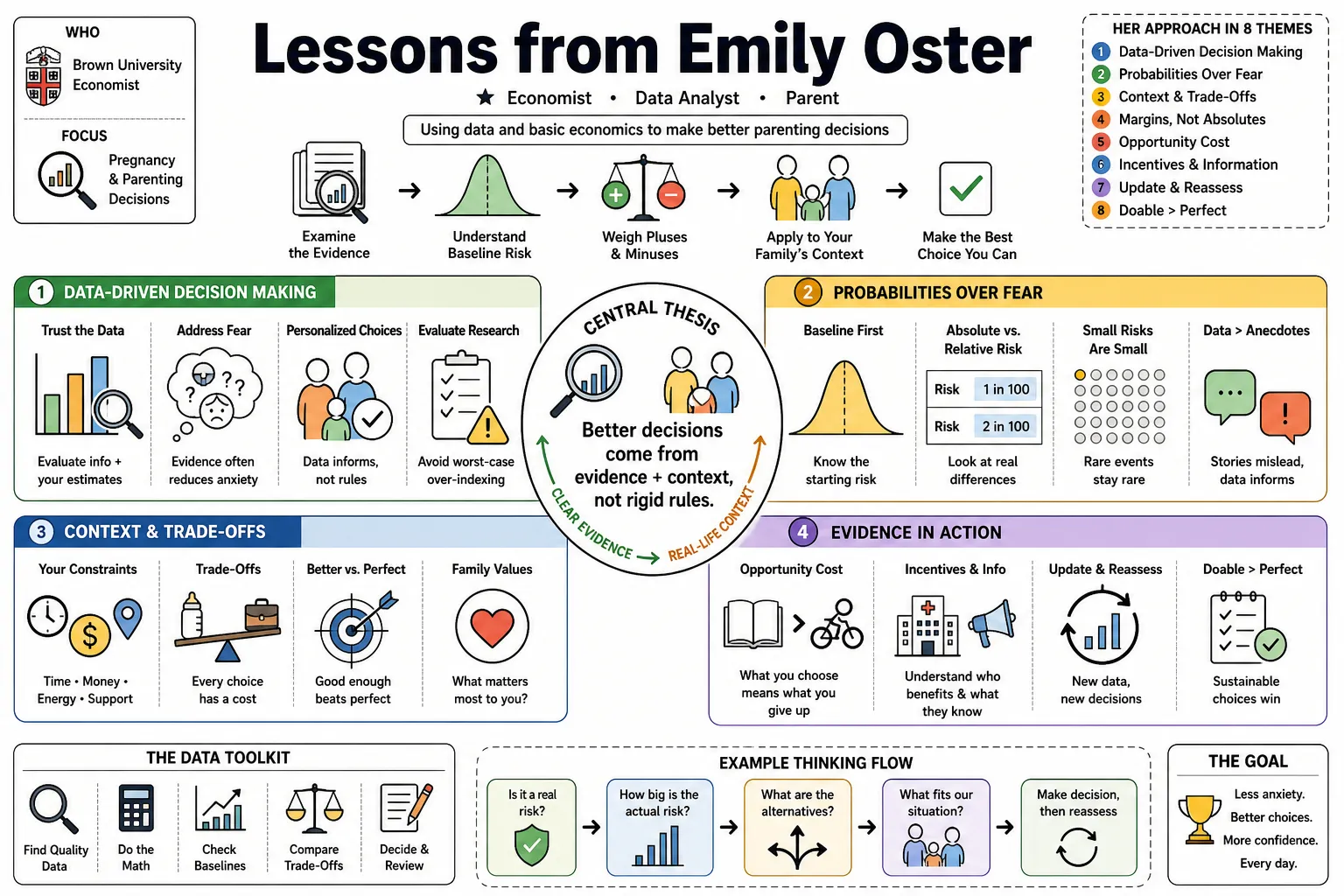
Lessons from Emily Oster
Brown University economist Emily Oster applies data analysis to the daily decisions of pregnancy and parenting. She argues that much of standard parenting advice relies on flawed research, and suggests parents weigh probabilities against their family's actual constraints rather than following rigid rules. This profile organizes her approach into eight themes, offering a practical guide to cutting through parental anxiety with clear evidence and basic economics.
Part 1: Data-Driven Decision Making
- On trusting data: "The key to good decision making is evaluating the available information—the data—and combining it with your own estimates of pluses and minuses." — Source: [Expecting Better]
- On addressing fear: "Using evidence to evaluate risk often reveals that common parental anxieties are based on flawed or outdated studies rather than sound methodology." — Source: [ParentData]
- On personalized choices: "Data is a tool to inform choices, not a universal rulebook; the right choice for one family may not be the right choice for another." — Source: [Cribsheet]
- On evaluating research: "Many medical recommendations over-index on worst-case scenarios rather than presenting parents with the baseline probability of an outcome." — Source: [Expecting Better]
- On the "why" of advice: "We know being a parent means getting a lot of advice, but this advice is almost never accompanied by an explanation of why something is true... we remove people's ability to think about these choices." — Source: [ParentData]
- On anecdotal evidence: "Trust the data, not anecdotes, when making parenting decisions." — Source: [Cribsheet]
- On navigating studies: "Correlation does not equal causation, which is why it is essential to distinguish between randomized trials and observational studies in parenting research." — Source: [The Family Firm]
- On imperfect information: "Sometimes the data is simply inconclusive, and in those cases, parents must rely on their own values and constraints." — Source: [ParentData]
- On medical paternalism: "Doctors sometimes simplify rules because they fear patients will misinterpret nuance, but this denies parents the agency to make informed choices." — Source: [Expecting Better]
Part 2: Pregnancy and Autonomy
- On maternal capability: "I'm not crazy about the implication that pregnant women are incapable of deciding for themselves... That feels, again, like pregnant women are not given any more credit than children." — Source: [Expecting Better]
- On the rules of pregnancy: "In reality, pregnancy medical care seemed to be one long list of rules. In fact, being pregnant was a lot like being a child again." — Source: [Expecting Better]
- On restrictive advice: "The concern... is that if you tell people they can have a glass of wine, they'll have 3... Better to say you can't have any, as that rule is easy to understand." — Source: [Expecting Better]
- On caffeine consumption: "Evidence suggests that moderate caffeine intake during pregnancy does not carry the severe risks often communicated by strict guidelines." — Source: [Expecting Better]
- On food restrictions: "When evaluating food risks like deli meat or sushi, it is more useful to look at the actual incidence rates of listeria or salmonella than to follow blanket bans." — Source: [Expecting Better]
- On alcohol in moderation: "The data on light drinking during pregnancy does not support the absolute zero-tolerance policy standard in the US medical community." — Source: [Expecting Better]
- On weight gain: "Guidelines on maternal weight gain during pregnancy are often overly rigid and fail to account for individual metabolic differences and starting weights." — Source: [Expecting Better]
- On birth plans: "A birth plan is less of a binding contract and more of a framework for communicating preferences while acknowledging the unpredictability of labor." — Source: [Expecting Better]
- On postpartum recovery: "The physical toll of pregnancy and birth is routinely under-discussed, leaving many women unprepared for the realities of the fourth trimester." — Source: [The Unexpected]
Part 3: Navigating Early Childhood
- On childhood illness: "Kids younger than school age get an average of six to eight colds a year... So in the winter, on average, your kid will have a cold 50 percent of the time." — Source: [Cribsheet]
- On breastfeeding: "For some women, breastfeeding makes them feel empowered and happy... For others, breastfeeding makes them feel like a cow." — Source: [Cribsheet]
- On sleep training: "Studies consistently show that sleep training methods, such as the Ferber method, do not cause long-term psychological harm and often improve maternal mental health." — Source: [Cribsheet]
- On toddler discipline: "First, recognize that children are not adults, and you usually cannot improve their behavior with a discussion... Toddler discipline is, really, parental discipline." — Source: [ParentData]
- On language acquisition: "There is a wide range of normal when it comes to early childhood milestones, and comparing one toddler's vocabulary to another is rarely productive." — Source: [Cribsheet]
- On potty training: "The data does not point to one superior method or timeline for toilet training; success depends mostly on the child's readiness." — Source: [Cribsheet]
- On screen time: "If the alternative to an hour of TV is a frantic and unhappy parent yelling at their kid for an hour, there is good reason to think the TV might actually be better." — Source: [Cribsheet]
- On picky eating: "Forcing children to eat specific foods is generally less effective than repeatedly exposing them to variety without pressure." — Source: [Cribsheet]
- On childcare choices: "Whether a child is in daycare, with a nanny, or cared for by a stay-at-home parent, long-term outcomes are remarkably similar as long as the environment is safe and loving." — Source: [Cribsheet]
- On parental presence: "Being present and happy with your kids is more important than, say, worrying about bees." — Source: [Cribsheet]
Part 4: Managing the Family Firm
- On structured households: "Good household decision-making often relies on thinking about your household like a firm." — Source: [The Family Firm]
- On logistics and joy: "We can make the logistics of our lives run better, and we can leave more time for fun." — Source: [The Family Firm]
- On deliberate decision-making: "The Four Fs framework (Frame the Question, Fact-Find, Final Decision, Follow-Up) helps prevent endless debate over household choices." — Source: [The Family Firm]
- On defining the question: "Moving from a vague anxiety to a specific, answerable question is the first step to finding clarity in family scheduling." — Source: [The Family Firm]
- On gathering evidence: "Fact-finding requires separating a child's actual needs from the logistical demands of an activity." — Source: [The Family Firm]
- On setting a meeting: "Final decisions should be made during a dedicated time, rather than in passing during a stressful evening transition." — Source: [The Family Firm]
- On reviewing choices: "Scheduling a follow-up date to evaluate a decision prevents families from feeling permanently locked into a choice that isn't working." — Source: [The Family Firm]
- On communicating with partners: "The message here is basically, ‘I love you a whole lot. And I still want you to update the household Asana tasks.’" — Source: [The Family Firm]
- On core values: "Before addressing the budget or the calendar, a family must explicitly write down what they value most, whether that is unstructured time, athletics, or daily family dinners." — Source: [The Family Firm]
Part 5: Valuing Parental Well-Being
- On centering parents: "So before you even get into reading what the evidence says is 'best' for your child... you—and your partner... should think about what you would really like to do." — Source: [Cribsheet]
- On maternal mental health: "A mother's well-being directly affects a child's environment, meaning self-care is a practical necessity, not a selfish luxury." — Source: [Cribsheet]
- On valid reasoning: "'This is the lifestyle I prefer' or 'This is what works for my family' are both okay reasons to make choices!" — Source: [Cribsheet]
- On letting go of guilt: "There will be many times that you need to just trust that if you're doing your best, that's all you can do." — Source: [Cribsheet]
- On the illusion of perfect parenting: "The idea that there is a single optimal way to raise a child creates unnecessary anxiety and sets parents up for inevitable failure." — Source: [ParentData]
- On sleep deprivation: "Prioritizing parental sleep is one of the most effective ways to improve a family's overall emotional climate." — Source: [Cribsheet]
- On external judgment: "Much of the stress of parenting comes not from the children themselves, but from the perceived judgment of other parents and society." — Source: [Expecting Better]
- On the "Second Best" solution: "In many parenting scenarios, the theoretical first best is practically impossible; embracing the second best is a hallmark of sustainable parenting." — Source: [ParentData]
- On reducing anxiety: "At the end, let's raise a glass to using data where it's useful, to making the right decisions for our families, to doing our best, and—sometimes—to just trying not to think about it." — Source: [Cribsheet]
- On trusting yourself: "Parents usually know their own children and constraints better than any expert, making their localized intuition highly valuable." — Source: [ParentData]
Part 6: Education and Extracurriculars
- On overscheduling: "The marginal benefit of adding a third or fourth extracurricular activity rarely outweighs the cost it imposes on family downtime and stress." — Source: [The Family Firm]
- On homework: "In the early school years, the data suggests that homework has very little impact on long-term academic achievement." — Source: [The Family Firm]
- On school readiness: "Redshirting a child before kindergarten may offer short-term advantages in maturity, but those differences typically fade by middle school." — Source: [The Family Firm]
- On reading development: "Children learn to read at wildly different paces, and late bloomers frequently catch up to early readers without intervention." — Source: [The Family Firm]
- On choosing schools: "When selecting a school, parents should weigh logistical factors like the commute and start times just as heavily as test scores, because daily stress impacts learning." — Source: [The Family Firm]
- On sleep and school: "Adequate sleep is highly correlated with academic performance and emotional regulation in school-aged children." — Source: [The Family Firm]
- On quitting activities: "Allowing a child to quit a sport or instrument mid-season is sometimes the optimal choice if the activity is actively draining the family's happiness." — Source: [The Family Firm]
- On peer influence: "As children enter school, the influence of their peer group begins to rival parental influence, requiring parents to shift from managers to consultants." — Source: [The Family Firm]
- On summer breaks: "Unstructured summer downtime is often just as developmentally beneficial as highly programmed academic or athletic camps." — Source: [The Family Firm]
Part 7: Navigating Risk and Uncertainty
- On the baseline of risk: "Life with children inherently involves risk; the goal is not to eliminate risk entirely, but to manage it intelligently based on probabilities." — Source: [Expecting Better]
- On public health trade-offs: "School closures during the pandemic highlighted how policymakers often failed to weigh the certain educational costs against the probabilistic health risks." — Source: [ParentData]
- On evaluating safety guidelines: "Safety recommendations frequently bundle sensible precautions with extreme edge-case protections, making it hard for parents to parse what actually matters." — Source: [Cribsheet]
- On fear-based marketing: "The parenting industry often monetizes anxiety by selling products designed to prevent highly unlikely negative outcomes." — Source: [Cribsheet]
- On physical risks: "Allowing children to engage in risky play, such as climbing or using tools, helps them develop physical competence and assess their own limits." — Source: [The Family Firm]
- On worst-case scenarios: "Dwelling on worst-case scenarios is a cognitive trap that prevents parents from making rational decisions based on the most likely outcomes." — Source: [Expecting Better]
- On pregnancy complications: "Having access to accurate statistics about miscarriage and complication rates can actually reduce anxiety by replacing unknown fears with concrete numbers." — Source: [Expecting Better]
- On conflicting studies: "When two studies contradict each other, it is useful to check the sample size and methodology before changing a family routine." — Source: [ParentData]
- On public policy: "Parenting choices are often constrained by a lack of societal support, meaning individual data-driven decisions must compensate for systemic failures." — Source: [The Unexpected]
- On accepting uncertainty: "No amount of data can predict the future; part of using data correctly is accepting its limits." — Source: [The Family Firm]
Part 8: The Economics of Parenting
- On opportunity cost: "Every parenting decision has an opportunity cost; an hour spent driving to a specialized class is an hour not spent resting or connecting at home." — Source: [The Family Firm]
- On return on investment: "The effort parents put into hyper-managing early childhood development often yields diminishing returns compared to providing a stable, affectionate environment." — Source: [Cribsheet]
- On division of labor: "Applying comparative advantage to household chores by assigning tasks based on who can do them most efficiently reduces marital friction." — Source: [The Family Firm]
- On budgeting time: "Time is a family's most constrained resource, and it should be budgeted as strictly and intentionally as household finances." — Source: [The Family Firm]
- On the cost of perfection: "Pursuing the absolute perfect choice often costs more in mental energy than the incremental benefit the choice provides." — Source: [ParentData]
- On maternal workforce participation: "The data shows that children of working mothers fare just as well academically and emotionally as children of stay-at-home mothers." — Source: [Cribsheet]
- On the Mom Tax: "Society frequently levies an invisible emotional and administrative tax on mothers, which requires deliberate, structural renegotiation within the home to fix." — Source: [The Family Firm]
- On sunk costs: "If a parenting strategy or schedule isn't working, families must be willing to abandon it regardless of how much time or money was already invested." — Source: [The Family Firm]
- On utility maximization: "Ultimately, the goal of family economics is utility maximization—structuring life in a way that generates the greatest possible happiness for the whole family unit." — Source: [The Family Firm]