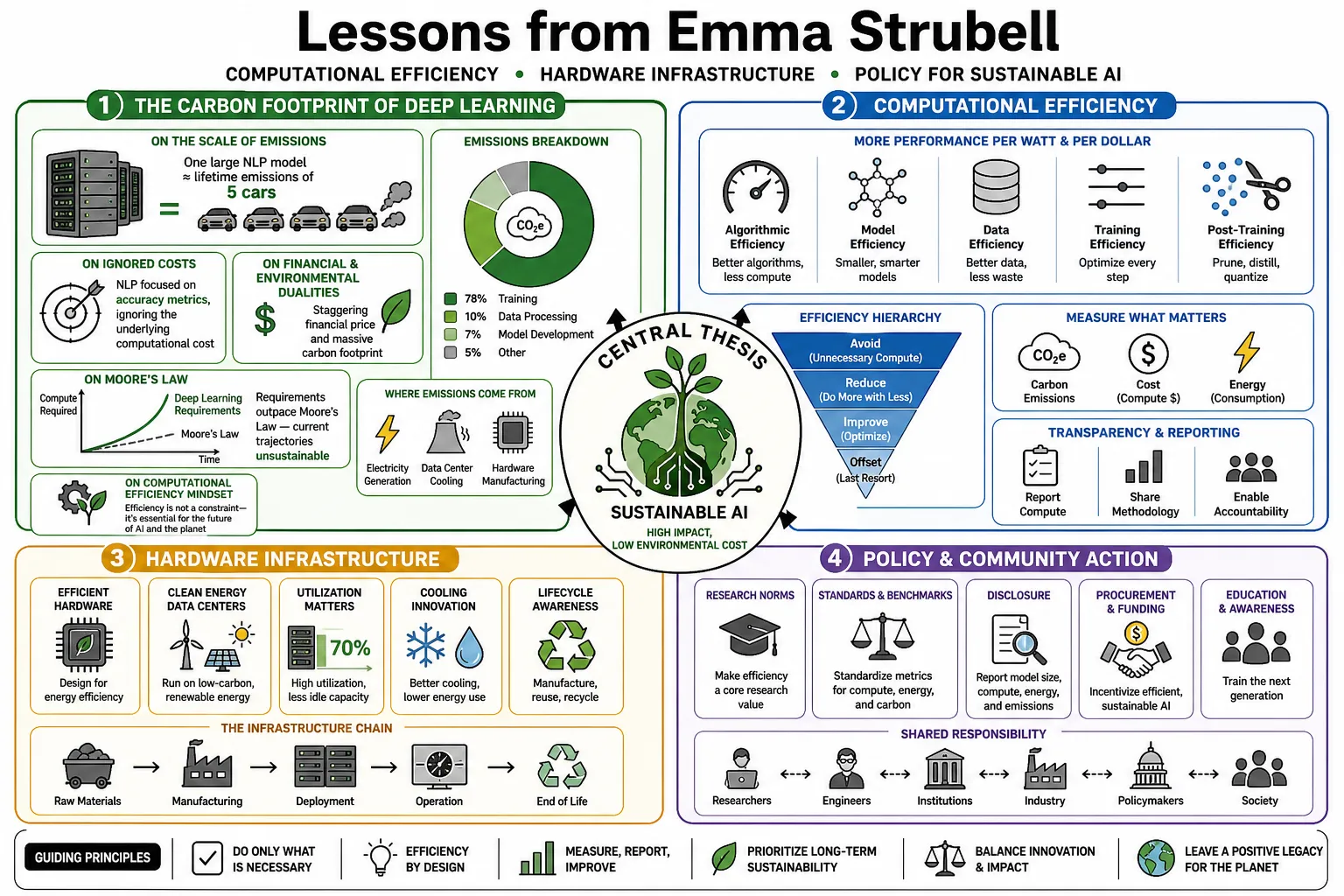
Lessons from Emma Strubell
Emma Strubell is a Carnegie Mellon University computer scientist whose work spans natural-language processing, computational efficiency, and AI’s environmental impacts. Her coauthored research has measured energy and emissions from training, development, and deployment, while arguing for better reporting and broader access to compute. These lessons revisit those published studies and direct interviews without treating estimated impacts as universal constants. — Emma Strubell — Research.
Part 1: The Carbon Footprint of Deep Learning
- Scale the Comparison Correctly: Strubell and coauthors estimated very large emissions for a 2019 neural-architecture-search process; the often-repeated five-car comparison was not the footprint of one ordinary final training run, and its assumptions were later disputed. — Mystery AI Hype Theater — Strubell Interview.
- Count Compute Alongside Accuracy: The 2019 study argues that model improvements should be evaluated against the compute and environmental costs required to achieve them, not accuracy alone. — ACL 2019 — Energy and Policy Considerations for Deep Learning in NLP.
- Track Financial and Carbon Costs: Large NLP training and development can carry both cloud-compute expenses and emissions from electricity use; the study estimated each rather than treating compute as free. — ACL 2019 — Energy and Policy Considerations for Deep Learning in NLP.
- Recognize Growth in Compute Demand: The authors describe a shift toward specialized accelerators and growing compute requirements, which can restrict who can afford state-of-the-art research. — AAAI 2020 — Modern Deep Learning Research.
- Make Cloud Emissions Visible: Cloud users need access to reliable energy and location-specific carbon data to choose lower-emission compute; provider opacity otherwise limits informed decisions. — FAccT 2022 — Carbon Intensity of AI in Cloud Instances.
- Evaluate the Full Lifecycle: Strubell emphasizes that development, final training, deployment, hardware production, and other lifecycle stages differ in both scale and frequency; one headline estimate cannot represent all of them. — Mystery AI Hype Theater — Strubell Interview.
- Understand Why NLP Uses Compute: The 2019 study ties NLP accuracy gains to large models, abundant data, and specialized hardware, while measuring the resulting resource demand. — ACL 2019 — Energy and Policy Considerations for Deep Learning in NLP.
- Include Architecture Search: Neural architecture search can require many training trials; the study estimated its compute and emissions separately from training a selected model once. — ACL 2019 — Energy and Policy Considerations for Deep Learning in NLP.
- Distinguish Scale From Efficiency: Strubell cautions that making hardware or software more efficient need not lower total energy demand if cheaper, more capable AI is used more widely. — Marketplace — Emma Strubell Interview.
- Measure What Cloud Computing Hides: An emissions estimate should state the hardware, electricity assumptions, and missing data; Strubell notes that her 2019 table left TPU emissions blank because power data were unavailable. — Mystery AI Hype Theater — Strubell Interview.
Part 2: Hardware and Infrastructure
- Count Hardware Production: AI impact extends beyond electricity during training: hardware manufacturing and related material use belong in a lifecycle assessment, although exact vendor data remain limited. — ICLR 2025 — Environmental Impact of Creating Language Models.
- Account for Water: A Strubell-coauthored model-series study measured water use as well as carbon; cooling, power generation, and manufacturing assumptions affect any estimate. — ICLR 2025 — Environmental Impact of Creating Language Models.
- Test End-to-End Hardware Gains: Faster accelerators or fewer FLOPs do not automatically make inference faster in practice; framework bottlenecks can absorb expected efficiency gains. — EMNLP 2023 — The Framework Tax.
- Consider Hardware Lifetimes: A Strubell-coauthored sustainable-computing vision calls for longer-lived, reused, and recycled hardware instead of assuming frequent refreshes are environmentally free. — Carbon Connect — Sustainable Computing.
- Choose Regions by Grid Emissions: In a cloud study, data-center region substantially changed operational carbon intensity for comparable workloads; choosing a lower-intensity grid can reduce emissions. — FAccT 2022 — Carbon Intensity of AI in Cloud Instances.
- Do Not Confuse PUE With Total Impact: Power-usage effectiveness adjusts for data-center overhead, but a full model footprint must also include workload energy, grid intensity, and lifecycle stages. — ICLR 2025 — Environmental Impact of Creating Language Models.
- Include Embodied Emissions Without Guessing Their Ratio: Hardware manufacture creates embodied emissions, but proprietary data and amortization assumptions make their share uncertain; it should be estimated and disclosed, not assumed to exceed operations. — ICLR 2025 — Environmental Impact of Creating Language Models.
- Measure Actual Utilization: Power draw varies throughout a training run; Strubell and coauthors measured it over time rather than assuming hardware always operates at its rated maximum. — ICLR 2025 — Environmental Impact of Creating Language Models.
- Ask Vendors for Lifecycle Data: Strubell notes that hardware materials, manufacturing emissions, and water use are difficult to audit when vendors do not disclose underlying data. — Mystery AI Hype Theater — Strubell Interview.
Part 3: Model Efficiency and Optimization
- Prioritize Efficient Algorithms: The 2019 paper asks researchers to pursue efficient algorithms and hardware alongside accuracy gains, including better alternatives to brute-force tuning. — ACL 2019 — Energy and Policy Considerations for Deep Learning in NLP.
- Compare Smaller Models Fairly: Compression research coauthored by Strubell treats a smaller model trained on a limited budget as a serious baseline, rather than assuming a larger compressed model always wins. — Just CHOP — LLM Compression.
- Count the Tuning Runs: A single final training run understates development cost: the paper logged thousands of jobs in one NLP research case study and recommends reporting sensitivity to hyperparameters. — ACL 2019 — Energy and Policy Considerations for Deep Learning in NLP.
- Test Distillation, Do Not Assume It Wins: In the tested 7B-model compression setting, simple structured pruning with continued training outperformed distillation-augmented variants; efficiency depends on method and scale. — Just CHOP — LLM Compression.
- Prefer Deployment-Efficient Structure: The coauthored compression study found structured layer pruning could improve inference efficiency in its tested models; sparsity alone is not a guarantee of a cheaper deployment. — Just CHOP — LLM Compression.
- Account for Compression Work: Pruning can reduce deployment cost, but the compression procedure itself includes further training; compare total costs and performance against smaller-model baselines. — Just CHOP — LLM Compression.
- Replace Brute-Force Tuning: The 2019 paper suggests software support for random or Bayesian hyperparameter search as an alternative to costly grid search; it does not quantify a universal benefit from aggressive early stopping. — ACL 2019 — Energy and Policy Considerations for Deep Learning in NLP.
- Evaluate Data Mixtures Efficiently: A Strubell-coauthored study found that training-data composition affects downstream results and tested reusable model components to make comparisons of candidate mixtures cheaper. — EMNLP 2024 — Scalable Data Ablation.
- Compare Training and Inference by Use Case: Inference can become an important lifecycle cost when a model serves many requests; the balance with training depends on deployment volume and hardware, not a universal rule. — ICLR 2025 — Environmental Impact of Creating Language Models.
Part 4: Measuring and Reporting Emissions
- Report More Than the Final Run: Researchers should report training time, resources, and hyperparameter sensitivity so others can judge costs and compare methods; final-run accuracy alone is incomplete. — ACL 2019 — Energy and Policy Considerations for Deep Learning in NLP.
- Make Review Requests Cost-Aware: In a coauthored NLP-community survey, some respondents reported peer-review requests for experiments too expensive to run; the authors recommend justifying such requests. — Compute-Hungry NLP Research — Survey.
- Use Measurement Tools With Scope Disclosed: Cloud-carbon tools can combine workload power with time- and location-specific grid intensity, but estimates limited to one instance or GPU omit some overhead. — FAccT 2022 — Carbon Intensity of AI in Cloud Instances.
- Acknowledge Measurement Gaps: Cloud providers do not always expose the operational data needed for precise estimates; Strubell’s later work calls for direct measurements and explicit assumptions. — FAccT 2022 — Carbon Intensity of AI in Cloud Instances.
- Use Time-Specific Grid Signals: The coauthored cloud study uses time- and location-specific marginal emissions data to help decide when and where to run workloads. — FAccT 2022 — Carbon Intensity of AI in Cloud Instances.
- Include Failed Development Runs: A lifecycle estimate should include experimentation, hyperparameter searches, and failed runs before final training; the 2025 study found these materially affected its own model series. — ICLR 2025 — Environmental Impact of Creating Language Models.
- Review Gains Against Resource Costs: Strubell’s coauthored work calls for cost-benefit comparisons of model accuracy and computation, while a later survey urges reviewers to justify expensive extra experiments. — ACL 2019 — Energy and Policy Considerations for Deep Learning in NLP.
- Show Energy Alongside Performance: The coauthored AI Energy Star proposal would benchmark energy for different tasks and models so users could compare efficiency as well as capability. — Nature — AI Energy Ratings.
- Share Reusable Research Artifacts: A coauthored survey found strong support for sharing models, code, and smaller versions to improve access and reproducibility; it did not measure a universal emissions saving from openness. — Compute-Hungry NLP Research — Survey.
Part 5: Accessibility and Democratization
- Widen Access to Compute: The 2019 paper argues that the price of large-scale computation excludes some academic researchers from experiments their ideas require. — ACL 2019 — Energy and Policy Considerations for Deep Learning in NLP.
- Avoid a Simple Academia–Industry Divide: Large compute budgets can concentrate research power, but a later coauthored survey found substantial disparities *within* sectors, not a statistically significant blanket industry-versus-academia gap. — Compute-Hungry NLP Research — Survey.
- Release Smaller Model Options: A coauthored community survey reports broad support for releasing smaller pretrained versions so researchers with limited hardware can still study them. — Compute-Hungry NLP Research — Survey.
- Recognize Unequal Research Options: Compute scarcity can prevent some researchers from running experiments; a coauthored survey found concentrated GPU access and many respondents unable to test work for lack of resources. — Compute-Hungry NLP Research — Survey.
- Pool Academic Computing: The 2019 paper proposes shared, publicly supported academic compute resources as one way to reduce unequal access. — ACL 2019 — Energy and Policy Considerations for Deep Learning in NLP.
- Value Lightweight Models: The coauthored survey recommends releasing smaller pretrained models for access and reproducibility, without asserting an unsupported ninety-percent-performance/ten-percent-cost ratio. — Compute-Hungry NLP Research — Survey.
- Take Student Resource Limits Seriously: The survey found that students were among groups most affected by limited compute and struggled to reproduce large-model research. — Compute-Hungry NLP Research — Survey.
- Design for Deployment Constraints: The coauthored compression study tests structured pruning to reduce inference burden; a deployment-efficient model must be measured on the hardware and task where it will run. — Just CHOP — LLM Compression.
- Make Reproduction Feasible: The compute-access survey links reproducibility barriers to unavailable hardware and advocates shared artifacts and smaller models. — Compute-Hungry NLP Research — Survey.
Part 6: AI Policy and Regulation
- Consider Policy Beyond Voluntary Choices: A Strubell-coauthored comment argues that governments could eventually regulate AI deployment efficiency and develop shared standards, after voluntary energy disclosure and benchmarking. — Nature — AI Energy Ratings.
- Make Commercial Emissions Accountable: The coauthored energy-ratings proposal asks commercial deployers to demand energy-efficient models and public consumption data, creating incentives beyond voluntary research reporting. — Nature — AI Energy Ratings.
- Support Independent Energy Tracking: The coauthored policy comment suggests independent authorities could track changes in AI energy use; it does not assert that a specific auditing body already verifies model claims. — Nature — AI Energy Ratings.
- Work Toward Comparable Standards: Strubell and coauthors argue that transparent energy benchmarks and global standards would help compare AI systems across applications and jurisdictions. — Nature — AI Energy Ratings.
- Disclose Actionable Grid Data: The coauthored cloud study argues that providers should reveal instance-level energy and location-specific carbon intensity to users; its recommendation does not specify a particular new law. — FAccT 2022 — Carbon Intensity of AI in Cloud Instances.
- Make Energy Use Legible: Energy ratings could help users understand model consumption and choose among systems; the coauthored proposal identifies a public-information gap without claiming policymakers are generally ignorant. — Nature — AI Energy Ratings.
- Treat Demand Growth as a Policy Problem: The coauthored comment urges regulators, developers, and users to address AI energy growth rather than assume efficiency improvements alone will neutralize demand. — Nature — AI Energy Ratings.
Part 7: Sustainable NLP Practices
- Ask if Small Gains Merit Large Costs: The 2019 study recommends comparing accuracy improvements with training and tuning costs before repeating expensive experiments. — ACL 2019 — Energy and Policy Considerations for Deep Learning in NLP.
- Distinguish Pretraining From Repeated Adaptation: A coauthored BERT study finds each fine-tuning run cheaper than pretraining, but many repeated fine-tunes add to aggregate energy use; one method is not always the answer. — EMNLP 2023 — Fine-Tuning BERT Energy.
- Expand Evaluation Beyond Accuracy: Strubell and coauthors recommend comparing model accuracy with computational resources, and later proposed task-level energy ratings for deployed models. — AAAI 2020 — Modern Deep Learning Research.
- Measure Real Deployment Latency: The coauthored framework-tax study shows that FLOP or accelerator-throughput gains can fail to improve end-to-end latency because software frameworks add bottlenecks. — EMNLP 2023 — The Framework Tax.
- Study Data Composition, Not Just Volume: The coauthored ablation study found that data-mixture choices affect downstream performance and devised a cheaper way to compare them; it does not prove more data is always worse. — EMNLP 2024 — Scalable Data Ablation.
- Collaborate Across Disciplines: Carbon Connect calls for computer scientists to work with economics, law, and industrial ecology to align computing design with environmental goals. — Carbon Connect — Sustainable Computing.
- Schedule Around Carbon Intensity: In the coauthored cloud study, time of day affects operational carbon intensity, making scheduling a possible mitigation when workloads can shift. — FAccT 2022 — Carbon Intensity of AI in Cloud Instances.
- Reuse Prior Training Computation: A coauthored modular-training study reuses models trained on data partitions when comparing new data mixtures; that is narrower than claiming all intermediate checkpoints should be shared. — EMNLP 2024 — Scalable Data Ablation.
Part 8: The Future of Green AI
- Change What the Field Rewards: The 2019 paper asks researchers to report resource demands and value efficient methods, and a later coauthored comment proposes ratings that make energy a visible selection criterion. — Nature — AI Energy Ratings.
- Lead With Accessible Research: The coauthored research argues that universities and public funders can broaden access through shared compute and efficient methods rather than compete only by model size. — ACL 2019 — Energy and Policy Considerations for Deep Learning in NLP.
- Evaluate Benefits Against Costs: Strubell notes AI could aid climate-related science, yet development, deployment, water, and material costs must be counted when judging a use case. — Marketplace — Emma Strubell Interview.
- Track Progress Without Declaring Victory: The coauthored energy-ratings comment notes growing attention to AI energy use while calling for better disclosure and standards; recognition of the problem is not evidence it has been solved. — Nature — AI Energy Ratings.
- Update Knowledge Selectively: A Strubell-coauthored study tested targeted parameter updates for continuing pretraining on temporally changing knowledge, improving results in the studied setting. — EMNLP 2024 — Gradient Localization for Lifelong Pretraining.
- Use Lifecycle Accounting: The 2025 coauthored study accounts for model development, final training, inference, hardware manufacturing, carbon, and water instead of only a final training run. — ICLR 2025 — Environmental Impact of Creating Language Models.
- Align Incentives With Efficiency: The coauthored AI Energy Star proposal seeks to make energy disclosure and ratings useful to buyers, giving developers a reason to reduce consumption. — Nature — AI Energy Ratings.
- Pair Engineering With Demand Awareness: Strubell sees hardware and software opportunities to improve efficiency, but warns that rising use can offset savings, so technical improvements alone are not guaranteed to solve the footprint. — Marketplace — Emma Strubell Interview.