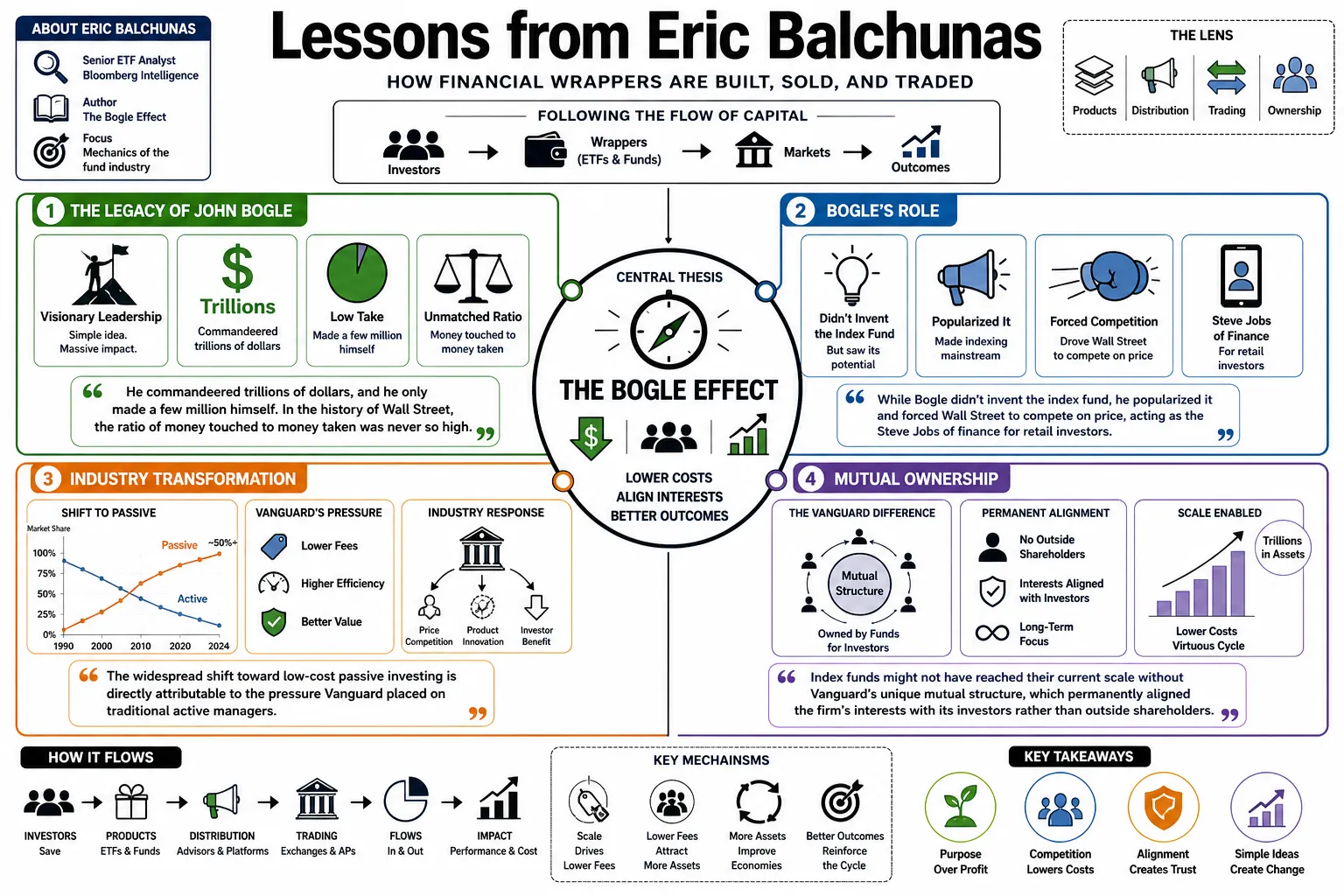
Lessons from Eric Balchunas
Eric Balchunas is a senior ETF analyst at Bloomberg Intelligence and the author of The Bogle Effect. He breaks down the mechanics of the fund industry to explain how passive investing, mutual ownership, and competition drive market flows. This profile collects his observations on how financial wrappers are built, sold, and traded.
Part 1: The Legacy of John Bogle
- On John Bogle's Influence: "He commandeered trillions of dollars, and he only made a few million himself. In the history of Wall Street, the ratio of money touched to money taken was never so high." — Source: [The Bogle Effect]
- On Bogle's Role: "While Bogle didn't invent the index fund, he popularized it and forced Wall Street to compete on price, acting as the Steve Jobs of finance for retail investors." — Source: [The Bogle Effect]
- On Industry Transformation: "The widespread shift toward low-cost passive investing is directly attributable to the pressure Vanguard placed on traditional active managers." — Source: [Trillions Podcast]
- On Mutual Ownership: "Index funds might not have reached their current scale without Vanguard's unique mutual structure, which permanently aligned the firm's interests with its investors rather than outside shareholders." — Source: [The Bogle Effect]
- On a Rare Happy Ending: The Vanguard and John Bogle story is, in Eric Balchunas's telling, the biggest and best happy ending on Wall Street, even though that makes it a harder story to tell than the usual tales of scandal and collapse. — Source: [The Investor's Podcast Network]
- On Unintended Consequences: "Even Bogle had complex feelings about the evolution of the industry, sometimes viewing highly specialized, high-turnover ETFs as a Frankenstein monster born from his simple index concept." — Source: [The Bogle Effect]
- On Wealth Transfer: "Vanguard’s model has effectively transferred trillions of dollars that would have gone to Wall Street management fees back into the retirement accounts of Main Street investors." — Source: [Bloomberg Intelligence]
- On Compound Interest: "Bogle’s core lesson focused on the compounding effect of avoiding high fees over a 30-year investing horizon." — Source: [The Bogle Effect]
- On Structural Gravity: "Once investors realized they could get market returns for a few basis points, it created a gravitational pull that permanently altered the pricing of all investment products." — Source: [Trillions Podcast]
- On Bogle's Stubbornness: "The refusal to compromise on cost and structure in the early, difficult years was the necessary ingredient that allowed the index fund to survive its rocky launch." — Source: [The Bogle Effect]
Part 2: The ETF Terrordome
- On Extreme Competition: "The modern ETF market is a Terrordome where products must fight brutally for assets in a hyper-saturated, low-fee environment." — Source: [Bloomberg ETF IQ]
- On Market Concentration: "The reality of the Terrordome is that giants like BlackRock and Vanguard capture roughly 60 percent of all incoming flows, leaving everyone else to fight for the scraps." — Source: [Bloomberg Intelligence]
- On the 3 C's of Survival: "To survive as a new ETF, you must be one of three things: Cheap, Creative, or Cabernet, which means having high-touch, relationship-based distribution." — Source: [Trillions Podcast]
- On Zombie ETFs: "A significant portion of the market consists of zombie funds trapped below $50 to $100 million in assets, struggling to cover their own operational costs." — Source: [Bloomberg Intelligence]
- On Product Mortality: "The launch environment is so unforgiving that roughly one in three new ETFs may eventually fail and shut down." — Source: [Bloomberg ETF IQ]
- On First-Mover Advantage: "In the Terrordome, being the first to launch a specific strategy gives a massive liquidity advantage that is extremely difficult for copycats to overcome, even with lower fees." — Source: [The Institutional ETF Toolbox]
- On Distribution Power: "Having a great ETF is meaningless if you lack a distribution network; the Cabernet approach of wining and dining advisors still works for legacy active managers." — Source: [Trillions Podcast]
- On Liquidity Begetting Liquidity: "Traders flock to the largest ETFs because of tight bid-ask spreads, creating a self-reinforcing cycle that locks in the dominance of established funds." — Source: [The Institutional ETF Toolbox]
- On Fee Wars: "The race to zero in expense ratios has turned basic market access into a loss leader, forcing issuers to find alternative ways to monetize their scale." — Source: [Bloomberg Intelligence]
Part 3: Cost and Index Mechanics
- On Expense Ratios: "In a marketplace of identical beta products, cost is the single most reliable predictor of long-term fund success and asset gathering." — Source: [The Bogle Effect]
- On Tracking Difference: "The headline expense ratio isn't the whole story; investors must watch tracking difference to see how efficiently the fund actually follows its benchmark after costs and securities lending." — Source: [The Institutional ETF Toolbox]
- On Securities Lending: "Many index ETFs offset their management fees by lending out securities to short sellers, meaning some funds effectively pay you to own them." — Source: [Bloomberg Intelligence]
- On Hidden Trading Costs: "The true cost of an ETF includes bid-ask spreads and market impact; a fund with a 0.05 percent fee but wide spreads might be more expensive to trade than a larger fund with a 0.09 percent fee." — Source: [The Institutional ETF Toolbox]
- On Index Inclusion Effects: "The sheer scale of passive investing means that when a stock is added to a major index like the S&P 500, forced buying creates immediate, predictable market mechanics." — Source: [Bloomberg ETF IQ]
- On Heartbeat Trades: "The tax efficiency of ETFs is largely driven by custom in-kind redemptions, often executed through coordinated heartbeat trades to wash out capital gains." — Source: [Trillions Podcast]
- On Custom Indexing: "The line between active and passive is blurring as index providers create highly customized, rules-based benchmarks to package specific active strategies." — Source: [Bloomberg Intelligence]
- On the Illusion of Free: "Zero-fee ETFs exist, but they often require investors to use specific platforms or give up securities lending revenue, proving that Wall Street always finds a way to make a margin." — Source: [The Bogle Effect]
- On Basis Point Obsession: "Institutional investors will switch billions of dollars from one S&P 500 ETF to another just to save one or two basis points in fees." — Source: [The Institutional ETF Toolbox]
Part 4: The Hot Sauce Strategy
- On Core-Satellite Construction: "The ideal modern portfolio holds roughly 85 percent in ultra-cheap, broad-market index funds, serving as the stable foundation." — Source: [Trillions Podcast]
- On the 15 Percent Allocation: "Investors should reserve the remaining 15 percent as a hot sauce allocation for thematic, active, or higher-risk bets to satisfy the psychological need to trade." — Source: [Bloomberg Intelligence]
- On Psychological Guardrails: "By confining speculative ideas to a small slice of the portfolio, investors prevent behavioral mistakes from ruining their long-term compounding." — Source: [The Bogle Effect]
- On Thematic Appeal: "Thematic ETFs function perfectly as hot sauce because they offer concentrated exposure to narratives like AI or clean energy without requiring stock-picking expertise." — Source: [Bloomberg ETF IQ]
- On Risk Budgets: "Hot sauce isn't about guaranteed outperformance; it's about allocating a specific risk budget to high-conviction ideas while the core does the heavy lifting." — Source: [Trillions Podcast]
- On FOMO Mitigation: "Having a dedicated satellite sleeve allows investors to participate in market crazes without blowing up their primary retirement strategy." — Source: [Bloomberg Intelligence]
- On Active Manager Roles: "The best place for traditional active management today is acting as the hot sauce, offering distinct, non-correlated returns rather than hugging the index." — Source: [The Institutional ETF Toolbox]
- On Entertainment Value: "Finance is partly entertainment; acknowledging this and budgeting 5 to 15 percent for trading fun is healthier than pretending to be perfectly rational at all times." — Source: [Trillions Podcast]
- On Performance Chasing: "Investors will always chase performance in their satellite holdings, but cheap beta ensures they still capture market returns in the majority of their wealth." — Source: [Bloomberg ETF IQ]
- On Narrative vs. Fundamentals: "Thematic ETFs sell a story of the future; they gather assets based on the plausibility of that narrative rather than current valuation metrics." — Source: [Bloomberg Intelligence]
Part 5: Active vs. Passive Dynamics
- On the Shift in Active Management: "Legacy active managers like Capital Group and JP Morgan have successfully adapted by lowering fees and launching transparent active ETFs." — Source: [Bloomberg Intelligence]
- On Closet Indexers: "High-fee active funds that closely mimic the benchmark are dead walking; they cannot justify their costs in a world of cheap beta." — Source: [The Bogle Effect]
- On High Conviction: "Active managers who survive will be those who run highly concentrated portfolios that look nothing like the standard indices." — Source: [Trillions Podcast]
- On the ETF Wrapper: "The ETF structure itself is agnostic; the recent boom in active ETFs proves that the wrapper's tax efficiency and tradability are appealing regardless of the underlying strategy." — Source: [The Institutional ETF Toolbox]
- On Mutual Fund Defections: "We are witnessing a massive structural migration as traditional mutual funds convert into ETFs to stop asset bleed." — Source: [Bloomberg ETF IQ]
- On Performance Cyclicality: "Active management tends to look better in down markets or periods of high dispersion, but predicting those cycles is as hard as picking the stocks themselves." — Source: [Trillions Podcast]
- On Factor Investing: "Smart beta sits neatly between active and passive, codifying active manager strategies into rules-based indices for a fraction of the traditional cost." — Source: [The Institutional ETF Toolbox]
- On Market Efficiency: "The rise of passive investing actually makes active management harder, as the remaining active traders are highly sophisticated institutional algorithms rather than retail amateurs." — Source: [Bloomberg Intelligence]
- On the Fee Compression Ceiling: "Active management fees won't go to zero, but they are settling into a new equilibrium where investors refuse to pay more than 40 to 60 basis points for alpha." — Source: [The Bogle Effect]
Part 6: Innovation and Niche Products
- On the DRAM Phenomenon: "Specific ETFs can suddenly gather billions in assets by solving immediate, highly specific access problems for investors at the exact right moment." — Source: [Trillions Podcast]
- On Derivative-Income Strategies: "The boom in covered call and buffer ETFs shows a massive retail appetite for products that manufacture yield or define downside risk." — Source: [Bloomberg Intelligence]
- On Buffer ETFs: "Investors are increasingly willing to cap their upside in exchange for downside protection, turning structured notes into liquid, tradable funds." — Source: [Bloomberg ETF IQ]
- On Single-Stock ETFs: "The launch of leveraged and inverse single-stock ETFs caters purely to day traders, turning the ETF wrapper into a standardized gambling mechanism." — Source: [Trillions Podcast]
- On Mutual Fund Obsolescence: "For taxable accounts, the structural advantages of the ETF wrapper render the traditional mutual fund functionally obsolete." — Source: [The Institutional ETF Toolbox]
- On Product Spaghetti: "Issuers constantly throw new concepts at the wall to see what sticks; for every successful thematic launch, dozens quietly delist." — Source: [Bloomberg Intelligence]
- On Institutional Adoption: "Hedge funds and institutions use ETFs not for long-term holds, but as rapid transition tools to equitize cash or short entire sectors instantly." — Source: [The Institutional ETF Toolbox]
- On Regulatory Moats: "The SEC's approval processes often dictate winners and losers in the ETF space, with first-in-line approvals granting massive commercial advantages." — Source: [Bloomberg ETF IQ]
- On the Democratization of Access: "The greatest achievement of the modern ETF industry is that a retail investor with $50 has access to the exact same sophisticated tools and pricing as a billionaire." — Source: [The Bogle Effect]
Part 7: Crypto and the Frontier
- On the Spot Bitcoin ETF Race: "The decade-long battle for a spot Bitcoin ETF was a defining regulatory saga that tested the limits of SEC authority over product innovation." — Source: [Bloomberg Intelligence]
- On Crypto Legitimacy: "Wrapping Bitcoin into an ETF format provided immediate institutional credibility, integrating digital assets into the legacy financial plumbing." — Source: [Trillions Podcast]
- On Generational Divides: "Crypto ETFs bridge a gap, allowing older advisors and Boomer capital to gain exposure to digital assets without needing to navigate wallets or exchanges." — Source: [Bloomberg ETF IQ]
- On the ETF as a Delivery Mechanism: "The approval of crypto ETFs proves that Wall Street views the ETF primarily as a universal delivery mechanism capable of holding virtually any asset class." — Source: [Bloomberg Intelligence]
- On Fee Wars in Crypto: "The aggressive fee cutting before the Bitcoin ETFs even launched demonstrated how established ETF issuers brought traditional Terrordome tactics to a brand new asset class." — Source: [Trillions Podcast]
- On Ethereum and Beyond: "The successful launch of Bitcoin products inevitably forced the door open for Ethereum and other single-asset crypto trusts." — Source: [Bloomberg ETF IQ]
- On Gold vs. Bitcoin: "The speed at which Bitcoin ETFs gathered assets rivaled and outpaced the historical launch of the first Gold ETFs, reflecting a massive pent-up demand." — Source: [Bloomberg Intelligence]
- On Custody Risks: "While the ETF wrapper solves access, it relies heavily on a few centralized custodians to hold the underlying crypto, creating new focal points of systemic risk." — Source: [Trillions Podcast]
- On Regulatory Reluctance: "The SEC's approval of spot crypto ETFs was driven more by court mandates than by a genuine shift in regulatory philosophy." — Source: [Bloomberg Intelligence]
- On Niche Dominance: "In frontier assets like crypto, the issuer that secures the most trading volume in the first week usually wins the category permanently." — Source: [The Institutional ETF Toolbox]
Part 8: Market Structure and The Future
- On the ETF Ecosystem: "The underlying plumbing of the ETF market, including authorized participants and market makers, functions as a highly efficient arbitrage machine." — Source: [The Institutional ETF Toolbox]
- On Liquidity Illusions: "Critics often worry that ETFs create systemic risk in illiquid bonds, but the ETF actually provides a price discovery mechanism when the underlying bonds stop trading." — Source: [Bloomberg ETF IQ]
- On Advisor Evolution: "As investment products became practically free, financial advisors had to pivot from stock-picking to providing comprehensive financial planning to justify their fees." — Source: [The Bogle Effect]
- On Vanguard’s Future: "The biggest risk to Vanguard isn't competitors lowering fees, but the potential erosion of its unique customer service culture as it scales to manage tens of trillions of dollars." — Source: [The Bogle Effect]
- On ESG Stagnation: "Despite intense media focus, ESG ETFs have largely struggled to gather durable assets in the US because retail investors prioritize returns and low fees over political mandates." — Source: [Trillions Podcast]
- On the Great Wealth Transfer: "As trillions of dollars pass to younger generations, the default vehicle for inheritance reinvestment is overwhelmingly the low-cost ETF." — Source: [Bloomberg Intelligence]
- On Direct Indexing: "While direct indexing is a powerful tax tool, it lacks the simplicity and portability of the ETF, keeping it as a niche product for high-net-worth individuals rather than a mass-market replacement." — Source: [Bloomberg ETF IQ]
- On Private Markets: "The next frontier for the ETF wrapper is attempting to democratize access to private equity and private credit, though the liquidity mismatch remains a massive hurdle." — Source: [Trillions Podcast]
- On the Ultimate Value Proposition: "At the end of the day, the ETF structure won because it is simply a better mousetrap: cheaper, more tax-efficient, and fully transparent." — Source: [The Institutional ETF Toolbox]