Eric Glyman co-founded Ramp with Karim Atiyeh, and in June 2026 they formally became co-CEOs. Ramp builds financial tools intended to help businesses manage payments, expenses and the use of time and money. Their partnership and customer-savings mission anchor the lessons below. — Ramp Co-CEO Announcement.
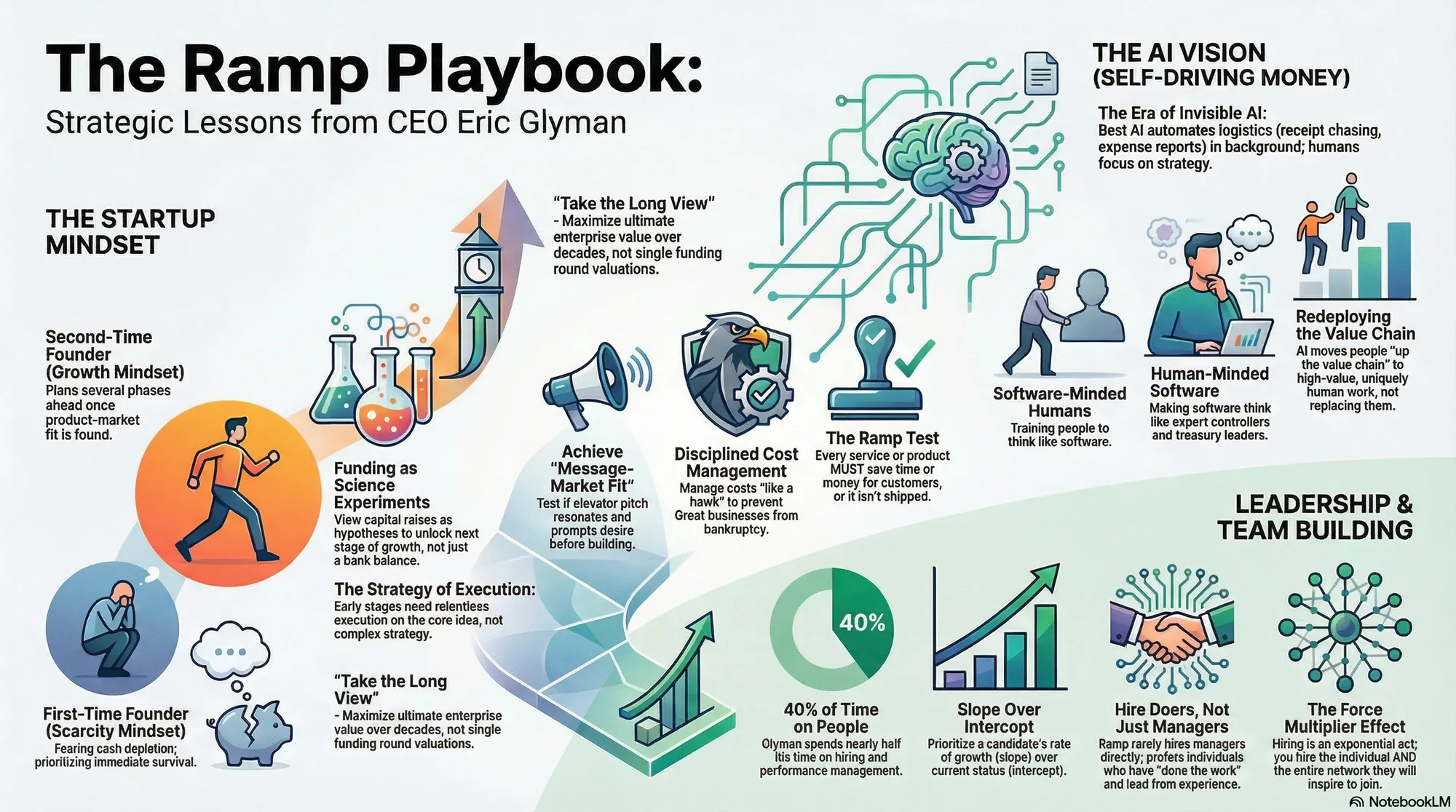
On Startups & Entrepreneurship
- Grow Past the First-Founder Scarcity Mindset: Glyman says his first startup left him fearful of running out of cash; building Ramp a second time helped him plan beyond immediate survival once a product was working. — Ramp Founder Interview.
- Plan Ahead After Product-Market Fit: Once Ramp found product-market fit, Glyman says it could lean into growth and plan for later phases rather than treating every decision as an immediate survival test. — Ramp Founder Interview.
- Contrarian Ideas Meet Early Resistance: Glyman recalls that Paribus and Ramp were initially dismissed; he argues that founders pursuing a genuinely contrarian idea must be prepared for sustained rejection before it can develop. — CFO Secrets Interview.
- Treat a Funding Round as an Experiment: Glyman frames financing rounds as chances to test what the company can prove with limited capital before asking for the next stage of funding. — 20VC Interview.
- Make Nonstandard Choices Deliberately: Glyman says leaders seeking unusual outcomes sometimes have to state controversial views, show why a standard approach is too slow, and make a clear change rather than follow convention by default. — Banking and Fintech Interview.
- Execution Is a Startup Advantage: Glyman emphasizes shipping and testing rapidly; at Ramp he describes measuring progress in days and repeatedly improving products, rather than relying on strategy statements alone. — Fortune Interview.
- Expand Along the Customer Workflow: Before adding a product, Glyman asks what surrounds a customer’s current job and whether extending deeper or wider in that workflow would solve more of the underlying pain. — Ramp Founder Interview.
- Do Not Optimize Only for a Round Price: Glyman argues that a financing valuation is a derivative of company value, not the end goal; he advises looking to durable enterprise value and customer outcomes. — Fortune Interview.
- Study Market Mechanics Before Building: At Ramp’s founding, Glyman says the team was more intentional about understanding the market, business model and how those mechanics connected to strategy. — Ramp Founder Interview.
- Build for a Long Horizon: Glyman says he wants Ramp to be the last company he works on and to keep building it for the rest of his career; he connects that ambition to enduring customer needs. — David Senra Interview.
- Keep Builders Close to Customers: Glyman says Ramp engineers join customer launch calls, own outcome metrics and maintain recent customer contact so product decisions reflect actual work. — Sequoia Training Data.
- Product Taste Starts with the User’s Work: Glyman describes product taste as understanding the user’s experience deeply enough to automate or remove a task, not merely make its interface prettier. — Sequoia Training Data.
On Finance & Business Strategy
- Test Message-Market Fit: Before broad launch, Ramp tested whether a promise to save companies money and time resonated enough that strangers would want to try the product. — Ramp Founder Interview.
- Position Ramp Beyond Corporate Cards: Glyman describes Ramp as a workflow and productivity company that moves money, with a mission to reduce time and money spent rather than simply issue cards. — Ramp Founder Interview.
- Protect Foundations, Iterate on the Rest: Glyman’s company recap advises taking time on core building blocks while testing less foundational decisions quickly; the captured wording is treated as a recap, not a verbatim quote. — Ramp Startup Advice.
- Cost Discipline Matters: From studying operators, Glyman says strong leaders watch costs so resources can be reinvested in the business. — CFO Secrets Interview.
- Restructuring Taught Him About Waste: Glyman says his financial-restructuring work showed that even strong businesses can fail if they lack rigor in how teams use time and money. — CFO Secrets Interview.
- Redesign Finance Systems, Not Just Tasks: Glyman argues CFOs should reconsider the architecture of their financial and operational systems as software gains the ability to reason and act. — CFO Secrets Interview.
- Apply a Time-or-Money Product Test: Glyman describes a Ramp rule: a product or service must help customers save time or money to fit the mission. — Hiring Super ICs Talk.
- Make AI Spending Visible: In his signed essay, Glyman argues that finance teams need to see who incurs AI costs, what outcomes they produce and how future bills may change. — Ramp: The Third Pillar.
- Spend Better on AI, Not Simply Less: Glyman urges companies to evaluate the value of AI work and match model capability to the task, avoiding both indiscriminate cuts and indiscriminate spending. — Ramp: The Third Pillar.
On AI & Technology
- Aim for Self-Driving Money: Glyman envisions finance software doing routine work automatically so teams can spend more time verifying outcomes and improving decisions. — CFO Secrets Interview.
- Use Zero-Touch Automation Where It Helps: Glyman argues that some AI experiences are best when the work happens in the background, such as retrieving receipts and preparing expenses, rather than requiring another chat interface. — Sequoia Training Data.
- Shift Finance Teams Toward Judgment: Glyman expects automation of routine data entry to leave finance teams more time for verification, improvement and strategic decisions; he presents this as a direction, not a guaranteed job outcome. — CFO Secrets Interview.
- Start AI Adoption with Real Problems: Glyman tells CFOs to give teams room to experiment but to begin with actual business problems and seek tools that solve them, rather than adopting AI as a novelty. — CFO Secrets Interview.
- Treat AI as a Major Productivity Shift: Glyman has described recent AI progress as the biggest productivity shift of his lifetime, while urging companies to ask what the new capability changes for their specific business. — Logan Bartlett Show.
- Build for Durable Customer Needs: Glyman says AI product choices should begin with persistent customer problems—such as making businesses more efficient and profitable—rather than a passing interface trend. — Sequoia Training Data.
- Match Model Cost to Task Value: Glyman warns against defaulting every workflow to a frontier model; cheaper intelligence can be sufficient for lower-stakes tasks such as summaries and calendar updates. — Ramp: The Third Pillar.
- Organize to Compound Model Progress: Glyman and Atiyeh say Ramp should be structured so advances in model capability translate into better products and faster execution without rebuilding the company each time. — Ramp Co-CEO Announcement.
On Leadership & Team Building
- A Company Is a People Business: In a hiring talk, Glyman argues that the team a technology company assembles largely determines what the company can build. — Hiring Super ICs Talk.
- Spend Founder Time on Hiring and Development: Glyman said he was spending roughly 35–40% of his time on hiring and performance management, including conversations about what employees want to become. — Ramp Founder Interview.
- Understand an Employee’s Growth Motive: Glyman says employees see themselves as the protagonists of their own careers; leaders should understand their motivations and make room for growth alongside company needs. — Ramp Founder Interview.
- Prefer Managers Who Have Done the Work: Glyman says Ramp rarely hires managers straight into the company and often favors people who have personally sold, written, designed or built the craft they will lead. — Hiring Super ICs Talk.
- Value Craft, Not Just a Management Résumé: Glyman urges teams to hire people strong in their craft who can still get their hands dirty and teach others from direct experience. — Hiring Super ICs Talk.
- Hire for Growth Slope: Glyman says Ramp looks for people with exceptional strengths and steep learning trajectories rather than requiring an apparently flawless starting résumé. — Hiring Super ICs Talk.
- Culture Is What People Actually Do: Glyman cautions that culture is not a list of words on a wall; it is what employees sincerely experience and how the company behaves. — Ramp High-Velocity Teams.
- Keep Ambitious People Challenged: Glyman says part of his job is to find ambitious talent and keep the company interesting enough that they continue to see worthwhile challenges there. — No Priors Interview.
- Seek Taste Alongside AI Production Capacity: Glyman argues that as AI lowers the cost of producing creative work, judgment about what will connect emotionally becomes more important in hiring. — Logan Bartlett Show.
- Distribute Decisions Through Co-Founder Trust: Glyman says he and Karim Atiyeh trust each other to make critical decisions across functions, a long-standing practice their co-CEO titles formalized. — Ramp Co-CEO Announcement.
- Design Every Function as a System: Glyman says Ramp treats every function as a systems-engineering problem, including functions whose components are mostly people. — Ramp Co-CEO Announcement.
- Look for Proof of Work in Hiring: Glyman says he is less interested in résumé labels than in evidence of drive and accomplished work, such as things candidates built or substantial work they produced. — David Senra Interview.
On Ramp's Mission & Vision
- Give Customers More from Time and Money: Glyman describes Ramp’s mission as helping customers get more from every dollar and hour so they can pursue their own business aims. — Ramp Founder Interview.
- Be a Multiplier for Customers’ Missions: Glyman notes that customers did not start companies to file expenses; Ramp aims to free resources for the work those companies actually set out to do. — Ramp Founder Interview.
- Earn Trust Through Delivered Value: Glyman says customers’ trust is earned when a product delivers the promised value and makes their businesses better; he treats revenue and valuation as downstream results. — Fortune Interview.
- Align Incentives with Customer Savings: Glyman argues Ramp inverted the usual rewards-card incentive by trying to help business customers spend less; he says that alignment can strengthen the business as customers see value. — Fortune Interview.
Learn more:
- Eric Glyman on Lessons Learned from Founding and Scaling Ramp — Original Interview Transcript
- One-on-One Interview Series: Eric Glyman, CEO of Ramp — CFO Secrets
- 20VC: Eric Glyman on Funding Rounds, Valuation and Building Ramp — Original Episode
- From Bankruptcies to Ramp: Eric Glyman’s Advice for Startups — Ramp
- Eric Glyman: Hiring Super Individual Contributors at Ramp — Original Talk
- Ramp CEO Eric Glyman: Using AI to Build Self-Driving Money — Sequoia Training Data
- Ramp at $44 Billion: The Third Pillar — Eric Glyman
- Welcoming My Co-Founder Karim as Co-CEO of Ramp — Eric Glyman
- Eric Glyman, Co-Founder of Ramp — David Senra Interview
- How Eric Glyman Built Ramp — Fortune Direct Interview
- How Eric Glyman Runs One of the Fastest-Growing Startups — Logan Bartlett Show
- Eric Glyman on Building High-Velocity Teams — Ramp Event Recap
- No Priors Episode 76: Ramp Co-Founders Eric Glyman and Karim Atiyeh — Original Interview