Eric Jang is an AI researcher focused on robotic manipulation, large-scale deep learning, and the path to artificial general intelligence. He is known for arguing that broad generalization emerges from scaling diverse data rather than engineering clever inductive biases, and that all AI software will eventually face the unstructured entropy of robotics. His more recent work extends that thesis into automated scientists, reasoning-era algorithms, real-time multimodal intelligence, and the hardware constraints that determine whether learned behavior is safe in the physical world.
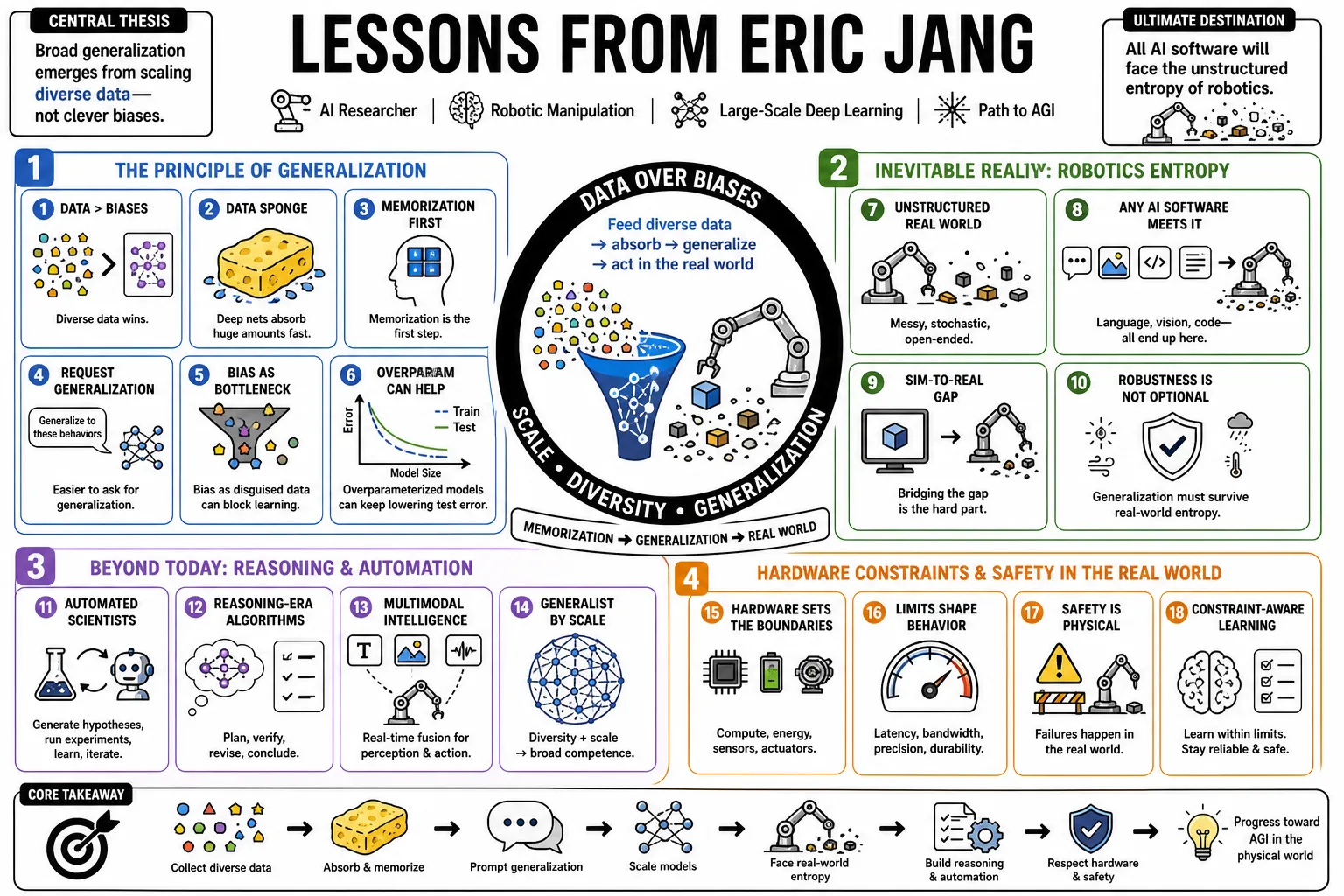
Part 1: The Principle of Generalization
- On the superiority of data over biases: "Large amounts of diverse data are more important to generalization than clever model biases." — Source: Just Ask for Generalization
- On the "data sponge" property: Deep neural networks trained via supervised learning are highly effective data sponges capable of quickly memorizing vast quantities of information. — Reference: Just Ask for Generalization
- On memorization's role: Jang credits his colleague Chelsea Finn with the maxim that memorization is the first step toward generalization. — Reference: Just Ask for Generalization
- On requesting generalization: It is often easier to prompt a model to generalize to desired behaviors than to attempt to optimize directly for those specific algorithmic outcomes. — Reference: Just Ask for Generalization
- On the danger of inductive biases: If an inductive bias functions merely as data in disguise, it can become an optimization bottleneck and actively hinder a model when faced with examples outside its assumptions. — Reference: To Understand Language is to Understand Generalization
- On overparameterization: In certain scenarios, overparameterized models can continue to lower test error and generalize well even after empirical risk reaches zero. — Reference: Just Ask for Generalization
- On the bitter lesson of compute: General methods that leverage massive compute power eventually bypass the need for complex, human-designed algorithmic tricks. — Reference: Eric Jang – Building AlphaGo from scratch | Kazuha
Part 2: The Architecture of Learning and Search
- On the inefficiency of reinforcement learning: Reinforcement learning is computationally inefficient at absorbing diverse data because it must gather its own experience to estimate returns and gradients, paying a steep cost for every update. — Reference: Just Ask for Generalization
- On solving the credit assignment problem: AlphaGo’s Monte Carlo Tree Search provides a training target that avoids the credit assignment problem seen in LLM reinforcement learning by suggesting a strictly better action for every single move. — Reference: Eric Jang – Building AlphaGo from scratch
- On amortizing deep search: A relatively shallow neural network can amortize the computational cost of simulating extremely deep paths in a game tree, a principle that applies to both board games and robotic movement. — Reference: Eric Jang – Building AlphaGo from scratch
- On continuous self-correction: Training methods like Dataset Aggregation in robotics mirror AlphaGo's training by teaching agents how to correct their course in real time when they drift from optimal paths. — Reference: Eric Jang – Building AlphaGo from scratch | Kazuha
- On the limits of automated researchers: While language models can automate experiment implementation and hyperparameter optimization, they still struggle with lateral thinking tasks like identifying dead ends or choosing the best next question to investigate. — Reference: Eric Jang – Building AlphaGo from scratch
- On architectural advantages: For specific spatial tasks like Go or certain physical robotics applications, convolutional networks like ResNets can remain more compute-optimal than Transformers. — Reference: Eric Jang – Building AlphaGo from scratch | Kazuha
Part 3: Language as the Blueprint for Generalization
- On the structure of generalization: The properties we associate with generalization—such as systematicity, productivity, and substitutivity—can be understood fundamentally as the basic structures of human language. — Reference: To Understand Language is to Understand Generalization
- On bolting generalization onto robotics: If language models capture the core structure of generalization, that structure can be used to impart generalization capabilities onto non-verbal domains like physical manipulation. — Reference: To Understand Language is to Understand Generalization
- On compositional non-verbal tasks: Robotic tasks, such as stacking blocks in new configurations or ignoring block colors, demonstrate linguistic properties like systematicity and substitutivity without requiring explicit language understanding. — Reference: To Understand Language is to Understand Generalization
- On words as disentangled concepts: Natural language offers a robust framework for combining disentangled concepts arbitrarily, allowing us to specify highly complex, open-ended goals to machines. — Reference: To Understand Language is to Understand Generalization
Part 4: The Convergence of Software and Robotics
- On the convergence of AI disciplines: All artificial intelligence software will eventually converge to resemble robotics software as agents interact with physical reality and unstructured environments. — Reference: All Roads Lead to Robotics
- On the predictability of bits vs. atoms: Pure software environments are easier to manage because digital bits are predictable and failure modes are known in advance, whereas robotics must constantly deal with the unknown variables of physical reality. — Reference: All Roads Lead to Robotics
- On shared infrastructure challenges: Language model developers and robotics teams face the same core engineering problems, such as indexing large volumes of autonomously collected data and establishing calibrated confidence in model outputs. — Reference: All Roads Lead to Robotics
- On the simultaneous arrival of AGI: Because the underlying infrastructure and engineering challenges for language models and robotics are identical, disembodied AGI and robotic AGI will likely arrive at roughly the same time. — Reference: All Roads Lead to Robotics
- On robots as an API: In the future, general-purpose humanoid robots could serve as a physical interface for computing, turning the physical world into the memory space of a massive operating system. — Reference: All Roads Lead to Robotics
Part 5: Scaling, Data Collection, and Real-World Autonomy
- On eliminating coding bottlenecks: By adopting an end-to-end neural network approach to robotic autonomy, a machine's capability scaling becomes constrained by data collection rather than the speed at which humans write software. — Reference: All Roads Lead to Robotics
- On data collector empowerment: Allowing the personnel who collect robotic data to train the models themselves drastically accelerates development by providing immediate feedback on data quality and volume requirements. — Reference: All Roads Lead to Robotics
- On zero-shot manipulation: Scaling imitation learning data across diverse tasks allows vision-based robotic systems to successfully perform completely unseen manipulation tasks without requiring prior demonstrations for those specific actions. — Reference: BC-Z: Zero-Shot Task Generalization with Robotic Imitation Learning
- On learning from interventions: Interactive imitation learning systems can achieve powerful generalization by combining data from both human demonstrations and active human interventions. — Reference: BC-Z: Zero-Shot Task Generalization with Robotic Imitation Learning
- On the infinite TAM of general robotics: While vertically integrated, niche robots provide immediate value today, aiming for general-purpose hardware and software addresses an infinite total addressable market. — Reference: All Roads Lead to Robotics
- On the constraints of base model training: As foundational models become exponentially more expensive to train, researchers across all institutions will face the reality that all downstream capabilities must be derived from a single, massive base training run. — Reference: All Roads Lead to Robotics
Part 6: Automated Research as a New Operating Model
- On coding agents becoming scientists: Once an agent can modify code, run experiments, inspect results, and propose the next hypothesis, its search space extends far beyond conventional hyperparameter tuning. — Reference: As Rocks May Think
- On standardizing the experimental loop: An automated research workflow becomes more reliable when each experiment is self-contained, saves machine-readable artifacts, and ends with explicit conclusions and unresolved questions. — Reference: As Rocks May Think
- On the researcher's changing job: High-output researchers will increasingly direct several parallel agents and judge which questions deserve attention instead of writing every architecture and submitting every job themselves. — Reference: As Rocks May Think
- On information gain per FLOP: Agent-run investigations can use compute more productively than broad blind sweeps because they interpret each result and adapt the next experiment to what was learned. — Reference: As Rocks May Think
Part 7: Reasoning Models and the Economics of Thought
- On prompt engineering's ceiling: Prompt tricks can activate reasoning patterns that already exist, but they cannot substitute for training stronger reasoning circuits into the model. — Reference: As Rocks May Think
- On initialization changing what works: An algorithm that fails when applied to a weak base model may succeed from a stronger initialization, so earlier negative results should not always be treated as permanent verdicts. — Reference: As Rocks May Think
- On inference compute as a strategic resource: Persistent automated thinking will create demand for inference compute far beyond today's chatbot usage as organizations continuously investigate, plan, and reduce technical debt. — Reference: As Rocks May Think
- On new algorithmic primitives: Reasoning models let programmers replace some rigid hand-designed state spaces with systems that can examine prior attempts holistically and choose unexplored directions. — Reference: As Rocks May Think
Part 8: Intelligence at Different Speeds
- On the frequency spectrum of intelligence: Intelligent behavior spans very slow developmental choices through rapid sensorimotor reactions, and human perception recognizes only a narrow band of that spectrum. — Reference: Ultra Instinct
- On the limits of one-hertz assistants: Today's turn-based assistants react too slowly to participate naturally in real-time human interaction, forcing people to pause, type, and wait for the model. — Reference: Ultra Instinct
- On fast and slow cognition in one system: A natural multimodal assistant must combine roughly human-speed reactions with long context and the ability to deliberate deeply, rather than optimizing for only one of those capabilities. — Reference: Ultra Instinct
- On sensor compression: Embodied intelligence requires architectures that can compress enormous high-frequency streams of video, audio, body language, and other sensor data into a tractable context in real time. — Reference: Ultra Instinct
Part 9: Evaluation as the Robotics Bottleneck
- On suffering from success: As a robot generalizes across more tasks and conditions, measuring whether a change actually improves the overall system becomes harder than getting an early prototype to work. — Reference: Robots Must Be Ephemeralized
- On the sample complexity of small gains: Detecting incremental improvements in real-world success rates can require thousands of trials, making physical evaluation too slow to support a fast research loop. — Reference: Robots Must Be Ephemeralized
- On moving iteration into software: Generalist robotics needs complementary simulation, world-model, offline-policy, and shadow-mode signals so researchers are limited by ideas rather than the throughput of physical trials. — Reference: Robots Must Be Ephemeralized
Part 10: Hardware and Learning Must Be Co-Designed
- On hidden collision energy: A robot limb can look slow and harmless while a highly geared motor behind it stores far more kinetic energy, making unplanned contact dangerous. — Reference: Motor Physics
- On the limits of copying human motion: Retargeting human-video trajectories to a stiff robot can reproduce joint positions while producing very different contact forces, so kinematic imitation alone is insufficient for safe dexterity. — Reference: Motor Physics
Part 11: Choosing Unusually General Technical Bets
- On finding unusually general building blocks: Applied deep learning advances by identifying technical objects with more generalization power than expected, then designing useful systems around them; Jang cites supervised learning and video models as successive examples. — Reference: Leaving 1X