Lessons from Eric Peters
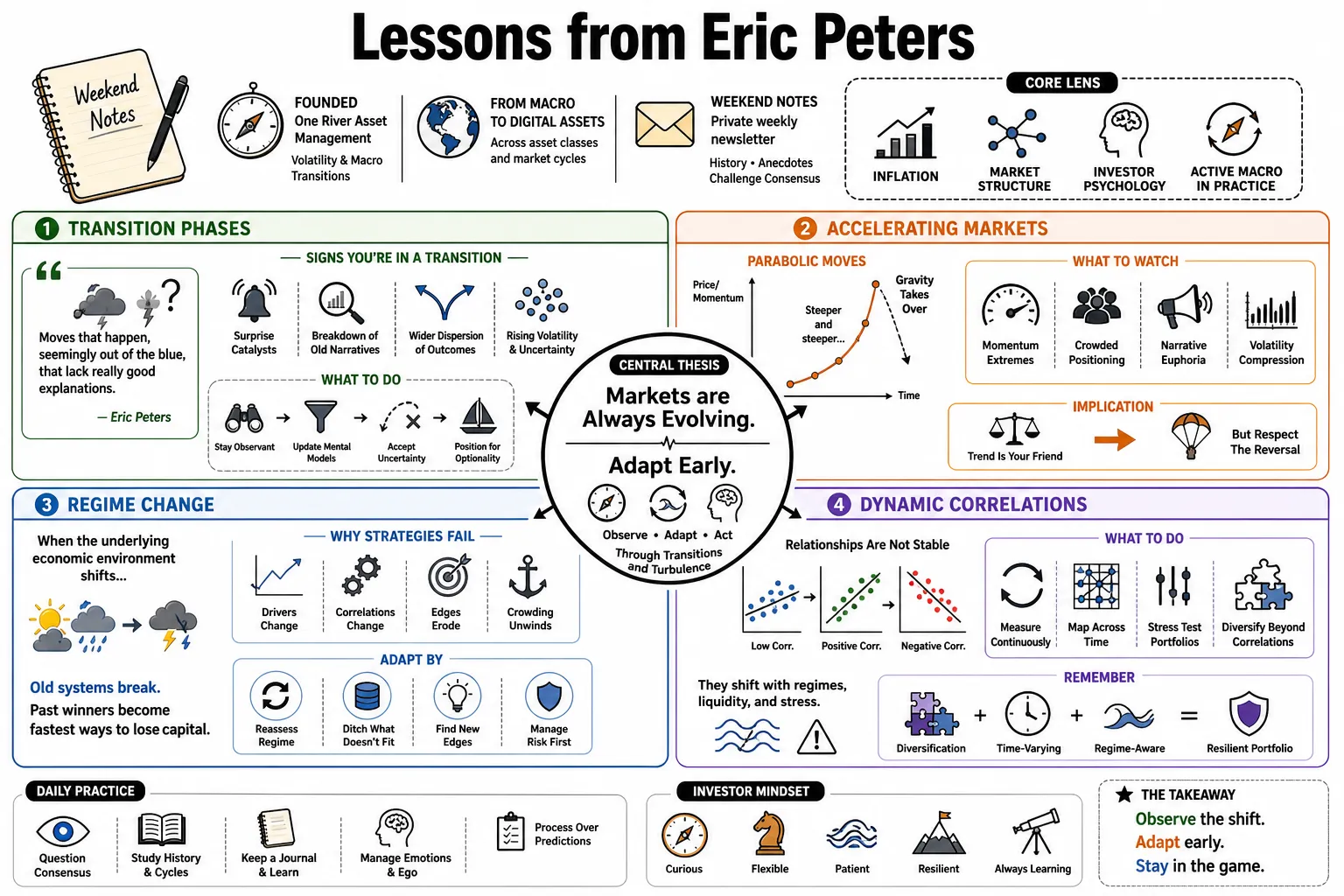
Eric Peters founded One River Asset Management to trade volatility and macro transitions before expanding into digital assets. He is best known for "Weekend Notes," a private weekly newsletter that uses history and personal anecdotes to challenge consensus market positioning. This profile collects his observations on inflation, market structure, and investor psychology to show how an active macro manager actually trades through economic upheaval.
Part 1: Market Regimes and Transitions
- On Transition Phases: "I think the things that we look for most often, that are most meaningful to markets, are moves that happen, seemingly out of the blue, that lack really good explanations. This is exactly the type of move that you see when you're in a transition phase for markets." — Source: [Macro Voices]
- On Accelerating Markets: Parabolic market moves accelerate steeper and steeper until gravity finally takes over. — Source: [Futu News]
- On Regime Change: When the underlying economic environment shifts, the systematic strategies that generated consistent returns for a decade often become the fastest way to lose capital. — Source: [One River Wknd Notes]
- On Dynamic Correlations: The relationships between asset classes are not static laws of nature; future correlations will be dynamic and subject to abrupt, painful reversals. — Source: [Mutiny Fund]
- On Inexplicable Price Action: When price action makes no sense to veteran market participants, it usually indicates that the rules of the game are being rewritten in real time. — Source: [Macro Voices]
- On Market Blindness: Financial professionals often remain blind to a new paradigm simply because their annual compensation depends on the continuation of the old one. — Source: [One River Wknd Notes]
- On Structural Shifts: True structural shifts in global markets rarely happen overnight; they are preceded by a series of localized tremors that consensus easily dismisses as anomalies. — Source: [Capital Allocators]
- On Adapting to Change: The most critical skill in macro investing is not perfectly forecasting the future, but accurately recognizing when the present has fundamentally broken from the past. — Source: [One River Wknd Notes]
- On Policy Exhaustion: When traditional monetary tools stop having their desired effect, financial markets begin to price in the inevitability of radical new policy frameworks. — Source: [Macro Voices]
- On Inflection Points: The most lucrative macro opportunities arise precisely when the consensus view is highly confident and least prepared for a sudden change in direction. — Source: [One River Wknd Notes]
Part 2: Inflation and Debt Cycles
- On Political Realities: "There is no appetite for austerity within either party, so their preference is for inflation-resistant assets, which [suggests]…stocks, gold, bitcoin." — Source: [Sabrient Systems]
- On Inflationary Solutions: The fact that gold and technology stocks both hit new highs in recent cycles signals that markets are aggressively pricing in inflationary solutions to manage the global debt burden. — Source: [Moomoo]
- On Sovereign Debt: When sovereign debt reaches mathematically unpayable levels, governments have historically always chosen to debase their currency rather than default explicitly. — Source: [One River Wknd Notes]
- On Financial Repression: Keeping interest rates artificially below the rate of true inflation is the only mathematical way highly indebted nations can slowly liquidate their obligations. — Source: [Macro Voices]
- On the Illusion of Wealth: Rising nominal asset prices driven by currency debasement create an illusion of wealth, effectively masking the underlying erosion of purchasing power. — Source: [One River Wknd Notes]
- On Central Bank Constraints: Central banks are trapped by the massive debt loads in the system; they cannot raise rates to a level that would truly crush inflation without triggering a systemic credit crisis. — Source: [Capital Allocators]
- On Inflation and Equality: Inflation acts as a regressive tax that heavily penalizes those who earn wages and save in fiat, while aggressively rewarding those who own scarce physical and financial assets. — Source: [One River Wknd Notes]
- On the Return of Scarcity: After decades where capital was abundant and resources seemed infinite, the global market is aggressively re-pricing physical scarcity. — Source: [Bankless]
- On Fiscal Dominance: We have moved from an era of monetary dominance, where central bankers pulled the strings, to fiscal dominance, where aggressive government spending dictates the economic trajectory. — Source: [Macro Voices]
- On Protecting Capital: In an environment defined by fiat debasement, holding cash is no longer a risk-free position; it guarantees a slow, silent bleed of purchasing power. — Source: [One River Wknd Notes]
Part 3: Geopolitics and Deglobalization
- On Brexit: "When the U.K. voted to leave Europe, after decades of prosperous global integration, the world's fifth largest economy, a leading democracy, stepped back – and that really matters." — Source: [Fox Business]
- On War and Inflation: We have entered a period where the strongest military powers are at odds, and historically, "wars are almost always inflationary." — Source: [Macro Voices]
- On the End of Integration: The multi-decade trend of optimizing global supply chains for maximum efficiency and lowest cost has abruptly reversed in favor of national security and domestic resilience. — Source: [One River Wknd Notes]
- On Strategic Competition: Nations are weaponizing economic ties, meaning future capital flows will increasingly follow geopolitical alliances rather than just seeking the highest yield. — Source: [Capital Allocators]
- On Energy Security: The realization that energy security is national security fundamentally alters how commodities are priced, hoarded, and subsidized by nation-states. — Source: [One River Wknd Notes]
- On Global Trade Fragmentation: The breakdown of a unified, frictionless global trading system introduces inefficiencies that structurally raise the baseline level of inflation for years to come. — Source: [Macro Voices]
- On Dollar Hegemony: While the US dollar remains dominant, the aggressive use of financial sanctions heavily accelerates efforts by rival nations to develop alternative settlement systems. — Source: [Hidden Forces]
- On Supply Chains: Supply chains that were built for a peaceful, unipolar world are profoundly vulnerable in a multipolar world characterized by strategic distrust. — Source: [One River Wknd Notes]
- On Domestic Politics: Rising domestic polarization limits the ability of Western governments to project unified power abroad, creating vacuums that regional powers eagerly attempt to fill. — Source: [Capital Allocators]
- On Geopolitical Risk Premiums: Markets spent decades pricing geopolitical risk at zero; the mechanical adjustment to a world where borders and resources matter again will be violent. — Source: [One River Wknd Notes]
Part 4: Volatility and Risk Management
- On Pricing Volatility: "It is clearly more attractive to buy volatility when it is cheap than when it is expensive." — Source: [The Hedge Fund Journal]
- On Market Conditioning: "I think that there are still an awful lot of people in the market that are conditioned to sell volatility and to buy the dip, and I think we're seeing that happen." — Source: [Macro Voices]
- On Rate Sensitivity: In highly leveraged financial systems, rising interest rates act as a distinct "pre-condition to equity market disruptions and selloffs." — Source: [Macro Voices]
- On Suppressed Risks: Interventions by central banks do not eliminate market risk; they simply suppress it, forcing the pressure to build up and eventually release in more explosive volatility. — Source: [One River Wknd Notes]
- On Convexity: Portfolio construction must prioritize convexity, ensuring that when the market inevitably fractures, the portfolio doesn't just survive, but actively capitalizes on the chaos. — Source: [Mutiny Fund]
- On the Illusion of Liquidity: Liquidity is often a mirage that feels abundant when you don't need it, but completely vanishes the exact moment everyone rushes for the same exit. — Source: [Capital Allocators]
- On Tail Events: The high frequency of so-called "tail events" in modern markets suggests that standard financial models dramatically misunderstand the actual distribution of real-world risks. — Source: [One River Wknd Notes]
- On Asymmetric Trades: The explicit goal of macro trading is finding specific setups where you lose very little if you are wrong, but make a tremendous amount of money if your thesis proves correct. — Source: [Macro Voices]
- On Volatility as an Asset: Instead of merely fearing volatility, sophisticated investors must learn to treat it as a distinct asset class that can be actively traded and harvested. — Source: [One River Wknd Notes]
Part 5: Bitcoin and Digital Assets
- On Bitcoin's Supply Dynamics: "It’s unlike any asset that I’ve seen in the world in the sense that there’s no supply response to the price. If bitcoin went up five times in value, or 10 times, or 100 times, there wouldn’t be more bitcoin produced." — Source: [Forbes]
- On The Inverted Market: "An asset that has finite supply, but no intrinsic value, could become priceless, if only we imagine it so." — Source: [One River Wknd Notes]
- On Valuing Crypto vs. Gold: Cryptocurrencies "have some unique qualities, part of which resemble the qualities that you'd find in gold except that they're wildly underpriced relative to gold." — Source: [Bitcoin.com]
- On Early Adoption: Allocating to digital assets early was a way to secure "a mere toehold to the future, a deposit on the view that everything we know about financial intermediation and its relationship to centralized policy will change." — Source: [Decrypt]
- On Institutional Arrival: Despite high-profile announcements, the reality is that the truly massive pools of traditional institutional capital have barely begun to allocate meaningfully to digital assets. — Source: [Bankless]
- On the Generational Shift: Digital assets represent a fundamental generational divide in how value is perceived, with younger demographics trusting open cryptography over central bank mandates. — Source: [One River Wknd Notes]
- On Network Effects: The value of a cryptocurrency network grows exponentially as adoption increases, creating a powerful feedback loop that traditional cash-flow valuation metrics struggle to capture. — Source: [Capital Allocators]
- On Pristine Collateral: In a financial world awash in rehypothecated debt, an asset that can be instantly verified and settled on a neutral ledger becomes highly sought-after pristine collateral. — Source: [Hidden Forces]
- On the Policy Escape Valve: Bitcoin serves as a systemic escape valve, giving global capital a place to run when confidence in sovereign debt and fiat currency structures begins to openly fracture. — Source: [One River Wknd Notes]
Part 6: Market Structure and Systematic Flows
- On Flows Over Pros: The dominance of systematic trading means that mechanical flows and algorithmic rules now frequently overwhelm the careful analysis of fundamental professionals. — Source: [Mutiny Fund]
- On Passive Investing: The relentless rise of passive index funds has effectively turned the stock market into a momentum machine, largely divorcing asset prices from underlying economic reality. — Source: [One River Wknd Notes]
- On Market Fragility: When a large percentage of market participants are acting on the exact same systematic signals, the market structure becomes inherently brittle and highly prone to flash crashes. — Source: [Macro Voices]
- On Central Bank Distortion: Years of quantitative easing have broken the price discovery mechanism, turning the government bond market into a political utility rather than a free market. — Source: [Capital Allocators]
- On Options Market Influence: The sheer volume of short-term derivatives trading now frequently dictates the daily price action of the underlying equities, creating a classic case of the tail wagging the dog. — Source: [One River Wknd Notes]
- On Short-Termism: The industry obsession with daily and weekly performance metrics forces institutional managers into crowded, short-term trades, leaving massive opportunities in long-term structural mispricings. — Source: [Hidden Forces]
- On Retail Participation: The gamification of retail trading and zero-commission brokers has introduced a highly coordinated, emotionally driven flow that institutions can no longer afford to ignore. — Source: [One River Wknd Notes]
- On Reflexivity: Markets are deeply reflexive; rising prices in an asset can artificially improve the fundamentals of the underlying company by lowering its cost of capital, further fueling the rally. — Source: [Capital Allocators]
- On the Illusion of Control: Regulators constantly try to engineer market structure to prevent the last crisis, inevitably planting the seeds for a completely different type of liquidity failure in the next. — Source: [One River Wknd Notes]
Part 7: Trading Psychology and Discipline
- On Managing Stress: Recounting a conversation with his son: "'I'm stressed Dad,' said Jackson... I smiled, hearing in his voice the story of my life. 'Stress is okay, drowning isn't. Which is it?'" — Source: [One River Wknd Notes]
- On Maintaining Flexibility: The greatest risk to an investor is not market volatility, but a rigid mind that refuses to quickly update its priors when confronted with conflicting evidence. — Source: [Capital Allocators]
- On the Discipline of Writing: The physical act of writing out your thesis forces you to confront the logical gaps in your own thinking and exposes the hidden weaknesses in your current positions. — Source: [One River Wknd Notes]
- On Ego in Investing: Markets have an uncanny ability to punish hubris; the exact moment you believe you have the market completely figured out is usually the moment you are about to lose money. — Source: [Macro Voices]
- On Taking Losses: Surviving in macro requires the strict emotional discipline to take a small loss immediately rather than holding onto a losing trade out of stubbornness and blind hope. — Source: [One River Wknd Notes]
- On Contrarianism: True contrarianism isn't just mindlessly taking the opposite side of the crowd; it's doing the deep, exhausting work to verify that the crowd is actually mathematically wrong. — Source: [Hidden Forces]
- On Patience: Most investors suffer from an inability to sit on their hands; sometimes the most profitable decision you can make in a given quarter is to execute absolutely no trades. — Source: [Capital Allocators]
- On Intellectual Honesty: You must actively seek out the smartest people who violently disagree with your worldview, and listen to them with genuine curiosity rather than immediate defensiveness. — Source: [One River Wknd Notes]
- On Emotional Contagion: Fear and greed are highly contagious pathogens in trading rooms; maintaining physical and mental distance from the noise of the crowd is a critical survival skill. — Source: [One River Wknd Notes]
Part 8: The Art of Observation
- On Multi-Disciplinary Thinking: Examining the world strictly through financial metrics guarantees severe blind spots; true insight requires synthesizing history, sociology, politics, and psychology. — Source: [One River Wknd Notes]
- On Anecdotal Evidence: Often, a simple, unfiltered conversation with a cab driver or a local shop owner reveals more about the true state of the economy than a hundred pages of revised government statistics. — Source: [One River Wknd Notes]
- On Historical Cycles: While the specific characters and technologies change, the fundamental human emotions of fear, greed, and the pursuit of power ensure that financial history continuously rhymes. — Source: [Hidden Forces]
- On Finding Signal: In an era characterized by an overwhelming deluge of free information, the most valuable cognitive skill is the ability to fiercely filter out the noise and identify the true signal. — Source: [Capital Allocators]
- On Narrative Economics: The stories people collectively tell themselves about the economy often become self-fulfilling prophecies, driving capital flows and literally shaping economic reality. — Source: [One River Wknd Notes]
- On the Value of Dialogue: Writing a private newsletter isn't just about broadcasting opinions; it's a mechanism designed to provoke high-quality pushback from an exceptionally smart network of readers. — Source: [One River Wknd Notes]
- On the Absurdity of Markets: Approaching financial markets with a sense of humor and an appreciation for the absurd is necessary to survive the profound irrationality of human crowds. — Source: [One River Wknd Notes]
- On Asking the Right Questions: Breakthrough investment insights rarely come from finding the right answer to a standard question, but rather from having the perspective to ask a completely different question altogether. — Source: [Macro Voices]
- On the Long Game: True wealth creation in investing is not about catching every short-term twist and turn of the market, but about correctly identifying a few massive secular themes and letting them play out for years. — Source: [One River Wknd Notes]