Eric Seufert is a quantitative marketer and the founder of Mobile Dev Memo and Heracles Capital. He defined the mechanics of mobile user acquisition in his book Freemium Economics and predicted the shift to "Content Fortresses" after Apple locked down user privacy. This profile breaks down his frameworks for measurement, creative testing, and building profitable digital products when data is scarce.
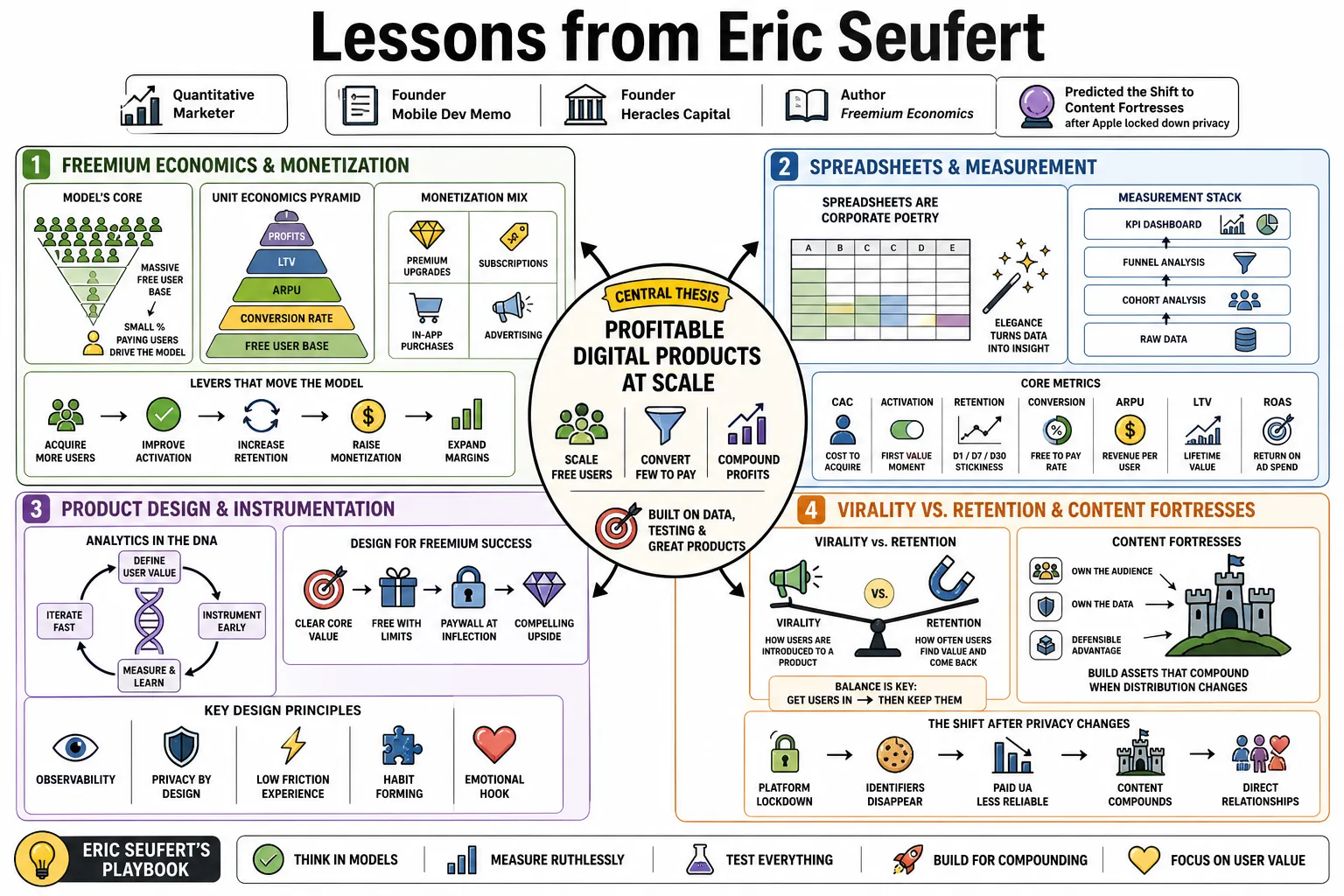
Part 1: Freemium Economics & Monetization
- On the Model's Core: "Freemium is not a marketing strategy; it is a business model that relies on the massive scale of a free user base to support a small percentage of paying users." — Source: [ResearchGate]
- On Spreadsheets: "Spreadsheets are corporate poetry; when constructed elegantly enough, they can be used to communicate sophisticated ideas to audiences who wouldn't otherwise be receptive to details." — Source: [Freemium Economics]
- On Product Design: Analytics cannot be an afterthought; it must be built into the product's DNA from the earliest stages of development to successfully implement a freemium model. — Source: [12min]
- On Virality vs. Retention: "Virality and retention exist on opposite sides of the acquisition threshold: virality describes how users are introduced to a product, and retention describes how long users remain with a product." — Source: [The SAI]
- On the Needs Cascade: For a user to pay, a product must first satisfy a fundamental need. Upgrades happen when the pain of a restriction outweighs the cost of the transaction. — Source: [ResearchGate]
- On Segmentation: Treating all users the same is a mistake. Developers must segment their audience into "whales" who drive revenue, "minnows" who spend little, and free users who provide necessary ecosystem liquidity. — Source: [InGameJob]
- On the Value of Free Users: The free user base acts as the product's content and scale. Without this massive liquidity, the premium tiers cannot function. — Source: [12min]
- On Giving Away the Farm: A successful free version must be functional enough to attract a massive audience, but limited enough to create a natural compulsion to upgrade among highly engaged users. — Source: [Freemium Economics]
- On the Two Sides of Delight: Both virality and retention fundamentally measure the same thing—the general sense of delight users feel for a product, manifested at different stages of the lifecycle. — Source: [The SAI]
- On Predicting Behavior: The ultimate goal of freemium analytics is predicting who will make a purchase, which allows you to optimize marketing efforts and tailor the user experience. — Source: [ResearchGate]
Part 2: Measurement Dysfunction & Analytics
- On Internal Misalignment: "Broken measurement kills growth." When finance, product, and user acquisition teams use different models for success, growth stalls entirely. — Source: [Sub Club Podcast]
- On the Measurement Myth: The industry's obsession with one-to-one deterministic tracking was a temporary luxury, not a permanent law of marketing. — Source: [Mobile Dev Memo]
- On Shifting Frameworks: "Everything can be measured if you shift away from deterministic." Probabilistic modeling is now a mandatory replacement. — Source: [YouTube]
- On Attribution Certainty: Marketers must accept that measurement is fundamentally and necessarily uncertain, even when campaigns are highly successful. — Source: [Sub Club Podcast]
- On Media Mix Modeling (MMM): As deterministic tracking deteriorates, MMM has returned as a primary tool for understanding how different channels contribute to aggregate growth. — Source: [Mobile Dev Memo]
- On Incrementality: Marketing teams must align on a single, incrementality-aware framework rather than trusting platform-reported numbers blindly. — Source: [YouTube]
- On the Growth Metric: "The only growth metric that matters is growth." Do not get distracted by intermediate engagement metrics that don't translate to top-line movement. — Source: [Mobile Dev Memo]
- On Defining Good: Without one shared internal framework for "what good looks like," marketing teams will spin in circles defending their own data. — Source: [Sub Club Podcast]
- On Business Realities: "Virality, luck, and favorable market conditions aren't business strategies." Growth requires a systemic, measurable engine. — Source: [Mobile Dev Memo]
Part 3: App Tracking Transparency (ATT) & Privacy
- On the Death of Determinism: ATT fundamentally broke the deterministic link between an ad click and a subsequent in-app purchase. — Source: [Mobile Dev Memo]
- On the Privacy Shuffle: We are currently in a "privacy shuffle" where restrictions have peaked, and platforms like Google are beginning to step back from the absolute edge of the tracking cliff. — Source: [YouTube]
- On ATT's Silver Lining: "Measurement did get overhauled kind of utterly... but it would have been a good idea even absent those privacy restrictions. Everyone’s kind of glad they did it." — Source: [YouTube]
- On Platform Power: Privacy changes often act as a mechanism for mobile operating systems to consolidate power over ad networks. — Source: [Mobile Dev Memo]
- On Adapting to Obfuscation: Even if an advertiser only spends on Meta, they must build internal probabilistic models to understand tools where metrics are deliberately obfuscated. — Source: [YouTube]
- On First-Party Data: The immediate consequence of ATT is that first-party data became exponentially more valuable than third-party tracking data. — Source: [Mobile Dev Memo]
- On Fingerprinting: Workarounds like device fingerprinting are temporary loopholes, not durable strategies for navigating platform privacy rules. — Source: [Mobile Dev Memo]
- On the New Normal: If marketing on mobile ever became easy again, it would mean the competitive advantage of technical capability has vanished. The difficulty is the moat. — Source: [Business Insider]
- On Apple's Motivations: ATT was framed as a privacy initiative, but its structural outcome was degrading the efficiency of rival ad platforms while boosting Apple's own Search Ads. — Source: [Mobile Dev Memo]
Part 4: The Content Fortress Strategy
- On Walled Gardens vs. Fortresses: "Walled Gardens get paid when users leave, Content Fortresses when users stay." — Source: [X]
- On the Definition: A Content Fortress is a platform that serves owned-and-operated inventory using first-party data to keep the entire user journey inside its own walls. — Source: [AlphaSense]
- On Everything Becoming an Ad Network: Any company with a massive first-party user base—like Uber, Marriott, or Netflix—will inevitably build its own ad network. — Source: [Mobile Dev Memo]
- On Meta's Evolution: Facebook Shops requiring native checkout rather than linking out to Shopify is the textbook execution of Meta building a Content Fortress. — Source: [Mobile Dev Memo]
- On Microsoft's Ecosystem: Microsoft's acquisitions across Xbox, PC, and mobile form a vast Content Fortress capable of retaining users and data across multiple hardware form factors. — Source: [X]
- On Ad Tech Acquisitions: When mobile game publishers buy ad networks, they are trying to own the inventory where their ad tech operates, effectively building a fortress. — Source: [Techmeme]
- On Subsuming Interactions: The goal of the fortress strategy is to subsume third-party web interactions into a natively hosted, first-party setting to preserve tracking capabilities. — Source: [Mobile Dev Memo]
- On Netflix's Potential: Netflix should use its personalization engine to route users through its own content portfolio as an ad network, rather than just selling space to outside brands. — Source: [Mobile Dev Memo]
- On Retail Media: Companies like Instacart own the transaction data and the digital shelf space, allowing them to run high-margin advertising completely protected from OS privacy policies. — Source: [Mobile Dev Memo]
- On the Hub-and-Spoke Model: The old internet model of a central hub sending traffic outward is being replaced by integrated environments that never let the user click away. — Source: [Mobile Dev Memo]
Part 5: Lifetime Value (LTV) & Payback Models
- On LTV as an Anachronism: Traditional Lifetime Value calculation is an anachronism in the modern, privacy-restricted mobile economy. — Source: [Medium]
- On LTV as a Curve: LTV is not a static, single dollar amount; it is a curve that evolves dynamically over a user's lifespan. — Source: [Mobile Dev Memo]
- On the Futility of Long Projections: Predicting a user's value three to five years out is "fragile and futile." — Source: [Mobile Dev Memo]
- On Cash Flow Reality: "If an advertiser is cash-constrained, a Day 365 LTV is irrelevant. Advertisers are better served focusing on month-to-month cash generation." — Source: [Mobile Dev Memo]
- On Retention Dependency: You cannot project LTV without a firm grasp of your retention profiles; LTV is entirely downstream of retention. — Source: [Medium]
- On Payback Windows: Instead of maximizing theoretical lifetime value, advertisers should optimize for specific payback windows that align with their operational cash flow. — Source: [Mobile Dev Memo]
- On the Time Value of Users: The hypothetical LTV of a user acquired today matters much less than the actual cash they generate in the first 30 days. — Source: [Mobile Dev Memo]
- On Adjusting Bids: LTV models must be constantly recalibrated against actual early cohort data, or marketers risk heavily overbidding for declining user quality. — Source: [Mobile Dev Memo]
- On Metric Obsession: Fixating on an arbitrary LTV target often causes teams to lose sight of whether their acquisition engine is actually generating working capital. — Source: [Mobile Dev Memo]
Part 6: Creative Testing & Automation
- On Finding Losers Fast: "The way I approach creative testing is trying to identify losers as quickly as possible. The winners take time to prove out, but the losers are pretty quick to prove out." — Source: [Sub Club Podcast]
- On Stopping the 'Why': Marketers must stop asking why a specific ad worked; individual ad outcomes are often stochastic and uninterpretable. — Source: [Sub Club Podcast]
- On Feeding the Beast: "Just create an insightful process to feed the beast and let the beast do the work." Focus on inputs, not dissecting outputs. — Source: [Sub Club Podcast]
- On Process Over Intuition: Because ad algorithms operate as black boxes, success relies on the speed of your testing cycle rather than human intuition about creative narratives. — Source: [Sub Club Podcast]
- On the AI Role in Creative: Generative AI is best used for brainstorming concepts and automating repetitive asset variations, not for entirely replacing brilliant creative strategy. — Source: [Sub Club Podcast]
- On the Win Rate: Stop trying to find one magic ad. Focus entirely on improving the operational process that raises the percentage of tests that succeed over time. — Source: [YouTube]
- On Machine Learning vs GenAI: The real driver of ad efficiency isn't GenAI creating pictures, but the Machine Learning models powering Meta’s Advantage+ and Google’s Performance Max. — Source: [Mobile Dev Memo]
- On Creative Fatigue: Ad networks burn through creative quickly. A successful team builds a factory capable of producing high volumes of distinct visual concepts, not just minor iterations. — Source: [Mobile Dev Memo]
- On Algorithmic Dominance: You cannot manually outsmart modern ad buying algorithms. Your job is to provide them with enough diverse creative material to find the optimal audience. — Source: [YouTube]
- On Ad Predictability: If an ad network's algorithm decides an ad works, it works. Trying to map a human psychological narrative onto that machine decision is wasted effort. — Source: [Sub Club Podcast]
Part 7: Signal Engineering & Ad Platforms
- On the Definition of Signal Engineering: Instead of just buying ads, marketers must build "hurdles" or high-intent in-app events to send back to platforms as training data. — Source: [Sub Club Podcast]
- On Training the Algorithm: Sending specific, high-value user actions back to Meta or Google allows their AI to optimize for customers who will actually stick around, rather than just click. — Source: [Sub Club Podcast]
- On the Shift in Marketing Labor: The day-to-day job of media buying has moved away from manual bid adjustments toward designing better data payloads for ad network APIs. — Source: [Mobile Dev Memo]
- On AI Ads: "There's no chance that OpenAI doesn't have a scaled ad platform in four years." — Source: [YouTube]
- On Proxy Events: If a purchase takes days to happen, developers must identify early proxy events—like completing a specific tutorial step—that strongly correlate with that eventual purchase. — Source: [Sub Club Podcast]
- On Platform Monopolies: The power of Meta and Google is rooted in their ability to process massive amounts of conversion signals better than any individual advertiser could. — Source: [Mobile Dev Memo]
- On Event Mapping: Mapping out the user journey and deciding exactly which milestones to report back to ad networks is now the most critical phase of campaign setup. — Source: [Mobile Dev Memo]
- On Quality Over Quantity: It is better to send an ad network fewer, highly predictive signals of intent than to flood it with low-value behavioral data that confuses the algorithm. — Source: [Sub Club Podcast]
- On the End of Hacks: Algorithmic platforms have matured past the point where simple targeting hacks work. Deep integration of product analytics with the ad platform is the only way to scale. — Source: [Mobile Dev Memo]
Part 8: The Mobile Ecosystem & Investment
- On the Core Platform: "My theory is that mobile is the dominating computing platform of my lifetime, and I don't think that changes." — Source: [Business Insider]
- On Waterfall Scaling: "Don’t diversify just to diversify." Max out your primary acquisition channel until it hits your ROAS threshold before spending time and overhead on the next. — Source: [Sub Club Podcast]
- On Channel Overhead: Spreading budgets across too many ad channels too early adds massive operational overhead without necessarily improving blended performance. — Source: [Sub Club Podcast]
- On the Complexity Moat: The increasing technical difficulty of mobile marketing is a feature, not a bug; it creates a natural barrier to entry for less sophisticated companies. — Source: [Business Insider]
- On Economic Expansion: AI technologies will eventually act as an economically expansionary force, increasing overall prosperity by making the digital economy far more efficient. — Source: [Mobile Dev Memo]
- On Platform Risk: Building an entire business dependent on the policies of a single mobile operating system is an inherent risk that requires aggressive, continuous adaptation. — Source: [Mobile Dev Memo]
- On the Value of Tools: Building open-source tools, like his cohort analysis library Theseus, elevates the baseline competence of the entire mobile marketing industry. — Source: [Mobile Dev Memo]
- On Post-Privacy Valuations: Companies that successfully built first-party data moats or Content Fortresses saw their valuations disconnect entirely from the rest of the ad tech market post-ATT. — Source: [Mobile Dev Memo]
- On Strategy vs. Tactics: The mobile ecosystem moves too fast for static tactics. Only operators with a foundational grasp of quantitative economics can survive platform shocks. — Source: [Freemium Economics]