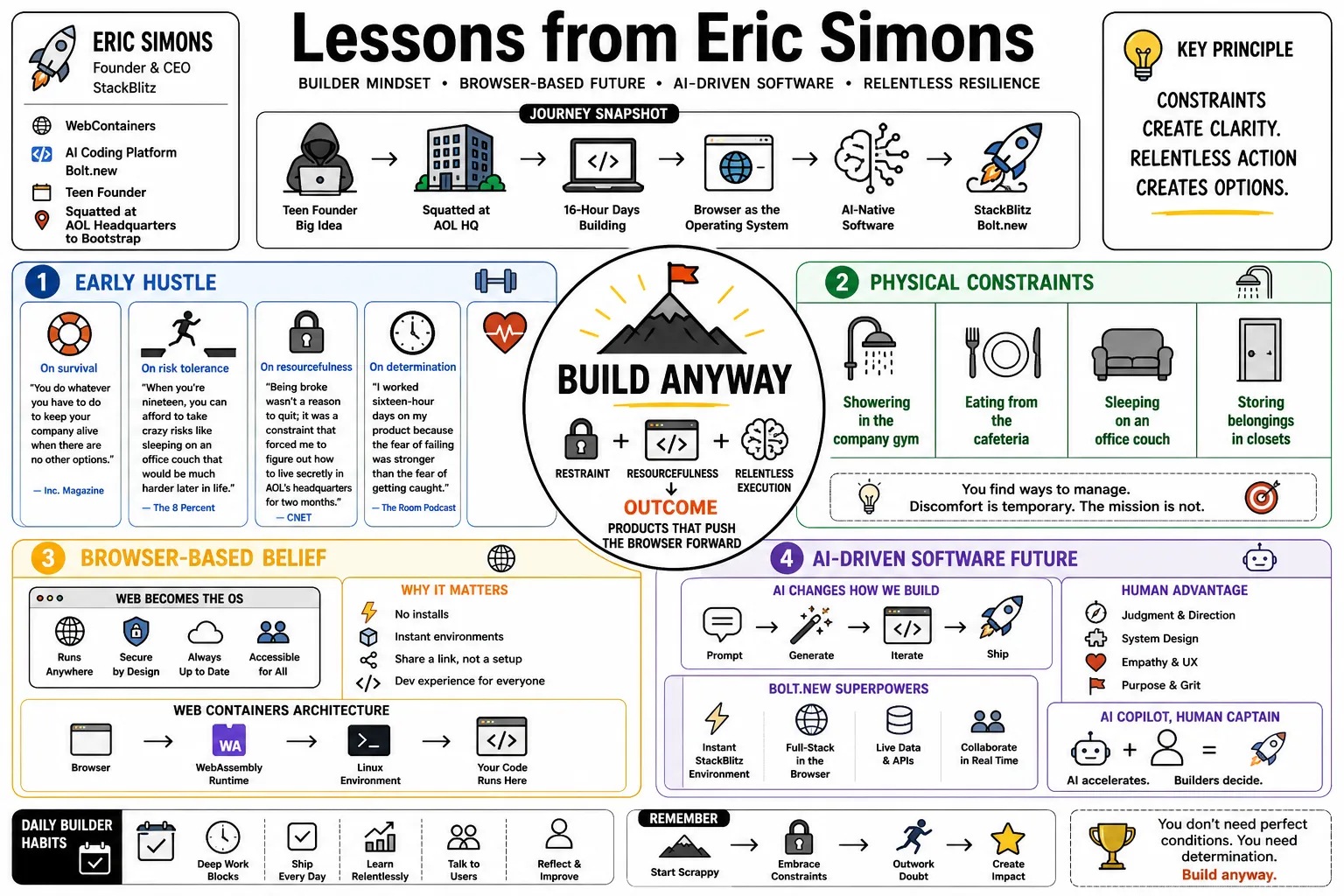
Lessons from Eric Simons
Eric Simons is the founder and CEO of StackBlitz, the company behind WebContainers and the AI coding platform Bolt.new. He first made headlines in Silicon Valley as a teenager who secretly squatted at AOL headquarters to bootstrap his early startup. This profile explores his takes on browser-based computing and AI-driven software, alongside the sheer resilience required to build a company.
Part 1: Early Hustle
- On survival: "You do whatever you have to do to keep your company alive when there are no other options." — Source: Inc. Magazine
- On risk tolerance: "When you're nineteen, you can afford to take crazy risks like sleeping on an office couch that would be much harder later in life." — Source: The 8 Percent
- On resourcefulness: "Being broke wasn't a reason to quit; it was a constraint that forced me to figure out how to live secretly in AOL's headquarters for two months." — Source: CNET
- On determination: "I worked sixteen-hour days on my product because the fear of failing was stronger than the fear of getting caught." — Source: The Room Podcast
- On physical constraints: "You find ways to manage—showering in the company gym, eating from the cafeteria, storing things in lockers." — Source: Bored Panda
- On blending in: "If you act like you belong there and look like you're working hard, most people just assume you're in a different department." — Source: Reddit
- On grit: "That period built a level of determination that carried over into everything I did afterward." — Source: Frederick.ai
- On early validation: "Getting into an incubator like Imagine K12 gave me just enough validation to believe the idea was worth any sacrifice." — Source: EdTech Magazine
- On optics: "It wasn't a publicity stunt. It was a period of intense necessity." — Source: Inc. Magazine
- On foundational habits: Simons’s early founder story matters less as folklore than as evidence of operating style: scrappiness, low burn, and persistence became part of how StackBlitz survived. — Reference: Lenny episode notes on Simons’s founder story
Part 2: The Near-Death Pivot
- On near-failure: StackBlitz was close to shutting down before Bolt; the lesson is that staying alive long enough to catch the right model shift can completely change the company. — Reference: Lenny episode notes on near-death and Bolt growth
- On timing: "Breakthrough innovations often come from staying committed to a fundamental problem until the right technological unlock finally arrives." — Source: Frederick.ai
- On overnight success: Bolt looked sudden from the outside, but Simons frames it as years of browser-infrastructure work finally meeting the right AI moment. — Reference: The Split episode on Bolt’s seven-year journey
- On catalyst moments: "The release of Claude 3.5 Sonnet was the exact unlock we needed to make Bolt functional and save the company." — Source: Startup Founder Stories
- On structural advantages: StackBlitz’s advantage came from doing the unglamorous infrastructure work first: WebContainers made browser-native development possible before the AI wave arrived. — Reference: StackBlitz WebContainers announcement
- On facing the end: "When you stare down the end of your runway, it forces absolute clarity on what the market actually wants." — Source: Product Growth Blog
- On pivoting: "The transition wasn't just a new feature; it was fundamentally changing from an online IDE to an AI-powered coding platform." — Source: Business Insider
- On staying committed: "Most would have quit when the core business stalled, but we knew the underlying virtualization tech had immense value." — Source: devtools.fm
- On traction: Bolt’s growth showed how quickly the market reacts when a hard technical foundation becomes newly useful: roughly zero to $40M ARR in about five months. — Reference: Lenny episode notes on Bolt traction
Part 3: Browser-Native Development
- On the browser as an OS: "The browser is no longer just a document viewer; it is a highly capable operating system for software development." — Source: StackBlitz Blog
- On WebContainers: "We built a way to run Node.js and npm natively inside the browser, completely removing the need for local environments." — Source: devtools.fm
- On removing friction: "Developers should be able to build, run, and deploy applications without complex local setups." — Source: StackBlitz Blog
- On local environments: "Local development environments are fragile and slow. The future is instantaneous booting in a browser tab." — Source: StackBlitz Blog
- On latency: WebContainers attack a core cloud-IDE weakness: instead of streaming a remote VM, the development environment runs inside the browser tab. — Reference: StackBlitz WebContainers post on latency
- On architectural conviction: "We bet on WebAssembly early because we knew it was the only way to run full-stack environments securely on the client." — Source: Greylock
- On native execution: "Running C++ and Node directly in the browser was considered impossible until we spent years making it work." — Source: StackBlitz Blog
- On shareability: "Code should be as easy to share as a Google Doc. You send a link, and the entire environment boots up." — Source: devtools.fm
- On offline capability: Browser-native compute changes the reliability profile: a developer can keep working through network blips because the environment is already running locally in the tab. — Reference: StackBlitz WebContainers post on offline work
- On the open web: "'Viva la Web!' is about preserving the open web as the ultimate platform for software creation." — Source: StackBlitz Blog
Part 4: Security and Supply Chains
- On sandboxing: "Running development tools in a sandboxed browser environment fundamentally changes the security profile of coding." — Source: StackBlitz Blog
- On supply chain attacks: "Local development environments are highly vulnerable to malicious npm packages. The browser's security model mitigates this." — Source: StackBlitz Blog
- On secure-by-default: Simons’s security argument is architectural: run untrusted development work inside the browser sandbox instead of on a developer’s machine or a remote VM. — Reference: StackBlitz WebContainers post on secure-by-default execution
- On zero trust: "By executing code in WebContainers, we enforce a zero-trust model that local environments simply cannot match." — Source: StackBlitz Blog
- On legacy security: "The traditional approach of securing cloud VMs is expensive and flawed compared to client-side browser isolation." — Source: devtools.fm
- On enterprise compliance: StackBlitz’s enterprise pitch is not only speed; browser-based development gives companies a cleaner way to standardize and constrain development environments. — Reference: StackBlitz seed announcement on enterprise adoption
- On vulnerability mitigation: "When every process runs inside a browser tab, a rogue script can only crash the tab, not access your file system." — Source: StackBlitz Blog
- On infrastructure risks: WebContainers reduce the need to maintain fragile remote or local dev infrastructure just to run and review web applications. — Reference: StackBlitz WebContainers post on infrastructure risk
- On isolation: "The browser has billions of dollars of security research poured into it; leveraging that for development environments just makes sense." — Source: StackBlitz Blog
Part 5: Democratizing Code
- On shattering barriers: Bolt’s promise is that a text box can become a software-creation surface for PMs, founders, and other non-developers, not only professional engineers. — Reference: The Split transcript on text-to-app creation
- On software composers: "We are shifting from an era of software engineers to an era of software composers." — Source: Business Insider
- On design empowerment: "Designers and product managers can now build production-ready applications through natural language prompting." — Source: Sacra
- On the new literacy: Simons’s AI-era lesson is that communication and product judgment matter more: the user has to describe intent clearly enough for the agent to build the right thing. — Reference: Lenny episode notes on AI-era product skills
- On accessibility: Bolt makes software creation more accessible by reducing the starting interface to plain language while keeping the execution environment close at hand. — Reference: The Split transcript on Bolt’s interface
- On leveling the field: "Tools like Bolt level the playing field, allowing anyone with domain expertise to create software solutions." — Source: Frederick.ai
- On unblocking creativity: When setup friction drops, more people can test product ideas directly; Bolt moves some creation work from waiting on engineering to trying the idea. — Reference: Lenny episode notes on PMs and entrepreneurs building
- On the creator economy: "The next wave of the creator economy will be people generating highly specific software for niche problems." — Source: Business Insider
- On ideation: Bolt compresses the path from idea to running application: describe the product, inspect the result, iterate, and deploy from the same workflow. — Reference: The Split transcript on prompt-to-deploy workflow
- On human potential: Simons sees AI coding as a way to spend less human effort on boilerplate and more on product logic, taste, and user experience. — Reference: Lenny episode notes on AI reshaping product work
Part 6: The AI Agent Era
- On vibe coding: "Vibe coding is the realization that you can generate working software simply by iterating on natural language feedback." — Source: Business Insider
- On agentic engineering: "We are entering a phase where AI agents don't just autocomplete code, but actively plan, execute, and debug full features." — Source: Business Insider
- On the workforce: "My goal is to eventually have more AI agents acting as employees than human employees." — Source: Business Insider
- On continuous iteration: Bolt works because the agent can write code, run it, see errors, and iterate inside the same browser-native environment. — Reference: Lenny episode notes on WebContainers and Bolt
- On model capabilities: "The jump from Claude 3 Opus to 3.5 Sonnet was the tipping point that made autonomous coding agents truly viable." — Source: Startup Founder Stories
- On agent contexts: For Simons, code files are not enough; an AI builder needs runtime context so it can observe the app, debug failures, and keep improving the result. — Reference: Lenny episode notes on browser runtime context
- On debugging: WebContainers make debugging part of the same browser workflow: the runtime, terminal, preview, and DevTools context are all close to the code. — Reference: StackBlitz WebContainers post on in-browser debugging
- On human oversight: Simons expects humans to move toward intent, review, and orchestration as agents take on more of the implementation loop. — Reference: Lenny episode notes on AI and org charts
- On scaling output: "A single developer directing multiple AI agents can output the work of an entire traditional engineering team." — Source: Business Insider
Part 7: Capital Efficiency
- On margins: "Running compute environments in the user's browser rather than on expensive cloud VMs gives us an incredible structural advantage in gross margins." — Source: Sacra
- On lean scaling: Bolt’s economics are tied to architecture and team shape: a small high-context team can move quickly when the runtime avoids heavy cloud-VM assumptions. — Reference: Lenny episode notes on small-team scaling
- On the AI tool reckoning: "The industry faces a reckoning regarding AI tools and churn; the winners will build sticky, high-value services that go beyond one-off generation." — Source: Business Insider
- On building boundaries: "Our vision shifted to 'Build Without Boundaries,' focusing on creating platforms that users live in, not just visit." — Source: Business Insider
- On infrastructure moats: The moat was built before the market looked obvious: seven years of WebContainer work became valuable once AI agents needed fast browser execution. — Reference: The Split episode on seven-year infrastructure work
- On product-led growth: Bolt’s product spread because its output was visible and shareable; people could show what they built, which turned usage into distribution. — Reference: Lenny episode notes on launch and viral growth
- On surviving the trough: StackBlitz survived by keeping burn low enough to keep experimenting until the model capability and market timing finally lined up. — Reference: Lenny episode notes on low burn and runway
- On value capture: "In the AI era, value accrues to the platforms that combine best-in-class models with the best execution environments." — Source: Sacra
- On market timing: Simons’s story is a timing lesson: deep infrastructure can look premature for years, then become obvious once the enabling technology catches up. — Reference: The Split episode on timing and persistence
Part 8: The Future of Software Creation
- On the open ecosystem: "We must ensure that the tools of the future remain part of the open web, accessible to anyone with a browser." — Source: StackBlitz Blog
- On continuous deployment: Bolt collapses creation and deployment into one loop: the app is generated, previewed, edited, and shipped from the same browser workspace. — Reference: The Split transcript on browser deployment
- On specialized models: Bolt’s inflection came when model capability finally matched the runtime; stronger coding models made the existing WebContainer foundation commercially useful. — Reference: Lenny episode notes on Claude 3.5 Sonnet
- On the end of setup: "Future generations of developers will look back at configuring local development environments as a bizarre historical artifact." — Source: devtools.fm
- On compounding innovation: Instant browser compute compounds with AI agents: faster runtime feedback means more attempts, more fixes, and shorter learning loops. — Reference: StackBlitz WebContainers post on instant compute
- On shifting bottlenecks: "The bottleneck in software creation is shifting from writing syntax to defining clear product requirements." — Source: Business Insider
- On ubiquitous software: "Soon, custom software will be so cheap to produce that people will generate temporary apps for single-day events and throw them away." — Source: Frederick.ai
- On global participation: Simons’s broader bet is that browser-based tools make software creation more widely available because the starting point is a tab, not a custom local machine. — Reference: StackBlitz seed announcement on browser-based development
- On legacy codebases: "AI will eventually be able to ingest legacy enterprise codebases and seamlessly translate them into modern web frameworks." — Source: Startup Founder Stories