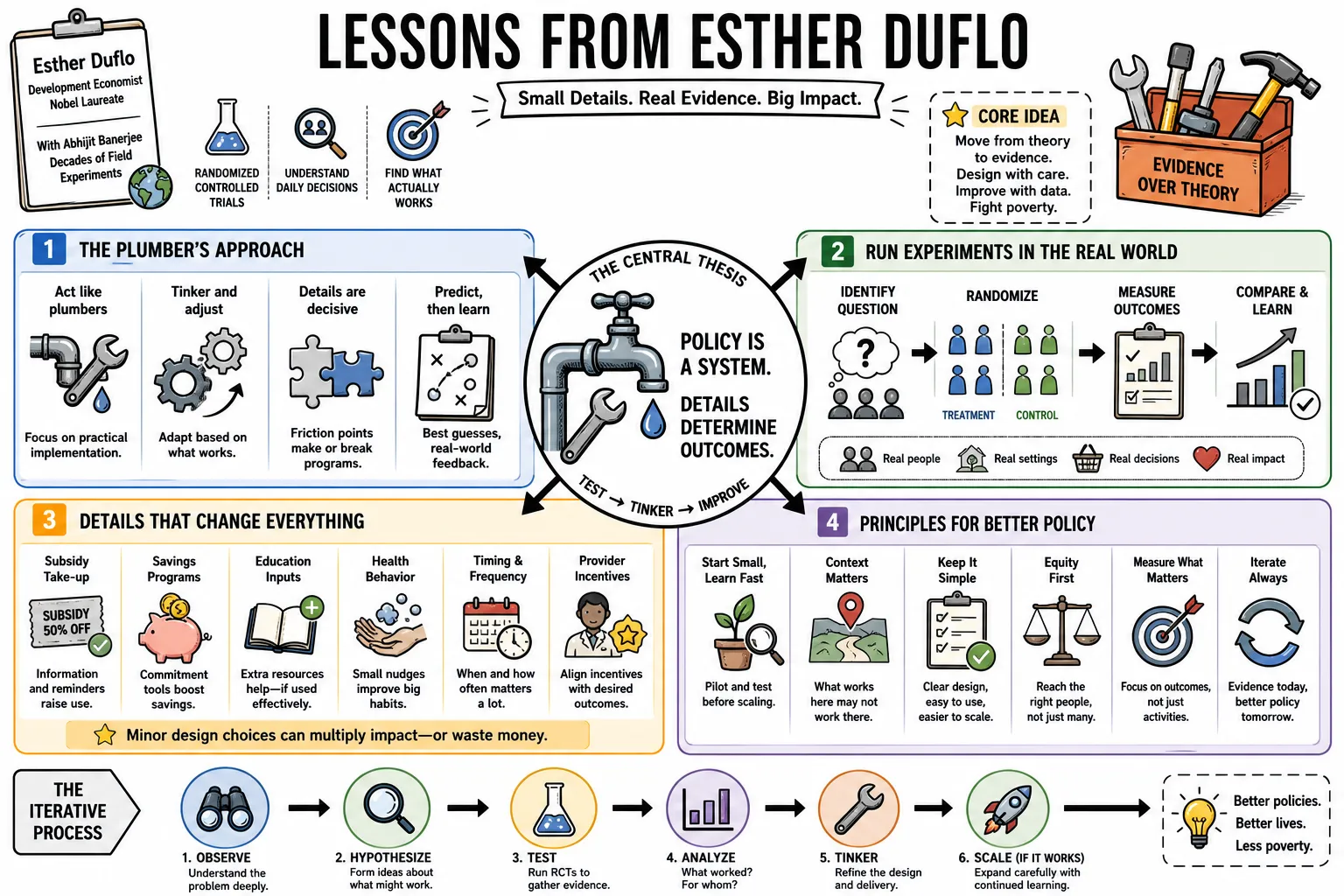
Lessons from Esther Duflo
Esther Duflo helped pull development economics away from abstract theories and toward randomized controlled trials to test what actually works. Alongside Abhijit Banerjee, she has spent decades running field experiments to map the daily decisions of the global poor. This compilation covers her findings on how minor details in policy design determine whether a program fights poverty or just wastes money.
Part 1: The Plumber's Approach
- On the economist's role: "Economists should act more like plumbers—concerned with the practical details of how a policy is implemented, rather than just the grand theory of what to do." — Source: [The Economist as Plumber]
- On the necessity of tinkering: "Because economic models often lack the theoretical guidance to predict how specific details will play out, we must be prepared to tinker and adjust based on what actually works in the real world." — Source: [The Economist as Plumber]
- On the danger of details: "Details that are often viewed as uninteresting by academic economists are usually the exact friction points where a policy succeeds or fails in reality." — Source: [The Economist as Plumber]
- On predicting outcomes: "Plumbers try to predict as well as possible what may work, mindful that the real world is messy and requires constant calibration." — Source: [The Economist as Plumber]
- On moving beyond reports: "An economist's job is not finished when they deliver a report; they must engage with the practical, often chaotic reality of how a program is rolled out." — Source: [The Economist as Plumber]
- On humility in design: "We do not know in advance which small administrative hurdle will prevent someone from accessing a benefit, which is why we must test the plumbing before turning on the water." — Source: [The Economist as Plumber]
- On the value of field experiments: "Randomized controlled trials allow us to treat poverty alleviation like a science, giving us the tools to shelve ideas that fail and scale those that succeed." — Source: [2019 Nobel Prize Lecture]
- On grand solutions: "There is no single formula to make a country prosperous, but there are thousands of small, practical questions we can answer to improve daily life." — Source: [2019 Nobel Prize Lecture]
- On the limitations of intuition: "Intuition is a poor guide for policy. What seems obvious in a seminar room often completely falls apart in a village." — Source: [Good Economics for Hard Times]
- On continuous learning: "Good economics means being willing to change your mind when the experimental data contradicts your prior beliefs." — Source: [Good Economics for Hard Times]
Part 2: Rethinking Poverty and Human Behavior
- On the agency of the poor: "The poor are just as rational as anyone else, but they have to make everyday decisions with far less information and a much smaller margin for error." — Source: [Poor Economics]
- On the burden of choice: "Wealthy people do not have to think about chlorinating their water or ensuring their doctors are qualified; these decisions are made for them. The poor bear the cognitive burden of navigating these choices daily." — Source: [Poor Economics]
- On financial discipline: "We often mistake a lack of savings for a lack of discipline, when in reality, the poor simply lack access to the automated, secure saving mechanisms that wealthier people take for granted." — Source: [Poor Economics]
- On risk and entrepreneurship: "Many micro-entrepreneurs in developing countries are not running businesses because they want to be the next Henry Ford, but because they have no other way to survive." — Source: [Poor Economics]
- On the trap of low expectations: "When people believe that their efforts will not lead to significant improvements in their lives, they often stop trying, creating a self-fulfilling cycle of stagnation." — Source: [Poor Economics]
- On stress and decision making: "Living in poverty produces a constant physiological stress that consumes cognitive bandwidth, making it harder to make long-term financial plans." — Source: [Poor Economics]
- On the value of hope: "Hope is a vital input for human capital investment. If parents do not believe their child can get a good job, they will not sacrifice to keep them in school." — Source: [Poor Economics]
- On borrowing costs: "The poor face exorbitant interest rates not just because of default risk, but because the administrative cost of collecting small loans forces moneylenders to charge a steep premium." — Source: [Poor Economics]
- On the allure of television: "When resources are extremely tight, people sometimes spend money on a television instead of more calories because the need for entertainment and relief from boredom is deeply human." — Source: [Poor Economics]
- On understanding daily life: "To design effective policy, we must first build a better understanding of how people live their lives from the ground up, one question at a time." — Source: [2019 Nobel Prize Lecture]
Part 3: Designing Better Health and Education Systems
- On immunization incentives: "Providing a small, tangible incentive—like a bag of lentils—can dramatically increase vaccination rates by offsetting the immediate inconvenience of traveling to a clinic." — Source: [J-PAL Immunization Study]
- On teacher absenteeism: "Hiring local contract teachers and tying their pay to verified attendance can be far more effective at improving student outcomes than simply pouring more money into the existing system." — Source: [Poor Economics]
- On curriculum pacing: "Schools in many developing countries are geared toward the top students, leaving the majority behind because the curriculum moves much faster than the average child can learn." — Source: [Poor Economics]
- On preventive care: "People are often willing to spend heavily on desperate, expensive cures when they are sick, but heavily discount the value of cheap preventive measures when they are healthy." — Source: [Poor Economics]
- On targeted education: "Grouping children by their current learning level rather than their age allows teachers to address specific gaps and significantly improves basic literacy and numeracy." — Source: [J-PAL Education Research]
- On the illusion of school enrollment: "Getting children into the classroom is only half the battle; if the pedagogy is disconnected from their reality, they will sit at desks for years without learning to read." — Source: [Poor Economics]
- On information gaps: "Simply informing parents about the actual returns to education for different years of schooling can shift their investment toward keeping their children in school longer." — Source: [Poor Economics]
- On default options in health: "Making safe water the default option—such as placing a chlorine dispenser directly next to a communal water source—radically increases usage compared to selling chlorine in stores." — Source: [TED Talk 2010]
- On maternal health: "Improving maternal health outcomes requires understanding the social dynamics of the household, not just building a closer clinic." — Source: [Poor Economics]
Part 4: Questioning Economic Dogma and "Iron Laws"
- On the myth of iron laws: "There are no iron laws of economics; human behavior is far too complex and context-dependent to be reduced to rigid mathematical certainties." — Source: [Good Economics for Hard Times]
- On simplistic narratives: "Ignorance, intuitions, ideology, and inertia combine to give us answers that look plausible, promise much, and predictably betray us." — Source: [Good Economics for Hard Times]
- On the seduction of the obvious: "We must resist the seduction of the obvious and remain skeptical of policies that sound perfectly logical but have never been empirically tested." — Source: [Good Economics for Hard Times]
- On universal basic income: "The fear that unconditional cash transfers will make people lazy is largely unfounded; evidence consistently shows that people use the money to improve their diets and invest in small businesses." — Source: [Good Economics for Hard Times]
- On minimum wage: "The standard model predicts that raising the minimum wage must reduce employment, yet empirical data frequently shows that moderate increases have negligible or even positive effects on job numbers." — Source: [Good Economics for Hard Times]
- On financial incentives: "Economists vastly overestimate the role of financial incentives in motivating human behavior while underestimating the power of dignity, status, and social connection." — Source: [ReThinking with Adam Grant]
- On acknowledging limits: "The only recourse we have against bad ideas is to be vigilant, be patient with complexity, and be honest about what we know and what we can know." — Source: [Good Economics for Hard Times]
- On economic models: "Models are useful tools for organizing our thoughts, but they become dangerous when policymakers mistake the map for the territory." — Source: [Conversations with Tyler]
- On ideological blind spots: "When we let ideology dictate our expectations of how markets should work, we ignore the empirical reality of how people actually behave." — Source: [Good Economics for Hard Times]
Part 5: The Reality of Migration and Movement
- On the reluctance to move: "Despite the massive wage gaps between countries, the most surprising fact about migration is not how many people move, but how few actually do." — Source: [Good Economics for Hard Times]
- On the uncertainty of migration: "Migration represents a plunge into uncertainty. Most people prefer the safety of their social networks and familiar surroundings over the prospect of higher wages in a foreign place." — Source: [Good Economics for Hard Times]
- On low-skilled immigration: "Evidence shows that an influx of low-skilled immigrants does not generally depress the wages of native-born workers, because immigrants expand the local economy and take jobs natives avoid." — Source: [Good Economics for Hard Times]
- On the true drivers of migration: "People typically migrate out of desperation—fleeing violence or total economic collapse—rather than rationally maximizing their lifetime earnings." — Source: [Good Economics for Hard Times]
- On internal mobility barriers: "Even within the same country, workers are surprisingly immobile due to housing costs, lack of information, and the risk of losing their informal safety nets." — Source: [Good Economics for Hard Times]
- On policy paranoia: "Wealthy nations design incredibly hostile immigration policies based on the false assumption that easing restrictions would lead to an unmanageable flood of migrants." — Source: [Good Economics for Hard Times]
- On the benefits of diversity: "Immigrants bring different skill sets and consumption patterns that complement the local workforce, creating a more dynamic and resilient local economy." — Source: [Good Economics for Hard Times]
- On the psychological toll: "We consistently underestimate the psychological cost of leaving one's home and culture, which acts as a massive natural barrier to global movement." — Source: [Good Economics for Hard Times]
- On framing the debate: "The debate around migration is overwhelmingly driven by fear rather than facts, ignoring that migration is a symptom of global inequality, not the cause of domestic stagnation." — Source: [Good Economics for Hard Times]
Part 6: Navigating Trade and Inequality
- On the uneven benefits of trade: "Trade expands the overall economic pie, but it also creates clear winners and losers, and the market does not automatically compensate those whose livelihoods are destroyed." — Source: [Good Economics for Hard Times]
- On geographic immobility and trade: "When a factory closes due to foreign competition, workers rarely pack up and move to a booming city; instead, the entire local community enters a prolonged economic depression." — Source: [Good Economics for Hard Times]
- On the pain of transition: "Economic models assume that labor reallocation happens smoothly and instantly, but in reality, retraining a middle-aged factory worker for a completely different industry is incredibly difficult." — Source: [Good Economics for Hard Times]
- On the role of luck: "Success in the modern global economy is heavily determined by the luck of where you were born and what industry your town happened to rely on." — Source: [Good Economics for Hard Times]
- On targeted compensation: "If we are going to reap the aggregate benefits of free trade, we have a moral and economic obligation to aggressively support the specific communities that bear the localized costs." — Source: [Good Economics for Hard Times]
- On the rise of inequality: "Extreme wealth concentration is not a natural law of capitalism; it is the result of specific policy choices regarding taxation, labor rights, and corporate regulation." — Source: [Good Economics for Hard Times]
- On executive compensation: "The astronomical rise in CEO pay is difficult to justify through marginal productivity; it is largely driven by changing social norms and institutional capture." — Source: [Good Economics for Hard Times]
- On automation anxiety: "The threat of automation is real, but tax codes frequently encourage companies to replace human workers with machines even when the machines are only marginally more efficient." — Source: [Good Economics for Hard Times]
- On economic dignity: "When a region loses its primary industry, the loss of jobs is accompanied by a profound loss of identity, purpose, and community standing." — Source: [Good Economics for Hard Times]
- On questioning growth: "Chasing GDP growth at all costs in wealthy nations often yields diminishing returns for human happiness, while ignoring the distributional consequences." — Source: [Good Economics for Hard Times]
Part 7: Climate, Environment, and Shared Responsibility
- On unequal consequences: "Climate change is fundamentally an issue of inequality; the wealthy countries caused the problem, but the poorest countries will face the most devastating consequences." — Source: [TEDxLondon Climate Curious]
- On technological optimism: "We cannot rely entirely on a magical technological breakthrough to solve the climate crisis; we must also fundamentally change how we consume and regulate energy." — Source: [Good Economics for Hard Times]
- On carbon taxation: "A carbon tax is economically necessary, but it will face fierce political backlash unless the revenue is visibly and directly redistributed to offset the burden on lower-income citizens." — Source: [Good Economics for Hard Times]
- On behavior change: "People are surprisingly willing to change their consumption habits to protect the environment if the changes are made convenient and framed around shared social responsibility." — Source: [Good Economics for Hard Times]
- On adapting to heat: "In developing nations, rising temperatures translate directly into lost agricultural productivity and increased mortality because they lack the infrastructure to adapt." — Source: [Good Economics for Hard Times]
- On environmental regulations: "Firms often argue that strict environmental regulations will destroy competitiveness, yet evidence shows that well-designed rules spur innovation and efficiency." — Source: [Good Economics for Hard Times]
- On global compensation: "There is a strong moral and economic argument for wealthy nations to heavily subsidize green technology and climate adaptation in the developing world." — Source: [Good Economics for Hard Times]
- On the fallacy of GDP fixes: "Tying poverty alleviation solely to endless carbon-intensive economic growth is a dangerous framework in a warming world." — Source: [TEDxLondon Climate Curious]
- On long-term discounting: "Humans are notoriously bad at weighing future environmental catastrophes against present conveniences, which is why policy must force the market to internalize those costs today." — Source: [Good Economics for Hard Times]
Part 8: Trust, Policy, and the Future of Economics
- On the loss of trust: "Economists have lost the public's trust because they often speak with unearned certainty about policies that end up harming working-class communities." — Source: [Good Economics for Hard Times]
- On restoring credibility: "To regain credibility, economists must admit when they are wrong, focus on empirical evidence, and listen to the lived experiences of the people they study." — Source: [Talking Politics Podcast]
- On women in economics: "Economics has historically been dominated by male perspectives, which has narrowed the types of questions the field asks and the policies it recommends." — Source: [2019 Nobel Banquet Speech]
- On political representation: "When women are elected to local leadership roles, they systematically invest more in public goods that benefit families, such as clean water and road infrastructure." — Source: [J-PAL Political Participation Research]
- On systemic discrimination: "Discrimination in the labor market is not just a moral failure; it is a massive misallocation of human talent that drags down the entire economy." — Source: [Good Economics for Hard Times]
- On government intervention: "The debate over whether government should be 'big' or 'small' is useless; the focus should be on building a government that is competent, transparent, and responsive." — Source: [Good Economics for Hard Times]
- On addressing polarization: "Political polarization is exacerbated by economic anxiety. When people feel secure in their livelihoods, they are less susceptible to divisive rhetoric." — Source: [Good Economics for Hard Times]
- On evaluating social programs: "We cannot rely on good intentions to alleviate poverty; we must rigorously test social programs to ensure they actually deliver the promised results." — Source: [2019 Nobel Prize Lecture]
- On the ultimate goal: "The goal of economics should not just be to maximize aggregate wealth, but to figure out how to structure society so that everyone can lead a life of dignity." — Source: [Good Economics for Hard Times]