Ethan Kross is an experimental psychologist and the director of the Emotion & Self Control Laboratory at the University of Michigan, where he researches how the conversations we have with ourselves affect our health and performance. He is best known for his work on chatter, the cycle of negative rumination, and for identifying practical techniques like distanced self-talk to break these loops. This profile collects his core findings on managing the internal monologue, offering concrete strategies for anyone looking to navigate stress, improve focus, and build healthier emotional habits.
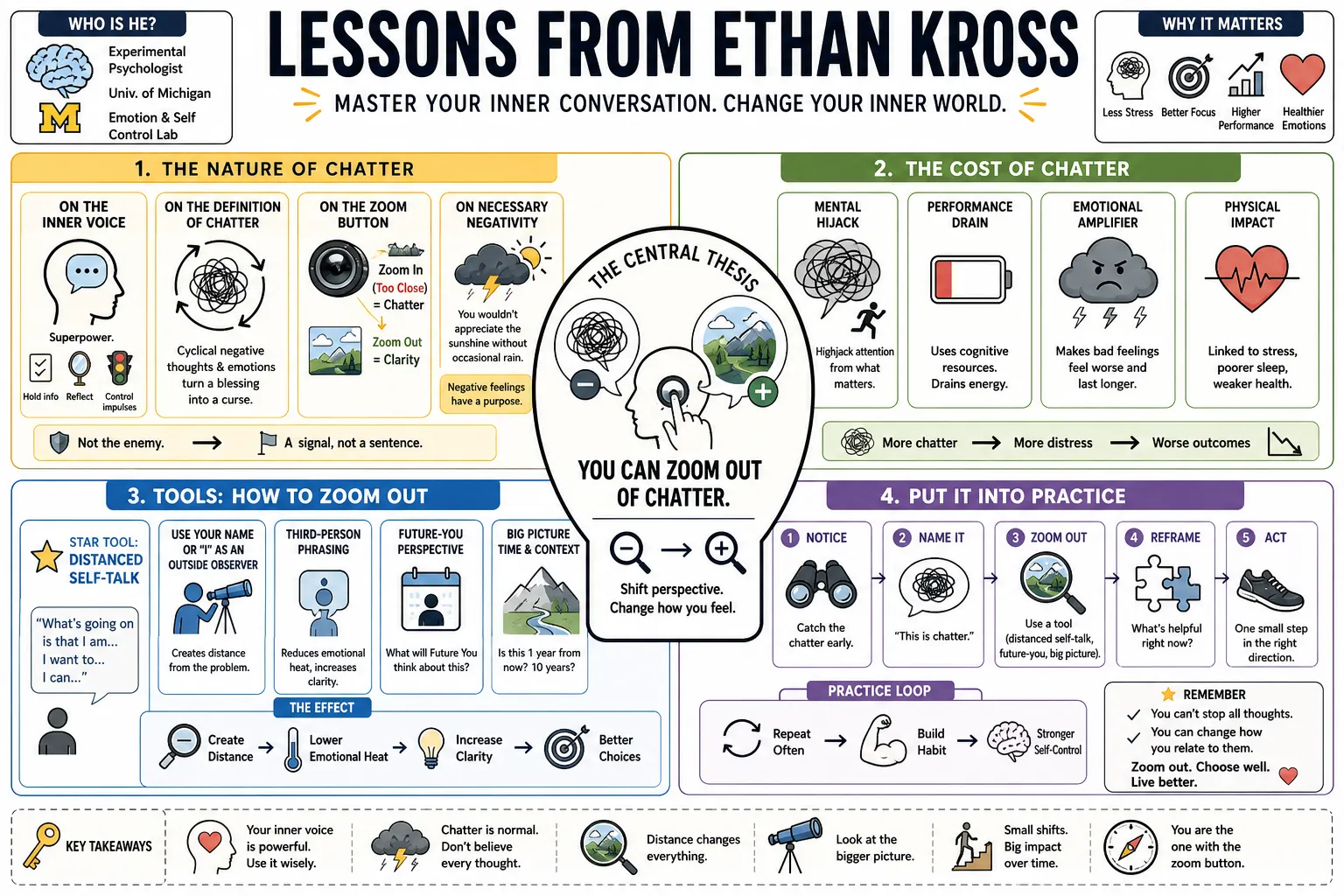
Part 1: The Nature of Chatter
- On the Inner Voice: "Our inner voice is a superpower that allows us to hold information in mind, reflect on our decisions, and control our impulses." — Source: [Chatter: The Voice in Our Head]
- On the Definition of Chatter: "Chatter consists of the cyclical negative thoughts and emotions that turn our singular capacity for introspection into a curse rather than a blessing." — Source: [Chatter: The Voice in Our Head]
- On the Zoom Button: "We can think of the mind as a lens and our inner voice as a button that zooms it either in or out. Chatter happens when we zoom in too close on an issue." — Source: [SuperSummary Analysis]
- On Necessary Negativity: "You wouldn't want to live a life without an inner voice that upsets you some of the time, because that internal friction signals when we need to pay attention to a problem." — Source: [Chatter: The Voice in Our Head]
- On Cognitive Bandwidth: Chatter hijacks our executive function and consumes the working memory we need to solve complex problems or simply be present in the moment. — Source: [Huberman Lab Podcast]
- On Mental Flexibility: The goal is never to permanently silence our internal monologue, but rather to recognize when it is harming us and bend it in a more productive direction. — Source: [Chatter: The Voice in Our Head]
- On the Generational Voice: "The voices of culture influence our parents' inner voices, which in turn influence our own. We are like Russian nesting dolls of mental conversations." — Source: [Shortform Guide]
- On Friction vs. Flow: When our inner voice is functioning well, it operates quietly in the background; chatter occurs when that voice gets snagged on an unresolved conflict or perceived threat. — Source: [Ten Percent Happier]
- On Evolution's Intent: Negative emotions like fear and sadness are evolutionary adaptations designed to keep us safe, meaning our inner voice is functioning exactly as it was built to, even when it makes us miserable. — Source: [Hidden Brain Podcast]
- On Emotional Escalation: When we obsess over a slight or a failure, our inner voice acts like an amplifier, taking a fleeting emotional reaction and prolonging it into a sustained state of distress. — Source: [Chatter: The Voice in Our Head]
Part 2: Distanced Self-Talk
- On Solomon's Paradox: Humans are remarkably adept at giving objective, logical advice to their friends, but struggle to apply that same wisdom to their own problems. — Source: [Huberman Lab Podcast]
- On Shifting Pronouns: Using your own name or second-person pronouns when thinking about a personal struggle forces the brain into the same analytical mode it uses to help others. — Source: [TED Talk]
- On the Wall of Emotion: Distanced self-talk pierces through the emotional intensity of a crisis, allowing the brain's executive centers to step in and offer rational guidance. — Source: [Hidden Brain Podcast]
- On Temporal Distancing: "Engage in mental time travel. Another way to gain distance and broaden your perspective is to think about how you'll feel a month, a year, or even longer from now." — Source: [Chatter: The Voice in Our Head]
- On the Malala Example: When Malala Yousafzai faced the Taliban, she instinctively shifted to third-person self-talk, asking "What will you do, Malala?", to bypass panic and access her courage. — Source: [TED Talk]
- On Silent Coaching: Using your name to coach yourself is most effective when done silently in your own head, preventing social awkwardness while still reaping the cognitive benefits. — Source: [Remarkable People Podcast]
- On De-escalating Threat: When you use your own name during a stressful event like a presentation, your physiological response shifts from a threat state of panic to a challenge state of focus. — Source: [Huberman Lab Podcast]
- On Gaining Perspective: "Distance doesn't solve our problems, but it increases the likelihood that we can by unclouding our verbal stream." — Source: [Chatter: The Voice in Our Head]
- On Expressive Writing: Journaling about a difficult experience from the perspective of an outside observer helps create the psychological space needed to process trauma without reliving it. — Source: [Hidden Brain Podcast]
Part 3: Environmental Interventions
- On the Definition of Awe: Awe is the emotional response we have when we encounter something vast and indescribable that fundamentally challenges our existing mental models of the world. — Source: [Huberman Lab Podcast]
- On the Shrinking Self: "When you contemplate something vast like a mountain range or a 300-year-old tree, your own ego and personal problems feel smaller and more manageable." — Source: [BBC Worklife]
- On Attention Restoration: Urban environments demand taxing, directed attention to navigate threats, while natural environments offer soft fascination that lets the mind rest and recover. — Source: [Chatter: The Voice in Our Head]
- On Awe Walks: Intentionally walking through a park or arboretum while seeking out majestic details is a reliable, accessible way to break a destructive cycle of rumination. — Source: [Ten Percent Happier]
- On Human-Made Vastness: Awe is not exclusive to nature; contemplating human achievements like space exploration, deep scientific discoveries, or grand architecture can trigger the exact same perspective shift. — Source: [BBC Worklife]
- On Environmental Order: When our internal world feels chaotic, cleaning a room, organizing a desk, or clearing out a closet can impose a sense of external control that actually calms the mind. — Source: [Chatter: The Voice in Our Head]
- On Sensory Shifters: Changing your immediate physical environment by putting on a specific piece of music or smelling a familiar scent can act as a circuit breaker for spiraling thoughts. — Source: [Hidden Brain Podcast]
- On the Little Earthquake: Experiencing awe acts like a mild seismic event in the brain, rattling our self-absorption just enough to let new, more constructive perspectives slip in. — Source: [BBC Worklife]
- On the Power of Trees: Simply looking at a canopy of large trees shifts our visual focus upward and outward, physically mirroring the cognitive process of broadening our perspective. — Source: [Huberman Lab Podcast]
- On Visual Horizons: Exposing ourselves to wide, sweeping vistas helps dilute the concentration of our internal monologue, reminding us that we are just one small piece of a massive universe. — Source: [Chatter: The Voice in Our Head]
Part 4: Social Media & Technology
- On Digital Nuance: Social media is neither a pure evil nor a universal good; its impact on our psychological well-being is dictated entirely by how we choose to engage with it. — Source: [Harvard T.H. Chan Seminar]
- On Passive Use: Mindlessly scrolling through feeds without interacting acts as a conduit for envy, as we inevitably compare our internal struggles with the curated highlight reels of others. — Source: [APA Speaking of Psychology]
- On Active Engagement: Using social media directly to message friends, comment on posts, and build real communities can actually buffer against loneliness and improve overall mental health. — Source: [Huberman Lab Podcast]
- On the Digital Megaphone: The internet provides a frictionless platform to broadcast our emotions at their absolute peak, bypassing the natural cooling-off period that offline interactions require. — Source: [Harvard T.H. Chan Seminar]
- On Support Accessibility: For individuals grappling with severe depression, the digital barrier of social media often makes it safer and easier to ask for help than a face-to-face conversation. — Source: [APA Speaking of Psychology]
- On Digital Citizenship: Just as we teach children how to cross a busy street safely, we must actively train young people in the etiquette and emotional navigation of digital spaces. — Source: [Harvard T.H. Chan Seminar]
- On Profile Curation: Taking time to review our own curated profiles can occasionally serve as a self-esteem booster, reminding us of our past successes when we are doubting our current abilities. — Source: [APA Speaking of Psychology]
- On the Feed as a Trigger: Social networks frequently accelerate internal chatter by serving up highly polarizing content designed specifically to agitate our evolutionary threat-detection systems. — Source: [Huberman Lab Podcast]
- On Strategic Muting: Actively curating your digital environment by muting or unfollowing accounts that reliably trigger feelings of inadequacy is a basic form of modern emotional hygiene. — Source: [Ten Percent Happier]
Part 5: Relationships & Co-rumination
- On the Danger of Venting: Simply talking about our problems without moving toward a solution can act like throwing logs on a fire, keeping the negative emotions burning longer than necessary. — Source: [Huberman Lab Podcast]
- On Co-rumination: When two people continuously rehash a problem together without seeking a resolution, their shared validation amplifies their anxiety and deepens their emotional rut. — Source: [Chatter: The Voice in Our Head]
- On Actionable Empathy: The most effective social support integrates the emotional need to be heard with the cognitive need to find a solution and broaden one's perspective. — Source: [Shortform Guide]
- On the Support Paradox: Relying too heavily on friends to process every minor frustration can eventually exhaust their goodwill and damage the very relationships we lean on for stability. — Source: [Hidden Brain Podcast]
- On Selecting Advisors: We should not treat all friends as equally equipped to help us with every problem; we must deliberately choose a chatter board of advisors tailored to the specific issue at hand. — Source: [Chatter: The Voice in Our Head]
- On Invisible Support: The best way to help someone who is struggling with chatter is often to provide assistance indirectly, so they do not feel incompetent or micromanaged. — Source: [Huberman Lab Podcast]
- On Empathetic Listening: True support requires you to initially validate the other person's pain before gently guiding them to look at the situation from a wider, more objective angle. — Source: [Ten Percent Happier]
- On Contagious Chatter: Anxiety and rumination can be highly infectious within a social circle or team; one person's unmanaged stress can easily become a collective obsession. — Source: [Chatter: The Voice in Our Head]
- On the Limits of Affection: Love and caring are not substitutes for perspective. A partner might care deeply about your distress but still be the wrong person to help you solve a specific workplace crisis. — Source: [Huberman Lab Podcast]
Part 6: Physical Interventions
- On Compensatory Control: When the internal mind feels chaotic, completing a strict physical ritual provides an immediate illusion of order that directly reduces psychological distress. — Source: [Chatter: The Voice in Our Head]
- On Attentional Distraction: Rituals require us to execute specific steps in an exact order, effectively monopolizing our working memory and leaving no room for negative self-talk to intrude. — Source: [Huberman Lab Podcast]
- On the Cocktail Effect: "The reason rituals are so effective at helping us manage our inner voices is that they're a chatter-reducing cocktail that influences us through several avenues at once." — Source: [Chatter: The Voice in Our Head]
- On Psychological Placebos: The power of a ritual or lucky object often lies in our belief that it works; this expectation alone prepares the brain to manage stress more effectively. — Source: [Shortform Guide]
- On Predictability: By engaging in a rigid, repetitive routine before a high-stakes event, we satisfy the brain's deep-seated craving for certainty in an unpredictable environment. — Source: [Hidden Brain Podcast]
- On Elite Performance: High-level athletes like Rafael Nadal use elaborate on-court routines not out of superstition, but as a deliberate strategy to order their surroundings and quiet their minds. — Source: [Ten Percent Happier]
- On Household Chores: Engaging in menial tasks like washing the dishes or folding laundry can act as a potent physical reset when professional anxieties begin to spiral out of control. — Source: [Huberman Lab Podcast]
- On Affectionate Touch: The physical sensation of being hugged or held by a trusted loved one instantly downregulates the nervous system, cutting through mental chatter faster than words. — Source: [Chatter: The Voice in Our Head]
- On Physical Grounding: Using a tactile object like holding a specific stone or tracing the edge of a desk can physically anchor an individual to the present moment when their thoughts race into the future. — Source: [Hidden Brain Podcast]
- On the Power of Charms: Even if we consciously know a lucky charm possesses no magical properties, the psychological comfort it provides translates into very real performance benefits under pressure. — Source: [Chatter: The Voice in Our Head]
Part 7: Mind-Body Connection & Health
- On the Stress Response: Chatter prolongs our body's fight or flight response, taking a transient burst of cortisol meant for acute survival and turning it into a chronic, toxic drip. — Source: [Huberman Lab Podcast]
- On Physical Weathering: Consistently elevated stress hormones driven by a critical inner voice can actively accelerate the aging of our cells and increase our vulnerability to cardiovascular disease. — Source: [Chatter: The Voice in Our Head]
- On Epigenetic Impact: Unmanaged rumination alters gene expression, particularly by upregulating the genes responsible for bodily inflammation. — Source: [Huberman Lab Podcast]
- On Sleep Architecture: Nighttime chatter destroys restorative sleep, as the brain treats unresolved emotional conflicts with the same urgency as a physical predator standing beside the bed. — Source: [Hidden Brain Podcast]
- On the Illusion of Threat: The body cannot distinguish between a real, immediate danger and an embarrassing memory replayed over and over by the inner voice. — Source: [Ten Percent Happier]
- On Digestive Health: Because the brain and the gut are intimately connected, chronic mental chatter frequently manifests physically as stomach pain, nausea, and digestive disorders. — Source: [Chatter: The Voice in Our Head]
- On Pain Perception: Anticipating pain and obsessing over physical discomfort actually amplifies the brain's pain signals, making the subjective experience far worse than it needs to be. — Source: [Huberman Lab Podcast]
- On Somatic Markers: Our physical bodily sensations like a tight chest or shallow breathing often serve as the earliest warning system that our internal monologue has shifted into destructive chatter. — Source: [Hidden Brain Podcast]
- On Healing Capacity: Learning to distance oneself from negative thoughts improves mood and measurably reduces inflammation markers to speed physical recovery from illness. — Source: [Chatter: The Voice in Our Head]
Part 8: Leadership, Work, & Performance
- On Performance Infrastructure: Emotional regulation is a fundamental cognitive infrastructure that allows leaders to make sound, strategic decisions under pressure. — Source: [Huberman Lab Podcast]
- On Unlinking: When a professional athlete or experienced leader begins overthinking a deeply ingrained habit, the conscious mind interferes with automatic muscle memory, causing catastrophic failure. — Source: [Chatter: The Voice in Our Head]
- On Analysis Paralysis: Chatter consumes the exact cognitive resources required for creative problem-solving, locking executives into a state of endless deliberation with no forward motion. — Source: [Ten Percent Happier]
- On Advising Teams: A strong manager acts as a chatter advisor for their team, offering a calibrated mix of genuine empathy and crisp, actionable reframing to pull employees out of mental ruts. — Source: [Huberman Lab Podcast]
- On Workspace Order: Leaders who insist on maintaining a clean, highly organized physical workspace are intuitively utilizing environmental control to keep their internal bandwidth clear for complex tasks. — Source: [Chatter: The Voice in Our Head]
- On High-Stakes Presentations: Shifting your internal dialogue to the third person moments before stepping onto a stage or entering a boardroom can dramatically blunt performance anxiety. — Source: [TED Talk]
- On Executive Time Travel: When facing a severe organizational crisis, pausing to ask "How will this specific failure impact the company in five years?" prevents panicked, short-term reactions. — Source: [Huberman Lab Podcast]
- On Emotional Contagion in the Office: Because leaders set the emotional tone for their organizations, an executive who openly spirals into unmanaged chatter will rapidly spread anxiety throughout their entire team. — Source: [Chatter: The Voice in Our Head]
- On Emotions as Data: The most effective operators do not suppress their inner voice; they treat their immediate emotional reactions as raw data, analyzing it from a distance before deciding how to act. — Source: [Hidden Brain Podcast]