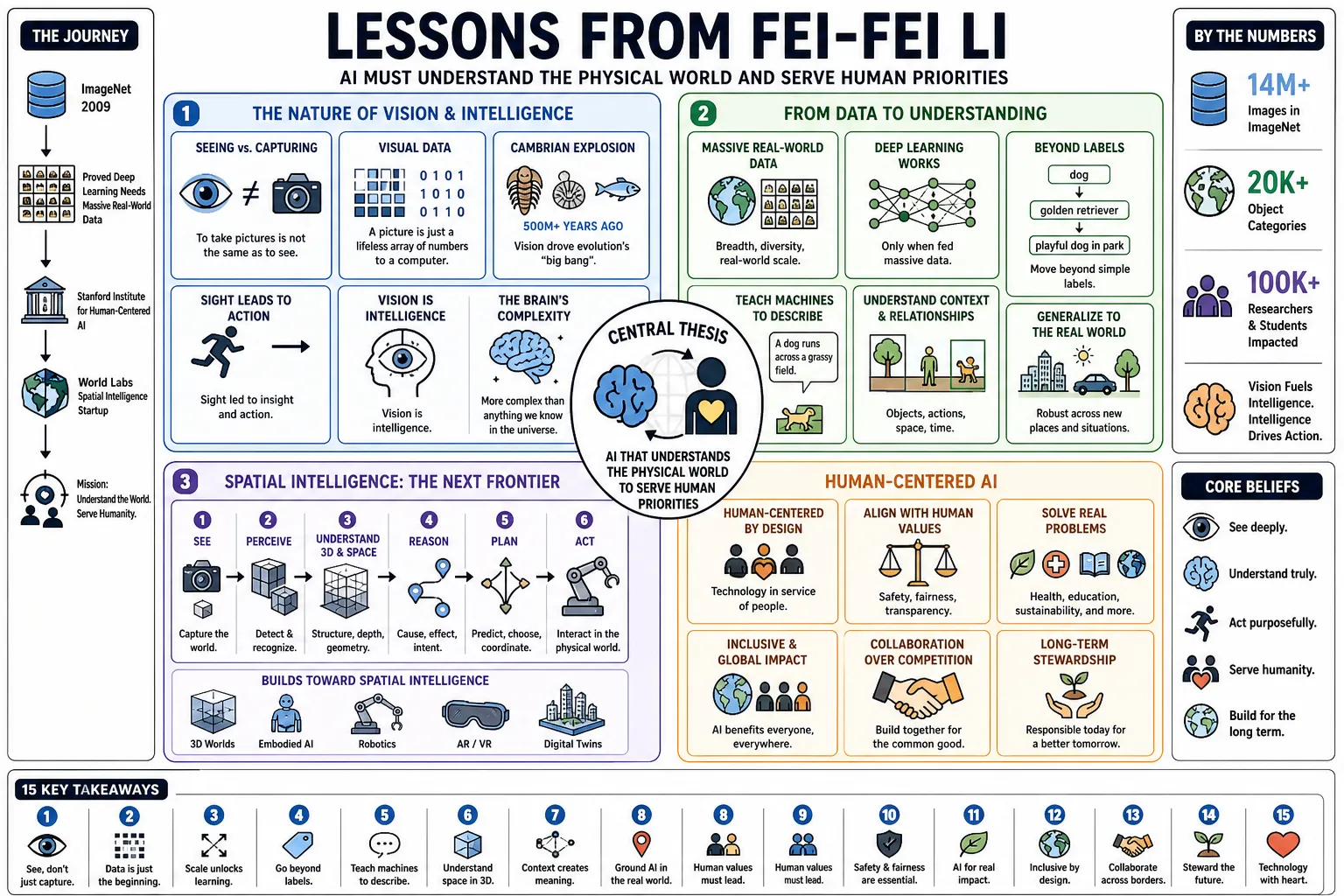
Fei-Fei Li created the ImageNet dataset, proving that deep learning only works when fed massive amounts of real-world data. She later founded the Stanford Institute for Human-Centered AI and the spatial intelligence startup World Labs. These 75 insights document her argument that artificial intelligence must understand the physical world and serve human priorities.
Part 1: The Nature of Vision and Intelligence
- On Seeing vs. Capturing: "To take pictures is not the same as to see, and by seeing, we really mean understanding." — Source: [TED]
- On Visual Data: "A picture is just a lifeless array of numbers to a computer." — Source: [TED]
- On the Cambrian Explosion: "More than 500 million years ago, vision became the primary driving force of evolution's 'big bang', the Cambrian Explosion." — Source: [Scale]
- On Sight Leading to Action: "Sight led to insight and action." — Source: [TED]
- On the Essence of Vision: "Vision is intelligence." — Source: [Medium]
- On the Brain's Complexity: "The human brain is more complex than anything else we know in the universe." — Source: [Medium]
- On Teaching Machines to Describe: "The goal is moving beyond simple labels to generating natural language sentences that describe relationships and actions." — Source: [TED]
- On Recognizing Objects: "Teaching a computer to see is difficult because objects can take infinite forms, positions, and lighting conditions." — Source: [TED]
- On Ancient Traits: "Spatial intelligence is an ancient biological trait that evolved over millions of years, allowing humans to do everything from picking up a cup to building cities." — Source: [YouTube]
Part 2: The Creation of ImageNet and Data
- On the Missing Ingredient: "All along, neural networks hadn't needed fancier math and more exotic abstractions. They were simply waiting for a clearer picture of the world we expected them to understand." — Source: [The Worlds I See]
- On Breathing Life into Systems: "Data, it seemed, had a way of breathing fire in the system." — Source: [The Worlds I See]
- On the Era Before Big Data: "Before ImageNet, big data was not a concept. People were in fact working with small data. In fact, data was not appreciated at all. Data was just afterthought." — Source: [The Tim Ferriss Show]
- On Changing AI Research: "One thing ImageNet changed in the field of AI is suddenly people realized the thankless work of making a dataset was at the core of AI research." — Source: [Optim VC]
- On the Struggle of Creation: "We call this the ImageNet project but no undergrad wanted to do this—they just get so bored and it's such a laborious work and we gave up." — Source: [Optim VC]
- On Discovering Crowdsourcing: "I logged into my Amazon account... the first task I checked out to do just to try was labeling wine bottles... I realized, 'Wait, this is it.' We could use the power of the crowd to label the world." — Source: [Optim VC]
- On the Scale of the Project: "ImageNet was a project that took us three or four years... at the end, it was the largest data set that the AI field has ever seen, consisting of 15 million images, hand-curated with labels." — Source: [Optim VC]
- On the Rocket Fuel of ML: "If data is likened to the 'rocket fuel' of machine learning, ImageNet is undoubtedly the first and most substantial barrel of fuel." — Source: [The Worlds I See]
- On Prioritizing Data Over Algorithms: "The bottleneck in AI wasn't the math, but the lack of real-world data to train on." — Source: [Substack]
- On Overcoming Resource Constraints: "How could we use the crappy machines at the time to do this? So we're like, 'Oh my god, we're stuck.'" — Source: [Optim VC]
Part 3: Spatial Intelligence and World Labs
- On the Next Frontier: "Spatial intelligence is the ability of an AI to perceive, reason about, and interact with the 3D physical world." — Source: [Radical VC]
- On Language Models: "While Large Language Models have mastered text, they are 'wordsmiths in the dark'—they lack a grounded understanding of the physical world." — Source: [Radical VC]
- On the Path to AGI: "AGI cannot be achieved without the ability to navigate 3D space, understand physics like gravity and collisions, and reason about how objects relate to one another." — Source: [Drainpipe]
- On Physics-Aware Generation: "Unlike standard generative AI that might create a flat image, World Labs' models generate structured, 3D environments where walls hold ceilings and chairs slide under tables." — Source: [Vast Data]
- On the Missing Piece: "Teaching machines to see and interact with 3D space is the critical missing piece of modern AI." — Source: [a16z Podcast]
- On Seeing for Doing: "Simply seeing is not enough. Seeing is for doing and learning." — Source: [TED]
- On Action Driving Learning: "When we act upon this world in 3D space and time, we learn, and we learn to see and do better." — Source: [TED]
- On Synthetic Training Grounds: "Spatial intelligence provides synthetic training grounds where robots can practice tasks millions of times in a physics-accurate simulation before being deployed." — Source: [Drainpipe]
- On Transforming the Metaverse: "Spatial intelligence will move gaming from static virtual spaces to truly interactive, immersive environments that respond naturally to user actions." — Source: [Vast Data]
- On Editable Persistent Worlds: "The technology allows users to transform text prompts, photos, or videos into fully editable, persistent 3D environments with precise camera control." — Source: [Radical VC]
Part 4: Human-Centered AI
- On Tools and Values: "Tools don't have independent values—their values are human values." — Source: [YouTube]
- On Human-Made Tools: "AI is fundamentally a human-made tool, and the responsibility for its impact lies with its developers and governors." — Source: [Issues in Science and Technology]
- On the Human Condition: "The ultimate goal of AI should be to improve the human condition, not just to achieve technical benchmarks." — Source: [McKinsey]
- On Benevolence: "Technology requires a benevolent approach, focusing on how it can serve collective human needs." — Source: [YouTube]
- On Studying Human Impact: "AI must be studied as a multidisciplinary field, including ethics, economics, and law, to understand its profound impact on society and culture." — Source: [McKinsey]
- On Augmentation vs. Replacement: "AI should be designed to enhance and super-power human capabilities rather than replace human labor or dignity." — Source: [McKinsey]
- On Biological Inspiration: "AI development should be inspired by the depth and nuance of human intelligence, such as cognitive neuroscience and psychology, to create more intuitive systems." — Source: [McKinsey]
- On Individual Responsibility: "The framework of responsibility begins with the personal and professional ethics of the scientist and developer." — Source: [Issues in Science and Technology]
- On Healthcare Applications: "Healthcare is the most human-centered industry, where AI can bridge the gap between being data-rich and insight-poor to improve patient outcomes and dignity." — Source: [YouTube]
- On Education: "AI should be used to support educators and address the teacher crisis, rather than attempting to automate the learning process." — Source: [YouTube]
Part 5: The Human Element in Technology
- On Human Agency: "Artificial intelligence will change the world, but who will change artificial intelligence?" — Source: [What Should I Read Next]
- On the Artificiality of AI: "There's nothing artificial about artificial intelligence. It's made by humans, intended to work with humans, and it will have the impact for humans." — Source: [What Should I Read Next]
- On AI and Human Dignity: "Can AI ultimately respect human dignity?" — Source: [The Worlds I See]
- On the Core of Everything: "Really, at the end of the day, people are at the heart of everything." — Source: [The Tim Ferriss Show]
- On Having a Say: "People made AI, people will be using AI, people will be impacted by AI, and people should have a say in AI." — Source: [The Tim Ferriss Show]
- On Community Impact: "Responsibility extends to the impact on specific groups, such as healthcare workers or students who rely on these systems." — Source: [YouTube]
- On Human Motivations: "AI's impact would ultimately depend on human motivations." — Source: [The Worlds I See]
- On Ignoring Human Struggle: "To ignore the millennia of human struggle that serves as our society's foundation, however... would be an intolerable mistake." — Source: [Goodreads]
- On the Blitheness of Innovation: "Merely seeking to disrupt with the blitheness that has accompanied much of this century's innovation ignores the human struggle at society's foundation." — Source: [Goodreads]
Part 6: Science, Research, and Curiosity
- On Physics and Passion: "It turned out what physics taught me was not just the math and physics. It was really this passion to ask audacious questions." — Source: [The Tim Ferriss Show]
- On Science's Virtues: "Among science's greatest virtues, however, is its ability to recast a lesson in humility as a moment of possibility." — Source: [Goodreads]
- On Long-Term Commitment: "Research should be long-term and have an impact. Don't just look at the current trends." — Source: [What Should I Read Next]
- On Finding Oneself in Work: "Time lost its meaning in the lab, and I lost myself in the work." — Source: [The Worlds I See]
- On the Feeling of Discovery: "Research triggered the same feeling I got as a child exploring the mountains surrounding Chengdu with my father." — Source: [The Worlds I See]
- On Solid Research: "You should be committed to doing solid and influential research." — Source: [What Should I Read Next]
- On Curiosity as a Driver: "Curiosity and humanity must remain the primary drivers of scientific exploration, rather than purely commercial motives." — Source: [The Worlds I See]
- On the North Star for Scientists: "Personal journeys and human connection serve as a North Star for young scientists navigating the complexities of AI." — Source: [The Worlds I See]
- On Multidisciplinary Study: "True progress in science requires a multidisciplinary lens that incorporates human behavior, psychology, and ethics alongside computation." — Source: [McKinsey]
Part 7: The Immigrant Experience and Personal Identity
- On Learning a New Language: "To an ESL student, every class is an English class." — Source: [The Worlds I See]
- On Finding an Anchor: "I didn't yet have a clear identity, but I had physics." — Source: [The Worlds I See]
- On Culture Shock: "For a Chinese student raised in the schools of Chengdu, my first days at Parsippany High School were an assault on the senses." — Source: [The Worlds I See]
- On Contrasting Worlds: "The mood was manic and unsteady, and everything around me was brighter, faster, heavier, and noisier than the world I left behind." — Source: [The Worlds I See]
- On Gratitude and Grace: "If I were to dedicate my life to science, whatever form that might take, it would be by the grace of the people I'd met during my lowest and most confusing days." — Source: [The Worlds I See]
- On Her Father's Influence: "My father, an electrical engineer with an allergy to seriousness." — Source: [The Worlds I See]
- On Survival and Science: "Navigating the immigrant experience requires the same resilience and adaptability required to pioneer new scientific frontiers." — Source: [The Worlds I See]
- On Blending Two Worlds: "The journey from a teenage immigrant to an AI pioneer is shaped by the constant balancing of cultural heritage and the pursuit of a new American identity." — Source: [The Worlds I See]
- On Relying on Community: "The success of an individual in science is deeply intertwined with the support of the community they lean on during difficult times." — Source: [The Worlds I See]
Part 8: The Future Impact of AI and Society
- On the Technological Revolution: "I believe our civilization stands on the cusp of a technological revolution with the power to reshape life as we know it." — Source: [Goodreads]
- On AI as a Civilizational Technology: "AI is a civilizational technology on par with electricity or the steam engine." — Source: [Issues in Science and Technology]
- On Democratization of AI: "The public sector must have access to the computing power and data currently concentrated in a few large tech companies to ensure AI is developed for the public good." — Source: [Issues in Science and Technology]
- On Public Awakening: "We are at an inflection point because the public has finally awakened to AI's potential and risks, moving the conversation from niche labs to the center of public life." — Source: [Issues in Science and Technology]
- On Societal Implications: "The impact of AI extends to global implications, including the labor market, democracy, and civilizational shifts." — Source: [Issues in Science and Technology]
- On the Human-Centric Revolution: "This revolution must, therefore, be unequivocally human-centered." — Source: [Scribd]
- On the Landscape of Human Life: "500 million years later, AI technology is at the verge of changing the landscape of how humans live." — Source: [What Should I Read Next]
- On Ethical Prioritization: "Human-centered AI prioritizes ethical technology that serves humanity's best interests." — Source: [Befreed]
- On the Concentration of Power: "To ensure AI benefits everyone, we must actively build resources like the National AI Research Resource (NAIRR) to prevent the monopolization of foundational models." — Source: [Issues in Science and Technology]