Felix Oberholzer-Gee is a professor at Harvard Business School and the author of Better, Simpler Strategy. He is known for developing the "value stick," a framework that evaluates business strategy based on raising a customer's willingness to pay and lowering an employee's willingness to sell. This profile synthesizes his practical approach to cutting through organizational complexity and focusing on the variables that drive performance.
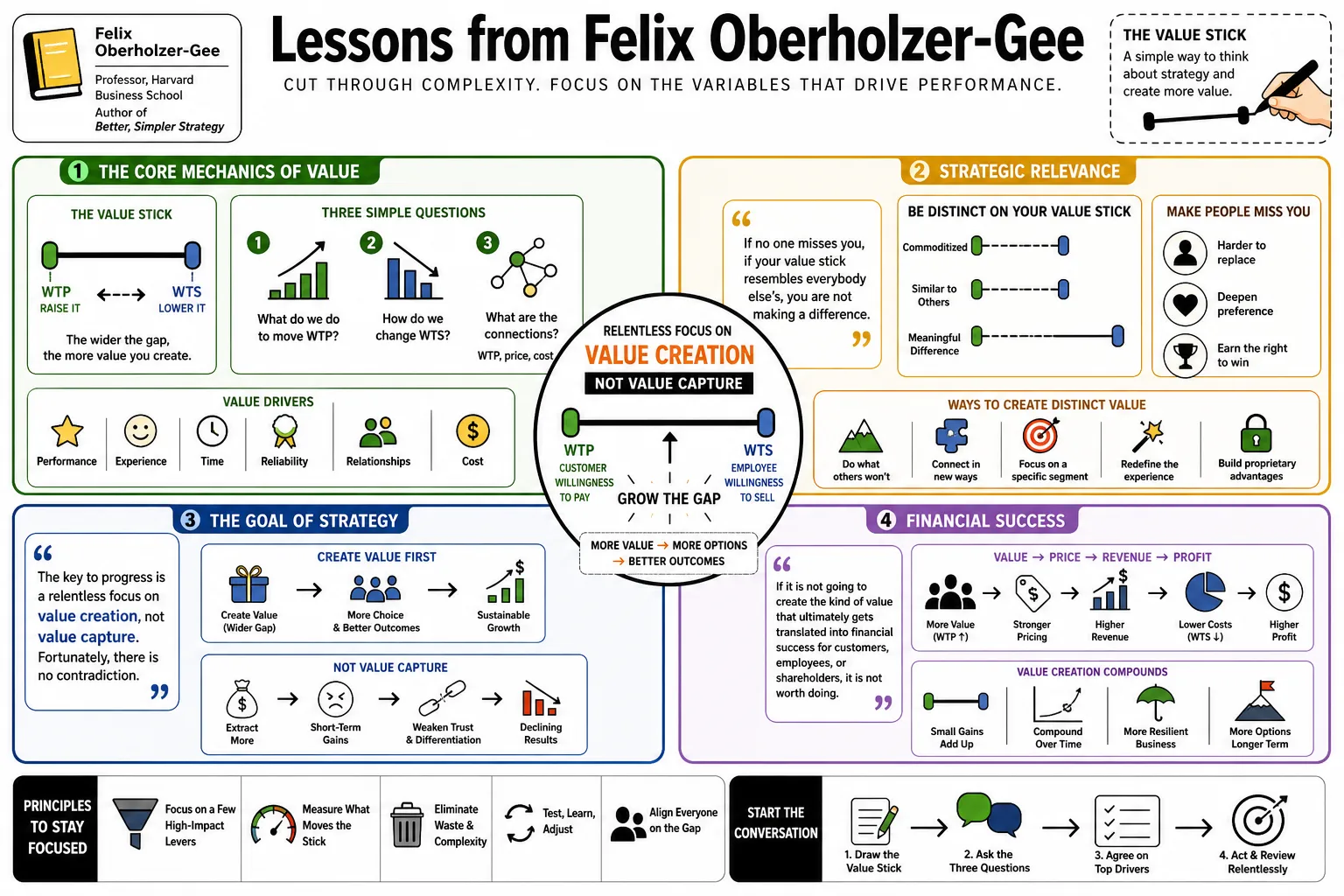
Part 1: The Core Mechanics of Value
- On the Goal of Strategy: "The key to progress is a relentless focus on value creation, not value capture. Fortunately, there is no contradiction." — Source: [Better, Simpler Strategy]
- On Strategic Relevance: "If no one misses you, if your value stick resembles everybody else's, you are not making a difference." — Source: [Better, Simpler Strategy]
- On the Value Stick: "To begin this conversation in your company, take a piece of paper, draw a value stick, and ask three simple questions. What do we do to move WTP? How do we change WTS? What are the connections between our value drivers, prices, and costs?" — Source: [HBR IdeaCast]
- On Financial Success: "If it is not going to create the kind of value that ultimately gets translated into financial success for customers, employees, or suppliers, they do not touch it." — Source: [Harvard Business School]
- On Strategy's Foundation: "Value creation is the distance between willingness to pay and willingness to sell." — Source: [Harvard Business Review]
- On Profit vs. Value: "Profit is simply the fraction of the total value created that a company manages to capture." — Source: [Better, Simpler Strategy]
- On Competitive Advantage: "Sustainable advantage is rooted in creating more value than rivals, rather than simple profit maximization." — Source: [The Parlor Room]
- On Self-Interest: "The companies that perform best do not think about themselves first and foremost. They dream up ever better ways to create value for others." — Source: [Better, Simpler Strategy]
- On Defining Value: "Value for customers is the difference between their appreciation of a product or a service and what they have to pay for it." — Source: [Harvard Business Review]
Part 2: Customer Willingness to Pay (WTP)
- On Willingness to Pay: "Willingness to pay is the maximum amount a customer would rationally spend to acquire a product or service." — Source: [Better, Simpler Strategy]
- On Customer Delight: "The gap between a customer's willingness to pay and the actual price they are charged is customer delight." — Source: [HBS IdeaCast]
- On Raising WTP: "You do not raise WTP by simply lowering the price. You raise it by making the product fundamentally more appealing or useful." — Source: [The Parlor Room]
- On Complements: "Products that are used together can dramatically increase a customer's willingness to pay for both." — Source: [Better, Simpler Strategy]
- On Differentiation: "True differentiation means moving your customer's WTP independently of what your competitors are doing." — Source: [Harvard Business Review]
- On Feature Bloat: "A new feature that costs money to develop but does not increase the customer's maximum willingness to pay is a strategic error." — Source: [After Hours Podcast]
- On Subjectivity: "Willingness to pay is inherently context-dependent and varies wildly depending on the specific problem the customer is trying to solve in that moment." — Source: [Harvard Business School]
- On Trust: "Brand connection and trust act as direct multipliers for willingness to pay." — Source: [Better, Simpler Strategy]
- On Price Ceilings: "If your price ever exceeds a customer's WTP, the transaction simply will not happen." — Source: [The Parlor Room]
Part 3: Employee Willingness to Sell (WTS)
- On Willingness to Sell: "Willingness to sell is the lowest compensation an employee would accept to take a job." — Source: [Harvard Business Review]
- On Lowering WTS: "You lower willingness to sell not by cutting wages, but by making work more attractive." — Source: [Better, Simpler Strategy]
- On Non-Monetary Value: "Flexibility, autonomy, and a good culture are forms of compensation that effectively reduce an employee's WTS." — Source: [After Hours Podcast]
- On Wage Increases: "Raising pay simply redistributes existing value. Making a job genuinely better creates new value by expanding the gap between WTS and WTP." — Source: [HBS IdeaCast]
- On Job Quality: "If you offer a terrible work environment, you will have to pay a steep premium just to keep people from leaving." — Source: [The Parlor Room]
- On Meaningful Work: "Employees who find meaning in their daily tasks have a substantially lower willingness to sell their labor to a competitor." — Source: [Better, Simpler Strategy]
- On Talent Retention: "Retention achieved through lower WTS is far more sustainable than retention bought through constant salary hikes." — Source: [Harvard Business School]
- On Workplace Culture: "Developing a positive corporate culture makes the organization a more attractive place to work, lowering the threshold for recruitment." — Source: [Harvard Business Review]
- On Compensation: "The difference between WTS and the actual wage paid is the value the employee captures from the relationship." — Source: [Better, Simpler Strategy]
- On Employee Experience: "The strategic lever is improving the lived experience of the worker." — Source: [After Hours Podcast]
Part 4: Supplier Relationships and Cost
- On Supplier WTS: "Suppliers have a willingness to sell, which is the lowest price they will accept for their goods or services." — Source: [Harvard Business Review]
- On Reducing Supplier Costs: "Helping a supplier reduce their own operating costs automatically lowers their WTS." — Source: [Better, Simpler Strategy]
- On Predictability: "Offering suppliers stable, predictable demand is a non-monetary benefit that can drastically lower their WTS." — Source: [The Parlor Room]
- On Squeezing Partners: "Squeezing suppliers on price is a zero-sum game; lowering their WTS by being a better partner expands the total value." — Source: [HBS IdeaCast]
- On Data Sharing: "Sharing inventory data and forecasts with suppliers helps them optimize, which lowers the minimum price they need to charge." — Source: [Better, Simpler Strategy]
- On Supply Chain Strategy: "A supplier's WTS applies to every input factor a company consumes." — Source: [Harvard Business School]
- On Long-term Contracts: "Long-term relationships reduce transaction costs and risk, fundamentally altering the supplier's cost structure." — Source: [After Hours Podcast]
- On Input Quality: "If you lower a supplier's WTS, you can capture that value as lower costs or reinvest it into higher quality inputs." — Source: [Better, Simpler Strategy]
- On Mutual Benefit: "The goal with suppliers is to create a scenario where they are highly motivated to serve you because doing so is easy and profitable for them." — Source: [Harvard Business Review]
Part 5: Eliminating Strategic Overload
- On Initiative Fatigue: "Many organizations struggle with strategic overload, pursuing too many initiatives, which leads to complexity and limited impact." — Source: [Harvard Business Review]
- On Focus: "Rather than spreading resources across a wide array of projects, leaders must prioritize the one or two value drivers where they can outperform." — Source: [HBS IdeaCast]
- On Saying No: "Strategy is as much about deciding what not to do as it is about picking what to pursue." — Source: [Better, Simpler Strategy]
- On Project Approval: "If an initiative does not move WTP or WTS, it is a distraction, no matter how interesting it seems." — Source: [The Parlor Room]
- On Value Maps: "Value maps are a visualization tool to identify exactly where a company is currently delivering benefits and where it is wasting effort." — Source: [Harvard Business Review]
- On Resource Allocation: "Strategic overload happens when a company tries to beat competitors on every single dimension of a value map." — Source: [Better, Simpler Strategy]
- On Execution Speed: "The simplicity of the strategy is key if one is to execute at breakneck speed." — Source: [Harvard Business School]
- On Alignment: "It is much easier to align an entire organization around two critical value drivers than a twenty-point strategic plan." — Source: [After Hours Podcast]
- On Zombie Projects: "Organizations lack the discipline to kill projects that are fun to do but fail to generate real value." — Source: [HBS IdeaCast]
- On Simplification: "Companies can make their strategies more powerful by selecting fewer, higher-impact initiatives." — Source: [Harvard Business Review]
Part 6: Growth, Scale, and Competition
- On Competitive Rivalry: "You avoid brutal rivalry not by attacking competitors, but by differentiating your value stick." — Source: [Better, Simpler Strategy]
- On the Limits of Scale: "Scale alone does not guarantee a sustainable advantage if it fails to translate into a higher WTP or a lower WTS." — Source: [Harvard Business Review]
- On Market Share: "Market share is an outcome of a superior value stick, not a strategy in itself." — Source: [The Parlor Room]
- On Digital Transformation: "Digital technologies are only strategically useful if they fundamentally alter the customer's willingness to pay or the firm's cost structure." — Source: [After Hours Podcast]
- On Network Effects: "Network effects can plateau; simply having more users does not infinitely raise WTP." — Source: [Harvard Business School]
- On Imitation: "Copying a competitor's moves usually just leads to price convergence and eroded margins." — Source: [HBS IdeaCast]
- On Competing on Cost: "Trying to win purely on price without structurally lowering WTS is a fast track to destroying value." — Source: [Better, Simpler Strategy]
- On Technological Change: Felix Oberholzer-Gee points out that competitive advantage actually erodes no faster today than in previous eras, which undercuts the idea that the pace of change facing companies has fundamentally shifted. — Source: [UnSILOed Podcast]
- On Industry Disruption: "Disruptors win by finding entirely new ways to structure the value stick, usually by drastically lowering WTS." — Source: [The Parlor Room]
Part 7: Execution and Simplicity
- On Daily Operations: "Every employee, from the executive team to the store manager, needs to know exactly how they help move WTP or WTS." — Source: [Better, Simpler Strategy]
- On Complexity: "Complex strategy frameworks paralyze action and confuse the frontline workers who actually have to execute them." — Source: [Harvard Business Review]
- On Decentralization: "When the strategy is simple, decision-making can be decentralized because everyone understands the criteria for a good idea." — Source: [HBS IdeaCast]
- On Testing Ideas: "Before launching a new feature, managers should have to explicitly state whether it is designed to increase WTP or decrease WTS." — Source: [Harvard Business School]
- On Clarity: "A good strategy fits on a single piece of paper." — Source: [Better, Simpler Strategy]
- On Actionable Metrics: "WTP and WTS are not abstract concepts; they are practical filters for everyday operational decisions." — Source: [The Parlor Room]
- On Strategic Agility: "Simplicity allows an organization to pivot rapidly when market conditions change." — Source: [After Hours Podcast]
- On Translating Vision: "The job of management is translating abstract goals into concrete actions that visibly alter the value stick." — Source: [Better, Simpler Strategy]
- On Continuous Improvement: "Can I ask you to never tire of seeking new ways to increase WTP and lower WTS?" — Source: [Better, Simpler Strategy]
- On Middle Management: "Middle managers are most effective when they act as editors, filtering out initiatives that do not clearly impact value creation." — Source: [Harvard Business Review]
Part 8: Leadership and Trade-offs
- On Leadership Choices: "The most difficult job of a leader is telling eager, smart employees that a good idea will not be pursued." — Source: [HBS IdeaCast]
- On Courage: "It takes courage to ignore what competitors are doing and focus entirely on your own value drivers." — Source: [Better, Simpler Strategy]
- On Communication: "Leaders must constantly communicate the why behind decisions by linking them back to the value stick." — Source: [The Parlor Room]
- On Balancing Priorities: "You cannot simultaneously maximize WTP and minimize WTS across the board; strategy requires choosing a distinct posture." — Source: [Harvard Business Review]
- On Evaluation: "Executives should be evaluated on the total value they create, not just the short-term financial metrics they capture." — Source: [Harvard Business School]
- On Trade-offs: "A strategy without painful trade-offs is not a strategy; it is a wish list." — Source: [Better, Simpler Strategy]
- On Social Responsibility: "When a company increases value for customers and improves conditions for workers, it fulfills its highest social purpose." — Source: [After Hours Podcast]
- On Legacy: "The mark of a great leader is leaving behind an organization that fundamentally understands how to generate its own value." — Source: [HBS IdeaCast]
- On the Long View: "Leaders who obsess over the size of the profit margin often destroy the very value creation engine that generated it in the first place." — Source: [Better, Simpler Strategy]