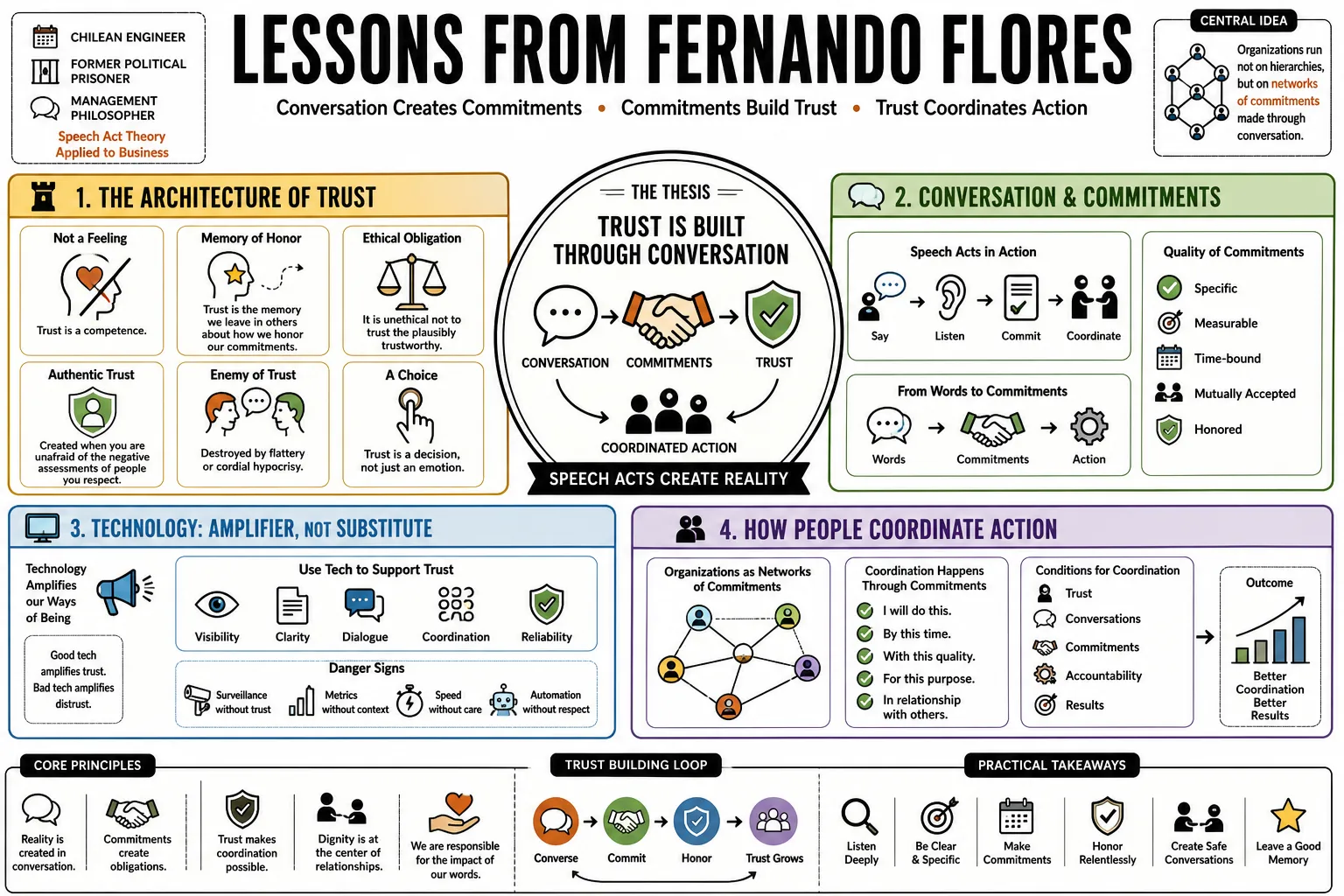
Fernando Flores is a Chilean engineer, former political prisoner, and management philosopher who applied speech act theory to business. He argued that organizations run not on structural hierarchies, but on networks of commitments made through conversation. These quotes trace his thinking on trust, technology, and how people actually coordinate action.
Part 1: The Architecture of Trust
- On the nature of trust: "Trust is not a feeling. Trust is not rapport. Trust is not chemistry. Trust is a competence, a way of being with others that produces reliability, dignity, and coordination in the real world." — Source: [Conceivian]
- On what builds trust: "Trust is the memory we leave in others about how we honor our commitments." — Source: [Conceivian]
- On ethical obligations: "It is unethical not to trust people when they are plausibly trustworthy, just as it is unethical to treat them unfairly." — Source: [York University]
- On authentic trust: "Authentic trust is created when you come to be unafraid of the negative assessments of people you respect." — Source: [York University]
- On the enemy of trust: "Trust is destroyed by flattery or cordial hypocrisy." — Source: [York University]
- On trust as a choice: "To think of trust as just an emotion is to cut ourselves off from the power we each can bring to our lives by working together." — Source: [York University]
- On naive versus authentic trust: "Authentic trust acknowledges the possibility of betrayal but chooses to commit to the relationship anyway, unlike simple, unthinking trust." — Source: [York University]
- On sincerity: "Sincerity is the assessment that a person genuinely intends to fulfill their commitments and is not being deceptive." — Source: [SoBrief]
- On reliability: "Reliability is the assessment of a person's track record. Do they consistently follow through on their promises over time?" — Source: [SoBrief]
- On care and involvement: "Involvement is the assessment that the person has your interests at heart and is committed to the long-term well-being of the relationship." — Source: [SoBrief]
Part 2: The Action Workflow
- On the essence of management: "An organization's results are determined through webs of human commitments, born in webs of human conversations." — Source: [QuoteFancy]
- On conversation and action: "Conversation is not merely a prelude to action, it is its very essence." — Source: [Seven Stones Leadership]
- On accountability: "Accountability is just one conversation after another." — Source: [Nathan Ehrlich]
- On organizational design: "Organizations are not just structures or systems, but networks of commitments created through conversation." — Source: [Nathan Ehrlich]
- On breakdowns in coordination: "A breakdown in a project is usually a breakdown in a conversation. It is a missing request, an unfulfilled promise, or a lack of clear standards for satisfaction." — Source: [Conversations for Action]
- On the preparation phase: "The first step of the action workflow is identifying a need or concern that must be addressed." — Source: [Conversations for Action]
- On requests: "A request is one of the five primary speech acts used by managers to ask someone to do something." — Source: [Dokumen]
- On promises: "Promises or offers are the commitments we make to do something for someone else." — Source: [Dokumen]
- On completion: "The workflow is not over when the work is done. It requires a declaration of completion from the performer." — Source: [Conversations for Action]
- On satisfaction: "The final step in a commitment loop is the requester's declaration of satisfaction that the work meets the agreed-upon standards." — Source: [Conversations for Action]
Part 3: Language and Reality
- On creating the future: "People don't merely use language to communicate their desires about the future. They create the future in language together by making commitments to each other." — Source: [Dokumen]
- On constructing reality: "We don't realize how much we create reality through language. If we say that life is hard, it will be hard." — Source: [AZ Quotes]
- On language as a medium: "Language is not a tool used within a world. It is the medium through which a world is disclosed." — Source: [Trance-Scripts]
- On linguistic action: "Linguistic action is the essential human activity." — Source: [Trance-Scripts]
- On declarations: "Declarations are speech acts that use authority to change reality, such as telling someone they are promoted or that a project is cancelled." — Source: [Dokumen]
- On assertions: "Assertions are statements of fact that can be proven, distinct from opinions or judgments." — Source: [Dokumen]
- On assessments: "Assessments are the opinions or judgments we make that guide our navigation of the world." — Source: [Dokumen]
- On the power of language: "The power of language is to articulate recurrence, to identify patterns, to claim structure, to explain." — Source: [Legatum Books]
- On meaning and existence: "We encounter deep questions of design when we recognize that in designing tools we are designing ways of being." — Source: [Digital Humanities]
Part 4: Breakdowns and Innovation
- On invisible tools: "The most important aspect of any tool is the way in which it becomes invisible when it is used." — Source: [Capurro]
- On the nature of breakdowns: "It is only when there is a breakdown, when the tool fails or is not suited to the task, that it becomes an object of reflection." — Source: [Capurro]
- On disharmony: "The entrepreneur seizes upon disharmony to create a cultural change." — Source: [Strategy+Business]
- On recognizing anomalies: "Disharmony is a sense that something in our current way of life is off or could be better, even if others haven't noticed it yet." — Source: [Academia.edu]
- On knowledge and coping: "Our knowledge is not represented in the brain at all, but consists of an unformalized shared background from which we articulate representations in order to cope with new situations." — Source: [Legatum Books]
- On the limits of formalization: "Computer programs contain only pre-selected objects and properties, and there is no basis for moving beyond this initial formalization when a disruption occurs." — Source: [Erudit]
- On human recurrence: "Anomalies force us to shift from unthinking execution into deliberate, conscious design." — Source: [Digital Humanities]
- On shifting practices: "We are at our best when we seize upon a breakdown as an opportunity to change taken-for-granted, everyday practices." — Source: [Penguin Books]
- On moving past execution: "In times of breakdown, standard operating procedures fail and the capacity to invent new commitments becomes paramount." — Source: [Conversations for Action]
Part 5: Technology and Cognition
- On what it means to be human: "In asking what computers can do, we are drawn into asking what people do with them, and in the end into addressing the fundamental question of what it means to be human." — Source: [Substack]
- On technology and human nature: "All new technologies develop within a background of tacit understanding of human nature and human work." — Source: [Purposive Drift]
- On the impact of tools: "The use of technology in turn leads to fundamental changes in what we do, and ultimately what it is to be human." — Source: [Capurro]
- On the limits of computers: "An essential part of being human is the ability to enter into commitments and to be responsible for the courses of action that they anticipate. A computer can never enter into a commitment." — Source: [Trance-Scripts]
- On artificial intelligence: "Manipulating a representation formally is not understanding." — Source: [Trance-Scripts]
- On the illusion of mechanical thought: "We should stop trying to build intelligent machines that mimic human thought and instead design coordination systems that support human communication." — Source: [Digital Humanities]
- On shared background: "Computers will never truly understand natural language because they lack the biological and social background that gives words their meaning." — Source: [Trance-Scripts]
- On systemic context: "The significance of a new invention lies in how it fits into and changes the network of institutions, equipment, practices, and conventions." — Source: [Trance-Scripts]
- On thrownness: "We are always already oriented to a certain direction of possibilities." — Source: [Legatum Books]
Part 6: Ontological Coaching and Leadership
- On the necessity of risk: "You have to be able to risk your identity for a bigger future than the present you are living." — Source: [AZ Quotes]
- On listening: "Trust begins with listening for concerns. People trust you when they feel you understand what they care about." — Source: [AZ Quotes]
- On delivering excellence: "To deliver exquisite care, you need an organization that coordinates well and listens well." — Source: [AZ Quotes]
- On power and truth: "Communication, truth, and trust are at the heart of power." — Source: [Varnelis]
- On the locus of management: "I saw that communication, truth, and trust are at the heart of power, rather than just hierarchy." — Source: [Cabinet Magazine]
- On transformation over victimhood: "I never told a victim story about my imprisonment. Instead, I told a transformation story about how prison changed my outlook." — Source: [Cabinet Magazine]
- On applying cybernetics: "We are now in a position from which it is possible to implement on a national scale scientific views on management and organization." — Source: [Cabinet Magazine]
- On decentralizing power: "The Cybersyn project aimed to acquire the benefits of cybernetic synergy for the whole industry, while developing power for the workers at the same time." — Source: [Blogspot Archive]
- On democratic systems: "A management system must behave in a decentralizing, worker-participative, and anti-bureaucratic manner." — Source: [Cabinet Magazine]
- On leadership as coordination: "The leader is not the one who knows all the answers, but the one who can orchestrate the network of commitments." — Source: [Conversations for Action]
Part 7: Entrepreneurship and History-Making
- On the true nature of an entrepreneur: "The entrepreneur does not have faith in and commitment to herself but rather to an intuition or an idea that has struck her as requiring the giving up of the self as she knows it for a new life in a new world that everyone will share." — Source: [AAUP]
- On determining value: "The entrepreneur is the person who determines which needs will seem important." — Source: [Learning Org]
- On the goal of business: "A business develops an identity by providing a product or a service to people. None of this is the goal of the activity. Profit is but a step in a process by which entrepreneurs attain identities." — Source: [Kottke]
- On competition: "We compete to make things, and ourselves, more worthy." — Source: [Learning Org]
- On making history: "Human beings are at their best not when they are engaged in abstract reflection, but when they are intensely involved in changing the taken-for-granted, everyday practices in some domain of their culture." — Source: [Penguin Books]
- On world disclosure: "Entrepreneurs disclose a new world by changing the practices and equipment we use." — Source: [Strategy+Business]
- On articulation: "One method of history-making is articulation, bringing a latent or confused practice into sharp focus." — Source: [ResearchGate]
- On cross-appropriation: "Entrepreneurs can make history through cross-appropriation, taking a practice from one domain and applying it to another." — Source: [ResearchGate]
- On reconfiguration: "Reconfiguration changes the marginal practices of a culture into central ones." — Source: [ResearchGate]
Part 8: Moods and the Emotional Workspace
- On the mechanics of mood: "When trust improves, the mood improves." — Source: [DiscProfile]
- On organizational capability: "The mood of an organization dictates what actions are possible." — Source: [QuoteFancy]
- On powerful teams: "Key moods for a powerful team are ambition, acceptance, serenity, respect, membership, pride, camaraderie, and celebration." — Source: [Goodreads]
- On serenity: "Serenity allows us to accept the facts of the world without falling into resignation." — Source: [Goodreads]
- On ambition: "Ambition is the mood that opens up possibilities for action in the future." — Source: [Goodreads]
- On resignation: "Resignation is a mood that closes off possibilities, where one believes nothing can be done to alter the future." — Source: [Goodreads]
- On resentment: "Resentment traps an individual in the past, blocking their ability to coordinate effectively with others." — Source: [Goodreads]
- On managing emotions: "A manager's job is not just to manage tasks, but to manage the moods that make those tasks possible." — Source: [Goodreads]
- On the climate of work: "The emotional space we create with our language is the very climate in which our commitments either thrive or die." — Source: [Goodreads]