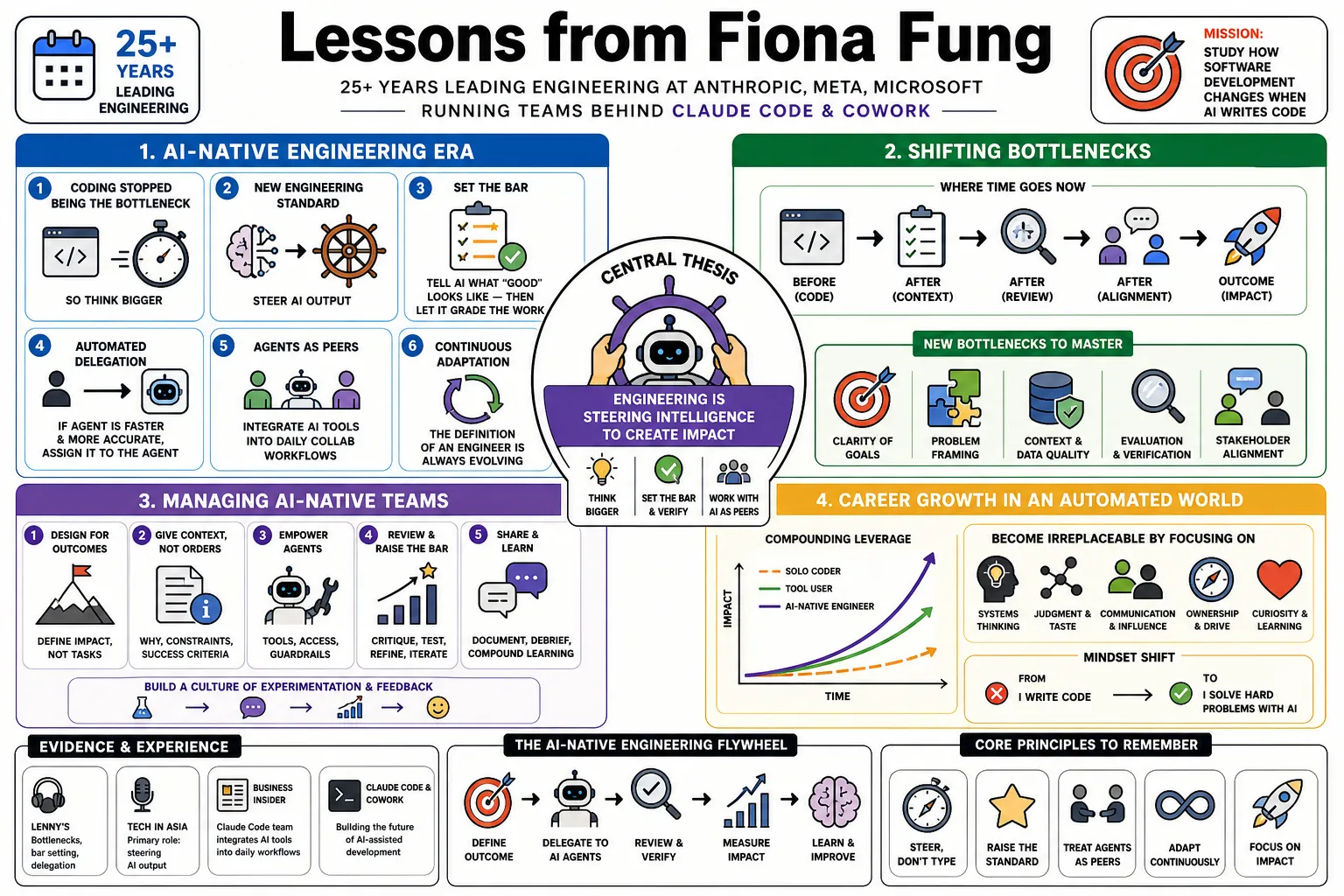
Lessons from Fiona Fung
Fiona Fung has spent over 25 years leading engineering teams at companies like Anthropic, Meta, and Microsoft. She currently runs the teams behind Claude Code and Cowork, studying how software development actually changes when AI handles code generation. This profile collects her observations on managing teams, shifting bottlenecks, and career growth in an automated environment.
Part 1: The AI-Native Engineering Era
- On the coding bottleneck: "Coding stopped being the bottleneck — so think bigger." — Source: Lenny's Podcast
- On the new engineering standard: "The primary engineering role is shifting from writing original syntax to steering AI output." — Source: Tech in Asia
- On setting the bar: "Tell AI what 'good' looks like — then let it grade the work." — Source: Lenny's Podcast
- On automated delegation: "If an AI agent can complete a task faster and more accurately than you, you should assign it to the agent." — Source: Lenny's Podcast
- On treating agents as peers: "The Claude Code team found success by integrating AI tools directly into their daily collaborative workflows." — Source: Business Insider
- On continuous adaptation: "The definition of an engineer is evolving into a systems thinker rather than a pure code writer." — Source: Tech in Asia
- On building Claude Code: "Developing AI-assisted coding tools requires testing them against the actual engineering challenges your own team faces daily." — Source: Developing.dev
- On the end of pure coding: "Writing code is becoming a baseline commodity; the value lies in architecture and user validation." — Source: Lenny's Podcast
- On agent capability: "Developers must learn to give permission to kill any automated process that isn't working as intended." — Source: Lenny's Podcast
- On future software development: "Teams that fail to adopt AI-assisted coding will quickly fall behind those that ship at agent-assisted speeds." — Source: Tech in Asia
Part 2: Shifting Bottlenecks & Verification
- On the new job description: "Verification is the new job — trust, but verify." — Source: Lenny's Podcast
- On code reviews: "Human oversight must now focus on ensuring the quality and reliability of AI-generated work, not correcting syntax." — Source: Medium
- On cross-functional alignment: "When coding speeds up, the actual bottlenecks become organizational alignment and security validation." — Source: Tech in Asia
- On quality assurance: "You have to build testing frameworks that assume the initial code generation will have logical gaps." — Source: Medium
- On security validation: "Security cannot be an afterthought when agents are generating thousands of lines of code per day." — Source: Tech in Asia
- On human judgment: "AI can generate the application, but a human must decide if it solves the correct user problem." — Source: Lenny's Podcast
- On source of truth: "Code is the primary source of truth; extensive design documents are becoming less relevant." — Source: Trae AI
- On shifting focus: "Engineers must spend more time reading and verifying code than writing it from scratch." — Source: Medium
- On testing frameworks: "Comprehensive automated testing is the only way to manage the massive output generated by AI assistants." — Source: Tech in Asia
Part 3: Team Culture & The Loneliness of AI
- On developer isolation: "The thing that we found interesting on the Claude Code team is, after a while, we felt it could start being a lonely experience because we all started just working with our agents so much." — Source: Business Insider
- On human connection: "The work gets lonely — build connection back in." — Source: Lenny's Podcast
- On pair programming: "Everybody uses a flow so differently. When we do pairwise programming, we actually learn so much from each other." — Source: Business Insider
- On combating isolation: "Implementing programming lunches and shared maker time helps counteract the solitary nature of agent-assisted coding." — Source: Business Insider
- On hackathons: "Regular hackathons are necessary to maintain team cohesion when individual daily work is highly automated." — Source: Business Insider
- On culture evolution: "Management must recognize that culture is a living thing that changes drastically when tools change." — Source: Lenny's Podcast
- On sharing workflows: "Because everyone interacts with AI differently, teams must actively share their successful prompts and methods." — Source: Business Insider
- On continuous learning: "Watching a peer interact with their AI agent often reveals entirely new ways to solve a problem." — Source: Business Insider
- On team dynamics: "The best AI engineering teams balance intense, solitary agent-collaboration with deliberate social engineering." — Source: Developing.dev
- On maintaining morale: "Recognizing the psychological impact of AI on developers is a requirement for modern engineering managers." — Source: Business Insider
Part 4: Leadership & Management Mechanics
- On dogfooding: "Leaders must actively use their own team's products to build rapport and demonstrate they care about the actual work." — Source: The Peterman Pod
- On just-in-time planning: "Long-term, six-month roadmaps are obsolete; teams should favor rapid validation and short cycles." — Source: Medium
- On adapting to speed: "Management must adjust expectations when teams start shipping multiple times faster than historical baselines." — Source: Medium
- On meeting hygiene: "Status updates belong in asynchronous channels; face-to-face time is for strategy and problem-solving." — Source: Entrepreneur
- On setting direction: "The manager's role shifts from tracking tickets to ensuring the AI's output aligns with company goals." — Source: Developing.dev
- On performance evaluation: "You have to measure impact and product quality rather than lines of code committed." — Source: Medium
- On scaling teams: "Hiring should prioritize systems-level thinkers and product-minded engineers over pure syntax specialists." — Source: Tech in Asia
- On rapid validation: "The goal is to get AI-generated features in front of real users as quickly as possible to validate assumptions." — Source: Medium
- On navigating ambiguity: "Managers must provide clear boundaries while allowing engineers the freedom to experiment with new agent workflows." — Source: Developing.dev
Part 5: Mentorship & Career Ownership
- On driving mentorship: "Mentees should not wait for mentors to define the relationship; they must take initiative." — Source: Entrepreneur
- On setting agendas: "A mentee must own the agenda and clearly state what they want to achieve in the relationship." — Source: Entrepreneur
- On receiving feedback: "The most pivotal feedback is often feedback on receiving feedback and learning how to process criticism." — Source: Developing.dev
- On 1-on-1s: "Never waste a 1-on-1 meeting on a status update that could have been an email or a Slack message." — Source: Entrepreneur
- On career growth: "Progression requires explicitly asking for the scope and responsibility you want next." — Source: The Peterman Pod
- On finding mentors: "Look for mentors who have recently navigated the specific transition you are currently facing." — Source: Entrepreneur
- On mentor expectations: "Mentors are there to provide perspective, not to do the work or make decisions for you." — Source: Entrepreneur
- On continuous feedback: "Create a habit of regularly soliciting feedback from peers in addition to managers." — Source: Developing.dev
- On managing up: "Communicate your wins and roadblocks clearly so leadership knows exactly where to apply their efforts." — Source: The Peterman Pod
- On actionable advice: "When a mentor gives you advice, report back on how you implemented it to keep the relationship engaged." — Source: Entrepreneur
Part 6: Risk, Fear, & Personal Growth
- On facing fear: "The cave you fear to enter holds the treasure you seek." — Source: Lenny's Podcast
- On using fear as a compass: "The thing that feels the scariest is usually a clear indicator of what you should be doing." — Source: Lenny's Podcast
- On making mistakes: "Make new mistakes — not zero mistakes." — Source: Lenny's Podcast
- On discomfort: "True professional growth only happens in environments where you feel slightly underqualified." — Source: The Peterman Pod
- On career pivots: "Transitioning between major tech companies requires a willingness to unlearn past successful behaviors." — Source: The Peterman Pod
- On taking bets: "Building zero-to-one products like Facebook Marketplace requires making decisions with incomplete data." — Source: Developing.dev
- On resilience: "The ability to recover quickly from a failed experiment is more valuable than trying to prevent all failures." — Source: Developing.dev
- On challenging the status quo: "If a process feels slow or broken, you have the permission to question and break it." — Source: Lenny's Podcast
- On personal limitations: "Acknowledging what you do not know is the fastest way to build trust with a new team." — Source: The Peterman Pod
Part 7: Building Trust & Accountability
- On agency: "High agency = high accountability ('freedom to cook')." — Source: Lenny's Podcast
- On empowering teams: "You give engineers the freedom to design solutions, but they must own the outcomes of those designs." — Source: Lenny's Podcast
- On earning trust: "Trust is built by consistently delivering on commitments, no matter how small they seem." — Source: The Peterman Pod
- On organizational transparency: "Clear communication about why decisions are made prevents teams from feeling disconnected from leadership." — Source: Developing.dev
- On identifying demand: "Hunt for latent demand — the workarounds people tolerate." — Source: Lenny's Podcast
- On psychological safety: "Engineers must feel safe to admit when an AI-generated solution has introduced a critical bug." — Source: Medium
- On ownership: "When you own a feature, you own its performance, its security, and its impact on the end user." — Source: The Peterman Pod
- On peer accountability: "The strongest teams hold each other accountable rather than relying on top-down enforcement." — Source: Developing.dev
- On clear boundaries: "Freedom to innovate only works when the non-negotiable constraints are clearly defined upfront." — Source: Medium
Part 8: Productivity & Shipping Velocity
- On true progress: "Don't mistake motion for progress." — Source: Lenny's Podcast
- On shipping speed: "Anthropic's engineering teams are now shipping approximately 8x more code per quarter than they did historically." — Source: Business Insider
- On eliminating friction: "Any process that delays code from reaching production needs to be aggressively automated or removed." — Source: Tech in Asia
- On AI multipliers: "Agentic tools act as direct multipliers for the effective output of every single engineer." — Source: Business Insider
- On focusing effort: "When output volume increases, you must be extremely disciplined about what features you actually choose to build." — Source: Tech in Asia
- On measuring success: "Velocity is useless if the product changes do not actually solve the customer's problem." — Source: Medium
- On tooling investments: "Time spent optimizing your team's internal tools pays compound interest in long-term shipping velocity." — Source: Developing.dev
- On continuous deployment: "Rapid iteration cycles allow you to correct mistakes before they compound into systemic failures." — Source: Trae AI
- On the ultimate goal: "The primary purpose of increasing velocity is to learn what the market wants as quickly as possible." — Source: Tech in Asia