Force Management trains B2B revenue teams in buyer-focused sales messaging and qualification. Its Command of the Message framework starts with customer problems, differentiated value and consistent execution across customer-facing teams; its MEDDICC training helps teams qualify opportunities and align selling with buying. — What Command of the Message Means.
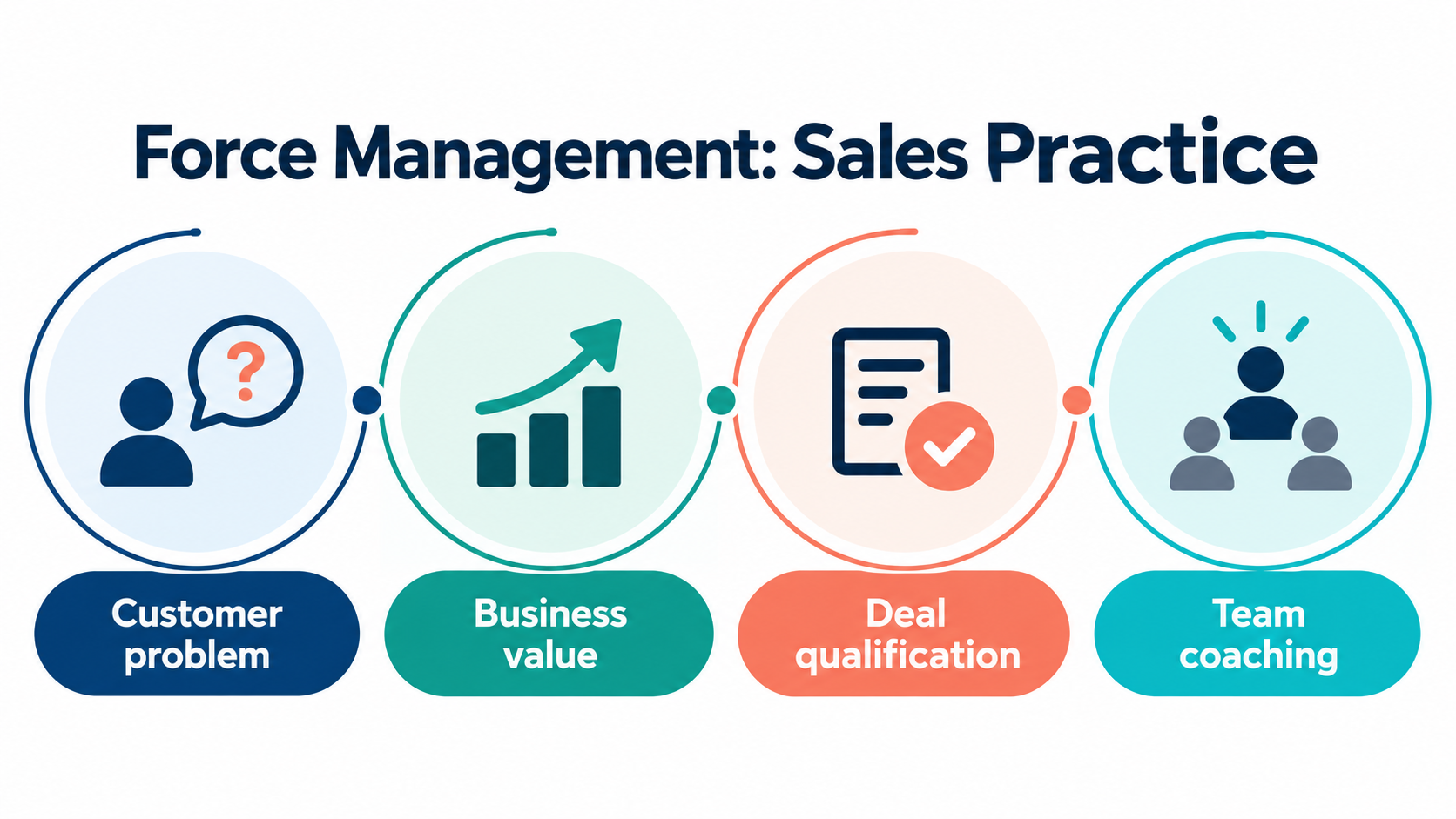
Core Philosophies and Mindset
- Differentiate through the selling process: In a direct client interview, Joe Marcin said his team moved from leading with demos toward discovery of customer business issues, changing not only what it sold but how it engaged buyers. — Enabling a Global Sales Organization.
- Focus time on viable deals: Force Management presents MEDDICC as a way to direct seller time toward opportunities that can advance and away from deals unlikely to happen. — Force Management MEDDICC Methodology.
- Align message and execution: Force Management recommends aligning revenue teams around a shared account of customer problems, differentiated value and proof before trying to scale a sales motion. — A Revenue Leader’s Strategy for Growth.
- Own the customer problem: John Kaplan’s first-person sales account begins with understanding the buyer’s business and using discovery questions to help the buyer examine the problem before proposing a solution. — Help Buyers Stand in the Moment of Pain.
- Differentiate around the problem: Force Management argues that a message grounded in a specific customer problem is harder to commoditize than a feature pitch and should connect the solution to what matters to that buyer. — What Command of the Message Means.
- Make difficult talent decisions responsibly: John Kaplan advises leaders to address damaging team behavior directly and to handle every talent decision with dignity and respect. — The Team: Building and Managing Successful Business Teams.
- Own the leadership of change: Force Management argues that a sales leader should personally own a new initiative and keep reinforcing it rather than delegating the launch and disappearing afterward. — What Every Elite Sales Organization Does.
Command of the Message
- Keep one buyer message: Command of the Message is designed to give customer-facing teams a consistent account of value, differentiation and expected business outcomes. — What Command of the Message Means.
- Articulate value and differentiation: The framework asks sellers to explain how a solution addresses a buyer’s problem and why that approach is meaningfully different from alternatives. — What Command of the Message Means.
- Start with the customer’s need: Force Management cautions against opening with a product demo or features before understanding the business problem the buyer wants solved. — What Command of the Message Means.
- Connect value to outcomes: Command of the Message links the buyer’s problem to the business impact of solving it, so the price discussion rests on articulated value rather than features alone. — What Command of the Message Means.
- Answer four value questions: John Kaplan frames the message around four questions: what problem is solved, how it is solved, how it differs from alternatives, and where that result has been demonstrated. — How Do You Hire Elite Salespeople?.
- Differentiate without overclaiming: Force Management advises sellers to connect genuine strengths to the buyer’s priorities without disparaging competitors or overstating benefits. — What Command of the Message Means.
- Use a shared Value Framework: The Value Framework is intended to keep sales, marketing, services and customer success aligned on the same buyer-facing value message. — What Command of the Message Means.
MEDDICC/MEDDPICC
- Fit MEDDICC to the buying process: Force Management recommends adapting MEDDICC to the organization and its customers’ buying process, then teaching reps and managers how it fits their sales stages. — MEDDICC: Boost Sales Qualification.
- Account for paper process: MEDDPICC adds a paper-process check for the contractual documents and signatures needed to complete a purchase. — MEDDICC: Boost Sales Qualification.
- Qualify in or out: Force Management uses MEDDICC to help sellers qualify opportunities in or out and concentrate on the accounts with stronger potential. — Force Management MEDDICC Methodology.
- Make qualification mutual: The company describes MEDDICC qualification as a way to help both buyer and seller navigate the decision-making process. — Force Management MEDDICC Methodology.
- Align selling with buying: Force Management says qualification should keep seller actions aligned with the way the customer buys. — Force Management MEDDICC Methodology.
- Use gaps to guide deal coaching: Manager-rep reviews should identify missing MEDDICC evidence in a deal and plan how to close the gaps, rather than merely score the opportunity. — MEDDICC: Boost Sales Qualification.
- Metrics: Metrics are quantifiable measures of the business benefit a proposed solution is expected to deliver. — MEDDICC: Boost Sales Qualification.
- Economic Buyer: The economic buyer is the person with final approval authority for the purchase. — MEDDICC: Boost Sales Qualification.
- Decision Criteria: Decision criteria are the formal requirements decision makers use to assess a solution. — MEDDICC: Boost Sales Qualification.
- Decision Process: The decision process is how a customer evaluates, selects and buys a solution. — MEDDICC: Boost Sales Qualification.
- Identify Pain: Identify the buyer problem creating urgency to solve it within a particular timeframe. — MEDDICC: Boost Sales Qualification.
- Champion: A champion is an influential person inside the buyer organization with an interest in the solution being selected. — MEDDICC: Boost Sales Qualification.
- Competition includes inaction: In MEDDICC, competition means all alternatives to buying the solution, including doing nothing or building internally—not just rival vendors. — MEDDICC: Boost Sales Qualification.
Sales Leadership and Enablement
- Make criteria a common language: Force Management assigns leaders the job of making MEDDICC criteria usable and consistent across the sales organization through tools, training and coaching. — MEDDICC: Boost Sales Qualification.
- Coach with deal reviews: Managers are advised to review MEDDICC criteria with reps, identify gaps in live opportunities and coach a plan for closing them. — MEDDICC: Boost Sales Qualification.
- Coach beyond compliance: The firm recommends that managers use opportunity reviews to help reps advance deals, rather than treating reviews as a compliance checklist. — Five Components of a Sales Process.
- Ask for deal help early: Force Management tells sellers to surface what they do not know and request the resources needed to move a qualified opportunity forward. — MEDDICC: Boost Sales Qualification.
- Treat training as an ongoing investment: A sales-training launch should be followed by a plan for practice, reinforcement and adoption rather than being treated as a single event. — The Key to Accelerating Your Sales Initiative.
- Include customer-facing roles: Force Management recommends extending value-selling enablement beyond direct sales to lead generation, pre-sales, post-sales, channel, marketing and product roles. — The Key to Accelerating Your Sales Initiative.
- Equip managers to coach adoption: Front-line managers need a plan for guiding new behaviors within existing workflows, not merely inspecting whether reps comply. — The Key to Accelerating Your Sales Initiative.
- Own both plan and talent: John Kaplan describes effective sales leadership as combining process rigor with active ownership of talent development and difficult personnel choices. — The Team: Building and Managing Successful Business Teams.
- Make the discipline executable: Force Management’s four sales-effectiveness areas are message, sale, plan and talent; it urges leaders to turn methodologies into usable content, tools and manager cadence. — What Every Elite Sales Organization Does.
- Lead from the front: Force Management advises senior sales leaders to participate in designing, launching and reinforcing a new sales initiative, including preparing managers to coach it. — Lead from the Front at Sales Kickoff.
Additional Learnings
- Build Command of the Sale around buyers: Kaplan describes Command of the Sale as mapping the customer’s buying stages first, then assigning seller actions and qualification criteria to those stages. — How Do You Hire Elite Salespeople?.
- Plan pipeline and forecast cadence: Command of the Plan covers territory, account and opportunity planning, with a management rhythm for pipeline health, coverage and forecasting. — Key Components of a Successful Sales Plan.
Learn more:
- MEDDICC Sales Qualification Methodology & Process
- A Revenue Leader’s Strategy for Achieving the Next Growth Milestone
- What’s the Meaning of Command of the Message?
- Enabling a Global Sales Organization: Q&A with a Sales Leader
- How Do You Hire Elite Salespeople?
- Enable Your Salespeople to Help Buyers Stand in the Moment of Pain
- Five Components that Help Drive Revenue Throughout the Sales Process
- Key Components of a Successful Sales Plan
- The Team: Building and Managing Successful Business Teams
- MEDDICC: Boost Sales Qualification and Drive Revenue Growth
- The Key to Accelerating Your Sales Initiative
- What Every Elite Sales Organization Does
- Critical SKO Advice for Leaders: Lead from the Front