Francis Ford Coppola directed some of the most analyzed films of the 1970s before financing his own experimental projects to escape studio control. His approach treats filmmaking as a high-stakes gamble where personal obsessions matter more than commercial safety. The following insights trace his thoughts on craft, financial independence, and why making art requires risking everything you have.
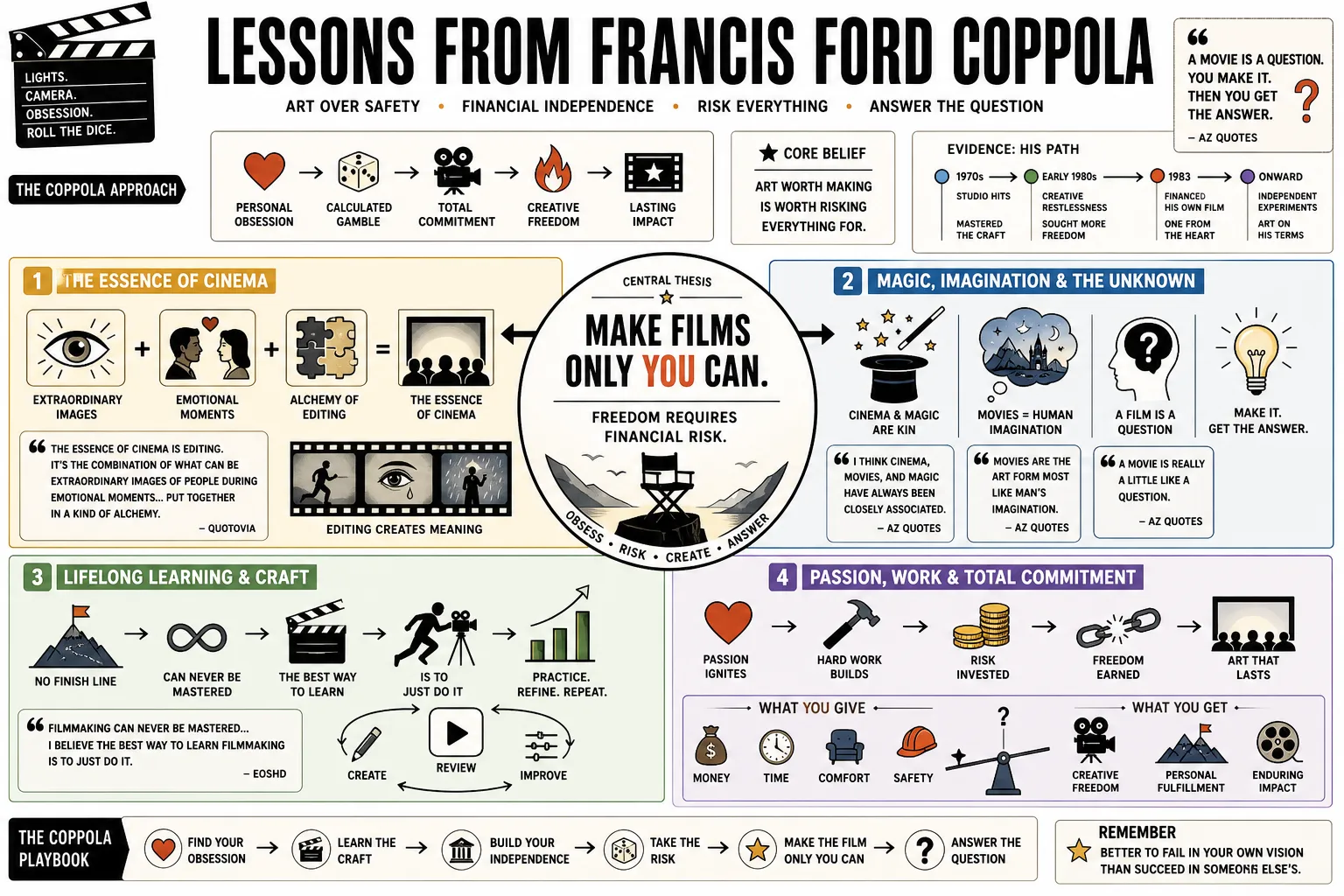
Part 1: The Essence of Cinema and Directing
- On Magic: "I think cinema, movies, and magic have always been closely associated. The very earliest people who made film were magicians." — Source: AZ Quotes
- On the Unknown: "In a sense, I think a movie is really a little like a question and when you make it, that's when you get the answer." — Source: AZ Quotes
- On Editing: "The essence of cinema is editing. It's the combination of what can be extraordinary images of people during emotional moments... put together in a kind of alchemy." — Source: Quotovia
- On Imagination: "Movies are the art form most like man's imagination." — Source: AZ Quotes
- On Lifelong Learning: "Filmmaking can never be mastered... I believe the best way to learn filmmaking is to just do it." — Source: EOSHD
- On Passion and Work: "I'm a firm believer in the theory that people only do their best at things they truly enjoy." — Source: Quotovia
- On Directing Music: "I've always felt that music is a very personal thing. It should be the director's final communication with the audience." — Source: Quotovia
- On Being a Student: He considers himself a student of cinema rather than a master, noting that the medium is still young and evolving. — Source: The Black List
- On Cinematic Language: "The cinema language happened by experimentation—by people not knowing what to do." — Source: Improvised Life
- On Finding Your Voice: "You will take what we give you and you will put it in your own voice and that's how you will find your voice." — Source: Goodreads
Part 2: Screenwriting and Story
- On Personal Writing: "Everything I've written is personal—it's the only way I know how to write." — Source: Screenwriters Utopia
- On Consistency: "The thing about writing is if you really try, if you do it every day, and you put in your time, you get better." — Source: Reddit
- On the Backwards Rewrite: Write the first draft front-to-back, but rewrite it back-to-front to see how scenes tie into your core themes. — Source: Steven Pressfield
- On Theme: Discover the theme of your movie in just one or two words to help anchor the story. — Source: The Black List
- On the Difficulty of Writing: He calls writing the most difficult personal art you can do because it demands deep originality rather than exact replication. — Source: Reddit
- On the Foundation of Film: "You never hear of a movie that's so wonderful because of the photography or the art direction being great. It's usually the acting or writing; without those two things you don't have anything." — Source: Magic of Story
- On the Script as a Blueprint: The screenplay serves as a blueprint, but you should remain in a state of dreaming on set to allow for spontaneity. — Source: Quotovia
- On the Three Versions: Every film has three versions: the script you sign on for, the movie you shoot, and the movie you make in the editing room. — Source: Steven Pressfield
- On Honesty in Storytelling: An artist's role is to share their existence, document modern life, and seek the truth in their experiences. — Source: Industrial Scripts
- On Trusting Ideas: "You have to really be courageous about your instincts and your ideas. Otherwise you'll just knuckle under, and things that might have been memorable will be lost." — Source: No Film School
Part 3: Risk and Courage in Art
- On Risk: "An essential element of any art is risk. If you don't take a risk then how are you going to make something really beautiful, that hasn't been seen before?" — Source: EOSHD
- On Fearless Art: "I always like to say that cinema without risk is like having no sex and expecting to have a baby." — Source: WordPress
- On Creative Abandon: "When risk is taken and the filmmakers dive into the subject matter without a parachute – very often what you get is something with those qualities that make it age well with the public." — Source: QuoteFancy
- On the Ultimate Risk: "I always had a good philosophy about risks. The only risk is to waste your life." — Source: EOSHD
- On Ambition vs. Success: "I think it's better to be overly ambitious and fail than to be underambitious and succeed in a mundane way." — Source: QuoteFancy
- On Creating Without Means: "There's nothing creative about living within your means." — Source: AZ Quotes
- On Doubt: "I don't think there's any artist of any value that does not doubt what they're doing." — Source: Goodreads
- On Defying Rules: He believes there are no set rules to art and pushes back against models that demand guaranteed commercial outcomes. — Source: Screen Daily
- On Leaping into the Unknown: "When we leap into the unknown, we prove that we're free." — Source: CityNews
Part 4: The Business of Filmmaking
- On Commercial Formulas: "They want it to be like Coca-Cola. You get it and it's Coca-Cola and you drink it and they make it again and again and again and they make good money." — Source: Pulse.rs
- On the Reality of Cinema: "That's OK if you're making Coca-Cola because you want to know that you're going to be able to sell it without risk. But cinema is not Coca-Cola. Cinema is something alive and ever-changing." — Reference: The Independent AP interview with Francis Ford Coppola
- On Studio Priorities: Studio executives are not motivated to make good movies; their primary mandate is to pay their debt obligations. — Source: Reddit
- On Giving Up the Mainstream: "I gladly, I voluntarily gave up the kind of commercial film career I had going as soon as I had enough money to finance my own films." — Source: AZ Quotes
- On Financing Personal Films: "The secret of making art is to make it personal... These days I think that it's good to be rich because you are not going to make any money making personal films." — Source: Pulse.rs
- On Financial Independence: He disconnected his filmmaking from the necessity of making a living by pursuing the wine business to preserve his creative freedom. — Source: WordPress
- On Self-Financing Rules: One of his core maxims for independent creators is to self-finance their projects whenever possible to retain absolute control. — Source: EOSHD
- On Corporate Risk Aversion: "For them to create one movie is a risk and they don't like risks. No business does." — Source: Pulse.rs
- On the Value of One-Offs: He views the success of standalone movies as proof that audiences still crave singular ideas over ongoing franchises. — Source: Film Stories
Part 5: Actors and Collaboration
- On the Sex of Art: "You can make the decision that you feel is best, but listen to everyone, because cinema is collaboration. I always like to say that collaboration is the sex of art." — Source: The Black List
- On Listening to Actors: "You're going to listen to the actors because they have great ideas." — Source: The Black List
- On Giving Up Authority: He learned early in his career to stop saying he knew best, discovering that letting actors challenge the staging creates superior results. — Source: The Black List
- On Casting Controversies: "The stuff that I got in trouble for, the casting for The Godfather or the flag scene in Patton, was the stuff that was remembered, and was considered the good work." — Source: Industrial Scripts
- On Diverse Perspectives: Bringing together a cast with conflicting political viewpoints forces everyone to unite toward a common creative goal. — Source: Exclaim!
- On the Director as a Coach: The role of the director is akin to a coach who guides and supports the performers rather than dictating every movement. — Source: Film Talk
- On Symbiosis: Filmmaking is a symbiotic relationship where the material and the people shape and transform one another through ongoing cooperation. — Source: No Film School
- On Sound: "Sound is your friend because sound is much cheaper than picture, but it has equal effect on the audience – in some ways, perhaps more effect because it does it in a very indirect way." — Source: Industrial Scripts
- On Finding the Best in People: A director's true job is establishing an environment where a team can contribute their absolute best work without fear. — Source: Industrial Scripts
Part 6: Technology and the Future
- On the Infancy of Film: Cinema remains in its infancy and will continually be redefined by technological evolution. — Source: The Film Stage
- On the Digital Transition: "It will be digital, it will bounce off satellites, and it will create the screams and hallucinations of the world." — Source: The Film Stage
- On Live Cinema: He envisions a future of live cinema, a hybrid of theater and film where the performance is broadcast and manipulated in real time. — Source: LA Review of Books
- On a New Golden Age: He is confident about an approaching era of wonderfully illuminating and boundary-pushing cinema. — Source: Screen Daily
- On Artificial Intelligence: "We will have to educate artificial intelligence like another child." — Source: El País
- On the Humanities and Tech: The arts and humanities must guide technological advances to ensure the development of informed citizens. — Source: El País
- On Unimaginable Futures: The entertainment his descendants will consume will be so far beyond what he can imagine that he cannot even begin to anticipate it. — Source: El País
- On Modern Tools: A filmmaker should write original screenplays and produce them with the most modern equipment available to them. — Source: EOSHD
- On Freedom Through Tech: The ultimate goal of advancing film technology is to empower directors to be free from traditional industry constraints. — Source: CityNews
Part 7: Chaos and Production
- On Passion and Chaos: "Anything built on a grand scale or with intense passion invites chaos." — Source: Goodreads
- On the Madness of Apocalypse Now: "We were in the jungle, there were too many of us, we had access to too much money, too much equipment, and little by little we went insane." — Source: Reddit
- On Becoming the Subject: "My movie is not about Vietnam... my movie is Vietnam." — Source: Quoteikon
- On Surviving Bad Reviews: "There were people who said Apocalypse Now was the worst film ever made! But little by little, audiences kept seeing it and it sort of persisted in that way." — Source: The Talks
- On Underappreciation: "The Godfather was a very unappreciated movie when we were making it." — Source: Quotovia
- On the Joy of Production: Despite the immense stress of The Godfather, he later reflected that he loved the process and was living a dream. — Source: Goodreads
- On Shifting Styles: "I went from the classic formalism of The Godfather... to a film like Apocalypse Now." — Source: The Talks
- On Unrepeatable Feats: "I realized I probably wouldn't make another film that cuts through commercial and creative things like Godfather or Apocalypse." — Source: QuoteFancy
- On Going All In: "Filmmaking – as, probably, is everything – is a game you should play with all your cards, and all your dice, and whatever else you've got. So, each time I make a movie, I give it everything I have." — Source: Industrial Scripts
Part 8: Life, Family, and Philosophy
- On Persistence: "My talent is that I just try and try and try and try again and little by little it comes to something." — Source: QuoteFancy
- On Saying Yes: "The secret of life is to say yes all the time, because when you're old, you don't want to say, 'I wish I'd done this, I wish I had done that.'" — Source: Goodreads
- On the Ultimate Wealth: "The only wealth in this world is children." — Source: Spokesman
- On Being a Man: "A man who doesn't spend time with his family can never be a real man." — Source: Spokesman
- On Wine and Life: "Drinking wine is just a part of life, like eating food." — Source: AZ Quotes
- On Creating Wonderlands: He built his winery as a park of pleasure for food, wine, music, and celebrating the simple joy of existing. — Source: Forbes
- On Winemaking vs. Filmmaking: Both disciplines involve taking raw materials and relying on strict intuition to blend them into something meaningful. — Source: Cellophane Land
- On the Greatest Pleasure: "Of all the pleasures of life, the greatest one is learning." — Source: VinePair
- On Avoiding Regret: He justifies taking monumental personal risks by refusing to reach the end of his life with unfulfilled creative ambitions. — Source: EOSHD
- On Personal Authenticity: "You are one in a million individual, and if you make your films very, very personal... it will live forever." — Source: Cinema Express