Lessons from Frank Blake
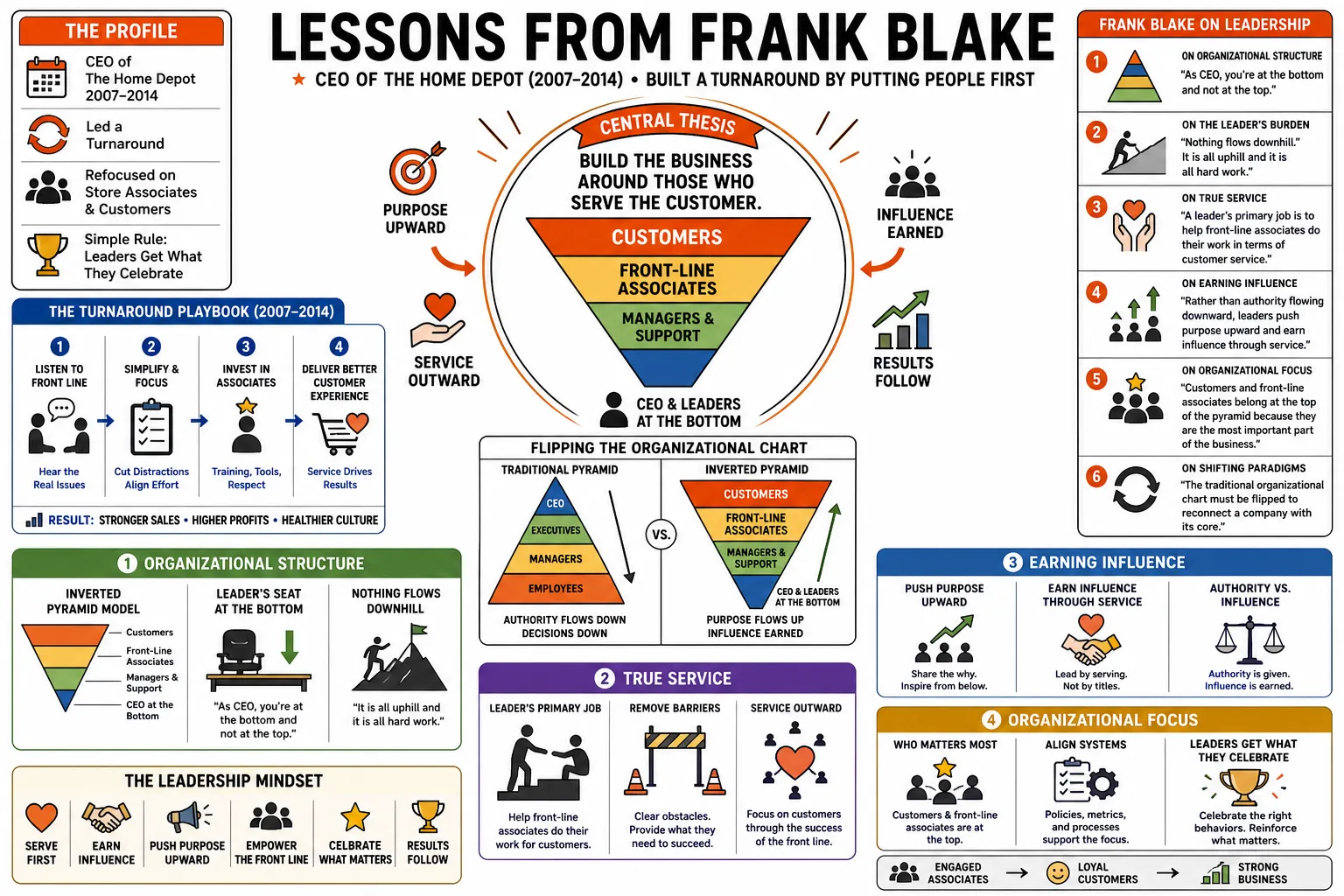
Frank Blake was CEO of The Home Depot from 2007 to 2014, leading a turnaround that refocused the company on its store associates and customers. He ran the business using an "inverted pyramid" management model and the simple rule that leaders get what they celebrate. This profile compiles his ideas on leadership and strategy to show how he built an organization around frontline workers.
Part 1: The Inverted Pyramid & Servant Leadership
- On Organizational Structure: "As CEO, you're at the bottom and not at the top." — Source: [My Leadership Foundry]
- On the Leader's Burden: "Nothing flows downhill. It is all uphill and it is all hard work." — Source: [Retail TouchPoints]
- On True Service: "A leader's primary job is to help front-line associates do their work in terms of customer service." — Source: [Trium Group]
- On Earning Influence: "Rather than authority flowing downward, leaders push purpose upward and earn influence through service." — Source: [Trium Group]
- On Organizational Focus: "Customers and front-line associates belong at the top of the pyramid because they are the most important part of the business." — Source: [Buildertrend]
- On Shifting Paradigms: "The traditional organizational chart must be flipped to reconnect a company with its core values." — Source: [Spencer X Smith]
- On Executive Responsibility: "The CEO's highest obligation is to create a successful, positive experience for the people who actually work for the company." — Source: [Spencer X Smith]
- On Empowering the Front Line: "True leadership begins by listening deeply to frontline employees rather than merely cascading corporate mandates." — Source: [Lardbucket]
- On Clearing the Path: "A CEO's role at the bottom of the pyramid is to remove obstacles so employees can effectively serve the customer." — Source: [Lardbucket]
- On Breaking Down Barriers: "Corporate executives should eat in the same cafeteria as everyone else to signal a return to an egalitarian culture." — Source: [Inc. Magazine]
Part 2: You Get What You Celebrate
- On Reinforcing Behavior: "You achieve what you celebrate." — Source: [The Tim Ferriss Show]
- On the Power of Recognition: "Gratitude and recognition are among the most underappreciated and underutilized tools a leader possesses." — Source: [Nate Meikle]
- On Personal Touch: "Writing hundreds of handwritten thank-you notes to employees is a tangible way to honor their specific acts of service." — Source: [Nate Meikle]
- On Shaping Culture: "Organizational culture is entirely shaped by what leadership intentionally chooses to highlight and reward." — Source: [Crazy Good Turns]
- On Meaningful Praise: "A simple note of thanks from someone in authority has the power to make an employee feel like they are walking on air." — Source: [Crazy Good Turns]
- On Setting Direction: "Leadership is about setting a direction by celebrating the right things." — Source: [Crazy Good Turns]
- On Authentic Values: "Stories of actual good deeds are far more compelling and effective than abstract corporate values statements." — Source: [Crazy Good Turns]
- On Consistency in Praise: "Devoting hours every Sunday specifically to writing notes ensures that recognition remains a disciplined leadership habit." — Source: [Nate Meikle]
- On the Multiplier Effect: "Spotlighting individuals who perform acts of kindness inspires the broader organization to emulate those actions." — Source: [Nicole J. Phillips]
- On Recognizing Effort: "Leaders must celebrate specific efforts alongside final outcomes to foster a culture of continuous improvement." — Source: [Nicole J. Phillips]
Part 3: Mentors and Influences
- On Success: "Leaders must be fueled by the success of others and find genuine excitement in their team's accomplishments." — Source: [Inc. Magazine]
- On Constructive Dissent: "A good leader explicitly tells their team that they are not paid to simply agree with the boss." — Source: [Inc. Magazine]
- On Energy: "An organization feeds off the energy of its leader; high intensity and engagement are required in every interaction." — Source: [Inc. Magazine]
- On Growing Others: "While early career success is about growing oneself, true leadership is defined entirely by creating more leaders." — Source: [Inc. Magazine]
- On Lifelong Learning: "Even as a CEO, seeking out regular one-on-one mentorship from experienced leaders is required for ongoing development." — Source: [Adam Mendler]
- On Kindness in Power: "Simple acts of decency and personal gratitude have enormous power, even at the highest levels of government." — Source: [Crazy Good Turns]
- On Dedicating Time: "Seeing a Vice President spend an hour each morning typing personal notes to staff proves that recognition is worth prioritizing." — Source: [Crazy Good Turns]
- On Empathy: "A leader's capacity for personal thoughtfulness during an employee's time of grief leaves an impact that lasts for decades." — Source: [Crazy Good Turns]
- On Generosity: "True leaders must learn to be generous with credit and opportunity." — Source: [Inc. Magazine]
- On Blending Styles: "The most effective leaders can successfully blend high-intensity operational rigor with people-centric empathy." — Source: [The Tim Ferriss Show]
Part 4: Turning Around The Home Depot
- On Strategy Simplification: "The best leaders pull complexity up and push simplicity down." — Source: [How Leaders Lead: Frank Blake]
- On Sustainable Growth: "Growth should be a byproduct of excellence rather than a primary goal in itself." — Source: [How Leaders Lead: Frank Blake]
- On Strategic Focus: "Pausing aggressive new store expansion is sometimes necessary to reallocate capital toward improving the existing customer experience." — Source: [How Leaders Lead: Frank Blake]
- On Core Identity: "Divesting massive non-core assets can provide the necessary focus and capital to restore a company's fundamental retail operations." — Source: [Spencer X Smith]
- On Economic Alignment: "Store-level success must translate to financial rewards, like success sharing, for the employees creating that success." — Source: [Lardbucket]
- On Restoring Culture: "A successful turnaround requires reconnecting the company to the original values of its founders." — Source: [Spencer X Smith]
- On Managing Complexity: "Leaders must shield front-line workers from corporate complexity so they can focus entirely on the customer." — Source: [How Leaders Lead: Frank Blake]
- On Focusing Strategy: "Writing a turnaround strategy on a single whiteboard and sticking to it is more effective than constantly shifting directives." — Source: [Spencer X Smith]
- On the Retail Mindset: "Employee morale is a critical, measurable competitive advantage in retail." — Source: [Lardbucket]
- On Excellence: "It's hard to be excellent. Excellence takes intense focus." — Source: [The Science of Hitting]
Part 5: Navigating Transitions
- On Business Acumen: "Transitioning from legal counsel to business operations requires actively seeking to understand the business beyond a legal scope." — Source: [Spencer X Smith]
- On Adding Value: "Lawyers succeed in business when they start contributing relevant commercial insights at the table, rather than pointing out risks." — Source: [Spencer X Smith]
- On Endless Curiosity: "An endlessly curious mindset is the most important trait for anyone shifting into a new industry or discipline." — Source: [Spencer X Smith]
- On Ground Truth: "Seek to understand the actual reality on the ground rather than relying entirely on abstract corporate reports." — Source: [Spencer X Smith]
- On Unlearning: "Law school trains people to worry about things no normal human would worry about; business leaders must detach from that to avoid creating unnecessary ambiguity." — Source: [Spencer X Smith]
- On Problem Solving: "Practical business execution often requires ignoring the theoretical complexities that lawyers are trained to over-analyze." — Source: [Spencer X Smith]
- On Career Paths: "Career trajectories do not need to be linear; a willingness to shift sectors often leads to unexpected leadership opportunities." — Source: [Spencer X Smith]
- On Humility in Transitions: "Entering a new role with a self-effacing style, rather than assumed expertise, builds trust more quickly." — Source: [Spencer X Smith]
- On Seeking Reality: "Moving out of defined functional silos is the only way to uncover what is actually happening in the business." — Source: [Spencer X Smith]
Part 6: Communication and Connection
- On Creating Safety: "Create an environment where people are free to say what they think." — Source: [Spencer X Smith]
- On Listening: "A new CEO's most critical first task is to do a lot of listening to understand what front-line workers actually need." — Source: [Spencer X Smith]
- On Visual Communication: "Using simple visual aids ensures every single employee can immediately grasp the company's direction." — Source: [Spencer X Smith]
- On Honest Feedback: "Direct, honest feedback is far superior to standardized, anonymous practices which often mask root issues." — Source: [Spencer X Smith]
- On Authentic Connection: "Leadership requires breaking down the physical and hierarchical barriers that separate corporate executives from field associates." — Source: [Inc. Magazine]
- On Repetition: "A core message must be communicated repeatedly and consistently until it becomes the default mindset of the organization." — Source: [The Tim Ferriss Show]
- On Pushing Back: "Team members must feel a responsibility to work hard to prove the leader wrong when they believe a mistake is being made." — Source: [Inc. Magazine]
- On Clarity: "The mark of a good strategy is not how smart it sounds in a boardroom, but how easily it can be explained in a breakroom." — Source: [Spencer X Smith]
- On the Voice of the Customer: "Communication systems must be designed to pull unfiltered customer and associate feedback directly to the top." — Source: [How Leaders Lead: Frank Blake]
Part 7: Crazy Good Turns & Philanthropy
- On Taking Action: "A crazy good turn is about taking the thought of helping someone else and turning it into concrete, difficult action." — Source: [Crazy Good Turns]
- On Inspiring Others: "If society actively celebrates those who do amazing things for others, the overall number of such acts will naturally grow." — Source: [Crazy Good Turns]
- On Scaling Kindness: "The same leadership principle that turns around a business can be applied to elevate society." — Source: [Crazy Good Turns]
- On Extraordinary Service: "A crazy good turn goes beyond everyday politeness; it represents extraordinary generosity, personal risk, or selfless service." — Source: [Crazy Good Turns]
- On Narrative Power: "Hearing the stories of people who perform acts of kindness is the most effective way to combat cynicism." — Source: [The Tim Ferriss Show]
- On Recognizing the Unseen: "Many of the most impactful acts of generosity are done quietly; it is the observer's duty to shine a light on them." — Source: [Crazy Good Turns]
- On Community Impact: "True philanthropy is about celebrating the individuals who do the hard work on the ground." — Source: [Crazy Good Turns]
- On Spreading Good: "A platform dedicated to positive stories serves as a necessary counterbalance to a culture obsessed with critique." — Source: [Crazy Good Turns]
- On Simple Advice: "The simple directive to do a good turn daily remains one of the most profound pieces of life advice." — Source: [Crazy Good Turns]
Part 8: Personal Character and Mindset
- On Integrity: "When leading an organization, upholding absolute integrity must always be the first order of business." — Source: [Retail TouchPoints]
- On Doing the Right Thing: "There is a critical difference between doing the right thing and merely doing things right." — Source: [Frank Blake: Leading From the Bottom of the Pyramid]
- On Decision Impact: "Leaders must constantly evaluate the human impact of their decisions, evaluating more than just operational efficiency." — Source: [Frank Blake: Leading From the Bottom of the Pyramid]
- On Humility: "A self-effacing approach to leadership is often more effective than projecting an image of infallible expertise." — Source: [Spencer X Smith]
- On Accountability: "True accountability means accepting the burden of failures while distributing the credit for successes." — Source: [Trium Group]
- On Entrepreneurial Thinking: "Fostering an environment where employees feel empowered to take risks and think like owners is essential for long-term vitality." — Source: [Lardbucket]
- On Avoiding Cynicism: "Choosing to focus on the good turns others do is an active daily practice that protects a leader against burnout and cynicism." — Source: [The Tim Ferriss Show]
- On Legacy: "A leader's ultimate legacy is determined by how they treated the people at the bottom of the pyramid, not the peers at the top." — Source: [Trium Group]