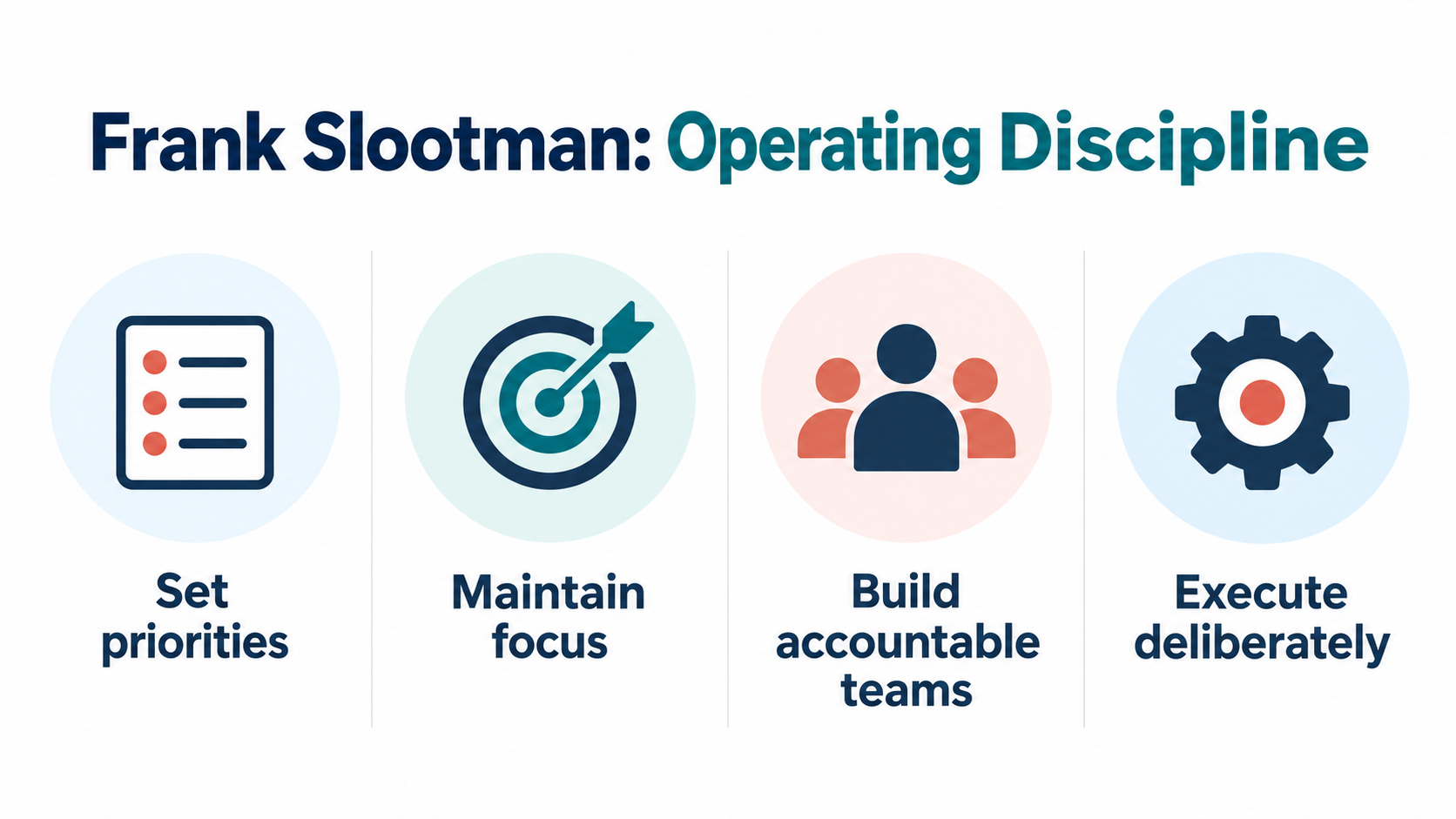
Frank Slootman led Data Domain, ServiceNow and Snowflake through major growth periods and public-market transitions. In his book and interviews, he describes a leadership approach built around stronger execution, narrower focus, higher standards and faster operating tempo. The lessons below distinguish his own views from ideas he credits to other leaders. — Sequoia — Frank Slootman Spotlight.
On Execution and Strategy
Slootman puts execution ahead of abstract strategy debates because weak delivery can obscure whether a plan itself is sound. — Amp It Up — Execution Before Strategy.
- Credit Andy Grove for the Execution Maxim: Slootman credits former boss Andy Grove for the observation that strategy cannot exceed execution; he uses it to argue that operational capability must come first. — Cloud Wars — Frank Slootman Interview.
- Develop Execution Before Debating Strategy: Slootman argues that leaders should build an organization’s execution ability before treating strategy as their principal problem. — Amp It Up — Execution Before Strategy.
- Execution Clarifies the Strategic Diagnosis: Weak execution can make a sound strategy look flawed, so Slootman says leaders should first learn whether their teams can carry out the current plan. — Amp It Up — Execution Before Strategy.
- Turn Hope into Operating Action: Slootman’s performance framework emphasizes explicit priorities, higher standards and a faster pace rather than relying on hopeful projections. — Performance Culture — Frank Slootman.
- Anchor Strategy in Customer Outcomes: In discussing Snowflake, Slootman ties strategy to the actual use and value customers receive, rather than treating an internal product narrative as sufficient. — Snowflake — Amp It Up Transcript.
- Fix the Product Before Blaming Sales: Slootman argues that excellent salespeople cannot reliably compensate for a product customers do not want; diagnose product quality before treating weak sales as only a staffing problem. — The Knowledge Project #173.
- Earn a Brand Through Customers: In the publisher’s foreword, investor Doug Leone identifies winning more customers as a Slootman mantra; Slootman’s own customer-service discussion gives the principle operational context. — Amp It Up — Publisher Foreword.
On Focus and Prioritization
Slootman treats focus as a decision about what work to defer so resources can move the most important objective. — Performance Culture — Frank Slootman.
- Choose a Real Top Priority: Slootman warns that a long list of nominal priorities obscures the singular goal that should guide resource allocation. — Performance Culture — Frank Slootman.
- Do Fewer Things at Once: He argues that narrowing concurrent work concentrates resources on the work most likely to move the business. — Performance Culture — Frank Slootman.
- Revisit Priorities as Conditions Change: In the original interview, Slootman describes prioritization as continuing work rather than a one-time ranking exercise. — The Knowledge Project #173.
- Name the Work You Will Not Do: Slootman asks leaders to make the opportunity costs of focus explicit, including which requests and initiatives will be deferred. — Performance Culture — Frank Slootman.
- Combine Focus, Standards and Pace: His performance framework treats a narrower aperture, higher-quality work and faster tempo as mutually reinforcing operating choices. — Performance Culture — Frank Slootman.
- Sequence Major Initiatives: Slootman advises leaders to put efforts in sequence when parallel work would scatter attention and reduce quality. — LEADERS — Frank Slootman Interview.
On Leadership and Urgency
He describes urgency as a leadership responsibility: clarify the mission, align people and challenge the organization’s default pace. — LEADERS — Frank Slootman Interview.
- Use Five Levers to Raise Performance: Slootman describes raising standards, aligning people and culture, sharpening focus, picking up pace and then transforming strategy as related leadership levers. — LEADERS — Frank Slootman Interview.
- Use the Mission to Filter Activity: Slootman describes a clear enterprise goal as a test for which activities deserve scarce people and resources. — Performance Culture — Frank Slootman.
- Make Priorities Concrete: Slootman says CEOs should give teams a clear purpose and limited objectives rather than leave everyone to infer what matters. — Performance Culture — Frank Slootman.
- Challenge Default Cycle Times: Slootman describes asking whether work expected next week could be done sooner as a way to question an organization’s habitual pace. — Performance Culture — Frank Slootman.
- Expect Discomfort in the CEO Role: Slootman describes uncertainty and anxiety as ordinary features of leading a company amid competition; this is his experience, not a universal requirement for healthy leadership. — 20VC — Frank Slootman Interview.
- Keep Board Accountability Distinct from Operating Control: Slootman says directors can hire or fire the CEO, while the CEO remains responsible for day-to-day operating choices. — Sequoia — Frank Slootman Spotlight.
- Confront Performance Problems: In his first-person essay, Slootman treats difficult conversations about pace, standards and contributions as part of the CEO’s job. — Performance Culture — Frank Slootman.
On Culture and Talent
Slootman defines culture through recurring workplace behavior, including how standards, accountability and customer commitments are practiced. — Amp It Up — Culture.
- Recognize People Who Take Ownership: Slootman describes a performance culture in which initiative and measurable contribution are noticed and rewarded. — Performance Culture — Frank Slootman.
- Distinguish Drivers from Passengers: Slootman’s driver/passenger metaphor distinguishes employees who take initiative to solve problems from those who only describe them; it is a management lens, not an objective label for people. — Amp It Up — Drivers Wanted.
- Address Sustained Role Misfit: The original interview recap describes acting when someone is in the wrong role instead of indefinitely waiting for the mismatch to correct itself. — Foundation Capital — How to Amp It Up.
- Hire Sellers Who Have Had to Sell: Slootman distinguishes candidates who built demand through difficult campaigns from those who mainly processed orders in a fast-moving market. — The Knowledge Project #173.
- Treat Tolerated Mediocrity as a Management Choice: Slootman argues that accepting merely adequate performance can lower an organization’s standards; his “B players” language is his management opinion, not a universal empirical rule. — Performance Culture — Frank Slootman.
- Reward Strong Contributions Visibly: Slootman discusses recognition, differentiated bonuses and other rewards for people doing unusually strong work. — The Knowledge Project #173.
- Go Direct Across Reporting Lines: Slootman favors resolving issues through direct communication and influence rather than waiting for messages to climb a hierarchy. — Snowflake — Amp It Up Transcript.
- Support Sales as a Company-Wide Effort: Slootman describes sales as the commercial tip of the spear and expects other functions to support customers and the selling effort. — The Knowledge Project #173.
- Value Self-Motivated Candidates: Slootman says he looks for people with a strong personal drive to prove themselves; this is a hiring preference, not a guaranteed predictor of performance. — The Knowledge Project #173.
On Mindset and Personal Growth
Slootman emphasizes candid appraisal of operating reality and a willingness to adjust, while also reflecting on the personal drive behind his career. — Cloud Wars — Frank Slootman Interview.
- Correct Mistakes Quickly: In ICONIQ’s firsthand account of his conversation, Slootman favors recognizing failed approaches and adjusting course rather than defending them. — ICONIQ — Frank Slootman Conversation.
- Practice Intellectual Honesty: Slootman argues that leaders must face operating conditions as they are, including uncomfortable facts, before deciding what to change. — Cloud Wars — Frank Slootman Interview.
- Raise the Standard of Work: Slootman describes asking teams whether they truly like what they produced and pushing beyond “good enough”; this can motivate better work in his experience. — Performance Culture — Frank Slootman.
- Treat CEO Anxiety as a Signal to Examine Risks: Slootman says competition and uncertainty make anxiety unsurprising for a CEO, rather than presenting calm certainty as evidence that risks have vanished. — 20VC — Frank Slootman Interview.
- Understand Ambition as Personal Restlessness: Slootman describes his own ambition as linked to not feeling fully adjusted or satisfied; this is his interpretation, not a general psychological law. — The Knowledge Project #173.
- Focus on Others Rather Than Personal Legacy: Slootman says “legacy” is not the word he uses for his aims and places more weight on what colleagues and stakeholders achieve. — The Knowledge Project #173.
Learn more:
- Frank Slootman, Amp It Up: Put Execution Ahead of Strategy
- Frank Slootman, Amp It Up: Hire Drivers, Not Passengers
- Frank Slootman, Amp It Up: Build a Strong Culture
- Frank Slootman, Amp It Up: Align Incentives for Customer Success
- Frank Slootman, Amp It Up: Ramp Up Sales
- Frank Slootman, Amp It Up: Grow Fast or Die Slow
- Amp It Up: Praise for the Book and Doug Leone Foreword
- LEADERS Magazine: Interview with Frank Slootman
- Cloud Wars: Frank Slootman on Amp It Up and Execution
- Frank Slootman: Performance Culture (2018 Essay Reprint)
- The Knowledge Project #173: Frank Slootman — Original Recording
- The Knowledge Project #173: Frank Slootman — Episode Page
- 20VC: Frank Slootman on Focus and CEO Leadership
- Sequoia: Frank Slootman Is a Malcontent—That’s How He Likes It
- ICONIQ Growth: Frank Slootman on Leadership and Mediocrity
- Foundation Capital: How to Amp It Up with Frank Slootman
- Snowflake, Rise of the Data Cloud: Amp It Up Transcript
- Frank Slootman, Amp It Up: Competition and Incrementalism