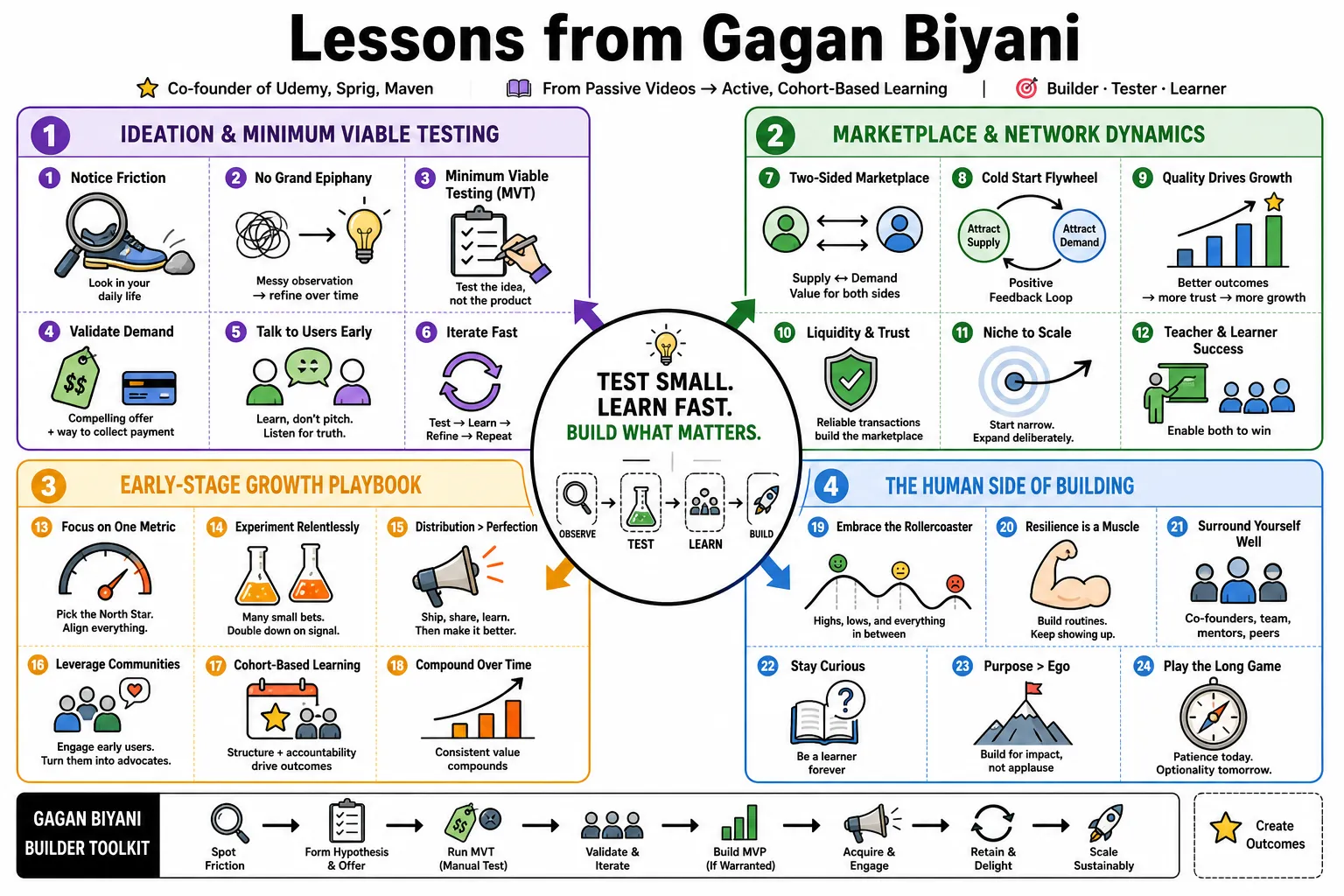
Lessons from Gagan Biyani
Gagan Biyani co-founded Udemy, Sprig and Maven. After working on two online-education businesses with different models, he set out a Minimum Viable Testing approach: test a market’s essential assumptions before committing to a full product. — First Round MVT Essay.
Part 1: Ideation and Minimum Viable Testing
- Explore Before Fixing an Idea: Biyani says ideas can arise from many directions. He recommends exploring businesses, users and markets—and noticing what people already struggle to do—before settling on a startup concept. — The Art of Ideation.
- Treat Ideation as a Nonlinear Process: Biyani describes moving back and forth between exploration and definition. Udemy, for example, reconsidered live lectures after customer conversations pointed toward recorded video courses. — The Art of Ideation.
- Test a Risk Before Building a Product: A Minimum Viable Test isolates an assumption that must hold for the business to work; it need not look like the future product. Biyani advises running such tests before investing in an MVP. — First Round MVT Essay.
- Ask for a Real Commitment: When testing whether people want an offering, Biyani advises asking them to commit time or money rather than relying only on favorable answers in interviews. — First Round MVT Essay.
- Study What Customers Already Do: Biyani’s early ideation process starts by learning users’ jobs-to-be-done and how they currently accomplish them. Their actions can reveal needs more reliably than asking them to design a future product. — First Round MVT Essay.
- Protect Unstructured Exploration Time: Biyani warns that an execution-oriented schedule can crowd out the earlier creative phase. He recommends deliberately reserving open time to investigate markets and let ideas form. — The Art of Ideation.
- Let Market Feedback Change the Idea: Udemy’s founders first expected live online lectures to lead. After listening to instructors and users, they shifted toward recorded courses—an example of returning to exploration when an initial concept fails. — The Art of Ideation.
- Avoid Building Company Trappings Too Early: Biyani criticizes founders who hire, design a brand or build an elaborate MVP before proving whom they can serve and what value they can deliver. — First Round MVT Essay.
- Rank the Assumptions That Could Kill the Business: An MVT should target a crucial risk—demand, execution, distribution, market size or profit—rather than test a fully formed product in one inconclusive launch. — First Round MVT Essay.
- Use Manual Tests to Learn Faster: Before building Maven’s course-creation software, Biyani and his team manually delivered a course with no-code tools. The test revealed demand and operational details earlier than a full product build would have. — First Round In Depth Interview.
Part 2: Growth versus Marketing
- Treat Growth as a Product System: Biyani distinguishes growth from traditional marketing because software companies can connect product changes, analytics and distribution in one testable system. — Snafu Founder-Led Sales.
- Recruit the First Market Participants by Hand: Udemy initially contacted potential instructors one by one and partnered with an existing newsletter audience to sell a filmed course. Early traction came from manual matching, not a self-running growth loop. — Mixergy Growth Interview.
- Develop Channels Around What Converts: Udemy found newsletter partnerships that could sell specific courses, tracked each partner’s audience and conversion, then shifted as that channel began to weaken. Biyani treats channel choice as a test, not a permanent formula. — Mixergy Growth Interview.
- Immerse Yourself as a User and Operator: To understand online education before Maven, Biyani enrolled in courses, taught one, and worked with other education teams. He recommends that kind of firsthand immersion before proposing a product. — First Round In Depth Interview.
- Use Metrics Without Losing Judgment: Biyani questions an exclusively numerical view of human behavior and says founders also need observation and judgment about what their measures omit. — David Perell Interview.
- Persuade Without Removing Agency: Biyani argues that explaining a product’s value is a form of influence, but customers should remain free to decide. Fear of any persuasion can keep a founder from making a useful offer. — Snafu Founder-Led Sales.
- Notice the Referral Loop You Did Not Plan: Udemy’s team initially credited paid acquisition for growth it could not fully explain. Biyani later recognized that instructors promoted courses to their audiences and students told friends. — Mixergy Growth Interview.
- Do Not Assume Paid Acquisition Is the Whole Engine: Biyani says Udemy did use paid acquisition, but the team initially underestimated how much instructor and student referrals contributed. The lesson is to measure the full path to purchase, not to ban paid marketing. — Mixergy Growth Interview.
Part 3: Cofounder Dynamics and Building Teams
- Choose a Cofounder’s Vision Deliberately: Biyani joined Eren Bali and Oktay Caglar after seeing their open-instructor model for Udemy. He knew Eren would lead and chose the stronger shared vision over his own CEO title. — Udemy: A Product of Recession.
- Encode Culture in Early Onboarding: At Maven, Biyani says the team sets a high bar through intensive feedback during a long onboarding period, so new employees can carry the expectations forward. — Biyani on Maven Culture.
- Test a Candidate’s Work, Not Just Their Story: In a direct interview, Biyani describes combining questions about past work with a role-relevant simulation; observing the candidate solve a real problem gives a clearer hiring signal. — MarketerHire Interview.
- Leave a Cofounder Conflict Without Damaging the Company: Biyani says he left Udemy after disagreements about leadership. He avoided public attacks while the company raised its next round, and over time rebuilt his relationship with his cofounder. — Mixergy Sprig Interview.
- Address Fit Through Clear Feedback: Biyani describes direct, frequent feedback and high expectations at Maven. The record supports confronting performance and fit, not the inherited exact aphorism that keeping any poor fit is always cruel. — Biyani on Maven Culture.
- Delegate to Protect Founder Capacity: Reflecting on stress, Biyani recommends getting lower-leverage work off a founder’s plate, using help and time away to regain perspective and focus. — Biyani on Stress and Health.
- Tell the Team How the Company Is Doing: Biyani says he tells Maven employees when the company is doing well or poorly and documents major decisions in writing. The source supports his transparency practice, not the inherited universal quote about what every team can handle. — Biyani on Maven Culture.
- Make Compensation Part of the Culture: Biyani lists competitive cash and equity and proactive raises among Maven’s explicit culture practices, alongside direct feedback and high standards. — Biyani on Maven Culture.
- Do Not Confuse a Founder Title with Traction: Biyani warns against letting company swag, titles or fundraising replace the harder work of finding customers who actually want the product. — First Round MVT Essay.
Part 4: The Realities of Entrepreneurship
- Diagnose Failure in the Whole Market: Biyani’s Sprig post-mortem names several forces behind the shutdown: regulation, costly meal economics, rising competition and the difficulty of restarting after heavy losses. Fast initial growth hid these risks. — Biyani’s Sprig Post-Mortem.
- Write Down What Actually Failed: After Sprig closed, Biyani publicly examined the specific assumptions that broke—market timing, margins and burn—rather than treating the shutdown as one undifferentiated failure. — Biyani’s Sprig Post-Mortem.
- Acknowledge the Founder’s Emotional Cost: Biyani says Sprig’s final year and a half was exceptionally difficult and describes depression as an accurate term for that period. This is his account of his experience, not a general clinical claim. — Mixergy Sprig Interview.
- Do Not Mistake Public Success for Internal Health: Biyani recalls Sprig looking successful from outside while its leadership was privately scrambling after demand reversed and cash burn remained high. — Biyani’s Sprig Post-Mortem.
- Recognize When a Threat Is Existential: Biyani later judged that Sprig tried too hard to preserve its existing service after demand declined, rather than acknowledging how serious the competitive threat had become. — Mixergy Sprig Interview.
- Use Time Away to Regain Perspective: After Sprig’s closure, Biyani says time away reduced his stress. He later advised founders to take vacations and reassess workload rather than treating exhaustion as proof of dedication. — Biyani on Stress and Health.
- Keep Work Outcomes in Perspective: Biyani says that when work feels like all of life, every mistake or success can seem monumental. He advises deliberately stepping back and remembering the rest of life. — Biyani on Stress and Health.
- Founder Exhaustion Can Constrain a Restart: Biyani says Sprig’s team was exhausted after pivots and layoffs. With substantial losses already incurred, they chose to close and return the remaining capital rather than begin again. — Biyani’s Sprig Post-Mortem.
- Revisit the Assumptions Under a Strong Start: Sprig’s early growth masked costly delivery economics and the risk that improving third-party apps would erode its advantage. Biyani identified both in his later post-mortem. — Biyani’s Sprig Post-Mortem.
Part 5: Cohort-Based Learning and Maven
- Question Passive Video as a Complete Learning Model: Biyani returned to online education because on-demand access alone did not deliver the level of engagement and applied learning he wanted. Maven’s cohort format was a different response to that gap. — Forbes Interview on Learning.
- Design for Application, Not Just Access: Biyani’s Maven analysis associates its top-rated courses with projects, richer resources and active live sessions. Access to recordings is useful, but the course design also needs opportunities to apply ideas. — Maven Insights on Top-Rated Courses.
- Use Cohorts to Structure Practice: In Biyani’s analysis of Maven courses, top-rated courses assigned more projects. He recommends giving learners work to apply their skills and time to discuss that work with instructors. — Maven Insights on Top-Rated Courses.
- Let Instructors Facilitate More Than Lecture: Biyani advises replacing some live lectures with prepared materials so class time can be used for questions, exercises, office hours and student work. — Maven Insights on Top-Rated Courses.
- Treat Learning as Practice Beyond Classrooms: Biyani argues that expertise develops through immersion and repeated real-world practice, not classroom instruction alone. — David Perell Interview.
- Test Whether Experts Can Earn from Courses: Maven’s first test did not require course-creation software: the team manually delivered a cohort course with one creator and learned both whether creators would work with them and whether students would pay. — First Round MVT Essay.
- Make Peer Interaction Part of the Course: Biyani reports that highly rated Maven courses had more active communities. He recommends discussion prompts, peer feedback and small accountability groups rather than leaving students isolated with a syllabus. — Maven Insights on Top-Rated Courses.
- Test Price Against Delivered Value: Biyani framed Maven’s early test around whether buyers would pay substantially more for a cohort course than for an asynchronous course. The point was to test the value proposition and economics, not to assume a higher price causes better learning. — First Round MVT Essay.
- Learning Needs Repeated Doing: Biyani says immersion and practice teach skills in ways that observation alone cannot; he uses doing a job and playing baseball as examples of the needed repetitions. — David Perell Interview.
- Build the Creator Tool After the Learning Test: Biyani says Maven’s eventual goal was software for cohort-course creators, but its first test deliberately focused on a manually delivered course rather than software. — First Round MVT Essay.
Part 6: Marketplace Dynamics
- Solve Both Sides of a Marketplace: Udemy initially had neither teachers nor learners. Biyani describes importing existing video content as a first supply-side experiment, then learning that apparent signups did not yet mean a functioning marketplace. — Udemy’s Chicken-and-Egg Problem.
- Build Density in a Specific Course and Audience: Udemy found traction by matching a concrete course to an existing newsletter audience, then repeating that pattern with instructors and distribution partners. The early unit was a course people actually bought, not global catalog size. — Mixergy Growth Interview.
- Produce Initial Supply Yourself When Necessary: When instructors hesitated to record directly for Udemy, Biyani’s team hired a crew to film a live talk and published it as a course. This hands-on work helped demonstrate demand to later instructors. — Udemy’s Chicken-and-Egg Problem.
- Earn Marketplace Credibility Through Real Transactions: Biyani says early Udemy instructors were uneven, but actual course sales gave prospective teachers proof that online courses could work. The team had to improve both the offering and the credibility of the market. — Mixergy Growth Interview.
- Measure Liquidity on Both Sides: Biyani describes marketplace liquidity as both instructors finding students and students finding useful courses. A large signup count without those matches would not solve Udemy’s problem. — Mixergy Growth Interview.
- Notice When Organic Referrals Outgrow the Assumed Channel: Udemy’s team initially missed how much instructors’ audiences and students’ word of mouth contributed to growth. Biyani says recognizing that changed what they focused on. — Mixergy Growth Interview.
Part 7: Lifelong Learning and Mindset
- Keep Learning Beyond Formal School: Biyani describes himself as a lifelong learner and says learning new subjects makes the world richer and more intelligible to him. — David Perell Interview.
- Explore with Curiosity Before Committing: Biyani recommends researching several markets, taking classes, talking to users and keeping notes on questions that arise before forcing one startup idea. — The Art of Ideation.
- Use Reading and New Experiences to Broaden Ideas: During exploration, Biyani recommends business biographies, podcasts, classes and other activities that genuinely interest the founder; their value is widening observation rather than immediately yielding a startup pitch. — The Art of Ideation.
- Change Management Style as You Grow: Looking back on Udemy, Biyani says he was too intense with some employees. He later learned to state expectations factually and allow people to show whether the role fit. — This Week in Startups E1840.
- Be Intellectually Honest About Test Results: Biyani says founders should list the risks that could invalidate a business and interpret Minimum Viable Tests honestly, even when they began optimistic about the idea. — First Round MVT Essay.
- Start by Learning the Industry from Inside: Rather than rely only on expert opinion, Biyani recommends participating as a customer or operator. Before Maven he took online courses, taught one, and worked with education ventures. — First Round In Depth Interview.
- Shorten Feedback by Testing One Atomic Unit: An MVT can test a narrow demand, execution or profit assumption before a team commits to a full product. Biyani uses this sequence to learn what deserves a build phase. — First Round MVT Essay.
Part 8: Identity and the Founder's Life
- Hold Both Parts of an Indian-American Identity: In a first-person Diwali reflection, Biyani describes his Indian heritage and his pride in being American, contrasting childhood indifference to the holiday with greater curiosity he now encounters. — Biyani’s Diwali Reflection.
- Notice Cultural Acceptance in Daily Life: Biyani recounts a young neighbor’s curiosity about Diwali and says he has seen more openness toward Indian culture than when he was a child. — Biyani’s Diwali Reflection.
- Account for Family Financial Pressure: Biyani says family finances made leaving his Accenture job to build Udemy a difficult decision. His mother initially urged caution, then supported him taking the risk despite the cost to her. — Creator Lab Interview.
- Define Success Across More Than One Venture: Biyani’s career includes Udemy’s growth, Sprig’s closure and a return to education with Maven. In his Perell conversation he treats the mix of outcomes as experience to learn from, not a simple success-versus-failure identity. — David Perell Interview.
- Keep Relationships Outside Work: Biyani advises founders to invest in family, long-term friends and significant others rather than allowing work to become their entire social world. — Biyani on Stress and Health.
- Leave Room for Human Connection: Biyani argues that optimizing every minute can squeeze out art, food and relationships—the parts of life that make the time valuable in the first place. — David Perell Interview.
- Treat Burnout as a Signal to Reassess Fit: Biyani describes burnout as real but not solely a matter of hours worked. He advises examining emotional strain, role fit and purpose, and says burnout can force a needed change. — Biyani on Burnout.
- Build a Circle that Offers Perspective: Biyani recommends friends and family beyond one’s career, plus peers, mentors or coaches who can offer perspective when work becomes all-consuming. — Biyani on Stress and Health.
- Bring More Experts into Teaching: Biyani says Maven’s vision is to help experts who were not yet teaching online share knowledge that students could benefit from. This is his stated educational aim, not an invented claim about a personal legacy. — Forcing Function Interview.