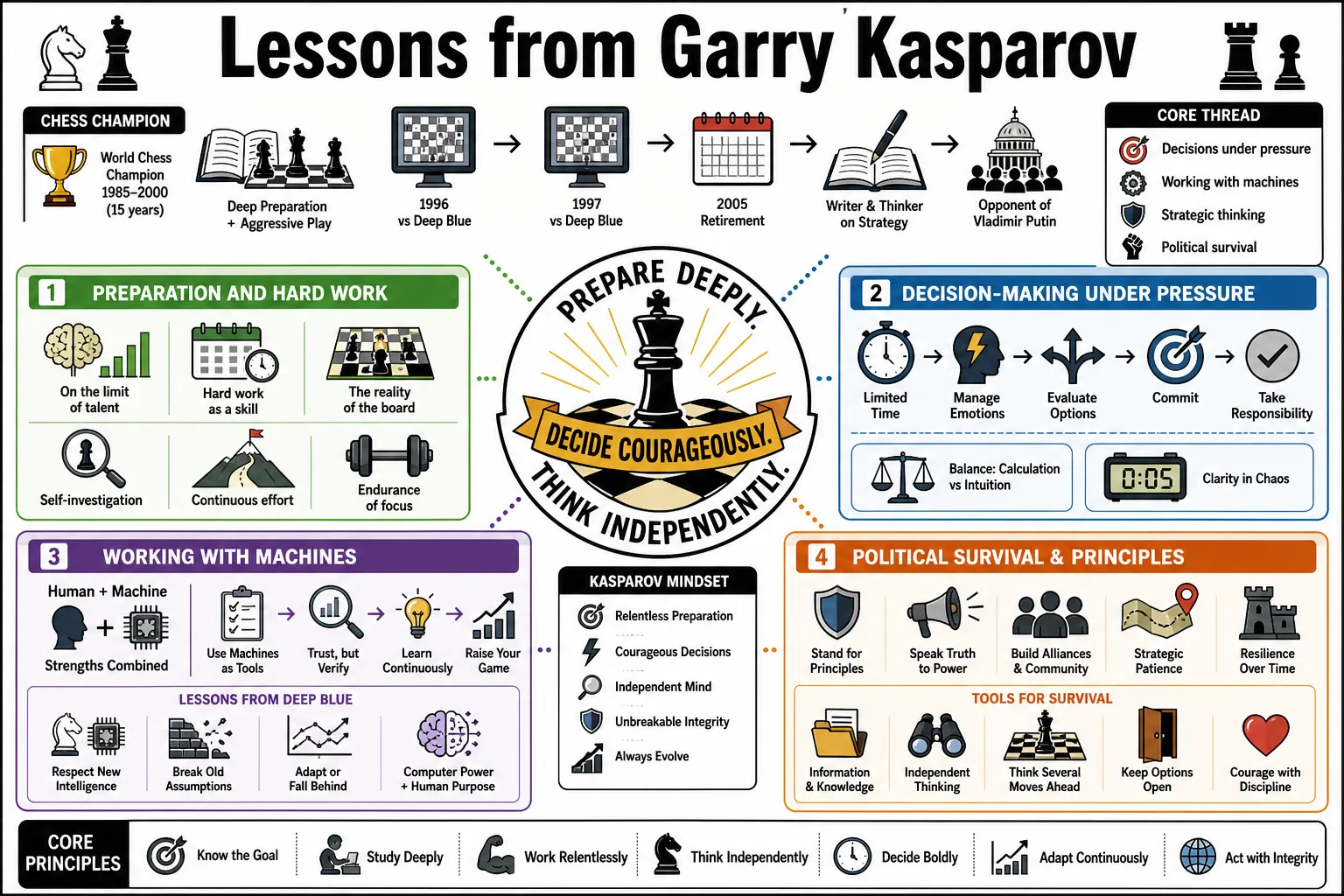
Lessons from Garry Kasparov
Garry Kasparov held the World Chess Championship for 15 years, relying on deep preparation and aggressive play. After his matches against IBM's Deep Blue and his eventual retirement, he turned to writing about strategy and opposing Vladimir Putin. This collection covers his practical approach to decision-making, working with machines, and political survival.
Part 1: Preparation and Hard Work
- On the limit of talent: "It’s not enough to be talented. It’s not enough to work hard and to study late into the night. You must also become intimately aware of the methods you use to reach your decisions." — Source: [Goodreads]
- On hard work as a skill: "The ability to work hard for days on end without losing focus is a talent. The ability to keep absorbing new information after many hours of study is a talent." — Source: [Lichess]
- On the reality of the board: "All the study and preparation in the world can't show you what it's really going to be like at the board." — Source: [Premier Chess]
- On self-investigation: "The method you employ to achieve success is a secret because it can be discovered only by you analyzing your own decisions." — Source: [Goodreads]
- On continuous effort: "Steady effort pays off, even if not always in an immediate, tangible way." — Source: [Progress Focused]
- On building an advantage: "Preparation means that you're analyzing the available data, that you understand your opponent, that you understand the framework of the game." — Source: [The Talks]
- On setting terms: "You try to create conditions for the battle on the most favorable terms for you." — Source: [The Talks]
- On active learning: "Through practice and observation, you must take an active role in your own education." — Source: [Progress Focused]
- On absolute commitment: "If you want to unravel the multitude of secrets of chess then don’t begrudge the time." — Source: [Wikiquote]
- On extreme readiness: "I was the most prepared player in the history of chess." — Source: [Reddit]
Part 2: Strategy and Tactics
- On the defining difference: "Strategy is knowing what to do when there is nothing to do." — Source: [The Business Quotes]
- On taking immediate action: "Tactics is to know what to do when there is something to do." — Source: [The Business Quotes]
- On complexity: "Tactical solutions are something immediate, almost instantaneous... they are actually the simplest part of chess and are almost trivial compared to strategy." — Source: [AZ Quotes]
- On goal-oriented thinking: "What am I trying to achieve and how does this move help me achieve it?" — Source: [Progress Focused]
- On predictable play: "When your opponent can easily anticipate every move you make, your strategy deteriorates and becomes commoditized." — Source: [Quote Fancy]
- On rushing decisions: "The worst enemy of the strategist is the clock." — Source: [AZ Quotes]
- On foundation before aggression: "You should have a solid and well-developed position before going on the attack." — Source: [Premier Chess]
- On maintaining focus: "We must also avoid being distracted from our strategic path by the competition." — Source: [Progress Focused]
- On scrutinizing victories: "It is so important to question success as vigorously as you question failure." — Source: [Premier Chess]
- On emotional distortion: "Time trouble reduces us all to pure reflex and reaction, tactical play. Emotion and instinct cloud our strategic vision when there is no time for proper evaluation." — Source: [AZ Quotes]
Part 3: Psychology and Intuition
- On trusting oneself: "The biggest problem I see among people who want to excel in chess – and in business and in life in general – is not trusting their instincts enough." — Source: [AZ Quotes]
- On the foundation of choices: "Intuition and instinct form the bedrock of our decision-making, especially the rapid-fire decisions that make up our daily lives." — Source: [Goodreads]
- On training the mind: "You have to learn to trust your intuition, which means you have to use it. Think of your intuition as a muscle. Do pushups and run. You have to strengthen it." — Source: [Kasparov.com]
- On the sequence of thought: "It’s intuition first, then calculation." — Source: [Chess.com]
- On true greatness: "Enormous self-belief, intuition, the ability to take a risk at a critical moment and go in for a very dangerous play with counter-chances for the opponent - it is precisely these qualities that distinguish great players." — Source: [IDR Labs]
- On mental endurance: "You can’t overestimate the importance of psychology in chess... winning requires a constant and strong psychology not just at the board but in every aspect of your life." — Source: [Quote Fancy]
- On handling tension: "Sometimes the hardest thing to do in a pressure situation is to allow the tension to persist. The temptation is to make a decision, any decision, even if it is an inferior choice." — Source: [Lib Quotes]
- On self-awareness: "You must always be aware of your limitations and also of your best qualities." — Source: [Premier Chess]
- On objective outcomes: "Chess serves as a goldmine for understanding psychology because the outcomes—win, lose, or draw—provide immediate feedback on mental states." — Source: [ChessBase]
Part 4: Artificial Intelligence and Machines
- On machine understanding: "Deep Blue was intelligent the way your programmable alarm clock is intelligent. Not that losing to a $10 million alarm clock made me feel any better." — Source: [Goodreads]
- On sensing artificial thought: "I could feel—I could smell—a new kind of intelligence across the table." — Source: [TIME]
- On human distinction: "Machines have calculations; humans have understanding. Machines have instructions; we have purpose. Machines have objectivity; we have passion." — Source: [TED]
- On technological progress: "My loss to Deep Blue was also a victory for humans — its creators and everyone who benefits from our technological leaps." — Source: [Kasparov.com]
- On shifting perspectives: "I always say that what I believe was a curse in 1997, I believe it was a blessing because I was part of something really unique. And it was an inspiring moment for computer science." — Source: [Chess.com]
- On embracing tools: "Rather than fearing artificial intelligence, humans should embrace it as a tool that allows us to focus on higher-level creativity and purpose." — Source: [TED]
- On the limit of computation: "While machines excel at calculation, human creativity and intuition remain essential at the boundaries of innovation." — Source: [Kasparov.com]
- On advanced chess: "Teaming a human with a computer often yields better results than a supercomputer alone, blending tactical perfection with strategic direction." — Source: [Business Insider]
- On dreaming big: "Intelligent machines free humanity from repetitive cognitive tasks, allowing us to focus on dreaming big." — Source: [Goodreads]
- On human error: "We fail because we make mistakes, not because machines are infallible." — Source: [Britannica]
Part 5: Politics and Autocracy
- On removing dictators: "Somehow, people always forget that it's much easier to install a dictator than to remove one." — Source: [Goodreads]
- On Putin’s game: "I was almost annoyed hearing that Putin plays chess... The game that defines dictators much better is poker because it's about bluffs. It doesn't matter whether you have a strong hand or weak hand." — Source: [Conversations with Bill Kristol]
- On regime survival: "Putin's regime is living on borrowed time—and if the West holds firm, the Russian leader's hold on power will likely collapse in the near future." — Source: [Khodorkovsky.com]
- On dictator motivations: "Putin can't afford to leave the office because he will be in real danger of being prosecuted for things he and his people did during their stay in power." — Source: [Medium]
- On the illusion of freedom: "Russia today is a police state masquerading as a democracy." — Source: [CBC]
- On Western complicity: "If the West would begin to shred Putin's cover story that he's a democrat, the Russian public would start to ask questions." — Source: [CBC]
- On the nature of rules: "In chess the rules are fixed and the outcome is unpredictable, whereas in Putin's Russia the rules are unpredictable and the outcome is fixed." — Source: [AZ Quotes]
- On the global threat: "Autocratic actions are not just national issues, but a war on the civilized world of international law and democracy." — Source: [Wikiquote]
- On confronting reality: "Acknowledging the true nature of a dictatorship is the first required step before meaningful opposition can begin." — Source: [Wikipedia]
Part 6: Democracy and Responsibility
- On universal values: "I think Russian people are learning that democracy is not an alien thing; it's not a western invention." — Source: [Medium]
- On personal accountability: "There is no one that can share your responsibility. It is your responsibility you must carry it on and you must be responsible for your actions." — Source: [Goodreads]
- On destiny: "At the end of the day we all are being challenged, sooner or later, by our destiny. And it's up to us to make all the difference in this life. If not you, who else?" — Source: [Goodreads]
- On the cost of fighting: "If you make a decision to fight for future of your own country you have to consider all the consequences." — Source: [Medium]
- On institutional foundation: "Russia's future relies on building democratic conditions from scratch and creating a political system that benefits all groups." — Source: [PBS]
- On speaking truth: "Defending democracy requires the courage to speak plainly about the actions of autocrats, regardless of personal risk." — Source: [Khodorkovsky.com]
- On civil society: "Preserving electoral mechanisms and civic engagement is the only reliable defense against creeping authoritarianism." — Source: [Wikipedia]
- On historical cycles: "We must recognize that the fight for freedom is continuous and never fully settled in one generation." — Source: [Medium]
- On leading by example: "True political opposition means participating actively and risking one's comfort for the greater good of the nation." — Source: [CBC]
Part 7: Competitors and Chess History
- On Anatoly Karpov’s strength: "His deep, infiltrating style, subtle positional feeling, and extraordinary persistence, practicality and flexibility rapidly raised him to the very summit of chess." — Source: [Chessable]
- On Karpov’s legacy: "Anatoly Karpov is one of the greatest epoch-creating players of the late 20th century, and his contribution to our knowledge of the subtleties of the ancient game is truly invaluable." — Source: [Stack Exchange]
- On intense rivalry: "While playing five title matches allowed them to know each other intimately, to know, know, know him was not necessarily to love, love, love him." — Source: [Chessable]
- On finding common ground: "His goodwill gesture outweighed all the negative factors which had accumulated during our long years of confrontation." — Source: [Chess.com]
- On historical context: "Evaluating players of the past requires understanding the specific era, tools, and theoretical knowledge available to them at the time." — Source: [Stack Exchange]
- On the Soviet machine: "The Soviet chess school provided an unparalleled infrastructure, but also imposed immense political pressure on its champions." — Source: [WooChess]
- On predecessors: "Studying the games of past world champions is mandatory; every generation stands on the shoulders of the masters before them." — Source: [Stack Exchange]
- On competitive fuel: "A great opponent forces you to find new depths within your own abilities that you could not reach alone." — Source: [LA Times]
- On enduring friction: "Some professional rivalries remain complex and unresolved because they are built on fundamentally different views of the game and the world." — Source: [Stack Exchange]
Part 8: Life, Adaptability, and Growth
- On the necessity of moving: "In chess we have the obligation to move; there is no option to skip a turn if you can't identify a direction that suits you." — Source: [Goodreads]
- On the importance of change: "The ability to adapt is critical to success." — Source: [Premier Chess]
- On misguided adjustments: "Losing can persuade you to change what doesn't need to be changed, and winning can convince you everything is fine even if you are on the brink of disaster." — Source: [Progress Focused]
- On discovering one's style: "Personal style is not generic software that you can download. You must instead recognize what works best for you and then, through trial and error, develop your own method." — Source: [Progress Focused]
- On the value of innovation: "The virtue of innovation only rarely compensates for the vice of inadequacy." — Source: [Progress Focused]
- On experiential learning: "I used to attack because it was the only thing I knew. Now I attack because I know it works." — Source: [Goodreads]
- On seizing chances: "It is always better to face the consequences of a bold attempt than to suffer the lifelong regret of inaction." — Source: [AZ Quotes]
- On continuous evolution: "Success at the highest level requires an endless willingness to reinvent your approach, even when you are currently winning." — Source: [Premier Chess]
- On life as a game of strategy: "The principles that govern mastery on the chessboard—preparation, objectivity, and resilience—translate directly to navigating the complexities of everyday life." — Source: [Progress Focused]