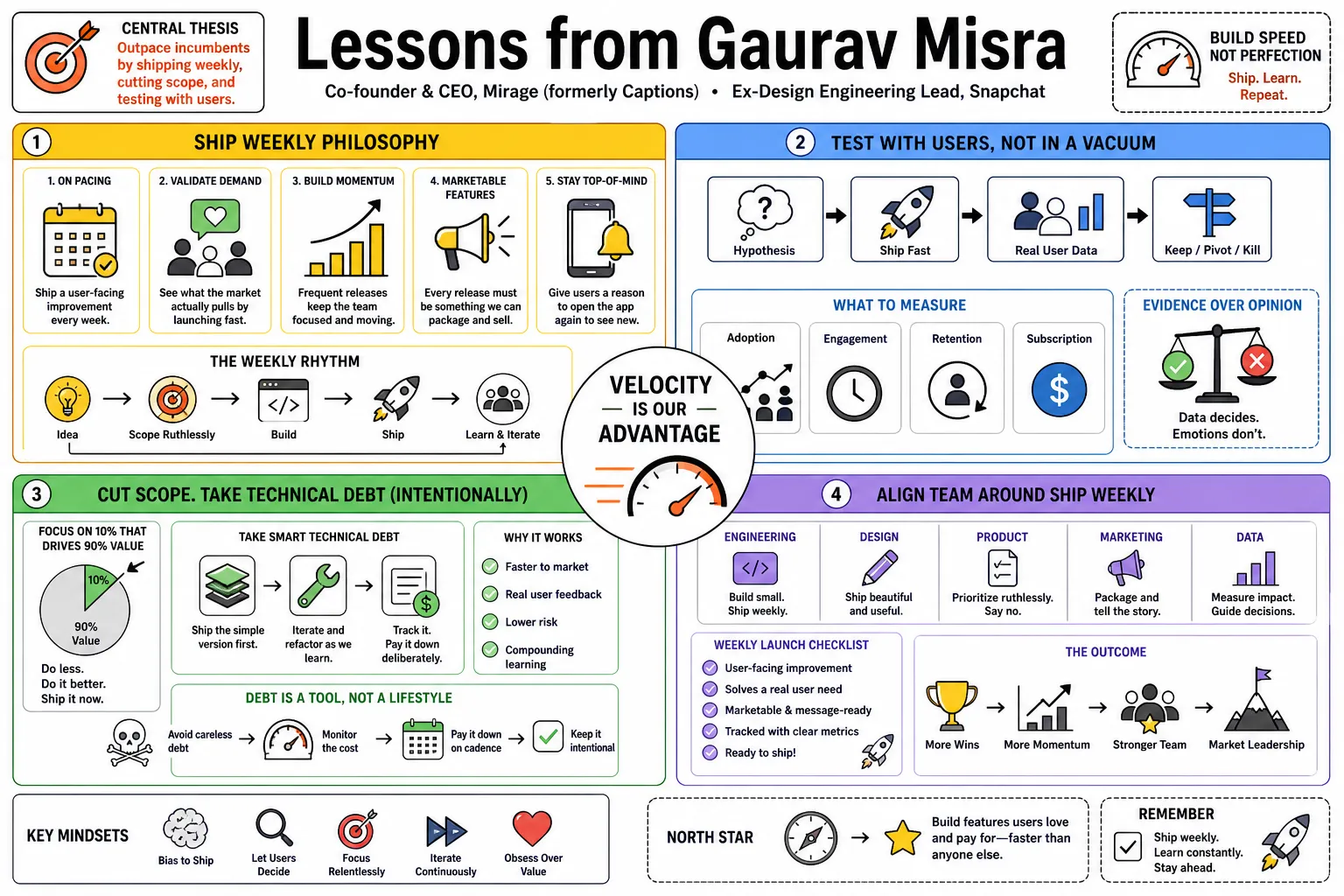
Lessons from Gaurav Misra
Gaurav Misra is the co-founder and CEO of the AI video platform Mirage (formerly Captions) and previously led design engineering at Snapchat. He runs an aggressive product cycle that requires teams to ship a new marketable feature every week and intentionally take on technical debt. His insights offer a practical look at how startups can outpace incumbents by cutting scope and testing directly with users.
Part 1: Velocity and The Ship Weekly Philosophy
- On pacing: "Require your engineers to ship a user-facing improvement every week that could independently drive a subscription." — Source: [Lenny's Podcast]
- On validating demand: "We launch features rapidly to see what the market actually pulls from us, rather than guessing what they want in a vacuum." — Source: [The MAD Podcast]
- On building momentum: "Frequent releases keep the team focused and prevent the stagnation that kills early-stage startups." — Source: [Lenny's Podcast]
- On marketable features: "Every single release must be something the marketing team can package and sell to users immediately." — Source: [Lenny's Podcast]
- On keeping users engaged: "You stay top-of-mind by consistently giving your audience a reason to open the app again to see what is new." — Source: [Generative Now]
- On beating incumbents: "Speed is the only structural advantage a startup has against massive companies with endless resources." — Source: [Lenny's Podcast]
- On iteration loops: "The faster you ship, the faster you get the data required to course-correct." — Source: [DealMakers Show]
- On engineering output: "Engineers should be measured by what ends up in the hands of the user, not just the complexity of the backend." — Source: [Lenny's Podcast]
- On staying relevant: "In the AI landscape, waiting a month to release something means you are already behind the market consensus." — Source: [Generative Now]
- On execution over strategy: "We prioritize shipping over endless debate, because the market will give us the answer faster than a whiteboard session." — Source: [The MAD Podcast]
Part 2: Scoping and The MVP of the MVP
- On ruthless scoping: "Cut the scope aggressively, but never compromise on the quality of the specific interaction you are testing." — Source: [Lenny's Podcast]
- On building the smallest version: "We aim to build the MVP of the MVP—the absolute minimum required to prove someone will pay for it." — Source: [Lenny's Podcast]
- On user complaints: "User complaints on a rough feature are better than silence on a perfectly engineered product nobody uses." — Source: [The MAD Podcast]
- On over-engineering early: "Building a massive infrastructure before you have confirmed user demand is a quick way to burn capital." — Source: [DealMakers Show]
- On knowing when to stop: "You have to know when a feature is 'good enough' to launch so you can move on to the next experiment." — Source: [Lenny's Podcast]
- On the secret roadmap: "Develop breakthrough features quietly in the background that competitors do not see coming." — Source: [Lenny's Podcast]
- On feature bloat: "Avoid adding bells and whistles until the core mechanic is proven to retain users." — Source: [Generative Now]
- On delivering unexpected value: "Sometimes the simplest iteration of an idea creates the most 'magic' for the end user." — Source: [Lenny's Podcast]
- On prioritization: "If a feature doesn't directly bridge a skill gap or a time gap for the user, cut it." — Source: [The MAD Podcast]
- On early-stage feedback: "The only feedback that matters is whether they return to use the tool a second time." — Source: [DealMakers Show]
Part 3: Embracing Technical Debt
- On strategic technical debt: "Taking on technical debt intentionally is necessary to outpace larger, established companies." — Source: [Lenny's Podcast]
- On market signal vs code quality: "I will gladly trade perfect code architecture for immediate market validation." — Source: [Lenny's Podcast]
- On refactoring: "You earn the right to refactor your code only after you have proven the feature drives revenue or retention." — Source: [Generative Now]
- On large-scale commitments: "Do not commit massive engineering resources until the cheap, messy version proves the thesis." — Source: [The MAD Podcast]
- On surviving the early days: "A startup's primary job is survival, and sometimes survival means writing code you plan to throw away." — Source: [DealMakers Show]
- On engineering pragmatism: "Engineers need to understand that beautiful code is worthless if the company runs out of money." — Source: [Lenny's Podcast]
- On speed advantages: "Incumbents are afraid of technical debt because it breaks their existing systems; startups must use it as a weapon." — Source: [Generative Now]
- On the cost of perfection: "Perfectionism in the first year of a startup is an active threat to finding product-market fit." — Source: [The MAD Podcast]
- On scaling infrastructure: "Scale the backend only when the servers are literally falling over from user demand." — Source: [DealMakers Show]
Part 4: Product Design and Engineering Alignment
- On design as a bottleneck: "Design should act as an intentional bottleneck to ensure all features align with the core product vision." — Source: [Lenny's Podcast]
- On product cohesion: "When design and engineering are separate silos, the product feels disjointed to the user." — Source: [Generative Now]
- On the Snap design culture: "At Snapchat, we tested features with small user groups to align the organization before committing to full launches." — Source: [Lenny's Podcast]
- On the designer-PM hybrid: "In our model, designers often function similarly to product managers, driving the 'why' and the 'how'." — Source: [DealMakers Show]
- On visual excellence: "Users will forgive bugs in a new feature if the interface feels premium and intuitive." — Source: [The MAD Podcast]
- On the changing triad: "AI is fundamentally shifting how designers, engineers, and product managers collaborate on a daily basis." — Source: [Generative Now]
- On building intuition: "Designers must develop an intuition for technical constraints so they don't design impossible interfaces." — Source: [Lenny's Podcast]
- On prototyping for alignment: "A functional prototype resolves arguments faster than a hundred-page specification document." — Source: [DealMakers Show]
- On market-driven design: "Good design is not just aesthetic; it is a mechanism for capturing and retaining user attention." — Source: [The MAD Podcast]
Part 5: Navigating the AI Shift and Synthetic Media
- On the AI era: "This shift creates so many possibilities that there are simply not enough people to capture all the opportunities." — Source: [Generative Now]
- On black-boxification: "We focus on making AI outputs interactive and manipulatable rather than delivering static, uneditable results." — Source: [The MAD Podcast]
- On bridging gaps: "The best AI tools either bridge a massive skill gap or compress a massive time gap for the user." — Source: [The MAD Podcast]
- On the trajectory of deepfakes: "We are not entirely ready for how convincing synthetic media will become in the next few years." — Source: [Decoder]
- On synthetic humans: "Building synthetic humans forces us to confront the ethical limits of digital representation." — Source: [Decoder]
- On misuse prevention: "Platforms have a responsibility to build guardrails against misuse as these tools become increasingly realistic." — Source: [Decoder]
- On AI video editing: "The goal is not to build complex software for professionals, but simple tools for people who could never edit before." — Source: [The MAD Podcast]
- On public perception: "Companies must actively demonstrate how their AI tools create a net positive impact for humanity." — Source: [Generative Now]
- On geography: "New York is rapidly emerging as the global epicenter for applied artificial intelligence." — Source: [Generative Now]
Part 6: Go-to-Market and Finding Product-Market Fit
- On pricing models: "Shifting to a subscription model early was the forcing function that told us what users actually valued." — Source: [DealMakers Show]
- On identifying real demand: "People will tell you they love an idea, but you only have product-market fit when they hand over a credit card." — Source: [Lenny's Podcast]
- On ignoring obvious signals: "We grew significantly even while the team initially ignored our most successful feature for over a year." — Source: [DealMakers Show]
- On building for non-professionals: "We are building for the person who could not have created video before, not the Hollywood editor." — Source: [The MAD Podcast]
- On democratizing creation: "The ultimate goal is lowering the barrier to entry so anyone can effectively share their stories." — Source: [Generative Now]
- On talking-video formats: "Observing the evolution of video at Snap made it clear that talking video would dominate the creator economy." — Source: [DealMakers Show]
- On distribution channels: "You cannot rely solely on paid acquisition; the product itself must have a viral loop baked into the output." — Source: [The MAD Podcast]
- On vertical applications: Real estate has become one of Captions' largest user segments, with agents relying on its automated editing and property-tour creation tools for video content. — Source: [HousingWire]
- On finding early adopters: "Target the users who are currently doing the task manually and poorly; they are your most forgiving early adopters." — Source: [Lenny's Podcast]
Part 7: Fundraising and The Art of Storytelling
- On the core of fundraising: "Storytelling is absolutely everything when it comes to early-stage fundraising." — Source: [DealMakers Show]
- On shaping the narrative: "Founders must sharpen their narrative using battle-tested frameworks to connect with the right investors." — Source: [DealMakers Show]
- On pitching the long-term vision: "Investors fund the immediate traction, but they ultimately buy into the ten-year vision of the market." — Source: [Generative Now]
- On the human element: "You have to explain the human problem your AI solves, not just the technical architecture you built." — Source: [DealMakers Show]
- On demonstrating traction: "Showing consistent weekly shipping velocity is a stronger signal to investors than a polished pitch deck." — Source: [Lenny's Podcast]
- On raising large rounds: "Raising massive capital is not an exit; it is simply acquiring the fuel required to maintain your velocity." — Source: [DealMakers Show]
- On investor alignment: "Pick investors who understand the necessity of technical debt and rapid iteration." — Source: [The MAD Podcast]
- On market timing: "Part of the story must explain why this specific product is only possible right now." — Source: [Generative Now]
- On simplifying the complex: "If you cannot explain your AI product in one sentence to someone outside of tech, you will struggle to raise money." — Source: [DealMakers Show]
Part 8: Founder Psychology and The Reality Distortion Field
- On dealing with rejection: "As a founder, you need to be insane, almost operating in a reality distortion field where you do not hear the word 'no'." — Source: [The MAD Podcast]
- On translating feedback: "When an investor or partner says 'no', you have to immediately translate it in your head to 'not yet'." — Source: [The MAD Podcast]
- On unlearning old habits: "The most underrated skill for a founder is the ability to unlearn old habits and pick up new skills rapidly." — Source: [Generative Now]
- On adapting to new markets: "What worked at a massive company like Snap will not always map directly to a seed-stage startup." — Source: [DealMakers Show]
- On full-stack leadership: "Founders must maintain a deep understanding of all aspects of their company, from engineering to sales." — Source: [DealMakers Show]
- On decision making: "If it is a two-way door, you can do whatever you want; if it is a one-way door, you need to do it correctly." — Source: [Lenny's Podcast]
- On bicultural perspectives: "A bicultural background allows you to view market problems through multiple distinct lenses." — Source: [DealMakers Show]
- On maintaining operational knowledge: "You cannot effectively delegate a function until you have done it yourself and understand the friction points." — Source: [The MAD Podcast]
- On leading through uncertainty: "The founder's primary job is to absorb market anxiety so the engineering team can focus on building." — Source: [Lenny's Podcast]
- On the founder's mindset: "You have to genuinely believe that your specific team is the only group capable of solving this specific problem." — Source: [Generative Now]