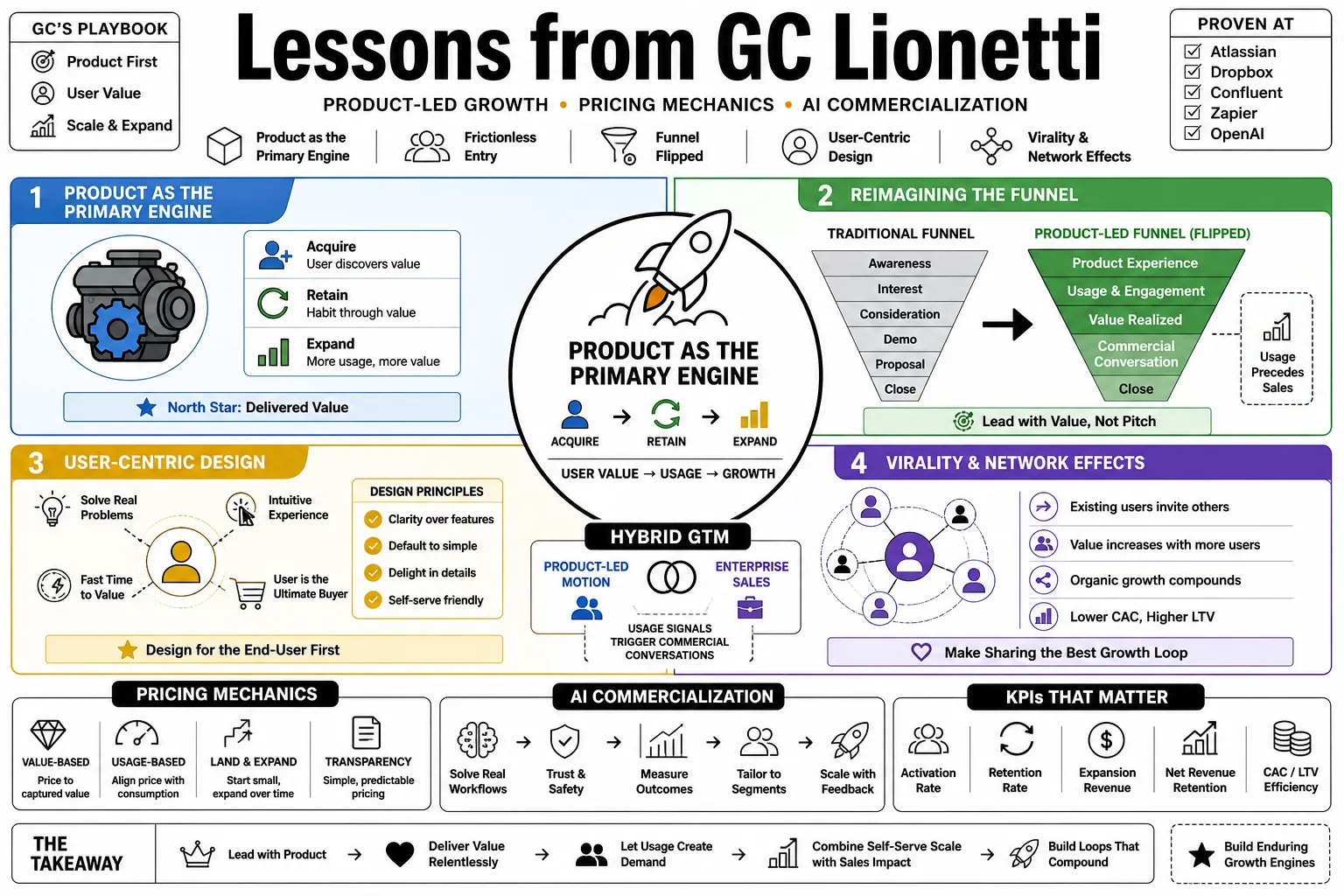
Lessons from GC Lionetti
Giancarlo "GC" Lionetti ran marketing and growth at Atlassian, Dropbox, Confluent, and Zapier before joining OpenAI as Chief Commercial Officer. He made his name defining the hybrid go-to-market model, linking self-serve product adoption with traditional enterprise sales. This profile collects his frameworks for product-led growth, pricing mechanics, and AI commercialization.
Part 1: The Foundations of Product-Led Growth
- On Product as the Primary Engine: "The product has to be the primary engine for acquiring, retaining, and expanding your user base." — Source: First Round Review
- On the Frictionless Entry Point: "A successful PLG motion requires eliminating friction from the initial user experience so people can discover value immediately." — Source: OpenView Partners
- On Reimagining the Funnel: "In a product-led world, the traditional sales funnel is flipped; usage and engagement precede the commercial conversation." — Source: First Round Review
- On User-Centric Design: "Design for the end-user first, because in modern software, the user is ultimately the buyer." — Source: SaaStr
- On Virality and Network Effects: "True product-led growth happens when existing users naturally invite new users through core product workflows." — Source: First Round Review
- On Time-to-Value: "Accelerating time-to-value is the single most important metric for a self-serve product." — Source: OpenView Partners
- On the Role of Marketing in PLG: "Marketing's job in a product-led company is to amplify the product's natural gravity, not to compensate for its flaws." — Source: SaaStr
- On Product Qualified Leads (PQLs): "PQLs are far more reliable than traditional MQLs because they are based on actual product usage and engagement." — Source: Pocus AMA
- On the End-User Era: "We are in the era of the end-user, where software adoption happens bottoms-up rather than top-down." — Source: First Round Review
Part 2: Bridging Self-Serve and Enterprise Sales
- On Reframing the GTM Motion: "Most of the time when people talk about these quote unquote different motions, they talk about them as an 'or'... but the truth is you have a company go-to-market." — Source: First Round Review
- On Hybrid Strategies: "The most successful modern software companies master the hybrid motion, seamlessly connecting self-serve adoption with enterprise sales." — Source: First Round Review
- On the Sales Handoff: "The transition from self-serve to sales should feel like a natural extension of the product experience, not an abrupt shift." — Source: Pocus AMA
- On Arming the Sales Team: "Sales teams in a hybrid model need deep visibility into how accounts are using the product before they ever make a call." — Source: Pocus AMA
- On Aligning Incentives: "If you want a hybrid motion to work, you have to align sales compensation with self-serve revenue so the two do not compete." — Source: SaaStr
- On Enterprise Readiness: "You cannot merely slap a sales team onto a consumer product; the product must evolve to include enterprise-grade administration and security." — Source: First Round Review
- On the Customer Journey: "You're actually really catering to your customers in the way your customers are trying and buying." — Source: First Round Review
- On Product-Led Sales: "Product-led sales is about using product data to prioritize sales outreach and personalize the conversation." — Source: Pocus AMA
- On Avoiding Cannibalization: "Self-serve and enterprise sales should target different buyer personas within the same account to avoid cannibalization." — Source: SaaStr
- On Scaling Revenue: "The self-serve motion builds the massive top-of-funnel, and the enterprise motion captures the maximum contract value." — Source: First Round Review
Part 3: Go-to-Market Strategy and Execution
- On Multi-Product Strategy: "When going multi-product, it is necessary to maintain a consistent go-to-market motion so you do not confuse your customers or your sales team." — Source: First Round Review
- On Consistent Packaging: "Consistent pricing and packaging across a product suite simplifies the buying process and accelerates cross-selling." — Source: First Round Review
- On Market Positioning: "Positioning is less about your messaging and more about what you build and how you deliver it to the market." — Source: SaaStr
- On Go-to-Market Alignment: "Marketing, sales, and product must operate as a single, unified go-to-market engine with shared metrics." — Source: First Round Review
- On Building a Flywheel: "The goal of a GTM strategy is to build a self-reinforcing flywheel where more users lead to a better product, which leads to more users." — Source: OpenView Partners
- On Focusing on Core Strengths: "Do not try to copy another company's GTM motion exactly; adapt their principles to your product's unique strengths." — Source: First Round Review
- On Global Expansion: "International growth in a self-serve model requires deep localization, not mere language translation." — Source: SaaStr
- On Ecosystems and Partnerships: "Building an ecosystem around your product can be a massive multiplier for your go-to-market efforts." — Source: First Round Review
- On the GTM Transition: "Transitioning from a single product to a platform requires a fundamental shift in how you market and sell." — Source: First Round Review
- On Customer Expansion: "The easiest revenue to capture is from existing customers who already experience value from your product." — Source: SaaStr
Part 4: Pricing, Packaging, and the Freemium Model
- On Pricing Thresholds: "We really respect the value that we give to the user with the free product, but we do a lot of aggressive testing to see like what that threshold is." — Source: OpenView Partners
- On Monetizing Value: "What do our users really care about? We will ask our users, do they value X feature enough to pay for it." — Source: OpenView Partners
- On the Freemium Balance: "The free tier must be good enough to drive massive adoption, but restricted enough to compel upgrades." — Source: OpenView Partners
- On Pricing Simplicity: "Pricing should be easy for the customer to understand and easy for the sales team to articulate." — Source: First Round Review
- On Value Metrics: "Align your pricing with the metric that best represents the value your customer receives from the product." — Source: SaaStr
- On Experimenting with Packaging: "Packaging is often a more powerful engine for growth than the actual price point itself." — Source: OpenView Partners
- On Transparent Pricing: "Atlassian taught me the power of transparent pricing; it builds trust and removes friction from the buying cycle." — Source: First Round Review
- On Enterprise Pricing: "Enterprise pricing must reflect the additional administrative and security value delivered to the organization." — Source: First Round Review
- On Continuous Optimization: "Pricing is never finished; it requires continuous optimization as your product and market evolve." — Source: OpenView Partners
Part 5: Organizational Design and Growth Teams
- On Structuring for Growth: "Growth teams need cross-functional representation across engineering, design, product, and marketing to execute rapidly." — Source: SaaStr
- On Breaking Down Silos: "The biggest barrier to a hybrid GTM motion is organizational silos between the sales and product departments." — Source: First Round Review
- On the Role of the CRO: "A modern Chief Revenue Officer must understand product adoption just as well as they understand pipeline management." — Source: Pocus AMA
- On Growth Culture: "A true growth culture embraces failure as a necessary byproduct of rapid experimentation." — Source: SaaStr
- On the Sales Engineer: "Sales engineers bridge the gap between technical reality and business value, making them essential in a product-led sales motion." — Source: First Round Review
- On Hiring for Growth: "Hire people who are obsessively curious about user behavior and comfortable with ambiguity." — Source: SaaStr
- On Marketing Evolution: "Marketing must evolve from lead generation to full-lifecycle engagement, driving adoption and retention alongside acquisition." — Source: First Round Review
- On Cross-Functional Alignment: "The most effective growth initiatives occur when product and marketing have shared goals and shared accountability." — Source: SaaStr
- On Scaling Teams: "As you scale, the processes that worked for a small team will break; you have to continually rebuild your operational foundation." — Source: First Round Review
Part 6: Marketing, Data, and Experimentation
- On Data-Driven Decisions: "In growth, opinions are interesting, but data is the only thing that actually matters." — Source: OpenView Partners
- On the Power of Surveying: "We will do a lot of surveying. We will ask our users what they value to inform our pricing and product roadmap." — Source: OpenView Partners
- On High-Velocity Testing: "The companies that grow the fastest are usually the ones that run the most experiments." — Source: SaaStr
- On Defining Metrics: "If you fail to define your core metrics precisely, you will end up optimizing for vanity numbers that do not drive the business." — Source: First Round Review
- On Understanding Churn: "Churn is a product and engagement problem that must be diagnosed at the user level." — Source: OpenView Partners
- On Personalization: "Effective marketing in a PLG motion relies on deep personalization driven by actual in-product behavior." — Source: Pocus AMA
- On the Limits of Data: "Data tells you what is happening, but qualitative feedback from users tells you why it is happening." — Source: OpenView Partners
- On Experiment Design: "A failed experiment that yields clear learnings is far more valuable than a successful experiment that you do not understand." — Source: SaaStr
- On Cohort Analysis: "You cannot understand growth without looking at cohorts; aggregate metrics will mask the underlying trends in your user base." — Source: OpenView Partners
Part 7: Career Trajectory and Leadership
- On Career Paths: "If you asked me in every single experience what my next experience was gonna be ... I wouldn't have guessed the one that I ended up doing." — Source: Grit Podcast
- On the 'Mini-MBA': "My time at Atlassian served as a mini-MBA, exposing me to every facet of how a modern software business is built." — Source: First Round Review
- On Adaptability: "The ability to unlearn old playbooks and adapt to new business models is the most essential skill for a modern executive." — Source: Grit Podcast
- On Leadership Philosophy: "Leadership is about creating clarity amidst chaos and empowering your team to execute without micromanagement." — Source: SaaStr
- On Remote Work: "Building a strong culture in a remote or distributed environment requires immense intentionality and over-communication." — Source: Grit Podcast
- On Taking Risks: "Career growth rarely happens in a straight line; it requires taking calculated risks on emerging companies and new categories." — Source: First Round Review
- On Work Ethic: "There is no substitute for doing the hard work and understanding the granular details of your business." — Source: Grit Podcast
- On Building Teams: "The best leaders are those who can recruit talent that is smarter than them and get out of their way." — Source: SaaStr
- On Balancing Priorities: "Being a parent and an executive forces you to be ruthless about how you allocate your time and energy." — Source: Grit Podcast
- On Mentorship: "The fastest way to accelerate your career is to find mentors who have already solved the problems you are currently facing." — Source: First Round Review
Part 8: The Economics of AI and the Future of Software
- On the Digital Economy: "Most AI books explain the technology. The Invisible Interface explains the economics — specifically, why the layer between users and AI services is the most valuable real estate in the digital economy right now." — Source: The Invisible Interface
- On Enterprise AI: "We're moving fast on computer-use agents for enterprises, and evaluations are how we measure progress and set higher standards." — Source: Computer Weekly
- On Actionable Intelligence: "AI must move beyond generating insights to taking autonomous actions within enterprise workflows to deliver true ROI." — Source: Technology Magazine
- On the AI Platform Shift: "The transition to AI-native applications is a platform shift as significant as the move to mobile or cloud computing." — Source: OpenAI Newsroom
- On Integrating AI: "The most successful companies will be those that deeply integrate AI into their core product experience, rather than bolting it on as an afterthought." — Source: OpenAI Newsroom
- On AI Go-to-Market: "Commercializing AI requires a fundamentally different go-to-market approach, as the value proposition centers on outcome rather than software access." — Source: Technology Magazine
- On Partnerships in AI: "Strategic partnerships are necessary in the AI era to build the required evaluations, integrations, and trust for enterprise adoption." — Source: UiPath Press Release
- On the Evolution of SaaS: "AI will fundamentally change the SaaS business model, shifting pricing away from per-seat licenses toward outcome-based or consumption-based models." — Source: OpenAI Newsroom
- On the Future of Work: "AI agents will not replace workers but will augment them, automating the mundane so humans can focus on complex, creative problem-solving." — Source: Computer Weekly