Geoffrey Litt is a prominent researcher and design engineer whose work explores the intersection of human-computer interaction, malleable software, and local-first architecture. By advocating for tools that prioritize user agency and data sovereignty, he challenges the modern paradigm of "locked-down" applications in favor of computing environments that users can truly own and shape.
Part 1: Malleable Software and User Agency
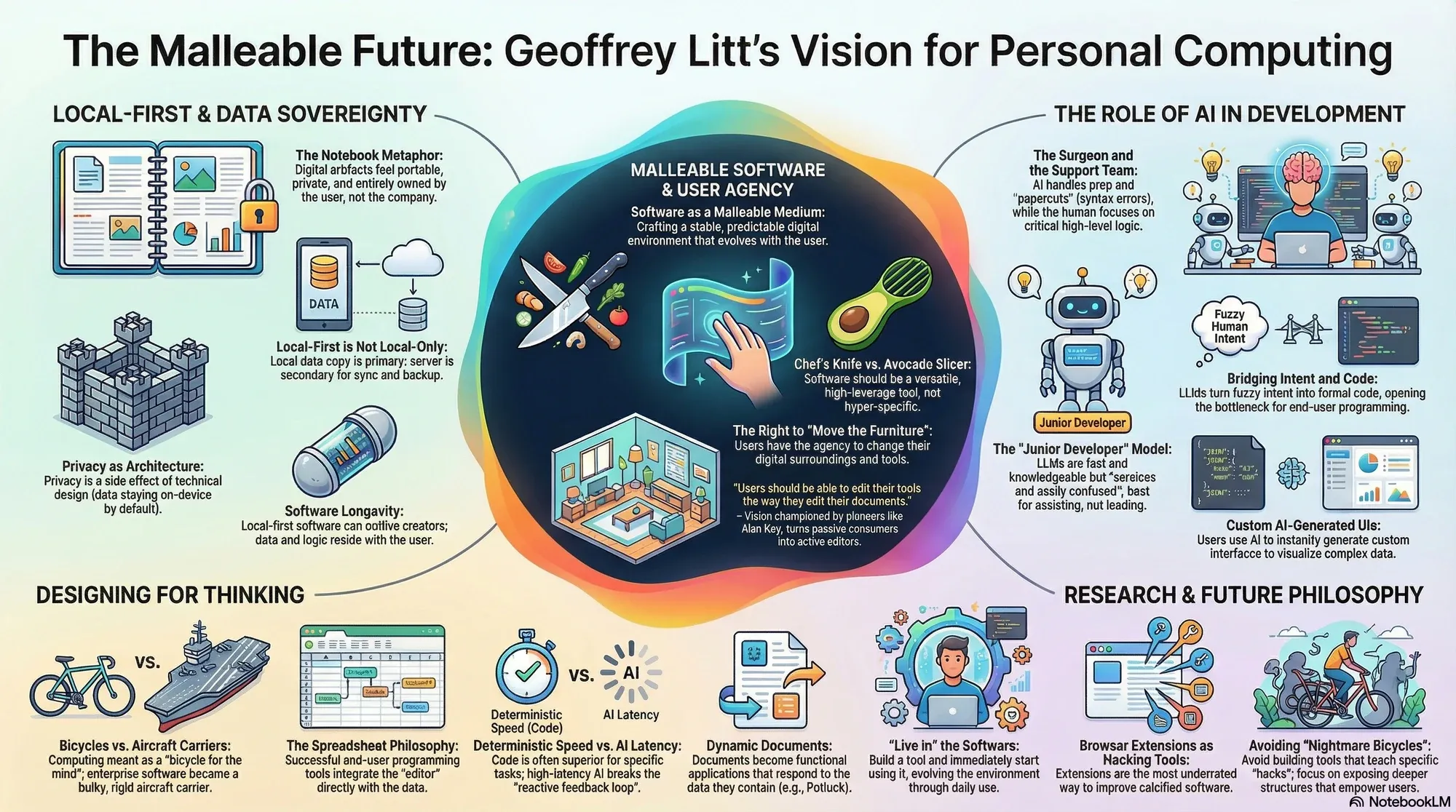
- On the Essence of Malleability: "When I say malleable software, I do not mean only disposable software. I think of it much more as crafting an environment over time that's actually more stable and predictable." — [Source: Dialectic Podcast]
- On the Furniture Metaphor: "If I want to move the furniture or put things on the wall in my house, I want to have the right to do that; software should be the same way." — [Source: Dive Club Podcast]
- On the Pain of Static Tools: "I find it almost painful when people can't change their surroundings, their environments, and their tools; it represents a fundamental lack of agency." — [Source: Jackson Dahl Interview]
- On Specialized Tools: On Specialized Tools: Litt's real analogy, from the essay: an avocado slicer is specialized to one use case and useless at anything else, while a knife can handle all the same steps and much more -- many applications are avocado slicers, when they should be more like knives. [1]
- On Stable Environments: "Ironically, I think malleable software results in more stable software because the user has more control over how it behaves and evolves." — [Source: Software You Can Shape]
- On Digital Ownership: "If we spend all our time in platforms that dictate every detail for us, we start losing the feeling that we own or control anything in our digital lives." — [Source: Generally Intelligent Podcast]
- On User Empowerment: "The goal isn't necessarily for more people to learn programming, but for more people to get involved in the act of crafting their own software." — [Source: Ink & Switch]
- On Platform-Level Solutions: "Malleability isn't something one application can easily solve; it requires a new fundamental way that we think about operating systems." — [Source: Dive Club Podcast]
- On Physical vs. Digital Reality: On Physical vs. Digital Reality: Litt's real framing, from the essay: in the physical world, the act of crafting our environments comes naturally, because physical reality is malleable. [2]
- On the Creator's Right: "Users should be able to edit their tools the way they edit their documents, a vision originally championed by pioneers like Alan Kay." — [Source: Dynamic Documents as Personal Software]
Part 2: Local-First Software and Data Sovereignty
- On the Notebook Metaphor: "In local-first software, your digital artifacts should feel like yours, just like a physical notebook you can carry around with you." — [Source: Local-First Software Essay]
- On Data Ownership: On Data Ownership: The essay's real framing: in local-first apps, ownership of data is vested in the user -- you should be able to copy and modify data in any way, write down any thought, and no company should restrict what you are allowed to do. [11]
- On the Primacy of Local Storage: On the Primacy of Local Storage: The essay's real framing: in local-first applications we swap these roles -- we treat the copy of the data on your local device as the primary copy, while servers still exist but hold secondary copies to assist with access from multiple devices. [8]
- On Collaborative Rich Text: "Algorithms like Peritext enable collaborative rich text editing by using CRDTs to resolve conflicts without a central authority." — [Source: Peritext Research Paper]
- On Reducing Complexity: "Leveraging reactive databases like Riffle can cut through the complexity of modern web apps by making the UI a pure function of the database." — [Source: Riffle Project Overview]
- On Irreducible Complexity: "Conflict resolution is often a semantic problem that developers must handle; it's not a magical problem that databases can solve entirely." — [Source: Geoffrey Litt's Twitter]
- On Software Longevity: On Software Longevity: The essay's real goal, more modestly stated: to fully realize the longevity goal of local-first software, applications should outlive any backend services managed by their vendors. [9]
- On Privacy as Architecture: On Privacy as Architecture: The essay's real framing: local-first apps have better privacy and security built in at the core, since local devices store only your own data instead of a centralized cloud database holding everybody's data. [10]
- On Offline Capability: "Offline capability shouldn't be an afterthought; it is a first-class requirement for software that people rely on for their daily thoughts." — [Source: Metamuse Podcast]
- On Data Portability: "True data ownership requires not just exporting a file, but having that data be in a format that remains useful and editable in other tools." — [Source: Bring Your Own Client]
Part 3: AI-Assisted Programming and End-User Development
- On Coding Like a Surgeon: "A surgeon focuses on the critical work while a support team handles the prep; AI should be that support team for the programmer." — [Source: Simon Willison's Weblog]
- On the 'Junior Developer' Model: On the Junior Developer Model: Litt's real, near-exact description, from the essay: GPT-4 feels like a junior developer who is very fast at typing and knows about a lot of libraries, but is careless and easily confused. [7]
- On Asynchronous AI Agents: "I find it useful to run secondary programming tasks—like fixing TypeScript errors—asynchronously while I focus on higher-level logic." — [Source: Code Like a Surgeon]
- On the End-User Step Change: On the End-User Step Change: Litt's real claim, from the essay: LLMs will represent a step change in tool support for end-user programming -- the ability of normal people to fully harness the general power of computers without resorting to the complexity of normal programming. [5]
- On Bridging Intent and Code: On Bridging Intent and Code: Litt's real claim, from the essay: end-user programming has until now been bottlenecked on turning fuzzy informal intent into formal, executable code -- now that bottleneck is rapidly opening up thanks to LLMs. [6]
- On custom UIs: "Any time I’m spending more than a minute staring at a JSON blob, I consider whether it’s worth building a custom AI-generated UI for it." — [Source: Geoffrey Litt's Blog]
- On the Value of 'Papercuts': "LLM support is invaluable for avoiding 'papercuts' in unfamiliar languages, which allows a developer to maintain their creative flow." — [Source: Simon Willison]
- On AI as Muse: "ChatGPT should be viewed as a muse that inspires and assists, rather than an oracle that provides definitive, unchangeable answers." — [Source: Geoffrey Litt's Substack]
- On the Future of Small Tools: "Soon, all computer users will have the ability to develop small, personal software tools from scratch to solve their specific problems." — [Source: AI as Teleportation]
- On Programming as Fun: "AI-assisted programming can make the process of building software more fun by removing the drudgery of boilerplate and syntax errors." — [Source: Geoffrey Litt's Bio]
Part 4: Designing for Thinking and Dynamic Documents
- On the 'Bicycle for the Mind': "We were promised bicycles for the mind—lightweight, personal tools—but instead, enterprise software gave us aircraft carriers." — [Source: Causal Islands Talk]
- On Dynamic Document Environments: On Dynamic Document Environments: The real projects, per the essay: Potluck let users enrich recipe text notes with dynamic behavior like scaling ingredients, while Embark built an editor for travel-planning documents with a hierarchical outline as its base format. [3]
- On Software as Curation: On Software as Curation: Litt's real point, from the essay: the essential value of a tool like Foam isn't code, it's the opinionated curation of existing building blocks into a coherent whole. [4]
- On the Speed of Code: "If code can do a task, it's better than an LLM doing it because code is deterministic, fast, and doesn't have a 5-second latency loop." — [Source: Dynamic Documents as Personal Software]
- On Reactive Systems: "Interactive feedback loops are essential for thinking; you can't have a reactive system if every keystroke requires a high-latency AI call." — [Source: Causal Islands Talk]
- On Exposing System Structure: "Good design doesn't hide the machine; it exposes the systemic structure and trusts that the user will learn how to use it." — [Source: Dialectic Podcast]
- On the Spreadsheet Philosophy: "Spreadsheets are the most successful end-user programming environment because the 'editor' is always available and integrated with the data." — [Source: Software You Can Shape]
- On Thinking with Environments: "Certain types of creative work can only emerge when you have the correct, highly-tailored digital environment to support them." — [Source: Jackson Dahl]
- On Interactive Documents: "A dynamic document should respond to the data it contains, effectively turning a static page into a functional application." — [Source: Potluck Research]
- On Amplifying Intelligence: "The goal of personal computing is not to replace human thought, but to provide tools that amplify our natural intelligence." — [Source: Geoffrey Litt's Research Philosophy]
Part 5: Research Philosophy and the Future of Software
- On Living in the Software: "When building a tool, you should build part of it and then start living in it, evolving the environment as you use it." — [Source: Dive Club Podcast]
- On the Value of Side Projects: "For your next side project, make a browser extension; they are the most underrated way to hack and improve existing software." — [Source: Geoffrey Litt's Blog]
- On Calcified Assumptions: "Our computing environment has calcified around the assumption that people are only 'users' and never 'editors' of their software." — [Source: Generally Intelligent]
- On the Problem of Sharing: "When everyone is constantly editing their own tools, we need new ways to share those modifications without breaking the underlying systems." — [Source: Malleable Software in the Age of AI]
- On True Simplicity: "True simplicity isn't about removing features; it's about exposing the fundamental structure and letting people take advantage of it." — [Source: Dialectic]
- On Research as Prototyping: "Research at labs like Ink & Switch is about building 'future-provocations'—prototypes that show what computing could feel like if we changed the rules." — [Source: Metamuse Podcast]
- On the 'Nightmare Bicycle': "Avoid building 'nightmare bicycles'—tools that teach very specific hacks rather than the deeper structures that empower users." — [Source: Geoffrey Litt's Substack]
- On the Shift in Professionalism: "The divide between professional developers and 'users' is a historical accident caused by the difficulty of early programming languages." — [Source: Ink & Switch]
- On Shared Environments: "Having shared, malleable environments that a team can customize together is just as important as individual customization." — [Source: Software You Can Shape]
- On the Ultimate Goal: "We want to reach a state where computing feels like a malleable medium, where the barrier between having an idea and building a tool is near zero." — [Source: Geoffrey Litt's Personal Site]
Learn more:
- Malleable Software: Restoring User Agency in a World of Locked-Down Apps (Ink & Switch)
- Malleable Software: Restoring User Agency in a World of Locked-Down Apps (Ink & Switch)
- Malleable Software: Restoring User Agency in a World of Locked-Down Apps (Ink & Switch)
- Foam: Software as Curation (Geoffrey Litt's Blog)
- Malleable Software in the Age of LLMs (Geoffrey Litt's Blog)
- Malleable Software in the Age of LLMs (Geoffrey Litt's Blog)
- Malleable Software in the Age of LLMs (Geoffrey Litt's Blog)
- Local-First Software: You Own Your Data, in Spite of the Cloud (Ink & Switch)
- Local-First Software: You Own Your Data, in Spite of the Cloud (Ink & Switch)
- Local-First Software: You Own Your Data, in Spite of the Cloud (Ink & Switch)
- Local-First Software: You Own Your Data, in Spite of the Cloud (Ink & Switch)