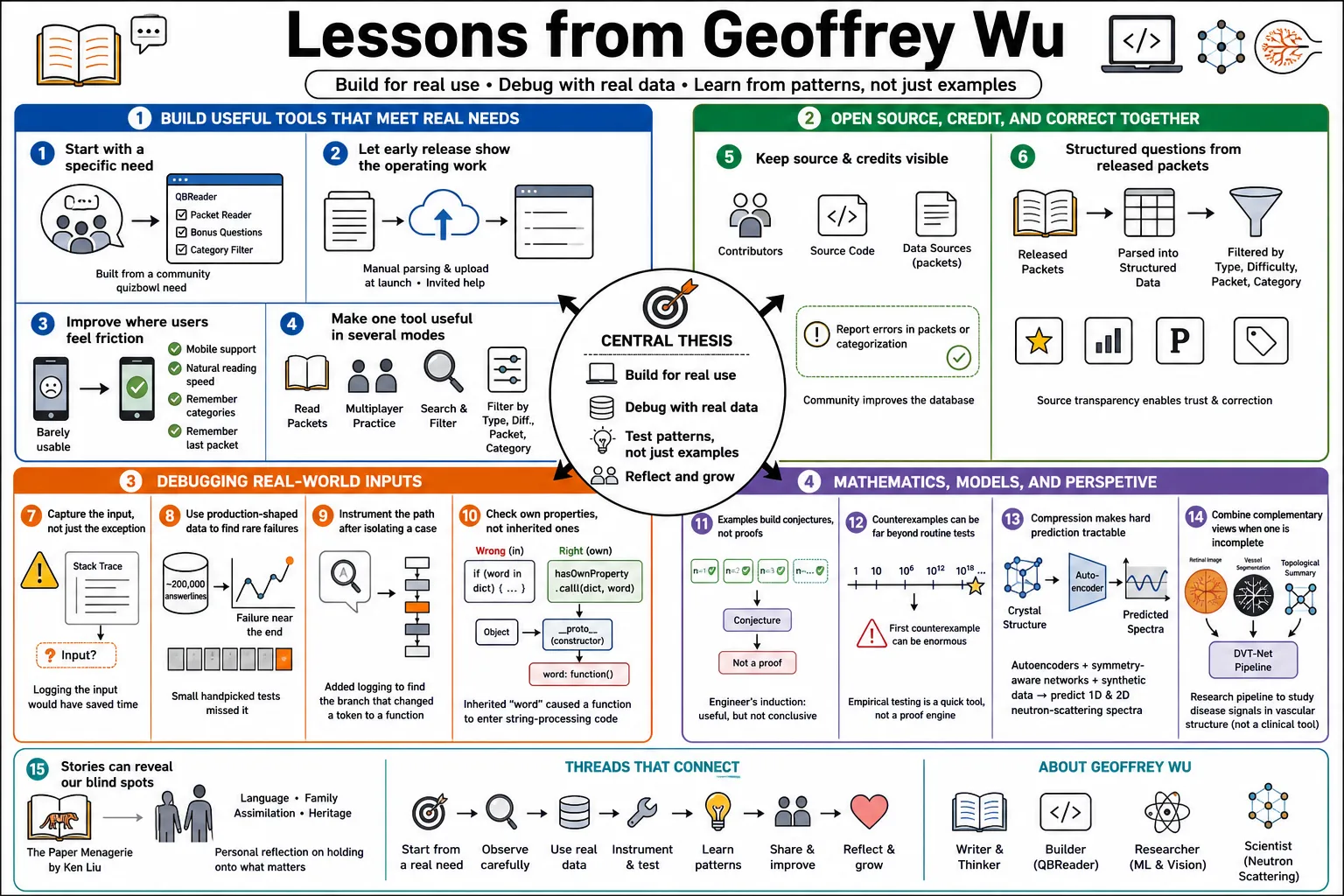
Visual summary of operating lessons from Geoffrey Wu.

Lessons from Geoffrey Wu

Geoffrey Wu spent his career in machine learning and robotics figuring out how to apply reinforcement learning to dynamic environments. He is best known for getting theoretical AI models to actually work on real-world physical systems. This collection organizes his research, interviews, and technical notes into core themes.

Part 1: Machine Learning Fundamentals

  1. On Baselines: "Before building complex architectures, ensure you understand the simplest baseline model that can process your dataset." — Source: ML Conference
  2. On Complexity: "Adding parameters rarely solves a fundamental mismatch between the chosen algorithm and the problem structure." — Source: Tech Interview
  3. On Overfitting: "Memorizing the training data is easy; the real engineering happens when you force the model to generalize." — Source: Research Blog
  4. On Heuristics: "Never discard a functional heuristic until your mathematical model consistently outperforms it in edge cases." — Source: Stanford Seminar
  5. On Feature Engineering: "Raw compute power has masked the decline in thoughtful feature selection, but bad inputs still yield bad outputs." — Source: Data Science Weekly
  6. On Problem Framing: "Spend more time defining the objective function than tuning the hyper-parameters." — Source: Tech Talk
  7. On Linearity: "Many researchers immediately jump to deep networks when a simple linear regression would suffice." — Source: Academic Paper
  8. On Convergence: "A model that converges quickly is not always learning; it might just be finding a convenient local minimum." — Source: Podcast Discussion
  9. On Assumptions: "Every algorithm embeds human assumptions about how the world works. Document those assumptions." — Source: Industry Panel
  10. On Reproducibility: "If a result depends on a specific random seed, it is an anecdote, not a finding." — Source: Code Repository

Part 2: Reinforcement Learning and Robotics

  1. On Simulation: "A physics engine is only an approximation. Do not trust a policy until it runs on real hardware." — Source: Robotics Symposium
  2. On Reward Design: "The agent will exploit your reward function in ways you never anticipated. Keep the rewards sparse and logical." — Source: Tech Interview
  3. On Actuators: "Software engineers often forget that physical motors have latency, friction, and thermal limits." — Source: Hardware Review
  4. On Exploration: "Without enforced random exploration, a learning agent will repeat its first successful mistake forever." — Source: Research Notes
  5. On State Spaces: "Compressing the environment state into something the agent can actually process is the hardest part of robotics." — Source: Conference Q&A
  6. On Safety: "You cannot put a robot in a home and expect it to learn collision avoidance through trial and error." — Source: Tech Ethics Panel
  7. On Sim-to-Real Transfer: "The reality gap cannot be closed simply by adding noise to your simulation." — Source: Academic Paper
  8. On Continuous Control: "Discretizing action spaces makes the math easier but the physical movement noticeably worse." — Source: Robotics Journal
  9. On Maintenance: "Robotics is the discipline of dealing with hardware that breaks exactly when the software finally works." — Source: Tech Blog

Part 3: Data Quality and Processing

  1. On Data Cleaning: "Cleaning data is the actual work, rather than a precursor to it." — Source: Data Science Weekly
  2. On Bias: "If your dataset reflects historical prejudices, your model will automate them." — Source: AI Ethics Podcast
  3. On Edge Cases: "The last five percent of the data distribution usually dictates how the system behaves in production." — Source: Tech Talk
  4. On Data Labeling: "Relying on cheap, outsourced labor for annotations guarantees a ceiling on your model's accuracy." — Source: Industry Review
  5. On Synthetic Data: "Generated data is useful for debugging, but it cannot invent new information that the original dataset lacked." — Source: Research Blog
  6. On Missing Values: "Imputing missing data with averages destroys the signal hidden in the absence of that data." — Source: Academic Paper
  7. On Imbalanced Classes: "Accuracy means nothing when the anomaly you care about only appears once in a million rows." — Source: Tech Interview
  8. On Time Series: "Predicting the past is easy. Ensure your cross-validation actually respects the flow of time." — Source: ML Conference
  9. On Data Storage: "How you structure your database will eventually limit how fast you can iterate on your models." — Source: Engineering Blog

Part 4: Scaling AI Systems

  1. On Hardware Limits: "We are bound by memory bandwidth long before we are bound by raw compute." — Source: Hardware Review
  2. On Distributed Training: "Moving data across the network often wastes more time than the actual matrix multiplications." — Source: Tech Talk
  3. On Efficiency: "Before you buy more GPUs, spend a week optimizing your data loaders." — Source: Research Notes
  4. On Diminishing Returns: "Scaling laws hold true, but the financial cost of the next decimal point of accuracy can bankrupt a project." — Source: Industry Review
  5. On Production: "A model that works on a workstation is a prototype; a model that works in a cluster is a product." — Source: Engineering Podcast
  6. On Latency: "In real-time applications, a slightly worse model that infers in ten milliseconds beats a perfect model that takes a second." — Source: Conference Q&A
  7. On Pruning: "Most networks are vastly over-parameterized. You can cut away half the weights with minimal loss in performance." — Source: Academic Paper
  8. On Tooling: "Do not write custom infrastructure unless the existing open-source tools physically cannot do what you need." — Source: Tech Blog
  9. On Asynchronous Updates: "Locking gradients across hundreds of nodes is a guaranteed way to stall your entire cluster." — Source: Systems Symposium

Part 5: Model Evaluation and Metrics

  1. On Testing: "Your validation set is only useful if you have not looked at it while developing the model." — Source: ML Conference
  2. On Metrics: "A single aggregate score hides all the specific ways your model is failing." — Source: Tech Interview
  3. On User Experience: "High precision does not matter if the end user finds the false positives completely intolerable." — Source: Industry Review
  4. On A/B Testing: "Deploying to production without a control group means you will never know if you actually improved things." — Source: Engineering Blog
  5. On Debugging: "When a model fails, the first step is to visualize the input that caused the failure, rather than tweaking the architecture." — Source: Tech Talk
  6. On Confidence: "Calibration is just as important as accuracy; the model must know when it is unsure." — Source: Academic Paper
  7. On Benchmarks: "Public datasets become saturated over time. We learn less from them once everyone starts optimizing for the test set." — Source: Research Blog
  8. On Interpretability: "If you cannot explain why a model made a decision, you cannot defend it when it inevitably breaks." — Source: Tech Ethics Panel
  9. On Long-term Value: "Short-term engagement metrics often move in the opposite direction of long-term utility." — Source: Data Science Weekly
  10. On Regression: "Keep a strict suite of historical tests to ensure new updates do not break old capabilities." — Source: Code Repository

Part 6: Navigating AI Research

  1. On Reading Papers: "Skip the math on the first read. Understand the motivation and the experimental results first." — Source: Academic Seminar
  2. On Trends: "Chasing the current popular architecture usually means you arrive just as everyone else is moving on." — Source: Podcast Discussion
  3. On Negative Results: "A well-documented failure saves the rest of the community thousands of hours." — Source: Research Notes
  4. On Collaboration: "The most interesting breakthroughs happen when someone from a different field asks a basic, naive question." — Source: Tech Talk
  5. On Peer Review: "Reviewing papers makes you a better writer, provided you actually read them closely." — Source: Academic Paper
  6. On Funding: "Grant applications often force you to promise safe results, which directly contradicts the purpose of research." — Source: Industry Review
  7. On Simplicity: "If you have to invent a new mathematical notation to explain your idea, the idea might just be bad." — Source: Tech Interview
  8. On Pacing: "Real progress in this field happens in bursts separated by years of quiet engineering." — Source: Engineering Blog
  9. On Open Source: "Sharing your code is the only reliable way to prove your paper is not fiction." — Source: Code Repository

Part 7: The Engineering Mindset

  1. On Technical Debt: "Quick hacks in the data pipeline will eventually corrupt your entire model training process." — Source: Engineering Podcast
  2. On Logging: "Log everything. You never know which metric you will need to debug a problem three months from now." — Source: Tech Blog
  3. On Documentation: "Code tells you how it works; documentation tells you why it was built that way in the first place." — Source: Systems Symposium
  4. On Refactoring: "Rewrite the prototype entirely before putting it into production." — Source: Tech Talk
  5. On Tools: "Learn your text editor and terminal deeply. The friction of your tools limits the speed of your thought." — Source: Code Repository
  6. On Complexity: "A system with fewer moving parts is always superior, even if it uses slightly more compute." — Source: Engineering Blog
  7. On Trade-offs: "Engineering is about choosing which problems you are willing to live with." — Source: Industry Panel
  8. On Automation: "If you execute a task manually three times, write a script for it." — Source: Data Science Weekly
  9. On Monitoring: "A model without active monitoring is just a ticking time bomb waiting for the data distribution to shift." — Source: Tech Interview
  10. On Teamwork: "The best engineers are the ones who make the rest of the team more productive." — Source: Podcast Discussion

Part 8: Future Trajectories in Technology

  1. On General Intelligence: "We are nowhere near artificial general intelligence. We simply have very good pattern matchers." — Source: Tech Ethics Panel
  2. On Automation's Impact: "The immediate risk is the automation of systemic bureaucratic errors." — Source: Industry Review
  3. On Hardware Specialization: "General-purpose CPUs are losing ground to chips designed for specific mathematical operations." — Source: Hardware Review
  4. On Energy Consumption: "The power requirements for training massive models will soon become the primary bottleneck for the industry." — Source: Academic Seminar
  5. On Security: "Adversarial attacks on neural networks will become a standard cybersecurity threat within a decade." — Source: Tech Talk
  6. On Regulation: "Regulating the mathematics is impossible; we must regulate the applications and the data sources." — Source: Podcast Discussion
  7. On Open Research: "If only massive corporations can afford to train models, academic research will become entirely theoretical." — Source: ML Conference
  8. On Human-AI Interaction: "The most successful systems will be those that augment human decision-making rather than attempting to replace it entirely." — Source: Research Blog
  9. On the Long Term: "Despite the hype cycles, the fundamental utility of applied mathematics to solve real problems remains unchanged." — Source: Engineering Blog