George Mack writes about high agency, mental models and marketing, drawing on his own essays and long-form interviews. — Infinite Loops: Marketing, Mental Models, and Technology.
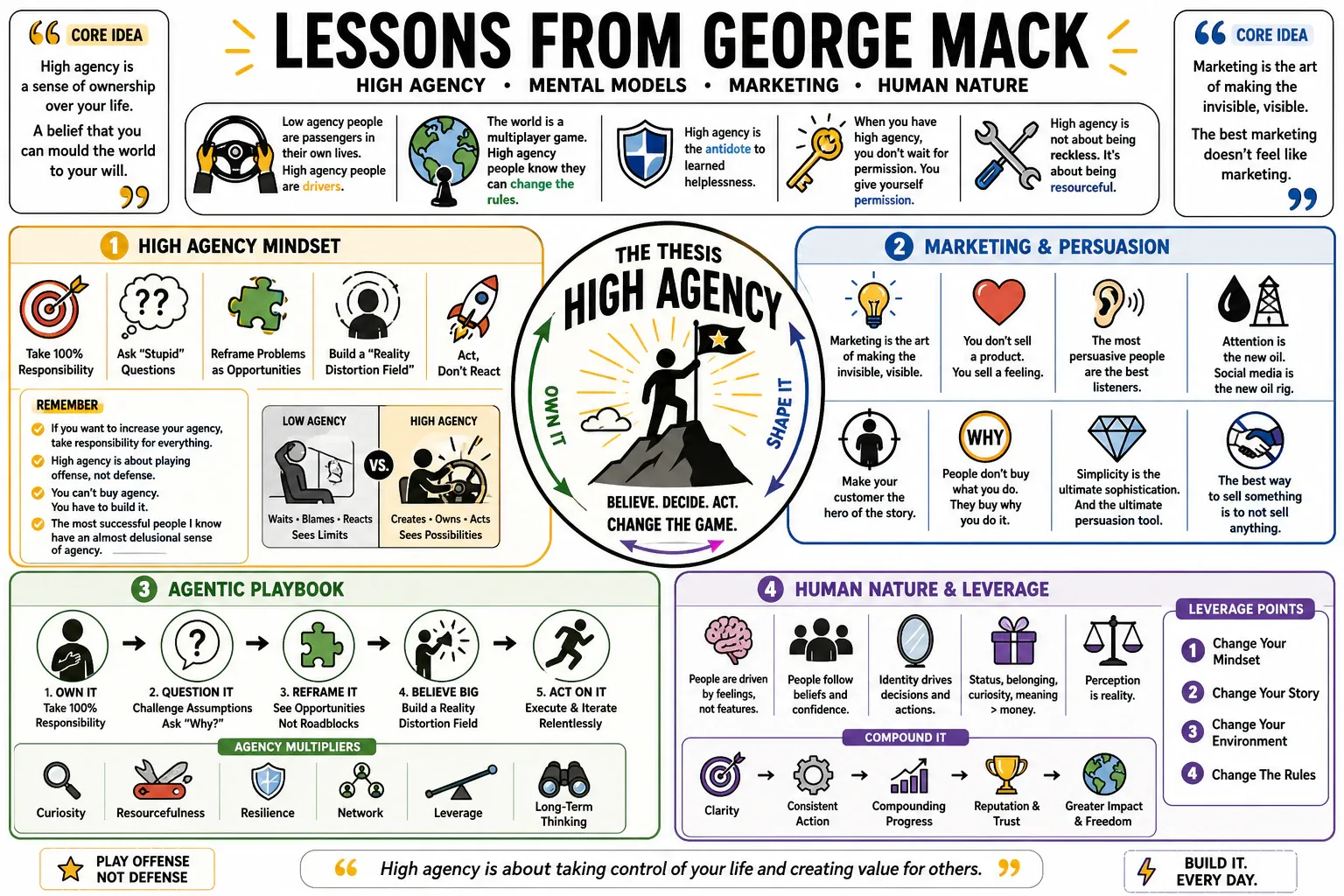
On High Agency
For Mack, high agency means combining clear thought, action and a willingness to question assumptions about what is possible. — High Agency in 30 Minutes.
Ideas:
- Agency shapes a possible future: Mack describes high agency as using clear thought and action to influence outcomes, rather than assuming the future is fixed. — High Agency in 30 Minutes.
- Treat constraints as questions: When a problem seems closed, Mack recommends testing which constraint is truly fixed and which can be changed by a different approach. — High Agency in 30 Minutes.
- Act without waiting for permission: Mack argues that imagined authority figures need not grant permission before someone begins a difficult, imperfect project. — The Adults Don’t Exist.
- Combine initiative with judgment: His account of agency joins action to clear thinking and a willingness to disagree when warranted; it is not a license for recklessness. — High Agency in 30 Minutes.
- Question apparent impossibility: For difficult but physically possible problems, Mack asks what would need to change before dismissing the outcome as impossible. — High Agency in 30 Minutes.
- Agency can be developed: Mack treats agency as a trainable set of habits, including making a concrete first move and learning from its result. — High Agency in 30 Minutes.
Learnings:
- Question received assumptions: Mack identifies independent verification and questioning even the framing of a question as signs of high agency. — How to Spot High Agency People.
- Use the tenfold-agency question: Mack suggests asking what someone with far more agency would try, using the counterfactual to surface options hidden by a stuck framing. — High Agency in 30 Minutes.
On Marketing and Persuasion
Mack’s marketing discussion spans clear self-presentation, publishing and the difference between a real product and its pitch. — How to Engineer Luck.
Ideas:
- Make the offer legible: Mack recommends a clear, specific introduction so other people can understand what you do and where an opportunity might fit. — How to Engineer Luck.
- Let the product demonstrate the promise: In an interview, Mack favors seeing what a product actually does over trusting a polished marketing pitch. — Modern Wisdom: 16 Wise Truths.
- Use a simple guiding principle: Mack discusses how a simple customer-experience principle can guide choices more consistently than a collection of slogans. — Modern Wisdom: Mental Models 104.
Learnings:
- Start from customer experience: Mack uses customer experience as a decision filter when discussing business strategy; the old promise of personal transformation went beyond the source. — Modern Wisdom: Mental Models 104.
- Publish to increase opportunity surface: Mack argues that sharing work publicly can create delayed opportunities by making skills and interests visible to others. — How to Engineer Luck.
On Mental Models and Decision-Making
Mack presents mental models as tools for recurring decisions, while crediting many of the underlying ideas to earlier thinkers. — Modern Wisdom: Mental Models 101.
Ideas:
- Use models as decision tools: Mack compares mental models to apps used for recurring decisions, while explicitly crediting earlier thinkers for the framework. — Modern Wisdom: Mental Models 101.
- Choose a model that fits the decision: For Mack, a model is useful when it gives a practical way to interpret a specific recurring situation, not merely when it sounds clever. — Modern Wisdom: Mental Models 101.
- Invert a problem: Mack explains the inversion method associated with Jacobi and Charlie Munger: examine what would produce the opposite of the desired outcome. — Modern Wisdom: Mental Models 101.
- Consider later-order consequences: Mack discusses how an action can look attractive immediately while its second- or third-order effects change the judgment. — Modern Wisdom: Mental Models 101.
- Run small decision experiments: Mack advises taking a small step and updating from its result instead of waiting for certainty before acting. — High Agency in 30 Minutes.
- Test maps against terrain: Mack distinguishes a useful conceptual map from the reality it describes and urges checking ideas against experience. — Modern Wisdom: Mental Models 101.
- Reduce problems to first principles: Mack discusses breaking a problem into underlying facts and assumptions before choosing a solution. — Modern Wisdom: Mental Models 101.
Learnings:
- Build a cross-disciplinary toolkit: Mack draws on Munger’s latticework idea and describes borrowing models from several disciplines for different decisions. — Modern Wisdom: Mental Models 101.
- Treat decisions as experiments: Mack recommends trying a bounded option, observing what happens and revising the next move, rather than pretending to know an outcome in advance. — High Agency in 30 Minutes.
- Check claims independently: Mack treats independent verification and a willingness to question group consensus as habits worth cultivating. — How to Spot High Agency People.
- Design incentives for action: Mack suggests setting up concrete prompts and commitments that make the desired action more likely; he does not claim incentives explain all behavior. — High Agency in 30 Minutes.
On Life and Learning
His writing on learning emphasizes curiosity, self-teaching and starting before one feels fully prepared. — How to Engineer Luck.
Ideas:
- Learn by correcting mistakes: Mack favors iterative, testable action over a demand for perfect confidence; the old alleged quotation is not retained. — High Agency in 30 Minutes.
- Start before feeling fully ready: Mack challenges the idea that some perfected adult class has everything figured out, and recommends acting while still learning. — The Adults Don’t Exist.
- Keep curiosity alive: Mack identifies sustained curiosity, especially as people age, as one way to increase the chance of unexpected opportunities. — How to Engineer Luck.
Sources
These original essays and recorded conversations support the revised lessons above. — High Agency in 30 Minutes.
- George Mack’s signed high-agency essay: Original source for the revised profile. — High Agency in 30 Minutes.
- George Mack’s signed essay on engineering luck: Original source for the revised profile. — How to Engineer Luck.
- Mental Models 101 — How to Make Better Decisions with George Mack (Modern Wisdom): Original source for the revised profile. — Modern Wisdom: Mental Models 101.