George Soros developed a theory of reflexivity from his work in financial markets and from a broader philosophical interest in fallibility and open society. — General Theory of Reflexivity.
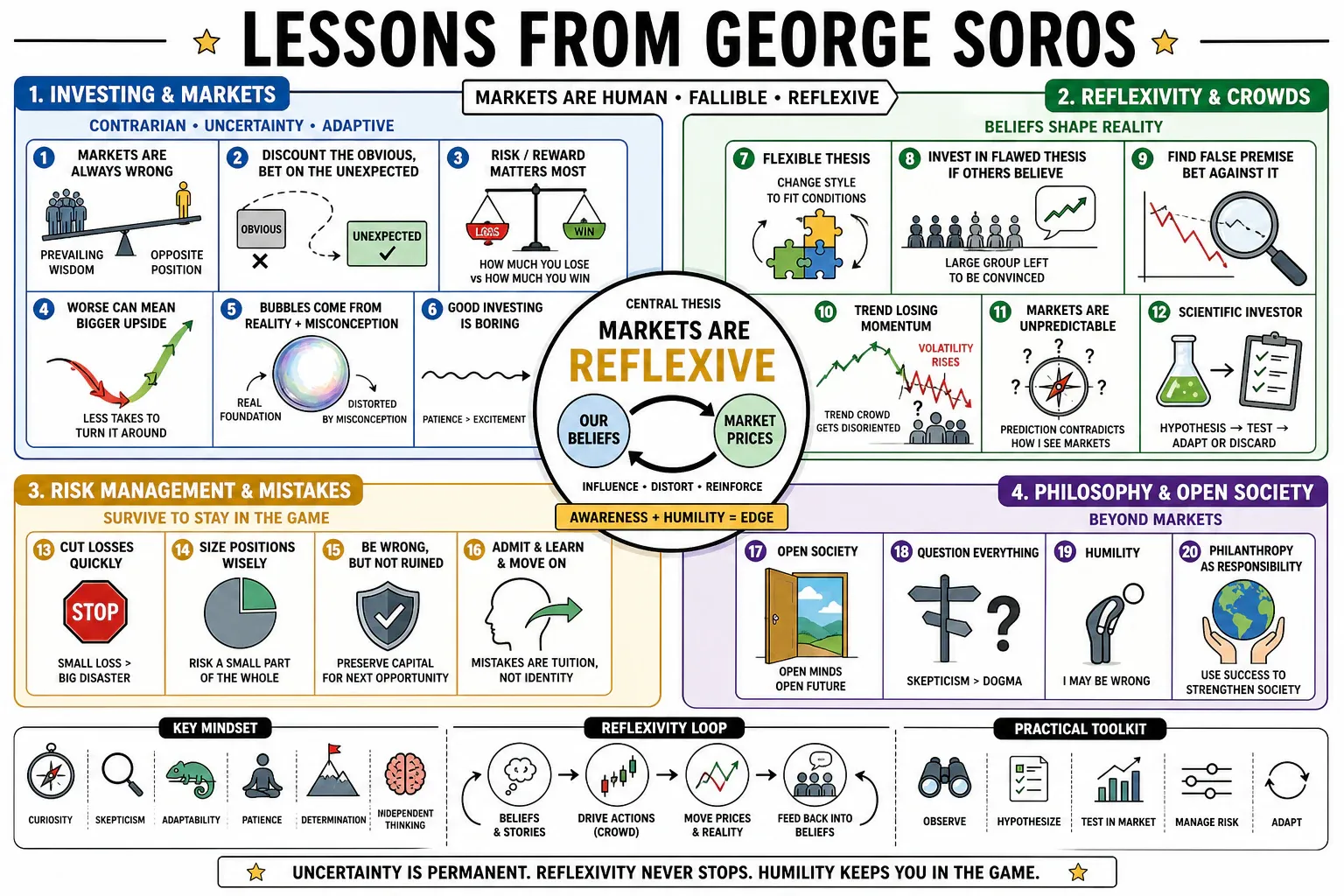
On Investing & Markets
Soros questioned the assumption that financial markets are always right, arguing that participants’ imperfect views and decisions can affect prices and underlying events. — Financial Markets Lecture.
- Markets Are Not Infallible: Soros rejects the idea that market prices reliably reflect an independent equilibrium; participants’ biased views can also affect the fundamentals they price. — Financial Markets Lecture.
- A Flawed Thesis Can Be Temporarily Profitable: Soros says a financial hypothesis need not be true to be profitable while it gains acceptance, but the investor must understand its flaw and be prepared to exit. — The Crisis of Global Capitalism, Ch. 1.
- Avoid False Certainty in Forecasts: Soros argues that participants’ imperfect understanding and reflexive feedback make outcomes uncertain; predictions should remain revisable. — General Theory of Reflexivity.
- Adapt Views as Conditions Change: Soros treats investment hypotheses as time-bound: what fits one stage of a reflexive process may cease to fit at another. — The Crisis of Global Capitalism, Ch. 1.
- Look for a Prevailing Misconception: Soros sought situations where his interpretation differed from prevailing wisdom and watched for errors in both his view and the market’s. — The Crisis of Global Capitalism, Ch. 1.
- Treat an Investment as a Testable Hypothesis: Soros describes formulating a hypothesis, investing on it, and measuring or revising it as evidence unfolds. — The Crisis of Global Capitalism, Ch. 1.
- Speculation Can Alter Fundamentals: Soros argues that speculative prices can influence the underlying conditions of supply and demand, so fundamental forces need not automatically correct a boom. — Financial Markets Lecture.
The Theory of Reflexivity & Fallibility
Soros’s reflexivity framework links imperfect perceptions to the events those perceptions help bring about, especially in financial markets. — General Theory of Reflexivity.
- Understand Reflexivity: Participants’ views can change the situations they try to understand; events in turn change those views, creating a feedback loop. — General Theory of Reflexivity.
- Fallibility Comes First: Soros links fallibility to reflexivity: imperfect views matter because people act on them and thereby affect the world they describe. — Fallibility and Reflexivity.
- Prices Express Biased Expectations: Soros argues that market prices incorporate participants’ imperfect expectations about the future rather than a neutral view of it. — Financial Markets Lecture.
- Identify Both Parts of a Bubble: In Soros’s account, an underlying trend and a misconception reinforce each other during a bubble; neither element alone explains the cycle. — Financial Markets Lecture.
- Prices Can Change Fundamentals: A rising market price may ease financing and thereby affect the underlying business, creating feedback between valuation and fundamentals. — Financial Markets Lecture.
- Participants Never See the Whole Situation: Soros says people’s views of social situations are partial and distorted; their actions can then alter the situation they are trying to understand. — General Theory of Reflexivity.
- Reinforcement Drives Boom and Bust: Soros describes the boom-bust process as a trend and misconception reinforcing one another until the relationship reverses. — Financial Markets Lecture.
- Boom and Bust Are Often Asymmetric: Soros describes a gradual boom followed by a comparatively abrupt bust in his typical bubble model; this is a pattern, not a law of every market. — Financial Markets Lecture.
- Recognize Limits to Comprehension: Soros says the complexity of the world exceeds any participant’s capacity to comprehend it, requiring simplification and leaving room for error. — General Theory of Reflexivity.
- Do Not Treat Social Markets Like Physics: Soros argues that thinking participants can change the subject being studied, limiting claims of timeless, physics-like laws in economics. — Fallibility and Reflexivity.
- Investigate the Gap Between Views and Events: Soros looked for situations where his interpretation differed from prevailing wisdom while remaining alert to errors in his own view. — The Crisis of Global Capitalism, Ch. 1.
- Correct False Predictions: Soros says discovering an error can be useful because it lets an investor take a profit or cut a loss before the error becomes more costly. — The Crisis of Global Capitalism, Ch. 1.
- Markets Can Destabilize Themselves: Soros disputes the assumption that financial markets always move toward equilibrium; reflexive feedback can produce bubbles and crises. — Financial Markets Lecture.
On Mistakes & Risk
Soros describes discovering and correcting errors as a practical advantage, while acknowledging that fund management often felt painful and uncertain. — The Crisis of Global Capitalism, Ch. 1.
- Correct Mistakes Without Shame: Soros regarded recognizing errors as a practical advantage: discovering a mistake could help him change course before financial damage grew. — The Crisis of Global Capitalism, Ch. 1.
- Use Doubt to Stay Alert: Soros describes doubt, uncertainty, and fear as prominent feelings in his fund management and says worrying helped keep him alert to danger. — The Crisis of Global Capitalism, Ch. 1.
- Survival Requires Changing Course: Soros recounts surviving the Nazi occupation through his father’s preparation and later applying a similar readiness to find and correct errors. — General Theory of Reflexivity.
- Acknowledge the Pain of Risk: Soros says managing a hedge fund was painful for him and describes doubt and fear as part of operating with incomplete knowledge. — The Crisis of Global Capitalism, Ch. 1.
- Know the Danger Points: Soros says he felt safer when he knew an investment’s potential flaws because they gave him signs to watch for selling. — The Crisis of Global Capitalism, Ch. 1.
- Cut Losses When a Thesis Fails: When he discovered an error, Soros says he could take a profit if available or cut losses if the investment had not worked. — The Crisis of Global Capitalism, Ch. 1.
On Life, Society & Philanthropy
Soros applied his open-society ideas through philanthropic institutions as well as his writing on politics and markets. — Soros on Soros, Ch. 6.
- Put Ideas to Work Through Philanthropy: Soros says his philosophical framework guided both making money and spending it as a policy-oriented philanthropist; his philanthropy pursued open-society principles. — General Theory of Reflexivity.
- Protect Civic Principles With Institutions: Soros argues that freedom, democracy and the rule of law require institutions and public-minded rules; market self-interest alone cannot safeguard them. — The Capitalist Threat.
- Capitalism Can Threaten Open Society: In his 1997 essay Soros argued that unconstrained capitalism and the spread of market values into civic life posed a threat to open society. — The Capitalist Threat.
- Social Change Takes More Than Money: Soros describes his philanthropy as an effort to improve the rules and institutions of open society, a different task from maximizing investment profits. — Capitalism vs. Open Society Lecture.
- Look for Fertile Fallacies: Soros called a temporarily useful but flawed construct a “fertile fallacy” and used the idea in interpreting both markets and history. — The Crisis of Global Capitalism, Ch. 1.
- Learn From Global Markets: Soros’s early securities work examined European companies for U.S. investors, and he describes becoming a global investor early in his career. — Soros on Soros, Ch. 2.
- Do Not Assume Self-Interest Serves the Public: Soros warns that the pursuit of self-interest in markets does not automatically protect universal civic principles. — The Capitalist Threat.
- Work Toward an Open Society Despite Imperfection: Soros connects his experience under Nazi and Communist rule to a commitment to open society, while emphasizing that every social arrangement remains imperfect. — General Theory of Reflexivity.
- Fund Principles, Not Public Relations: Soros says he funded open-society work because he cared about those principles and had the means to act, not to make amends for investment profits. — Soros on Soros, Ch. 6.
- Treat Improvement as Open-Ended: Soros argues that human and social constructs are imperfect, leaving continuing scope to improve understanding and institutions. — The Crisis of Global Capitalism, Ch. 1.
Learn more:
- George Soros, Soros on Soros: Staying Ahead of the Curve, Chapter 2 — The Guru in Training (1995)
- George Soros, Soros on Soros: Staying Ahead of the Curve, Chapter 6 — The Philanthropist (1995)
- George Soros, Soros on Soros: Staying Ahead of the Curve, Chapter 8 — The Future of the United States and Open Society (1995)
- George Soros, The Crisis of Global Capitalism, Chapter 1 — Fallibility and Reflexivity (1998)
- George Soros, Capitalism versus Open Society — Open Society Foundations Lecture Transcript (2009)
- George Soros, General Theory of Reflexivity — Open Society Foundations Lecture Transcript (2009)
- George Soros, Financial Markets — Open Society Foundations Lecture Transcript (2009)
- George Soros, Fallibility, Reflexivity, and the Human Uncertainty Principle (2014)
- George Soros, The Capitalist Threat — The Atlantic (1997)