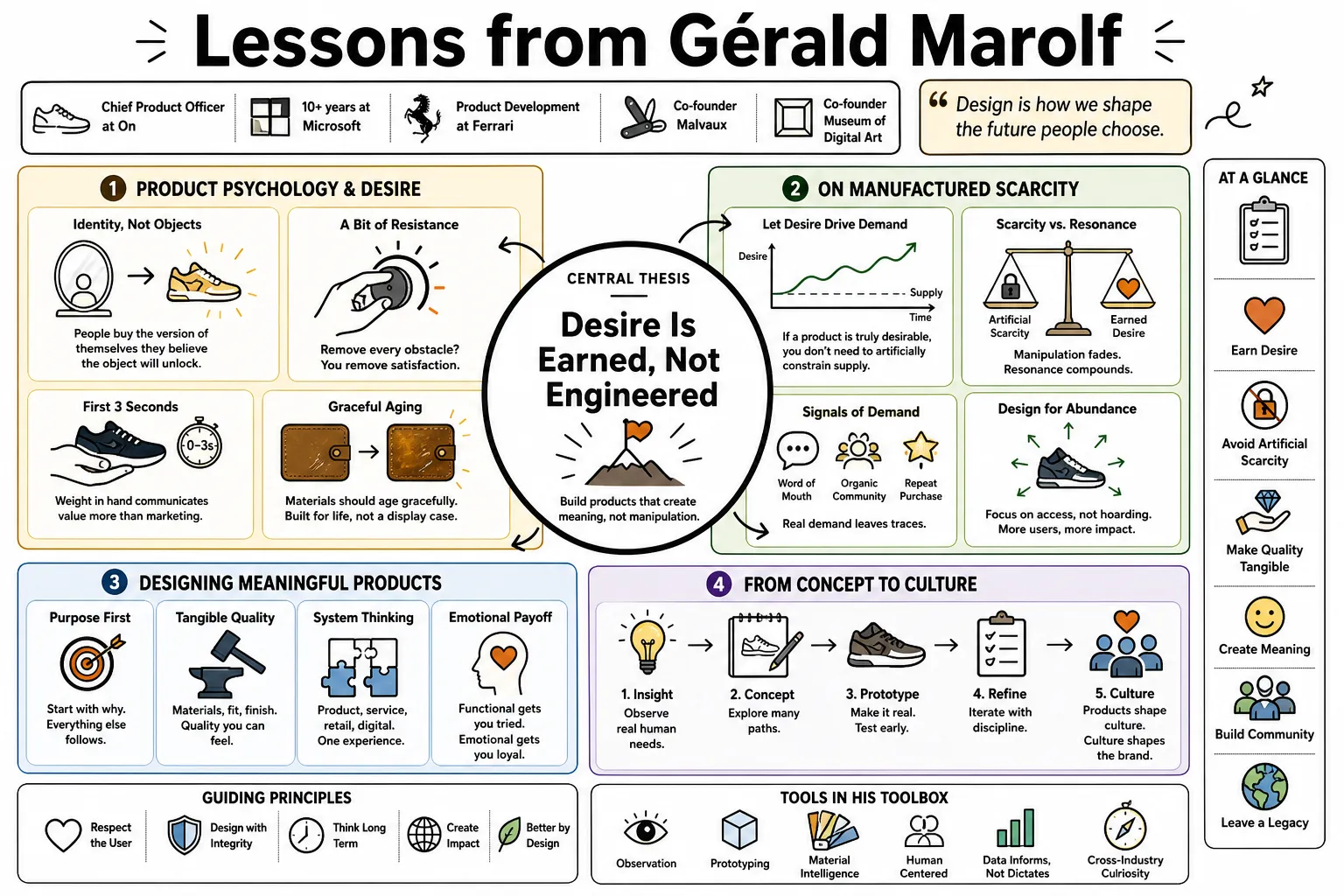
Lessons from Gérald Marolf
Gérald Marolf is the Chief Product Officer at On, where he directs athletic footwear and apparel design. Before that, he spent over a decade developing products for Microsoft and Ferrari, and co-founded the Swiss knife brand Malvaux and the Museum of Digital Art. This collection gathers his thinking on industrial design, product psychology, and how to build brands people actually care about.
Part 1: Product Psychology and Desire
- On manufactured scarcity: "If a product is truly desirable, you don't need to artificially constrain supply to make people want it." — Source: [The Twenty Minute VC]
- On defining desire: "Consumers don't buy objects; they buy the version of themselves they believe the object will unlock." — Source: [Domus Interview]
- On user friction: "Removing every obstacle in a user journey sometimes removes the satisfaction of the interaction. A bit of resistance feels like quality." — Source: [Etter Studio Retrospective]
- On first impressions: "The weight of a product in the hand does more to communicate its value in the first three seconds than a year of marketing." — Source: [Malvaux Launch Feature]
- On aesthetic decay: "Materials should age gracefully. If a scratch ruins the object, it was designed for a display case rather than human use." — Source: [HKDI Design Lecture]
- On anticipated needs: "Our aspiration was to be at the forefront of defining a world that consumers do not expect and do not foresee." — Source: [Domus Interview]
- On the novelty trap: "Adding features to hide a weak core proposition only accelerates a product's irrelevance." — Source: [The Twenty Minute VC]
- On tactile memory: "We remember textures longer than we remember colors. The feel of a surface dictates how often we will reach for it again." — Source: [Metacast Appearance]
- On irrational choices: "No one needs another pair of running shoes for logical reasons. We buy them to satisfy an emotional deficit." — Source: [Business Insider]
- On visual noise: "Quiet design isn't about minimalism; it's about removing anything that doesn't explicitly serve the user's immediate goal." — Source: [On Running Design Notes]
Part 2: Building Emotional Connections
- On emotional resonance: "Most products fail to create emotion because they solve a mechanical problem without acknowledging the user's emotional state." — Source: [The Twenty Minute VC]
- On loyalty: "Loyalty isn't built through reward points. It's built when a brand consistently respects the consumer's intelligence." — Source: [Business Insider]
- On brand sincerity: "You cannot engineer authenticity in a boardroom. It requires founders who are unreasonably obsessed with a specific problem." — Source: [Etter Studio Retrospective]
- On consumer trust: "Trust is lost the moment a product behaves exactly like its cheaper imitation." — Source: [HKDI Design Lecture]
- On unboxing: "The packaging shouldn't feel like a barrier to the product. It should feel like the first act of the performance." — Source: [On Running Design Notes]
- On narrative design: "A product without a story is just an inventory item waiting to be discounted." — Source: [Metacast Appearance]
- On failure: "When a customer complains about functionality, they are annoyed. When they complain about a brand's aesthetic shift, they feel betrayed. The latter is actually a sign of deep connection." — Source: [The Twenty Minute VC]
- On quiet confidence: "Loud logos are often a substitute for weak silhouettes. If the shape is distinct, the branding can whisper." — Source: [Domus Interview]
- On unexpected joy: "The most effective features are the ones users discover accidentally after a week of ownership." — Source: [Etter Studio Retrospective]
- On cultural relevance: "A brand becomes relevant when it stops trying to talk to everyone and starts intensely serving a specific subculture." — Source: [Jacobs Foundation Talk]
Part 3: Footwear and Athletic Performance
- On athletic footwear: "A running shoe must feel fast before it is even laced up. The static object has to communicate kinetic potential." — Source: [On Running Design Notes]
- On performance metrics: "Data tells us how a material reacts under stress, but it doesn't tell us how confident the runner feels wearing it." — Source: [Business Insider]
- On material innovation: "We don't invent new foams just to lower weight; we invent them to change the sensation of striking the pavement." — Source: [Domus Interview]
- On specialized gear: "The amateur athlete wants the exact same equipment as the professional, not because they need it, but because it validates their commitment." — Source: [The Twenty Minute VC]
- On form and function: "In sportswear, if an element doesn't improve speed or safety, it is a liability." — Source: [HKDI Design Lecture]
- On testing environments: "Lab results are a baseline. A shoe isn't finished until it has survived an unpredictable, rain-soaked trail run." — Source: [On Running Design Notes]
- On injury prevention: "Comfort isn't just about softness; it's about stability. A shoe that is too soft will eventually cause pain." — Source: [Metacast Appearance]
- On product lifecycles: "Running shoes have a terminal mileage. The challenge is ensuring the shoe performs identically on mile 300 as it did on mile 10." — Source: [Business Insider]
- On daily training: "The shoe you train in daily requires entirely different engineering than the shoe you race in once a month." — Source: [On Running Design Notes]
Part 4: Digital vs. Physical Design
- On digital permanence: "A physical object accrues character as it ages; a digital product simply becomes obsolete if it isn't updated." — Source: [MuDA Archival Interviews]
- On interface design: "Good digital tools get out of the way. If the user is thinking about the interface, the interface has failed." — Source: [Etter Studio Retrospective]
- On the Museum of Digital Art: "We built MuDA because code is a medium as expressive as paint, yet it was being treated purely as a utility." — Source: [MuDA Archival Interviews]
- On hardware and software: "Hardware sets the hard boundaries of an experience; software explores every inch of the space inside those boundaries." — Source: [The Twenty Minute VC]
- On data visualization: "Projects like Balloon.Earth succeed because they take abstract, overwhelming data sets and render them into a legible, geographic reality." — Source: [WithGoogle: Balloon.Earth Project]
- On tactile feedback: "Haptics are the bridge between the screen and the physical world. A tap on a screen must feel like a mechanical confirmation." — Source: [Metacast Appearance]
- On physical constraints: "Working with physical goods teaches you a deep respect for gravity and material limits. Digital designers often ignore these constraints until they try to build hardware." — Source: [HKDI Design Lecture]
- On rapid prototyping: "In software, you can push an update in an hour. In hardware, a mistake in the mold delays the project by three months. You have to measure twice." — Source: [Business Insider]
- On hybrid products: "The most compelling objects today are those that exist in the physical world but are seamlessly augmented by an invisible digital layer." — Source: [Jacobs Foundation Talk]
Part 5: Lessons from Legacy Brands
- On automotive timelines: "Automotive design operates on a timeline of years, forcing a level of patience and rigor that fast consumer goods rarely permit." — Source: [The Twenty Minute VC]
- On legacy expectations: "When you design for a heritage brand, you are in a dialogue with a century of past decisions. You cannot just erase them." — Source: [Domus Interview]
- On software scale: "At Microsoft, the challenge wasn't just solving a problem, but solving it for a billion people simultaneously without alienating any of them." — Source: [Etter Studio Retrospective]
- On precision engineering: "A brand like Ferrari teaches you that there is no detail too small to engineer perfectly. The stitching on a seat communicates the quality of the engine." — Source: [HKDI Design Lecture]
- On ecosystem lock-in: "Consumers stay with tech giants not because of the hardware, but because the ecosystem of software is too painful to leave." — Source: [Business Insider]
- On prestige: "Prestige cannot be manufactured in a single product cycle. It is the result of refusing to compromise quality over decades." — Source: [The Twenty Minute VC]
- On luxury versus mass market: "Mass market design focuses on cost reduction. Luxury design focuses on maximizing the sensory experience, regardless of the supply chain friction." — Source: [Metacast Appearance]
- On brand guidelines: "Strict brand guidelines aren't there to limit creativity; they exist to prevent a company from diluting its core identity during phases of rapid growth." — Source: [Domus Interview]
- On industrial tolerance: "The tolerance standards from automotive manufacturing should be applied to consumer electronics. We accept too much fragility in our daily tools." — Source: [HKDI Design Lecture]
Part 6: Identity and Community
- On brand identity: "What is crucial to us is having an identity behind the brand. We have people enthusiastic and proud about wearing On products because it enhances their performance, it gives them a sense of identity and belonging to a community." — Source: [Domus Interview]
- On market tribalism: "In saturated markets, people don't choose a product; they choose a tribe. The logo is just the membership badge." — Source: [The Twenty Minute VC]
- On shared priorities: "A community forms when a group of people realize they share a specific set of priorities that the rest of the market ignores." — Source: [Business Insider]
- On community barriers: "A strong community always has a mild barrier to entry. If everyone is invited, the core members will eventually leave." — Source: [Metacast Appearance]
- On customer complaints: "Listen closely to what your most obsessed customers complain about. They are stress-testing the edges of your brand." — Source: [Etter Studio Retrospective]
- On authentic subcultures: "You cannot invent a subculture in a marketing meeting. You can only observe an existing one and build tools to serve it." — Source: [HKDI Design Lecture]
- On peer recommendations: "The most effective marketing is a quiet conversation between two friends on a trail, where one points to their shoes and says they actually work." — Source: [On Running Design Notes]
- On local relevance: "Global presence requires local relevance. A shoe must make sense on the streets of Zurich and Tokyo." — Source: [Domus Interview]
- On daily rituals: "Running isn't just an exercise; it's a daily ritual. We design products to accommodate that specific hour of the day." — Source: [On Running Design Notes]
- On calculated alienation: "A brand must be willing to alienate certain demographics. A product for everyone is a product that no one passionately loves." — Source: [The Twenty Minute VC]
Part 7: Advergaming and Interactive Media
- On immersive environments: "When players are fully engaged in a game, they don't ignore the background advertising; they process it as part of the world's reality." — Source: [Advergaming and In-game Advertising (2007)]
- On disruptive advertising: "A banner ad interrupts the experience. Advergaming integrates the brand into the core loop of the experience." — Source: [Advergaming and In-game Advertising (2007)]
- On digital retention: "Games hold attention longer than any other medium because they require active input rather than passive consumption." — Source: [MuDA Archival Interviews]
- On interactive agency: "If a consumer feels they have control over an interactive experience, their recall of the associated brand increases exponentially." — Source: [Advergaming and In-game Advertising (2007)]
- On the psychology of play: "Play is how humans learn. When a brand facilitates play, it bypasses the standard defenses a consumer raises against marketing." — Source: [Metacast Appearance]
- On arbitrary gamification: "Adding arbitrary points to a boring task doesn't make it a game; it just makes it a condescending chore." — Source: [Etter Studio Retrospective]
- On reactive interfaces: "A digital space should react to the user. A static webpage is a missed opportunity for dialogue." — Source: [WithGoogle: Balloon.Earth Project]
- On virtual economies: "In-game assets only hold value if the game's internal economy is strictly regulated and respected by the developers." — Source: [Advergaming and In-game Advertising (2007)]
- On media evolution: "Brands eventually realize they shouldn't simply sponsor content; they should build the interactive systems where the content lives." — Source: [Jacobs Foundation Talk]
Part 8: The Business of Design
- On Swiss design utility: "The Swiss approach to design is that an object must first justify its existence through flawless utility." — Source: [Malvaux Launch Feature]
- On market saturation: "The world doesn't need more products. It needs better edits of the categories that are already overflowing with mediocrity." — Source: [The Twenty Minute VC]
- On design leadership: "A Chief Product Officer's main job is not to design, but to protect the design team from the short-term anxieties of the finance department." — Source: [Business Insider]
- On portfolio risk: "If every product in your lineup is a bestseller, you aren't taking enough risks on the fringes." — Source: [On Running Design Notes]
- On scaled production: "The true test of a design isn't the prototype on the desk; it's the ten thousandth unit off the assembly line." — Source: [HKDI Design Lecture]
- On physical durability: "True sustainability starts with durability. A product that lasts ten years is infinitely better than a biodegradable one that breaks in ten days." — Source: [Domus Interview]
- On departmental tension: "Engineers define boundaries, marketers identify audiences, and designers focus on emotions. Useful products emerge from the tension between these departments." — Source: [Etter Studio Retrospective]
- On development patience: "It takes three years to develop a truly new footwear silhouette. Anyone doing it faster is just rearranging existing parts." — Source: [Business Insider]
- On ultimate success: "A product has succeeded when the user can no longer imagine completing their routine without it." — Source: [Metacast Appearance]