Gergely Orosz, author of the widely-read "The Pragmatic Engineer" newsletter and "The Software Engineer's Guidebook," has become a prominent voice in the software engineering community. His writings offer practical advice and sharp insights on career growth, software quality, and engineering management. [source]
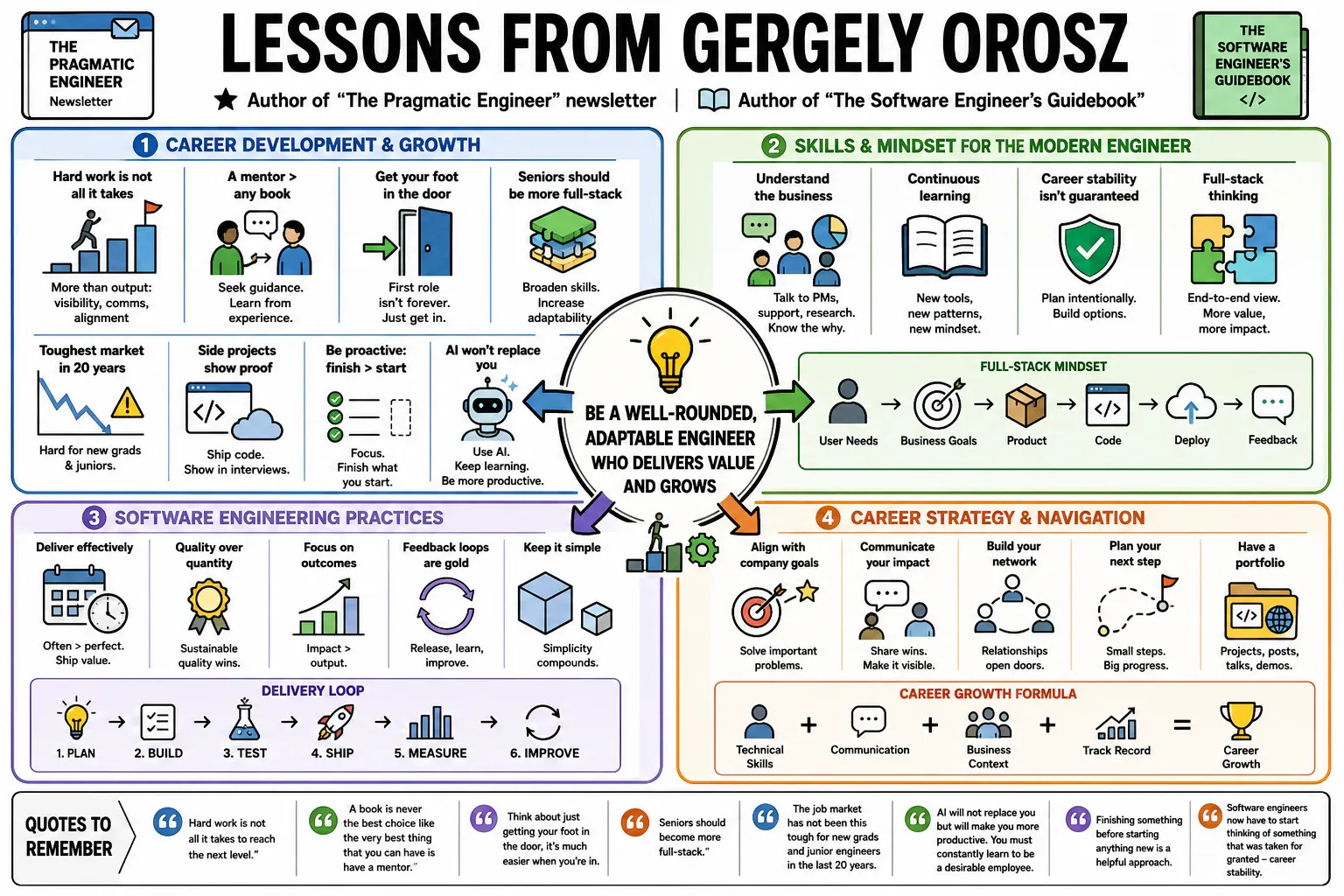
On Career Development and Growth
- On the reality of career progression: Career growth takes more than strong technical output. [source] Orosz emphasizes communication, influence, technical judgment, and ownership alongside coding skill.
- On the importance of mentorship: Mentorship accelerates growth when the mentee chooses a relevant mentor, sets clear goals, and prepares for each conversation. [source]
- For junior developers starting out: "Think about just getting your foot in the door, it's much easier when you're in." [source] Orosz advises juniors to prioritize gaining initial experience, even if the first role isn't their dream job.
- On the evolving role of senior engineers: "Seniors should become more full-stack." [source] In a changing market, Orosz advocates for senior engineers to broaden their skill sets to remain adaptable and valuable.
- On navigating a tough job market: "The job market has not been this tough for new grads and junior engineers in the last 20 years, ever since the dot-com bust." [source] This quote highlights the challenging landscape for early-career professionals and the need for strategic job-seeking.
- On the power of side projects: Orosz advises juniors to "work on their projects just so they have some code in production to show at job interviews." [source]
- On the value of proactivity: "Finishing something before starting anything new is a helpful approach." [source] This quote from "The Software Engineer's Guidebook" underscores the importance of focus and completion.
- On continuous learning: "AI will not replace you but will make you more productive. You must constantly learn to be a desirable employee in these new circumstances." [source]
- On career stability: "Software engineers now have to start thinking of something that was taken for granted for a long in tech – career stability." [source]
- On understanding business context: A way to become more full-stack is "understanding the business more by talking to product managers, customer support or user research to become a well-rounded engineer." [source]
On Software Engineering Practices
- On the purpose of a resume: “The goal of your resume is to get a recruiter call. It's a binary yes or no. That is the goal. As soon as you have your recruiter call, your resume doesn't really matter that much.” [source]
- On the nature of software challenges: Experienced engineers increasingly identify people and communication—not languages or frameworks—as their hardest problems. [source]
- On the role of automation: "In most cases, either figure out how to automate it or don't do it, which might require thinking outside the box." [source]
- On the shift in developer responsibilities: Developers are increasingly expected to "deploy their code, deal with security, monitoring, and architecture, get involved in project planning." [source]
- On the changing tech stack focus: In the current market, "it will be much easier to find a job as a TypeScript engineer than as a Rust engineer." [source]
- On the rise of the full-stack developer: "The team that once had frontend and backend developers, iOS and Android developers, DevOps, and QA engineers would probably be reduced to 3 or 4 full-stack engineers." [source]
On Engineering Management and Leadership
- On accountability: "I tell people that I'm always accountable for what we do, and our projects, which means that if someone should get in trouble or get fired, that someone should be me, the engineering manager." [source]
- On fostering a learning environment: "In return, I ask others to take on responsibility for their work. Hopefully, this creates an environment where failure is not a problem but something we can learn from." [source]
- On team autonomy: "Instead of getting a project manager who'll tell everybody what to do, I give that autonomy to the engineers, with some guardrails." [source]
- On team improvement: "Continuous improvement comes from pushing teams to commit, giving them space to fail and then ensuring there's reflection on what happened and what we should change." [source]
- On the manager's role in growth: Managers should help people grow through regular feedback, coaching, and deliberate development opportunities. [source]
- On the unrecognized work of mentorship: "Good mentoring happens in a lot of places, but often it's left unrecognized. The most obvious place to recognize it is when you have your performance review or promotion conversation." [source]
- On the frustration of hiring managers with team matching: “Team matching was very frustrating for hiring managers.” [source] This quote highlights the complexities of modern hiring processes in large tech companies.
- On dealing with departures: A good management book should cover "how to deal with people leaving, and also just firing people. I mean, I think this is something that, I mean, no manager signs up to do this, but sometimes you have to." [source]
- On the importance of aiming high: "I think it's really important to aim for 'world class'." [source]
On The Tech Industry and Company Culture
- On the divide in the tech industry: Orosz distinguishes the operating context of Big Tech and high-growth companies from more traditional technology workplaces. [source]
- On the reality of working at consultancies: "Clients pay for short-term results, not for a developer to work on long-term things like reducing tech debt." [source]
- On the challenge of switching from consulting: "Working at a consultancy for too long can make the switch to... product-focused companies harder." [source]
- On the impact of interest rates: The rise in interest rates "led to less startup funding, fewer tech IPOs, and massively cut tech budgets at companies of all sizes." [source]
- On the current state of developer demand: "Where there was high demand, high salaries, and ample benefits – now are layoffs, hiring freezes, and promotions so scarce that they have become exceptions." [source]
- On the shift away from "shiny" tech: "While developers were in high demand, companies were forced to attract them with shiny and new tech stacks and opportunities to experiment. Now that they don't have to do that anymore, companies will turn to tried-and-tested tech stacks." [source]
- On the nature of his newsletter's success: "The 'overnight success' of the newsletter was built on many years of writing." [source]
- On his motivation for writing "The Software Engineer's Guidebook": Orosz wrote the book to consolidate years of advice on the technical and interpersonal skills needed to grow as a software engineer. [source]
- On the importance of integrity in his work: "In my new career, integrity is the most valuable asset I have." [source]
On Personal Learnings and Mindset
- On the value of negative experiences: Short-term failures and sunk effort can become valuable long-term investments when they build reusable skills, knowledge, or relationships. [source]
- On the entrepreneurial spirit: After seeing startup building from inside Uber, Orosz chose to take a bet on himself and explore smaller, entrepreneurial work. [source]
- On the importance of writing: Writing regularly helped Orosz organize reusable ideas and communicate more easily with coworkers. [source]
- On the importance of giving back: Engineers with experience can give back by mentoring others, and managers should make that contribution visible and valued. [source]
Learn more:
- I Wrote a Book on Growing as a Software Engineer
- The Pragmatic Engineer’s Career Advice for Tough Times
- Developers’ Reality Check with Gergely Orosz
- Mentoring Developers: Interview with Gergely Orosz
- Building Great Engineering Teams with Gergely Orosz
- Tech Lead Journal: Gergely Orosz on Tech Resumes
- How Gergely Orosz Found a New Career in Writing
- Changelog: Growing as a Software Engineer