Girish Mathrubootham founded Freshworks in Chennai. A company filing records his retirement as executive chairman and board chair effective December 1, 2025. — Freshworks 2025 SEC Filing.
His 2021 founder letter describes a global, product-led software company built around intuitive products, employee happiness, and a culture the company calls Kudumba. — Freshworks S-1 Founder Letter.
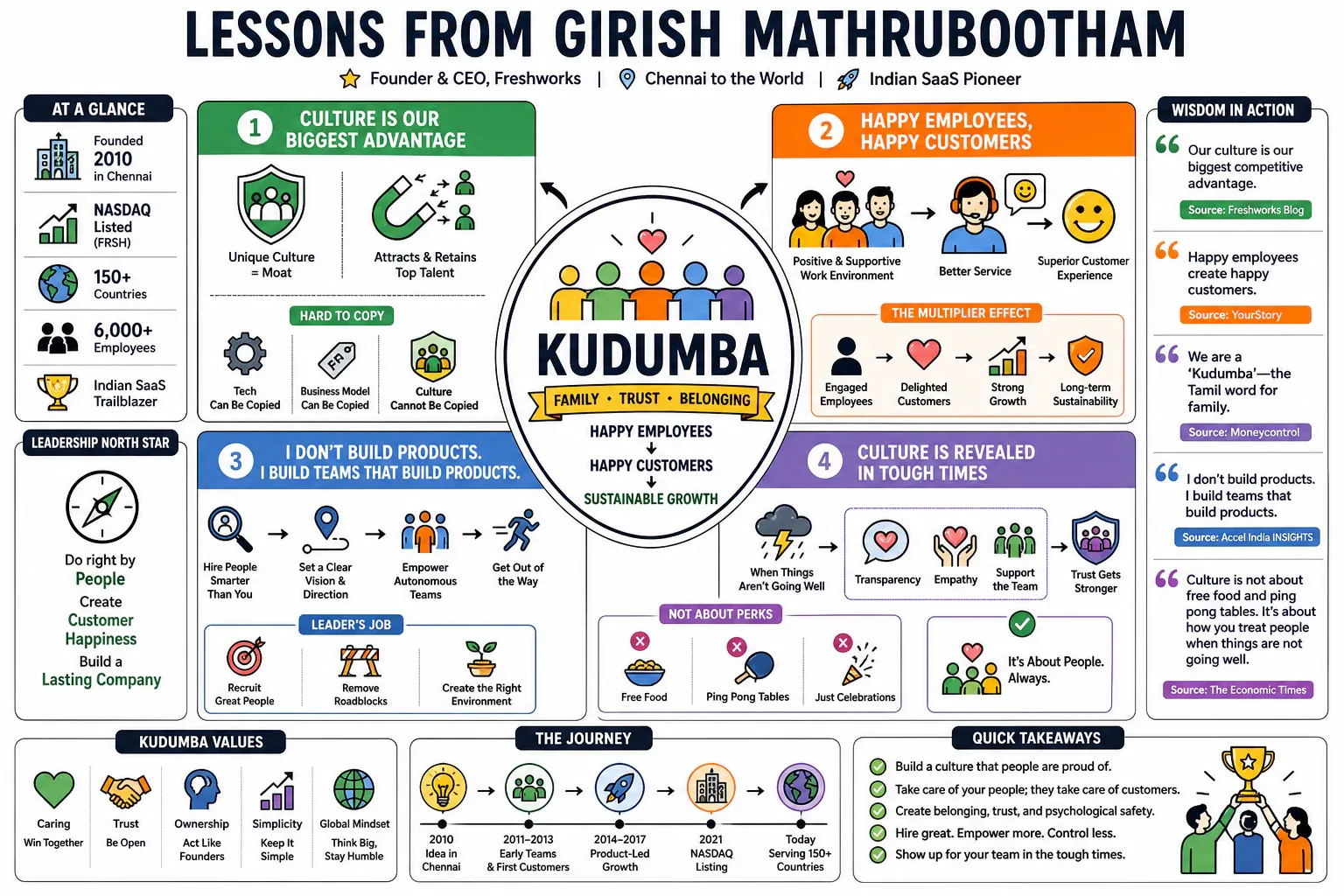
On Company Culture and People
- On culture as an advantage: Mathrubootham describes Freshworks’ people-centered culture as a deliberate way of working: the company recognized and celebrated values early, then codified them as it grew. — Freshworks S-1 Founder Letter.
- On happy employees and customers: Freshworks’ founder letter states its guiding mantra that happy employees create happy customers. Mathrubootham says he wanted to build a company optimized for employee happiness. — Freshworks S-1 Founder Letter.
- On Kudumba: Mathrubootham uses Kudumba, Tamil for family, to describe a sense of shared identity that celebrates Freshworks’ Chennai roots and binds its people as the company scales. — Freshworks S-1 Founder Letter.
- On building teams that build products: Mathrubootham describes leadership as creating an environment for performance, hiring capable people, and giving them room to do the work. He treats team-building as central to product-building. — 20VC Interview.
- On culture beyond perks: Freshworks’ CHAT values distinguish a happy work environment from foosball tables or free food: the question is whether the work itself gives people satisfaction and whether teams take ownership. — Freshworks S-1 Founder Letter.
- On hiring for talent and role fit: Mathrubootham separates teachable skills and factual knowledge from harder-to-teach traits. In early campus hiring, he looked for empathy and patience in support roles and different strengths in sales or pre-sales. — Blume Ventures Interview.
- On developing talent: When experienced global SaaS marketers were scarce in Chennai, Freshworks hired younger people for underlying strengths and trained them for roles; Mathrubootham later says some scale-critical posts require experienced hires. — Blume Ventures Interview.
On Entrepreneurship and Getting Started
- On an iPhone moment for business software: Mathrubootham uses the iPhone as an analogy for a future unified, intuitive enterprise-software experience. In the founder letter, this is a product vision, not a claim that the transition has already happened. — Freshworks S-1 Founder Letter.
- On building globally from Chennai: Freshworks says it was global from its first customers while operating from Chennai, using search-driven acquisition and product-led sales to reach underserved small businesses across continents. — Freshworks S-1 Founder Letter.
- On the problem before the launch: Mathrubootham says a poor customer-service experience suggested the product opportunity; a later Hacker News discussion of Zendesk pricing pushed him to start the company. The two events had distinct roles. — Blume Ventures Interview.
- On being frugal selectively: In Freshworks’ early years, Mathrubootham favored saving on costs such as office space while refusing to compromise on product quality needed to compete globally. — Blume Ventures Interview.
- On Rajinikanth as a role model: Mathrubootham names Rajinikanth as a personal role model and emphasizes the actor’s humility despite extraordinary success. The founder letter does not make the profile’s bus-conductor quotation. — Freshworks S-1 Founder Letter.
On Product, Customers, and Go-to-Market
- On products people enjoy using: Freshworks designed for the people actually using its software: intuitive setup, ease of use, fast time to value, and affordability were core product choices. — Freshworks S-1 Founder Letter.
- On solving the customer’s actual problem: Early Freshdesk prospects wanted core helpdesk needs met more than fashionable social integrations. Mathrubootham says the team reprioritized features after those conversations. — The Freshdesk Story.
- On starting accessible and expanding: Freshdesk entered with a relatively inexpensive self-service product for smaller customers; Mathrubootham explains how later packaging and additional capabilities served larger buyers. — 20VC Interview.
- On finding customers before the product was ready: Before launch, the team tested interest with a signup form, small search/social ad budgets, blog posts, and direct conversations with prospects. Those channels yielded early signups and feedback. — The Freshdesk Story.
- On pricing for the entry customer: Mathrubootham says pricing depends on the buyer, the problem, and the market-entry wedge. Freshdesk combined accessible pricing with a clear self-service route for its initial small-business segment. — 20VC Interview.
On Building a Global Business from India
- On a global-first Indian product company: Mathrubootham identifies a global inbound model, rather than first selling only in India, as one of Freshworks’ pivotal strategic choices. — Blume Ventures Interview.
- On India as a product builder: Mathrubootham argues that Indian technology companies can create globally competitive products, not only supply services. His signed essay frames this as an opportunity for a new product-building generation. — India’s Product Generation.
- On design and user experience: Freshworks’ founder letter argues that accessible, intuitive and unified experiences can differentiate enterprise software, using the iPhone as an analogy for the user experience it aimed to create. — Freshworks S-1 Founder Letter.
- On the IPO as a new phase: Mathrubootham likens the IPO to a wedding: the ceremony matters, but the work of being a public company starts afterward, with new responsibilities and a longer journey. — Blume Ventures Interview.
On Leadership and Mindset
- On humility after success: Mathrubootham says Freshworks faced repeated doubts while building from Chennai and kept focusing on execution. He also points to Rajinikanth’s humility as a quality he admires. — Freshworks S-1 Founder Letter.
- On candid private feedback: When a hire is not working out, Mathrubootham says he prefers a direct conversation about why, while keeping criticism private and separating role fit from personal regard. — 20VC Interview.
- On staying with the mission: Despite outside doubts about Chennai, crowded markets, and larger rivals, Mathrubootham says the company kept its head down and focused on its mission and execution. — Freshworks S-1 Founder Letter.
- On paying it forward: Mathrubootham connects SaaSBoomi and Together Fund to a broader wish to help more Indian founders build world-class product companies, sharing playbooks beyond Freshworks. — Blume Ventures Interview.
Additional Key Learnings
- On telling a true founding story: Mathrubootham says an authentic account of Freshdesk’s beginnings, shared on Hacker News, generated early attention; he distinguishes that from writing a post merely as a marketing exercise. — Freshworks Fundraising Essay.
- On craftsmanship: Craftsmanship is one of Freshworks’ codified CHAT values. The founder letter asks whether an individual or team would be proud to put their name on the work. — Freshworks S-1 Founder Letter.
- On ambitions that grow in increments: Mathrubootham says Freshworks did not begin with a plan to change the world: its first $1 million revenue ambition expanded into new products and larger ambitions over time. — Freshworks S-1 Founder Letter.
- On making software easy to adopt: Freshworks’ early product ethos combined intuitive setup, ease of use, fast time to value and affordability so online buyers could try and purchase without a complex enterprise process. — Freshworks S-1 Founder Letter.
- On the inbound business model: Mathrubootham describes search-driven online acquisition and product-led sales as a foundational Freshworks choice, later complemented by outbound sales for larger customers. — Freshworks S-1 Founder Letter.
- On learning from failure: Mathrubootham discusses an earlier venture that failed and the practical experience he gained before joining Zoho; the lesson is to learn from the attempt, not to pretend failure always produces success. — Blume Ventures Interview.
- On making the IPO a team win: Mathrubootham says the IPO created a way for early employees and investors to share in value they had helped build, while he saw the listing as a celebration for India’s SaaS ecosystem. — Small Business Trends Interview.
- On changing course with customer evidence: Mathrubootham recounts a collaboration product that reached customers too late; after weak adoption and customer feedback, Freshworks integrated with existing tools instead of persisting with its standalone plan. — 20VC Interview.
- On the Indian product-nation dream: Mathrubootham says Freshworks’ success should make it easier for other Indian founders to believe they can build world-class product companies; he uses SaaSBoomi and Together Fund to support that ecosystem. — Blume Ventures Interview.
- On planning leadership transitions: In his founder message, Mathrubootham says Dennis Woodside was recruited with succession in mind; he framed the CEO handoff as a planned way to give Freshworks experienced leadership for its next phase. — Freshworks Founder Message.