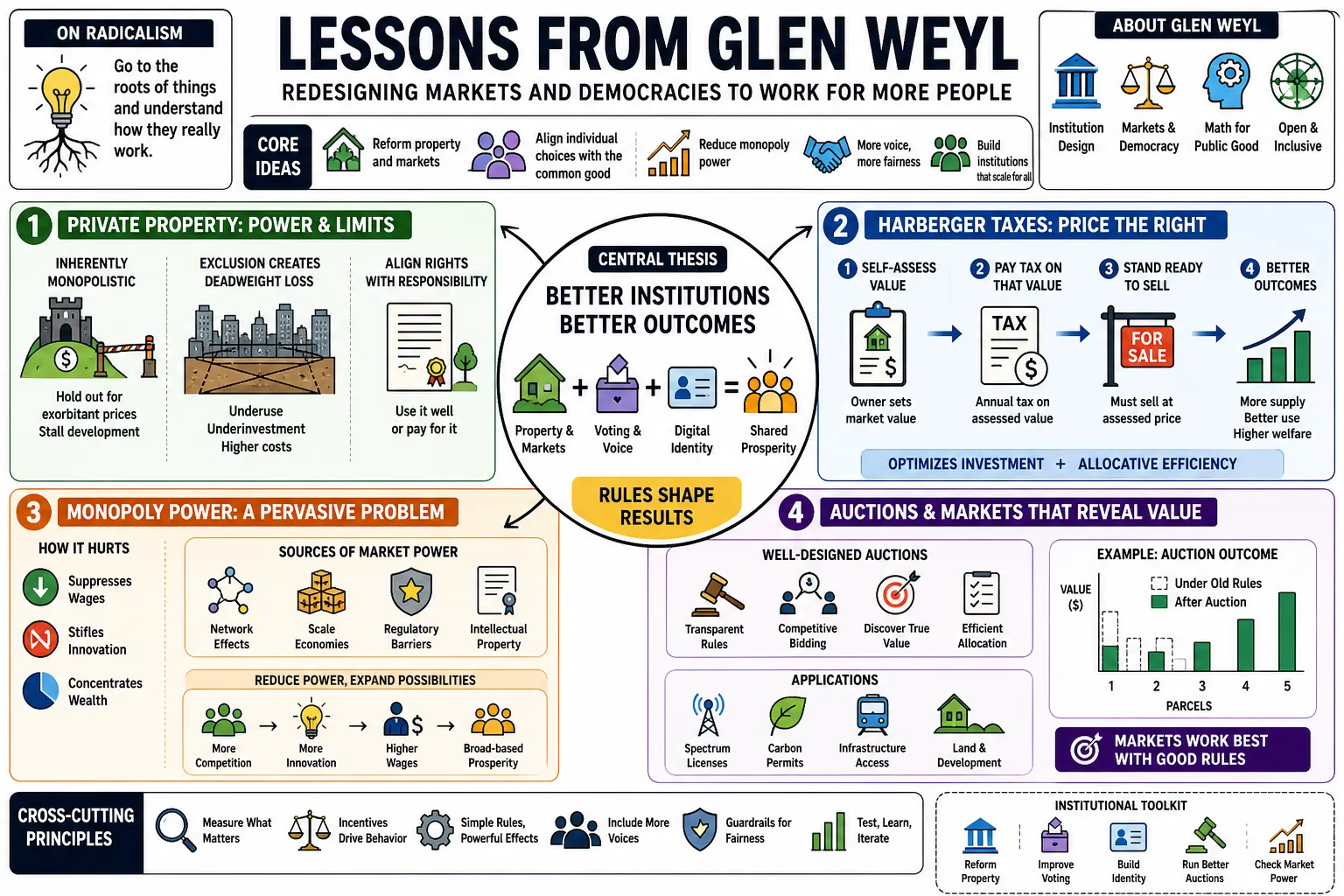
Lessons from Glen Weyl
Economist Glen Weyl studies how to redesign basic social institutions like property, voting, and digital identity. He developed Quadratic Voting and Plurality as mathematical ways to balance individual preferences with collective cooperation. This compilation covers his proposals for making markets and democracies work for more people.
Part 1: Radical Markets and Property
- On Radicalism: "And when I say radical, I mean it in the core sense of the word: we have to go to the roots of things and understand how they really work." — Source: University of Chicago
- On Private Property: "Private property is inherently monopolistic, giving owners the power to hold out for exorbitant prices and stall development." — Source: Radical Markets
- On Harberger Taxes: "By requiring owners to self-assess the value of their property and pay a tax on that value—while standing ready to sell it at that price—we can optimize both investment and allocative efficiency." — Source: ProMarket
- On Monopoly Power: "Market power is not an aberration; it is a pervasive feature of modern economies that suppresses wages and stifles innovation." — Source: AEA Papers and Proceedings
- On Auctions: "Expanding the scope of public auctions for resources can continuously reallocate assets to those who can use them most productively." — Source: Harvard Business Review
- On Inequality: "The present system of property rights is the fundamental driver of the current crisis of inequality." — Source: RadicalxChange
- On Market Design: "Markets are not natural forces; they are designed institutions that can be rebuilt to serve the common good." — Source: 80,000 Hours
- On Liquidity: "A perfectly liquid market is a theoretical ideal, but partial common ownership can bring us much closer to that reality than strict private ownership." — Source: Radical Markets
- On Economic Stagnation: "Stagnant growth and rising inequality are twin symptoms of an economy calcified by entrenched property interests." — Source: The Atlantic
- On Social Technology: "Economics should not just describe the world; it should be a discipline of inventing new social technologies." — Source: Wired
Part 2: Quadratic Voting and Democracy
- On the Flaws of One-Person-One-Vote: "The standard democratic model fails to account for the intensity of people's preferences, leading to the tyranny of the majority." — Source: Public Choice
- On Quadratic Voting: "Allowing voters to buy votes on issues they care about, at a cost that is the square of the number of votes, perfectly balances minority passion with majority rule." — Source: Radical Markets
- On Local Knowledge in Politics: "A lot of libertarians are into the idea of decentralised knowledge when it comes to Hayek and the market. But when we talk about politics, suddenly they think that there's no knowledge out there." — Source: 80,000 Hours
- On Tyranny of the Majority: "Quadratic voting protects minority groups by giving them a mechanism to outvote a mildly opposed majority on issues of existential importance to them." — Source: Bloomberg
- On Compromise: "By making extreme influence prohibitively expensive, quadratic systems naturally encourage citizens to compromise and seek consensus." — Source: The Economist
- On Voice Credits: "Providing every citizen with an equal budget of 'voice credits' creates an egalitarian foundation for expressing varying degrees of political concern." — Source: RadicalxChange
- On Political Polarization: "Current voting methods incentivize politicians to cater to the extremes; quadratic voting rewards broad, moderate appeal." — Source: Stanford Social Innovation Review
- On Corporate Governance: "Shareholder voting could be dramatically improved by applying quadratic costs, breaking the absolute control of majority blockholders." — Source: University of Chicago Law Review
- On Institutional Creativity: "Democracy is not a solved problem; it requires continuous institutional creativity and redesign." — Source: Harvard Law Review
Part 3: Data as Labor
- On the Digital Economy: "Users are not just consumers of digital platforms; they are the unpaid workers producing the data that makes these platforms valuable." — Source: AEA Papers and Proceedings
- On Artificial Intelligence: "What we call AI is really just machine learning trained on the collective, uncompensated labor of millions of human data creators." — Source: Brookings Institution
- On Data Unions: Weyl describes data labor unions as organizations meant to help citizens receive a fair share of the digital economy by representing the workers whose data creates its value. — Reference: Sarder TV page where Weyl explains data labor unions and fair shares of the digital economy
- On Tech Monopsony: "The real danger of Big Tech is not just monopoly power in product markets, but monopsony power in the market for human data." — Source: ProMarket
- On Digital Dignity: "Digital dignity requires acknowledging that the data we generate is an extension of our personhood and labor." — Source: Cairn.info
- On Universal Basic Income: "Rather than a passive Universal Basic Income, we should strive for a system where people are actively compensated for the digital labor they already perform." — Source: Radical Markets
- On the 'Free' Internet: "The barter of 'free' services for our data is a deeply unequal exchange that obscures the true economic value of human input." — Source: Noema Magazine
- On Platform Cooperatives: "Data cooperatives could act as fiduciaries, securely managing member data and negotiating its use on their behalf." — Source: MIT Technology Review
- On Human Capital: "Machine learning doesn't replace human capital; it repackages it." — Source: Harvard Business Review
- On Economic Justice: Weyl and Jaron Lanier argue that as AI depends on high-quality human data, platforms should pay users for that labor and let union-like mediators bargain over small data-producing tasks. — Reference: WIRED article on Weyl, Lanier, data labor, and mediators of individual data
Part 4: Plurality and Collaborative Technology
- On Plurality: "Plurality is technology for collaboration across social difference." — Source: Plurality.net
- On Social Diversity: "We must harness the potential energy in social diversity to drive truth, beauty, and progress, rather than polarization." — Source: re:publica
- On the Singularity: "Plurality is a symmetrical concept to the singularity; it embraces decentralization and diversity instead of central control and unification." — Source: RadicalxChange
- On Technocratic AI: "The narrative of centralized AI replacing human intelligence ignores the fundamentally social and collaborative nature of human cognition." — Source: Hear This Idea
- On Digital Public Spaces: "We need digital infrastructure that functions as a true public square, designed to bridge divides rather than optimize for engagement." — Source: Taiwan Presidential Hackathon
- On Identity: "Identity is not a single, static attribute; it is the intersection of our various social affiliations and commitments." — Source: Plurality.net
- On Collaboration Tools: "The next generation of software must be built to facilitate complex, large-scale cooperation among groups with competing interests." — Source: Scaling Theory
- On Empowering Humans: Weyl frames his work as building social institutions and technologies that empower diversity, cooperation, shared prosperity, and human plurality in the face of accelerating technological disruption. — Reference: Glen Weyl homepage on technology for cooperation, plurality, and governance innovation
- On Democratic Resilience: "Plurality offers a paradigm for democratic renewal in the digital age, enabling societies to reach consensus without erasing differences." — Source: RadicalxChange
- On Open Source: "Open, collaborative texts and open-source software are the bedrock of a pluralistic technological ecosystem." — Source: GitHub
Part 5: Soulbound Tokens and Decentralized Society
- On Web3 Financialization: "Web3 has become hyper-financialized; it needs a mechanism to represent social trust and unalienable reputation." — Source: Decentralized Society Paper
- On Soulbound Tokens: "Soulbound Tokens are non-transferable digital assets that represent the commitments, credentials, and affiliations of a person." — Source: Tokenist
- On Decentralized Society (DeSoc): "A Decentralized Society relies on encoded social relationships to reward trust and protect networks from capture." — Source: Decentralized Society Paper
- On the WoW Inspiration: "The concept of 'soulbound' items comes from World of Warcraft, illustrating that some achievements cannot simply be bought." — Source: NFT Now
- On Sybil Attacks: "By tying voting power to verifiable social affiliations, SBTs can prevent wealthy actors from buying multiple identities to hijack governance." — Source: Decrypt
- On Provenance: "An artist's 'Soul' can issue an SBT to an artwork, creating a verifiable on-chain provenance that doesn't rely on centralized platforms." — Source: Ledger
- On Lending: "Uncollateralized lending in crypto is only possible if we can establish a reliable, non-transferable on-chain credit history." — Source: Chainlink
- On Plural Property: "SBTs enable property rights that are tied to specific communities or usage contexts, rather than universal transferability." — Source: Decentralized Society Paper
- On the Risks of Social Credit: "We must be cautious that SBTs are designed from the bottom up to prevent them from becoming dystopian social credit systems." — Source: CoinDesk
Part 6: Antitrust, Tech Monopolies, and Economics
- On Institutional Economics: "Markets only function well when they are embedded in institutional frameworks that actively prevent the concentration of power." — Source: American Economic Association
- On Merger Guidelines: "Standard antitrust analysis often fails to capture the systemic risk posed by companies that act as both platform operators and competitors." — Source: Yale Law Journal
- On Institutional Shareholding: "When a few large index funds own significant shares of all competitors in an industry, they inherently reduce the incentive for those firms to compete." — Source: Harvard Law Review
- On Labor Monopsony: "Antitrust regulators must look beyond consumer prices and focus on how corporate consolidation depresses worker wages." — Source: ProMarket
- On Platform Regulation: "Treating major tech platforms as public utilities ignores the dynamic nature of digital markets; we need structural interventions." — Source: University of Chicago Law Review
- On the Limits of Capitalism: "Capitalism, in its current highly concentrated form, is systematically failing to deliver the broad prosperity it promised." — Source: Radical Markets
- On Wealth Inequality: "Wealth inequality is not a natural byproduct of free markets; it is the result of poorly designed market rules." — Source: The Atlantic
- On Free Trade: "International trade policy must balance the gains of globalization with explicit mechanisms to compensate those displaced by it." — Source: NBER
- On the Role of Economists: "Economists should act as engineers of society, proactively designing mechanisms rather than just analyzing data." — Source: Wired
Part 7: Quadratic Funding and Public Goods
- On Public Goods: "Standard mechanisms for funding public goods suffer from the free-rider problem, leading to chronic underinvestment in shared resources." — Source: Science Magazine
- On Quadratic Funding (QF): "Quadratic Funding mathematically optimizes matching funds by prioritizing the number of unique contributors over the raw amount of dollars." — Source: Liberal Radicalism Paper
- On Mathematical Democracy: "QF provides a mathematically rigorous way to determine which public goods a community actually values the most." — Source: Ethereum Foundation
- On the Matching Formula: "By matching the square of the sum of the square roots of contributions, QF heavily subsidizes small donations from many individuals." — Source: Liberal Radicalism Paper
- On Community Governance: "Quadratic funding decentralizes power by allowing communities, rather than central committees, to allocate capital." — Source: Gitcoin
- On Preventing Capture: "A QF system naturally resists capture by large whales, as their massive single donations receive minimal matching multipliers." — Source: Vitalik Buterin's Blog
- On Open Source Sustainability: "Open source software development represents a critical public good that can be sustainably financed through quadratic funding mechanisms." — Source: RadicalxChange
- On Philanthropy: "Traditional philanthropy relies on the whims of billionaires; quadratic funding democratizes the philanthropic process." — Source: Stanford Social Innovation Review
- On Collaboration: "QF creates a financial incentive for projects to collaborate and build broad communities rather than appealing to a few wealthy patrons." — Source: Gitcoin
Part 8: Philosophy, Social Science, and Future Institutions
- On Social Cooperation: "The fundamental problem of society is not reconciling selfishness with the common good, but achieving cooperation across lines of difference." — Source: RadicalxChange
- On Mechanism Design: "Mechanism design gives us the mathematical tools to construct institutions that align individual incentives with social welfare." — Source: American Economic Review
- On Political Philosophy: "We must bridge the gap between abstract political philosophy and concrete institutional engineering." — Source: Boston Review
- On Ideological Flexibility: "Radical ideas should not become fixed dogmas; they are fundamental advances in social technology that require continuous testing." — Source: 80,000 Hours
- On Intersections of Disciplines: "The most important breakthroughs in the 21st century will occur at the intersection of computer science, economics, and sociology." — Source: Microsoft Research
- On the Nation State: "The rigid borders of the nation-state are increasingly inadequate for governing the fluid, intersecting communities of the digital world." — Source: Plurality.net
- On Trust: "Institutions cannot mandate trust; they must be designed to probabilistically generate and reward trustworthy behavior." — Source: Hear This Idea
- On Human Nature: "We are neither purely selfish actors nor perfectly altruistic; we are deeply social beings shaped by the rules of the games we play." — Source: Radical Markets
- On the Future: "The future of human flourishing depends on our willingness to radically reimagine the foundational rules of our economy and society." — Source: RadicalxChange