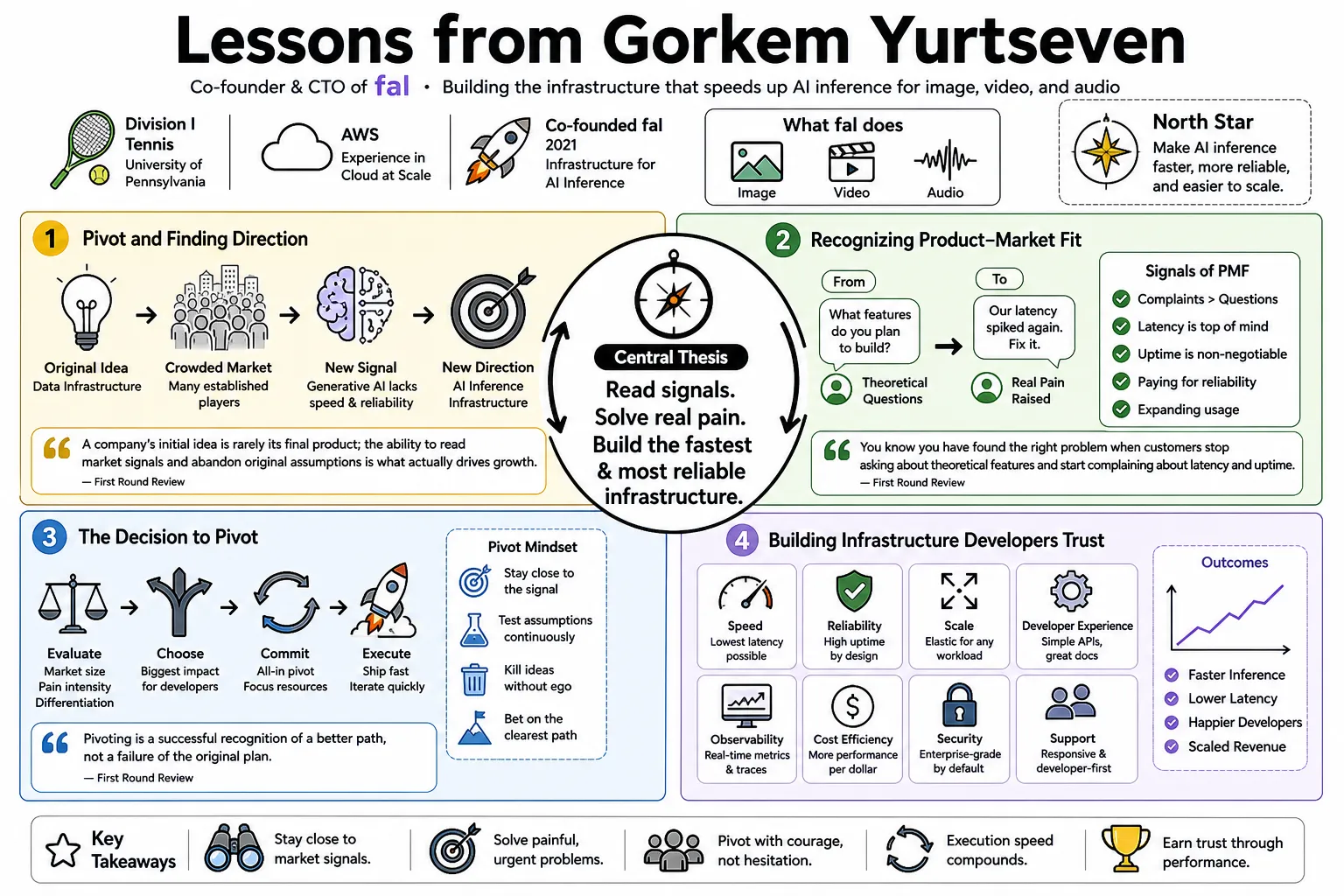
Lessons from Gorkem Yurtseven
Görkem Yurtseven is the co-founder and CTO of fal, an infrastructure platform that speeds up AI inference for image, video, and audio applications. Before starting the company in 2021, he worked at Amazon Web Services and played Division I tennis at the University of Pennsylvania. His background offers a practical look at managing startup pivots and building developer tools while scaling hardware for enterprise demand.
Part 1: The Pivot and Finding Direction
- On startup agility: "A company's initial idea is rarely its final product; the ability to read market signals and abandon original assumptions is what actually drives growth." — Source: First Round Review
- On leaving data infrastructure: "We realized that while the data space was crowded with established players, generative AI lacked the foundational speed and reliability developers needed." — Source: First Round Review
- On recognizing product-market fit: "You know you have found the right problem when customers stop asking about theoretical features and start complaining about latency and uptime." — Source: First Round Review
- On the decision to pivot: "Pivoting is a successful recognition of a better opportunity unfolding in front of you, rather than a failure of the original vision." — Source: First Round Review
- On the timing of generative AI: "We shifted focus to generative inference exactly when developers were experimenting with stable diffusion but struggling to deploy it efficiently." — Source: First Round Review
- On lean operations: "Growing revenue rapidly without bloating headcount forces a company to focus exclusively on what directly improves the core product." — Source: First Round Review
- On early customer discovery: "Listening to what developers complain about on forums provides more direction than conducting formal market research." — Source: First Round Review
- On abandoning sunk costs: "Walking away from months of work on a previous product iteration requires separating your ego from the codebase." — Source: First Round Review
- On surviving the transition: "The hardest part of a pivot is maintaining team focus while rebuilding the core technology stack from the ground up." — Source: First Round Review
- On staying close to users: "We found our new direction by watching what early adopters were hacking together on their own and deciding to build the enterprise version of that." — Source: First Round Review
Part 2: The Technical Layer Cake
- On infrastructure complexity: fal’s infrastructure challenge is layered: the company has to optimize low-level inference, model orchestration, developer workflows, and customer-facing reliability at the same time. — Reference: Sequoia podcast on fal’s technical layer cake
- On core inference engines: fal’s performance work is not a default-cloud configuration story; its team built a tracing compiler and kernel-level optimizations around generative-media workloads. — Reference: Sequoia podcast on fal’s inference engine
- On model hosting: Model variety is part of the product: fal has to make hundreds of open- and closed-weight image, video, and audio models usable through one platform. — Reference: Sequoia article on fal’s model platform
- On hardware utilization: fal’s margin and speed depend on orchestration as much as hardware access: the platform has to keep a distributed GPU fleet useful under volatile media workloads. — Reference: Sequoia podcast on distributed GPU scheduling
- On the compiler layer: Compiler work gives fal a reusable performance lever: it can identify common execution patterns and specialize them as new media models arrive. — Reference: Sequoia podcast on compiler-led inference optimization
- On architectural bottlenecks: Video inference has different constraints from text generation, so fal treats media models as a separate infrastructure problem rather than a variant of LLM serving. — Reference: Sequoia podcast on video-model bottlenecks
- On scaling inference: The hard part is not serving one demo model; it is making many fast-changing media models available reliably enough for production teams. — Reference: Sequoia podcast on scaling generative-media inference
- On abstraction: fal’s abstraction hides a messy stack behind developer-facing primitives: fast APIs, model choice, playgrounds, and enterprise controls. — Reference: Sequoia article on fal’s developer and enterprise platform
- On continuous optimization: In generative media, performance work never really settles because the model mix changes quickly and each release can shift the bottleneck. — Reference: Sequoia podcast on rapid model turnover
Part 3: Inference Speed and Performance
- On latency as a feature: "Speed is the primary feature of any generative media application, because users abandon tools that force them to wait more than a few seconds." — Source: SaaStr
- On real-time generation: "Pushing model inference to sub-second latency changes the user experience from a delayed request-response cycle to an interactive, continuous feedback loop." — Source: fal.ai
- On the economics of speed: "Faster inference naturally reduces compute costs per request, allowing you to pass those savings on to developers or improve your own margins." — Source: SaaStr
- On cold starts: "Eliminating cold boot times for massive diffusion models is essential for supporting unpredictable consumer traffic." — Source: fal.ai
- On benchmarking: "Public benchmarks only tell half the story; true performance is measured by how the system handles sustained peak loads during a viral product launch." — Source: SaaStr
- On custom serving infrastructure: "Off-the-shelf serving layers add unnecessary overhead; building a custom router for media generation trims vital milliseconds from the critical path." — Source: fal.ai
- On caching strategies: "Intelligent caching of intermediate model states can significantly accelerate subsequent generation requests for similar prompts." — Source: SaaStr
- On memory bandwidth: "The primary constraint in serving large generative models is often memory bandwidth rather than raw compute capability." — Source: fal.ai
- On perception of speed: "A progress bar is a poor substitute for actual performance; the goal is to make the generation process feel instantaneous." — Source: SaaStr
- On setting industry standards: "When you consistently deliver the fastest inference times, you establish the baseline that developers use to evaluate every other provider." — Source: fal.ai
Part 4: Empowering Developers
- On API design: fal’s API lesson is to turn complex multimodal infrastructure into a developer experience that moves quickly from experiment to production. — Reference: a16z investment note on fal’s developer experience
- On developer trust: Developers trust infrastructure when it is fast, reliable, and shaped around real pain points rather than abstract platform promises. — Reference: a16z investment note on reliability and customer pain points
- On the target audience: fal is built for practical builders who want to use media models without first becoming specialists in GPU infrastructure. — Reference: a16z investment note on multimodal builders
- On community feedback: The product direction comes from staying close to customer friction: developer pain points are treated as infrastructure requirements, not support noise. — Reference: a16z investment note on customer empathy
- On transparent pricing: AI infrastructure pricing has to reflect real inference cost because heavy usage can become expensive to serve if the economics are hidden. — Reference: SaaStr on fal and AI infrastructure economics
- On supporting open source: fal’s platform benefits from serving both open and closed models, giving developers access to a broader and faster-changing model ecosystem. — Reference: a16z investment note on open and closed model support
- On reducing friction: The developer-experience goal is to make model experimentation feel lightweight enough that teams can test creative AI ideas quickly. — Reference: a16z investment note on minimal-friction experimentation
- On error handling: A media-model API has to make failure states understandable because developers are depending on fal to abstract away fast-changing model behavior. — Reference: First Round episode on fal’s easy-to-use APIs
- On customer support: fal’s technical founders had to stay close to customer needs as the company moved from a pivot into enterprise-scale demand. — Reference: First Round episode on fal’s customer and enterprise learning
Part 5: Strategy and Go-To-Market
- On enterprise adoption: "Large companies buy AI tools when the infrastructure proves it can handle their existing traffic volume reliably." — Source: First Round Review
- On competing with giants: "Startups win against massive cloud providers by focusing exclusively on a single vertical, like generative media, and executing faster than a large organization can coordinate." — Source: First Round Review
- On finding the wedge: "Our initial wedge into the market was offering the absolute fastest Stable Diffusion inference, which caught the attention of every developer building visual tools." — Source: First Round Review
- On sales efficiency: "A product that solves a painful, technical bottleneck for engineers will often sell itself through word-of-mouth faster than a traditional sales team can." — Source: First Round Review
- On platform partnerships: "Securing integrations with major creative platforms validates the infrastructure and provides a stable baseline of recurring inference volume." — Source: First Round Review
- On marketing to engineers: "Technical marketing requires demonstrating actual performance gains through reproducible code, avoiding high-level conceptual promises." — Source: First Round Review
- On pricing models: "Usage-based pricing aligns the platform's incentives directly with the developer's success, forcing the infrastructure provider to ensure high availability." — Source: First Round Review
- On avoiding distraction: "Staying disciplined as a platform provider prevents you from competing with your customers by building consumer applications on top of your own infrastructure." — Source: First Round Review
- On market timing: "Entering the generative media space right as open-weight models reached production quality allowed us to capture the initial wave of application builders." — Source: First Round Review
Part 6: Navigating the AI Ecosystem
- On the open-source movement: "The rapid acceleration of open-source AI models provides a massive tailwind for infrastructure platforms that know how to host them efficiently." — Source: Salesforce Ventures
- On model commoditization: "As individual models become more commoditized, the real value shifts to the infrastructure layer that can run them reliably at scale." — Source: Salesforce Ventures
- On the fragmented ecosystem: "Developers currently have to stitch together tools from a dozen different providers; the winning platforms will offer a unified, cohesive experience." — Source: Salesforce Ventures
- On foundation models: "We do not train our own foundation models because it requires a completely different capital structure and focus compared to building an inference engine." — Source: Salesforce Ventures
- On hardware dependencies: "Navigating the GPU supply chain is a core competency for any AI infrastructure company; you cannot scale if you cannot secure compute." — Source: Salesforce Ventures
- On ecosystem collaboration: "The most successful AI companies share advancements in optimization techniques because a faster ecosystem benefits everyone building applications." — Source: Salesforce Ventures
- On the pace of research: "The infrastructure layer must be flexible enough to integrate a new, state-of-the-art model architecture within days of its public release." — Source: Salesforce Ventures
- On evaluating new models: "Not every viral model belongs in production; we evaluate new releases based on stability, licensing, and actual demand from our enterprise users." — Source: Salesforce Ventures
- On capital allocation: "Raising significant capital is necessary to secure compute, but it must be paired with extreme discipline in how that compute is deployed and monetized." — Source: Salesforce Ventures
Part 7: Team Building and Scaling
- On hiring engineers: "We look for engineers who have a background in low-level systems and a genuine curiosity about how machine learning models execute in memory." — Source: First Round Review
- On maintaining culture: "A lean team of exceptional engineers operating with high autonomy will consistently outperform a large, heavily managed engineering department." — Source: First Round Review
- On founder involvement: "As a technical founder, you have to stay close to the compiler and the core engine even as the company scales to dozens of employees." — Source: First Round Review
- On athletic discipline: "The resilience required to compete in collegiate athletics translates directly to the persistence needed to push through a startup pivot." — Source: Penn Athletics
- On remote work: "Building a highly technical infrastructure product requires intense, synchronous collaboration that is often easier to achieve when the core team is collocated." — Source: First Round Review
- On engineering velocity: "We optimize our internal tools and deployment pipelines obsessively so that engineers can ship improvements to the inference engine multiple times a day." — Source: First Round Review
- On interviewing: "The best technical interviews focus on how a candidate debugs a live, complex system rather than how they solve abstract algorithm puzzles." — Source: First Round Review
- On resolving disputes: "Technical disagreements should be resolved by profiling the code and looking at the metrics, rather than debating the theory in a meeting." — Source: First Round Review
- On scaling operations: "You cannot scale a company from two million to one hundred million in revenue without standardizing the chaos that worked in the early days." — Source: First Round Review
Part 8: The Future of Generative Media
- On video generation: Video generation is a distinct infrastructure category: the workloads are compute-heavy, fast-changing, and much less predictable than mature text-serving patterns. — Reference: Sequoia podcast on video-model infrastructure
- On multimodal interactions: fal’s opportunity widens as creative AI moves beyond still images into video, audio, 3D, and combined workflows. — Reference: a16z investment note on multimodal creative AI
- On real-time video: Real-time media generation raises the bar for infrastructure because latency and reliability become part of the creative experience. — Reference: a16z investment note on real-time media generation
- On synthetic data: The same media-generation infrastructure that powers creative output can support new production workflows across ads, storytelling, education, games, and other visual domains. — Reference: Sequoia article on generative-media use cases
- On spatial computing: As generated games and immersive media mature, demand shifts toward infrastructure that can create richer visual assets quickly enough for interactive workflows. — Reference: Sequoia article on generated games and immersive media
- On creative control: Creative teams need more than raw model access; fine-tunes, styles, collaboration, and workflow controls become part of the infrastructure product. — Reference: Sequoia article on fine-tunes, styles, and collaboration
- On audio models: fal’s platform scope includes audio alongside image and video, which forces the infrastructure to support multiple media-specific serving patterns. — Reference: First Round episode on image, video, and audio APIs
- On the role of the creator: fal’s market bet is that better infrastructure expands what creators can try, instead of reducing creative work to one-click automation. — Reference: Sequoia article on creators and generative media
- On edge computing: The near-term lesson is dynamic compute orchestration: media workloads need routing and scheduling across available GPU capacity as demand shifts. — Reference: Sequoia podcast on GPU-fleet orchestration
- On the ultimate goal: fal’s ambition is to make generative-media infrastructure invisible enough that builders can focus on the creative application rather than the serving stack. — Reference: Sequoia article on fal powering AI-first creativity