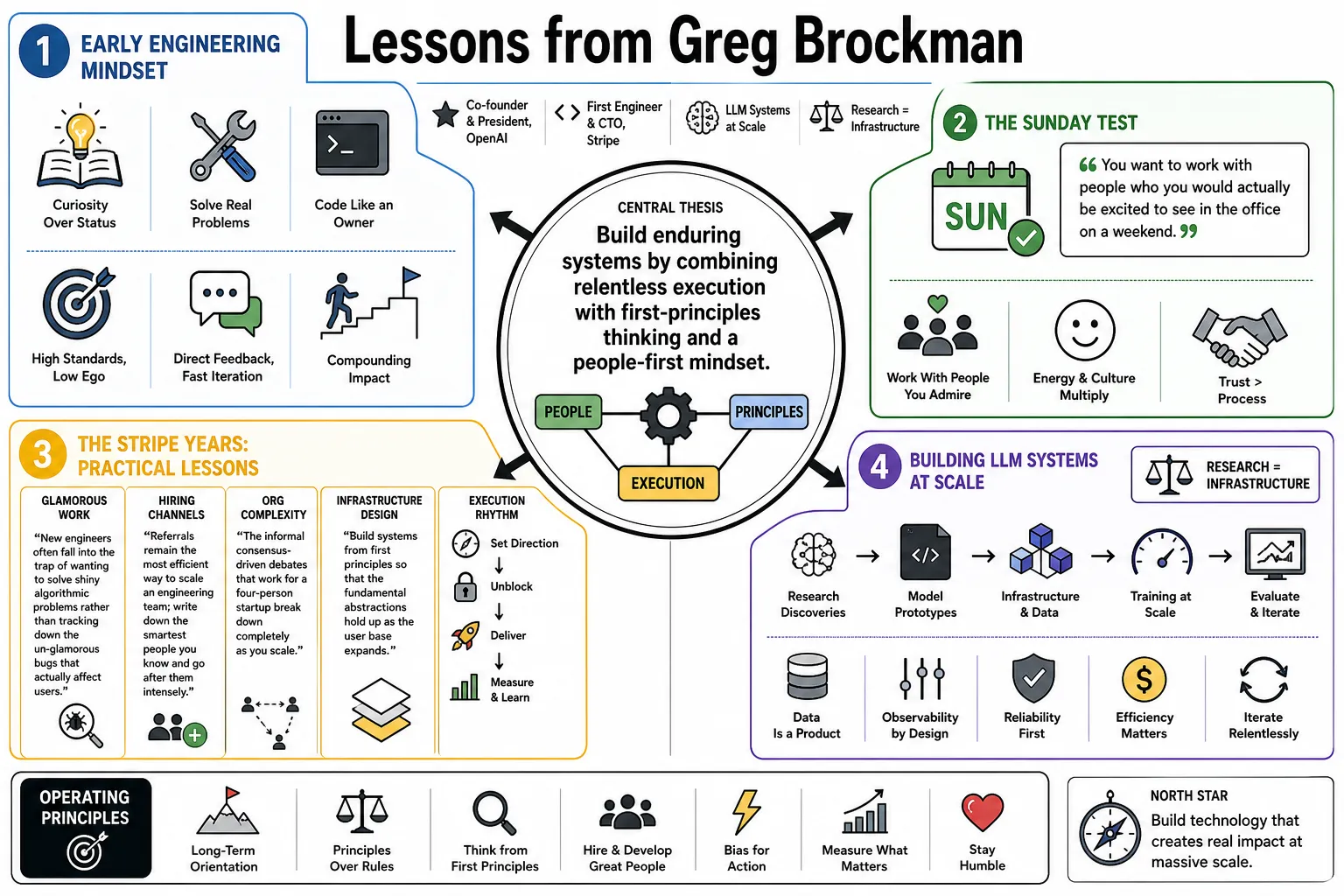
Lessons from Greg Brockman
Greg Brockman is a co-founder and president of OpenAI. He previously joined Stripe as an early engineer and became its CTO. His writing and interviews connect research, engineering, compute infrastructure, and organizational design. — Greg Brockman — #define CTO.
Part 1: Early Engineering and The Stripe Years
- Use the Sunday test: At Stripe, Brockman asked whether a candidate would make colleagues more eager to be around them—not whether the candidate would work weekends. — Greg Brockman — Sunday Test Discussion.
- Fix bugs that recur: In his Stripe engineering talk, Brockman warns that once a bug is triggered, it can keep recurring even when the triggering path seems unlikely. — Greg Brockman — Building a Culture Where Projects Get Done.
- Start recruiting with referrals: Brockman described referrals as a strong early hiring channel and urged teams to list and actively contact the best people their engineers know. — First Round — Greg Brockman on Hiring.
- Adapt as the organization grows: As Stripe grew beyond a circle of close friends, Brockman found it necessary to change how the engineering organization communicated and made decisions. — Greg Brockman — #define CTO.
- Build useful infrastructure abstractions: At Stripe, Brockman designed backend infrastructure and internal abstractions that made other engineers’ work easier. — Greg Brockman — #define CTO.
- Take responsibility beyond code: Brockman describes contributing to recruiting, culture, onboarding, and management as the engineering organization grew, even while he preferred writing code. — Greg Brockman — #define CTO.
- Minimize time to first use: In a talk on shipping at Stripe, Brockman recommends reducing the distance from a project’s start to its first production use. — Greg Brockman — Shipping at Stripe.
- Manage technical debt deliberately: Brockman’s Stripe presentation argues for managing technical debt rather than trying to eliminate it. — Greg Brockman — Shipping at Stripe.
Part 2: Scaling Infrastructure and Compute
- Treat compute as a real constraint: Brockman said OpenAI repeatedly sought more compute after ChatGPT launched because demand had exceeded what it could provision. — Sequoia — Greg Brockman on Human Attention.
- Scale compute with demand: He describes OpenAI’s compute business in terms of buying, renting, and building capacity to meet demand, rather than predicting a single winner of the compute race. — Sequoia — Greg Brockman on Human Attention.
- Engineer for GPU efficiency: OpenAI’s infrastructure account explains that multi-GPU jobs scale sublinearly and that utilization and orchestration matter to research throughput. — OpenAI — Infrastructure for Deep Learning.
- Make distributed experiments practical: OpenAI’s infrastructure team describes the work of making larger multi-GPU jobs accessible and manageable; the original claim about cascading failures is not established. — OpenAI — Infrastructure for Deep Learning.
- Follow empirical scaling laws: Brockman describes scaling laws as empirical relationships that guide AI development while acknowledging they do not remove the need for new ideas. — Sequoia — Greg Brockman on Human Attention.
- Protect expensive experiments: OpenAI’s account says large experiments can run for days across multiple machines, making experiment management and infrastructure continuity important. — OpenAI — Infrastructure for Deep Learning.
- Look beyond the GPU chip: OpenAI’s infrastructure account identifies interconnects, provisioning, and cluster orchestration as part of the hardware problem; the old power-delivery attribution is unverified. — OpenAI — Infrastructure for Deep Learning.
- Build cluster tools for researchers: OpenAI describes tooling for scheduling, monitoring, and autoscaling physical and cloud GPUs so researchers can focus on experiments. — OpenAI — Infrastructure for Deep Learning.
- Combine engineering with machine learning: Brockman recounts how OpenAI’s Dota work needed both a distributed reinforcement-learning framework and machine-learning insight. — Greg Brockman — Becoming an ML Practitioner.
- Invest in algorithmic ideas as well as scale: Brockman explicitly argues that OpenAI’s progress has involved new algorithms and data-formatting ideas, not simply larger data centers. — Sequoia — Greg Brockman on Human Attention.
Part 3: The Path to Artificial General Intelligence
- Keep AGI estimates subjective: In 2026 Brockman described himself as roughly 70–80% of the way to what he personally would call AGI; this was a subjective assessment, not a measured completion percentage. — Big Technology — Greg Brockman Interview.
- Expect a jagged frontier: Brockman says present systems can exceed people at some tasks while failing at basic others, which makes any precise AGI cutline debatable. — Big Technology — Greg Brockman Interview.
- Watch computer-based work first: Brockman expects AI to take on a widening range of intellectual tasks performed on computers, while acknowledging present capabilities remain uneven. — Big Technology — Greg Brockman Interview.
- Learn from real-world deployment: Brockman says real-world use and feedback are now necessary to develop capable systems further, alongside research. — Big Technology — Greg Brockman Interview.
- Distinguish reasoning training: Brockman explains reasoning models as building on next-token pretraining with reinforcement learning rather than simply replacing prediction with a separate kind of model. — The Knowledge Project — Greg Brockman Interview.
- Delegate parallel tasks to agents: In OpenAI’s Codex discussion, Brockman envisages an AI with its own computer delegating multiple tasks to a fleet of agents, with human review. — OpenAI Podcast — Codex and the Future of Coding.
- Use AI to improve AI development: Brockman describes using AI to improve the next generation of AI systems and a developing automated researcher that may take on more tasks autonomously. — Big Technology — Greg Brockman Interview.
- Iterate on safety empirically: OpenAI’s safety account describes risk analysis, limited pilots, monitoring, and retrospectives at successive stages of deployment. — OpenAI — Language Model Safety and Misuse.
Part 4: AI Development and Research Culture
- Value research and engineering together: Brockman says OpenAI’s founding principle was to value research and engineering equally because building working systems requires both. — Greg Brockman — Becoming an ML Practitioner.
- Let experiments expose failure: OpenAI’s infrastructure essay describes testing an idea, inspecting where a model fails, and iterating before scaling it to expensive runs. — OpenAI — Infrastructure for Deep Learning.
- Expect failed experiments: In OpenAI’s published example, a promising GAN experiment produced results below expectations even after many hypotheses were tested. — OpenAI — Infrastructure for Deep Learning.
- Combine systems and ML skills: Brockman says breakthroughs in the Dota project combined software engineering and machine-learning skill, motivating him to learn both sides. — Greg Brockman — Becoming an ML Practitioner.
- Make infrastructure a research multiplier: OpenAI’s infrastructure essay says a group’s infrastructure quality multiplies progress by reducing friction for many researchers. — OpenAI — Infrastructure for Deep Learning.
- Pay attention to data formatting: Brockman says seemingly small changes in how data is formatted can produce meaningful differences in model performance; the old data-versus-parameter comparison is unsupported. — Sequoia — Greg Brockman on Human Attention.
- Use feedback to improve usefulness: OpenAI reports that reinforcement learning from human feedback made InstructGPT better at following user intentions than its base models. — OpenAI — Aligning Language Models.
- Reassess progress as models improve: Brockman says coding models advanced rapidly as both model capability and the team’s understanding of how to use the technology changed. — Big Technology — Greg Brockman Interview.
Part 5: Coding in the AI Era
- Recognize AI’s role in internal coding: Asked how much of OpenAI’s code is written by AI, Brockman said the share not written by AI was hard to know and described humans as still important for code structure. — The Knowledge Project — Greg Brockman Interview.
- Treat the 20-to-80% figure as an example: Brockman described agentic tools moving from roughly 20% to 80% of “your code” in a December usage example; he did not identify this as an internal OpenAI-wide measurement. — Sequoia — Greg Brockman on Human Attention.
- Keep human accountability for code: Brockman says OpenAI wanted a human accountable for code that gets merged, including whether it is well structured and maintainable. — Sequoia — Greg Brockman on Human Attention.
- Let computers adapt to users: Brockman argues that AI interfaces should let people ask computers for outcomes in ordinary terms, instead of requiring people to contort themselves to rigid controls. — Big Technology — Greg Brockman Interview.
- Let agents investigate bugs: In OpenAI’s Codex discussion, the team describes giving agents the context and tools to investigate difficult bugs rather than asking users to paste snippets into a chat. — OpenAI Podcast — Codex and the Future of Coding.
- Direct higher-level coding work: Brockman says AI can take on mechanical coding steps, letting developers spend more attention on specifying the system they want to build. — Possible — Sam Altman and Greg Brockman.
- Open software building to more people: Brockman says coding tools can help people with a vision build prototypes even when they lack conventional programming skills. — Sequoia — Greg Brockman on Human Attention.
Part 6: Leadership and Building Teams
- Stay connected to the work: Brockman returned to writing code as CTO because doing the work gave him a more current feedback loop on his engineering organization. — Greg Brockman — #define CTO.
- Talk through significant concerns: In choosing a VP of Engineering, Brockman valued a working relationship where concerns about a decision could be discussed and unresolved concerns would pause that approach. — Greg Brockman — #define CTO.
- Communicate before acting: Brockman describes frequent one-on-ones and advance notices of planned actions as ways to keep leadership aligned during change. — Greg Brockman — #define CTO.
- Create leverage by empowering engineers: After delegating management work, Brockman redefined his CTO contribution as enabling engineers to make major improvements rather than being the part-time chief architect. — Greg Brockman — #define CTO.
- Use forcing functions cautiously: Brockman’s Stripe engineering presentation recommends forcing functions but explicitly cautions against using them indiscriminately. — Greg Brockman — Building a Culture Where Projects Get Done.
- Empower engineers to act: Brockman created an architecture working group to help engineers build better systems and make major improvements without relying on him for every decision. — Greg Brockman — #define CTO.
- Manage energy as well as time: Brockman says a technical leader needs activities that recharge them so they can sustain more draining, high-leverage responsibilities. — Greg Brockman — #define CTO.
- Do what the early organization needs: Brockman’s early Stripe role ranged from backend code to recruiting and culture work; responsibilities shifted as the team grew. — Greg Brockman — #define CTO.
- Avoid sporadic micromanagement: Brockman argues that a leader should delegate a function fully or stay consistently involved, rather than intervene unpredictably and disappear. — Greg Brockman — #define CTO.
Part 7: AI's Impact on Humanity
- Aim technology at human benefit: In the Possible interview, Brockman says the reason to build technology is to improve human lives and enable people to achieve more. The retired quotation’s wording belonged to Sam Altman. — Possible — Sam Altman and Greg Brockman.
- Broaden access to AI: Brockman argues that people worldwide should be able to access AI and have their preferences and feedback represented in it; the old quotation belonged to Sam Altman. — Possible — Sam Altman and Greg Brockman.
- Use AI to advance discovery: Brockman discusses AI’s potential to read scientific literature and contribute to cures and material abundance, beyond routine software tasks. — Lex Fridman — Greg Brockman on OpenAI and AGI.
- Expect disruption to work: Brockman cautions that jobs and previously stable career paths may change as AI is deployed, without promising that no jobs will disappear. — The Knowledge Project — Greg Brockman Interview.
- Explore adaptive tutoring: Brockman envisages AI tutoring that learns what motivates a student and guides them instead of simply doing their homework. — Possible — Sam Altman and Greg Brockman.
- Keep human agency central: Brockman describes the aim of AI tools as empowering people and keeping humans accountable for important choices. — Sequoia — Greg Brockman on Human Attention.
- Use memory and context for personalization: Brockman argues that AI assistants become more useful when they remember prior interactions and have relevant context rather than starting every conversation from scratch. — Big Technology — Greg Brockman Interview.
- Build social support for transitions: Brockman says people may lose stability in familiar jobs and institutions, so society needs support as the technology rolls out. — The Knowledge Project — Greg Brockman Interview.
Part 8: Navigating Crises and Corporate Structure
- Match structure to compute needs: Brockman says the founders concluded nonprofit fundraising could not fund the compute they believed OpenAI needed and chose an associated for-profit entity. — The Knowledge Project — Greg Brockman Interview.
- Separate mission from investor return: Brockman described OpenAI’s original capped-return structure as a way to raise capital while keeping residual value tied to its nonprofit mission. — Lex Fridman — Greg Brockman on OpenAI and AGI.
- Notice the team’s response in crisis: Brockman recalls colleagues volunteering to join a backup effort after he resigned and later signing a petition to reunite the company. — The Knowledge Project — Greg Brockman Interview.
- Build a viable backup with people: During the 2023 leadership crisis, Brockman and colleagues sketched a backup organization and found many staff willing to join; this does not prove the corporate structure lacked value. — The Knowledge Project — Greg Brockman Interview.
- Regroup after a setback: After resigning during OpenAI’s 2023 crisis, Brockman describes forming a backup plan with colleagues the next day rather than the invented Friday-to-Monday maxim. — The Knowledge Project — Greg Brockman Interview.