Gretchen Howard is an operating executive known for her tenure as Chief Operating Officer at Robinhood, where she managed extreme organizational scaling and the company's high-stakes public market debut. Before entering consumer fintech, she spent twelve years at Google and its growth equity fund CapitalG, overseeing early investments and advising founders on operational structures. This profile documents her practical frameworks for executive hiring, crisis management, and the mechanics of operating alongside founders.
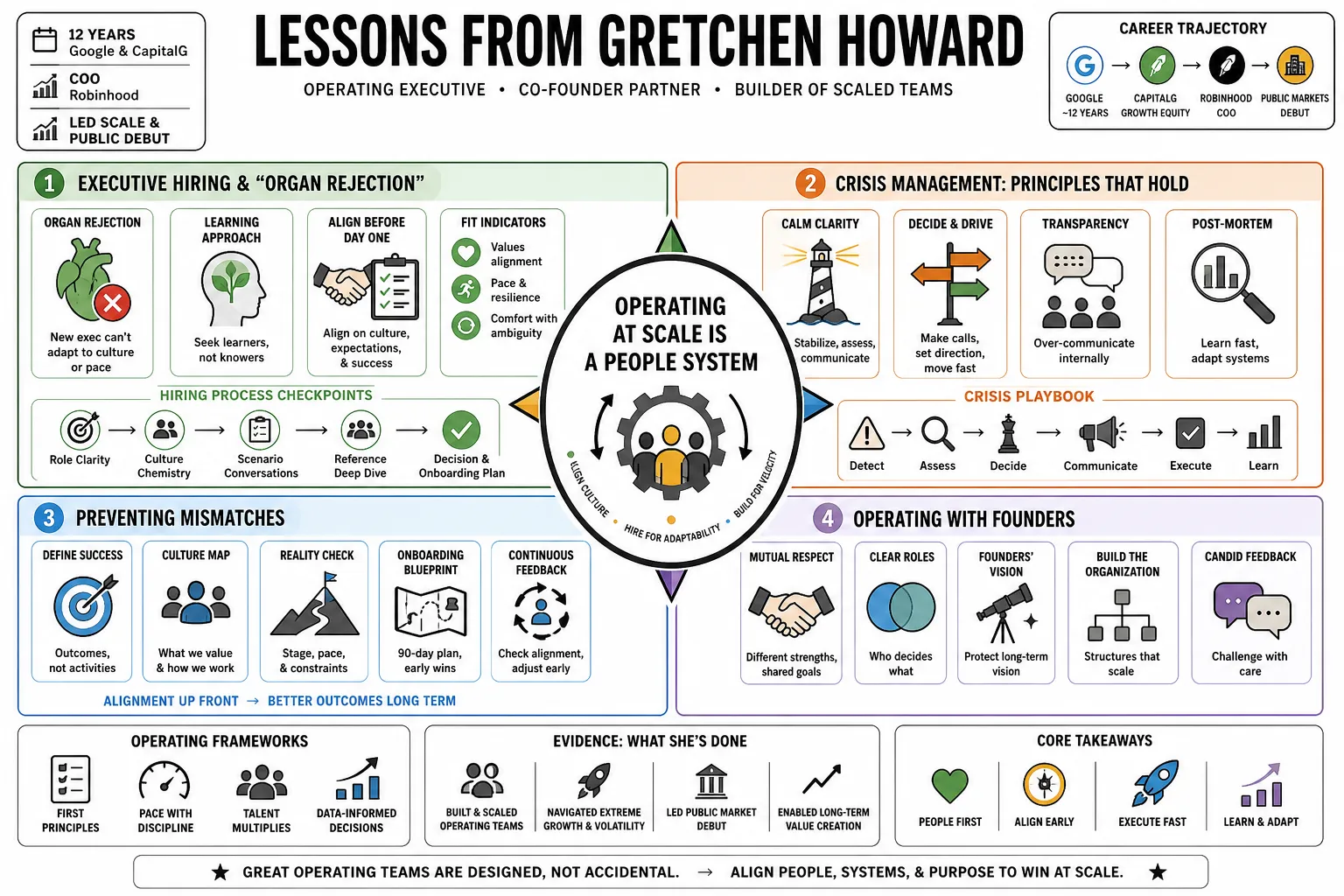
Part 1: Executive Hiring and "Organ Rejection"
- On Organizational Fit: "Organ rejection occurs when a new executive hire, often from a large established company, struggles to adapt to the culture or pace of a startup." — Source: First Round Review
- On the Hiring Mindset: "Look for candidates with a learning approach rather than a knower attitude. They must be willing to understand the unique culture rather than replicate past processes." — Source: First Round Review
- On Preventing Mismatches: "Successfully onboarding executives requires careful alignment on culture and expectations before the person even comes in the door." — Source: First Round Review
- On Future Trajectories: "Align hiring profiles with the business trajectory, not just the immediate fire you are trying to put out." — Source: First Round Review
- On Functional Expertise vs. Mindset: "A candidate can have deep functional expertise, but without an innovative, hands-on mindset, they won't survive the startup transition." — Source: First Round Review
- On Matchmaking in Interviews: "Approach leadership interviews as matchmaking to ensure alignment on both sides—what the company needs and what the candidate wants to learn." — Source: First Round Review
- On the Danger of Playbooks: "If a candidate simply wants to copy and paste the playbook they ran at their last company, they are a high risk for organ rejection." — Source: First Round Review
- On Assessing Adaptability: "You have to test for how someone reacts when the resources they are used to having are suddenly removed." — Source: First Round Review
- On Reference Checking: "Backchannel references are where you find out if a candidate was actually building the machine or just riding on top of it." — Source: First Round Review
- On Onboarding: "The first 90 days for an executive should be aggressively focused on listening and absorbing context before trying to change the architecture." — Source: First Round Review
Part 2: Scaling Operations and Hypergrowth
- On Operational Agility: Operational agility at scale means building systems that preserve speed while preventing chaos from turning into the company’s default operating model. — Reference: The General episode on building systems without bureaucracy
- On the Velocity of Execution: "I've been inspired by the velocity with which Robinhood builds and launches high-quality products." — Source: Robinhood
- On Managing Scale: Howard’s scaling lesson is that a company outgrows some of its early operating assumptions; leaders have to decide what to keep, what to professionalize, and when outside experience is needed. — Reference: First Round transcript on stage-appropriate leadership
- On People as a Strategic Lever: Howard treats people work as a strategic lever, not an HR side channel: hiring, onboarding, trust, and culture shape how much speed a company can actually absorb. — Reference: The General episode on the people function as a scaling lever
- On Anticipating Breakpoints: The operating job is partly to see the next breakpoint early: where the current team, process, or expertise will stop matching the company’s trajectory. — Reference: First Round transcript on hiring for the next business stage
- On the Tension of Speed: Speed is valuable only if the company can keep its integrity as it accelerates; the COO’s work is often to keep velocity from outrunning trust, controls, and judgment. — Reference: The General episode on velocity and company integrity
- On Process Redesign: Process redesign works when it solves the unglamorous problems that slow a company down while avoiding a new layer of bureaucracy for its own sake. — Reference: The General episode on unglamorous operating systems
- On Communication at Scale: As Robinhood scaled, open communication and trust between founders and executives became operating infrastructure, not just interpersonal preference. — Reference: First Round transcript on founder-executive communication
- On Cross-Functional Friction: Cross-functional friction is where the COO role becomes practical: translate between teams, earn trust, and keep the company moving without flattening real tradeoffs. — Reference: The General episode on earning trust and building velocity
- On Operational Debt: Operational debt accumulates in the unglamorous parts of the company, so the work is to fix the systems that no longer support the scale the business has reached. — Reference: The General episode on hard unglamorous operating problems
Part 3: The Role of the COO
- On Defining the COO: Howard’s version of the COO role is not a generic second-in-command; it is the person who turns founder ambition into operating rhythm, trust, and durable systems. — Reference: The General episode on what the COO role entails
- On Complementing Founders: A COO complements founders by earning enough trust to extend their judgment, not by trying to replace the founder’s instincts or impose a separate operating religion. — Reference: The General episode on founder chemistry and trust
- On Filling the Gaps: Howard’s work at Robinhood included helping the founders identify which leadership gaps mattered most and when the company needed new executive capability. — Reference: First Round transcript on building Robinhood’s leadership team
- On Context Switching: The COO context-switches across people, process, trust, and execution; the skill is keeping those domains connected instead of treating them as separate workstreams. — Reference: The General episode on the breadth of COO work
- On Ego: The COO role rewards low-ego operators because much of the valuable work is unglamorous: making the company function better without needing every win to carry your name. — Reference: The General episode on unglamorous operator work
- On Translation: Howard’s operator lesson is translation: turn founder intent into operating systems, people choices, and execution habits that teams can actually use. — Reference: The General episode on translating ambition into operating systems
- On Scope: The scope of an operator changes with the stage of the business; what matters is matching leadership capacity to the company’s next set of constraints. — Reference: First Round transcript on stage-dependent leadership scope
- On Decision Rights: Decision rights become clearer when leaders trust each other enough to separate input from ownership and to decide where the company needs focused investment. — Reference: First Round transcript on leadership trust and investment decisions
- On Trust: Trust is the operating currency of the COO role: without it, the operator cannot challenge founders, reshape systems, or carry decisions across the company. — Reference: The General episode on earning trust with founders
Part 4: Founder Chemistry and Alignment
- On Partnership: "I look forward to working with Vlad and Baiju to further their mission and bring this best-in-class product to more customers." — Source: Pulse 2.0
- On Entering Established Cultures: Entering an established culture requires diagnosis before prescription; the fastest way to fail is to trigger organizational rejection by changing what you do not yet understand. — Reference: First Round transcript on avoiding executive organ rejection
- On Founder Empathy: Founder empathy starts with understanding why the mission and team matter; Howard joined Robinhood because she believed the work and the people were worth taking the risk for. — Reference: FinTech Leaders interview on Robinhood’s mission and team
- On Pushing Back: Effective pushback starts from a learner’s posture: ask enough questions to understand the system before deciding what to challenge and how hard to push. — Reference: First Round transcript on knower-versus-learner executives
- On Shared Values: Howard’s executive-hiring lens combined competence with fit: functional expertise mattered, but so did mission alignment, collaboration, and openness to change. — Reference: First Round transcript on executive hiring fit
- On Earning Influence: Influence in the COO role is earned by making the company work better: build trust, increase velocity, and protect the integrity of decisions as scale rises. — Reference: The General episode on earning trust and operating influence
- On Founder Blind Spots: A strong COO helps founders see around their own constraints by identifying missing leadership capacity and turning blind spots into explicit operating choices. — Reference: First Round transcript on complementing founders with leadership capacity
- On Communication Styles: Howard’s communication lesson is that style matters because trust is built in repeated operating conversations, not only in formal planning meetings. — Reference: First Round transcript on open executive communication
- On Transitions: Transitions require judgment about who can grow with the company, where outside experience is needed, and how to introduce new leadership without breaking the culture. — Reference: First Round transcript on executive transitions and onboarding
Part 5: Leading Through Crises
- On High-Stakes Environments: "Navigating crises requires scaling operations during periods of intense public and regulatory scrutiny." — Source: Fintech Leaders
- On The GameStop Event: "When external volatility hits, the internal operations have to remain incredibly calm and focused on execution." — Source: Fintech Leaders
- On Prioritization During Chaos: "In a crisis, you have to immediately narrow the company's focus to the absolute essentials. Everything else stops." — Source: Fintech Leaders
- On Transparency: "During periods of intense scrutiny, internal communication matters just as much as external messaging. The team needs to know the reality." — Source: Fintech Leaders
- On Regulatory Scrutiny: "You have to view regulatory compliance not as a roadblock, but as a foundational requirement for operating at scale." — Source: Fintech Leaders
- On Resilience: "A crisis will expose every weak point in your operational infrastructure. The goal is to fix them fast and learn from the failure." — Source: Fintech Leaders
- On Team Fatigue: "Leaders have to monitor burnout carefully during a prolonged crisis. You cannot run the engine at redline indefinitely." — Source: Fintech Leaders
- On Decision Fatigue: "When making rapid-fire decisions under stress, you need a tight, trusted core group to prevent paralysis." — Source: Fintech Leaders
- On Post-Mortems: "The true test of a company's culture is how honestly it conducts the post-mortem after a major incident." — Source: Fintech Leaders
Part 6: The Learning Mindset Over the Knowing Mindset
- On Continuous Learning: "The executives who fail are usually the ones who think they have seen it all before. Every hypergrowth company is unique." — Source: First Round Review
- On Curiosity: "You want leaders who ask why a process is broken, rather than just declaring that it is broken and needs to be replaced." — Source: First Round Review
- On Humility: "Coming from a massively successful tech giant does not guarantee you will succeed at a fast-moving startup. Humility is required." — Source: First Round Review
- On Unlearning: "Part of adapting to a new environment is actively unlearning the habits that made you successful in your previous, slower-moving role." — Source: First Round Review
- On Asking Questions: "The best leaders spend their early tenure asking questions rather than giving directives." — Source: First Round Review
- On Feedback Loops: "You have to build tight feedback loops so you can learn quickly when an operational change isn't working." — Source: First Round Review
- On Adapting to Change: "If you need a predictable, static environment to thrive, high-growth tech is the wrong place for you." — Source: First Round Review
- On Intellectual Honesty: "A learning mindset requires the intellectual honesty to admit when a strategy you championed has failed." — Source: First Round Review
- On Evaluating Talent: "When interviewing, I listen for how candidates describe their failures. If they blame others, they lack a learning mindset." — Source: First Round Review
Part 7: Transitioning from Large Tech to Startups
- On Leaving Alphabet: "While it's bittersweet to leave Alphabet after 12 years, I'm excited to remain in the Alphabet family and work closely with the CapitalG team from the portfolio side." — Source: Robinhood
- On CapitalG's Perspective: "Working on the venture side at CapitalG gave me a macro view of how different founders approach the same scaling challenges." — Source: Fintech Leaders
- On Operating vs. Investing: "Investing teaches you pattern matching; operating requires you to actually execute and live with the consequences of those patterns." — Source: Fintech Leaders
- On Resource Constraints: "When you leave Google for a startup, the biggest shock is realizing you no longer have an army of internal tools and support staff." — Source: Fintech Leaders
- On Speed of Execution: "Large tech companies optimize for avoiding mistakes. Startups have to optimize for speed and course-correction." — Source: Fintech Leaders
- On Building the Machine: "At a mega-cap company, you are optimizing an existing engine. At a startup, you are building the engine while the car is moving." — Source: Fintech Leaders
- On Risk Tolerance: "The transition requires a massive recalibration of your personal and professional risk tolerance." — Source: Fintech Leaders
- On First Principles: "You can't rely on institutional momentum anymore. Every decision has to be reasoned from first principles." — Source: Fintech Leaders
- On Scrappiness: "You have to rediscover your scrappiness. If a problem needs solving, you might have to build the spreadsheet yourself." — Source: Fintech Leaders
Part 8: Democratizing Access and Mission-Driven Work
- On Robinhood's Mission: "I share their passion for democratizing financial services and bringing this product to more customers around the globe." — Source: Robinhood
- On Mission as a Filter: "A strong mission acts as a filter for hiring. It attracts people who are willing to endure the chaos of hypergrowth." — Source: Fintech Leaders
- On Access: "Building consumer fintech is fundamentally about expanding access to tools that were historically gatekept by traditional institutions." — Source: Fintech Leaders
- On Customer Focus: "When you lose sight of the end retail customer, your operational decisions start to skew toward internal convenience rather than user experience." — Source: Fintech Leaders
- On Product Quality: "Democratizing finance doesn't just mean making it available; it means delivering a high-quality product that people actually want to use." — Source: Pulse 2.0
- On Motivation: "The hours required to scale a company are grueling. If you don't genuinely believe in the mission, you will eventually tap out." — Source: Fintech Leaders
- On Institutional Pushback: "When you disrupt an established industry, you have to expect resistance. Operations must be resilient enough to handle that external pressure." — Source: Fintech Leaders
- On Long-Term Vision: "The daily fires are intense, but the operating team has to keep the long-term vision of financial inclusion clearly in sight." — Source: Fintech Leaders
- On Responsibility: "With massive growth comes massive responsibility to the customers who are trusting you with their money." — Source: Fintech Leaders
- On Impact: "The most rewarding part of operating at scale is seeing the tangible impact your infrastructure has on millions of individual users." — Source: Fintech Leaders