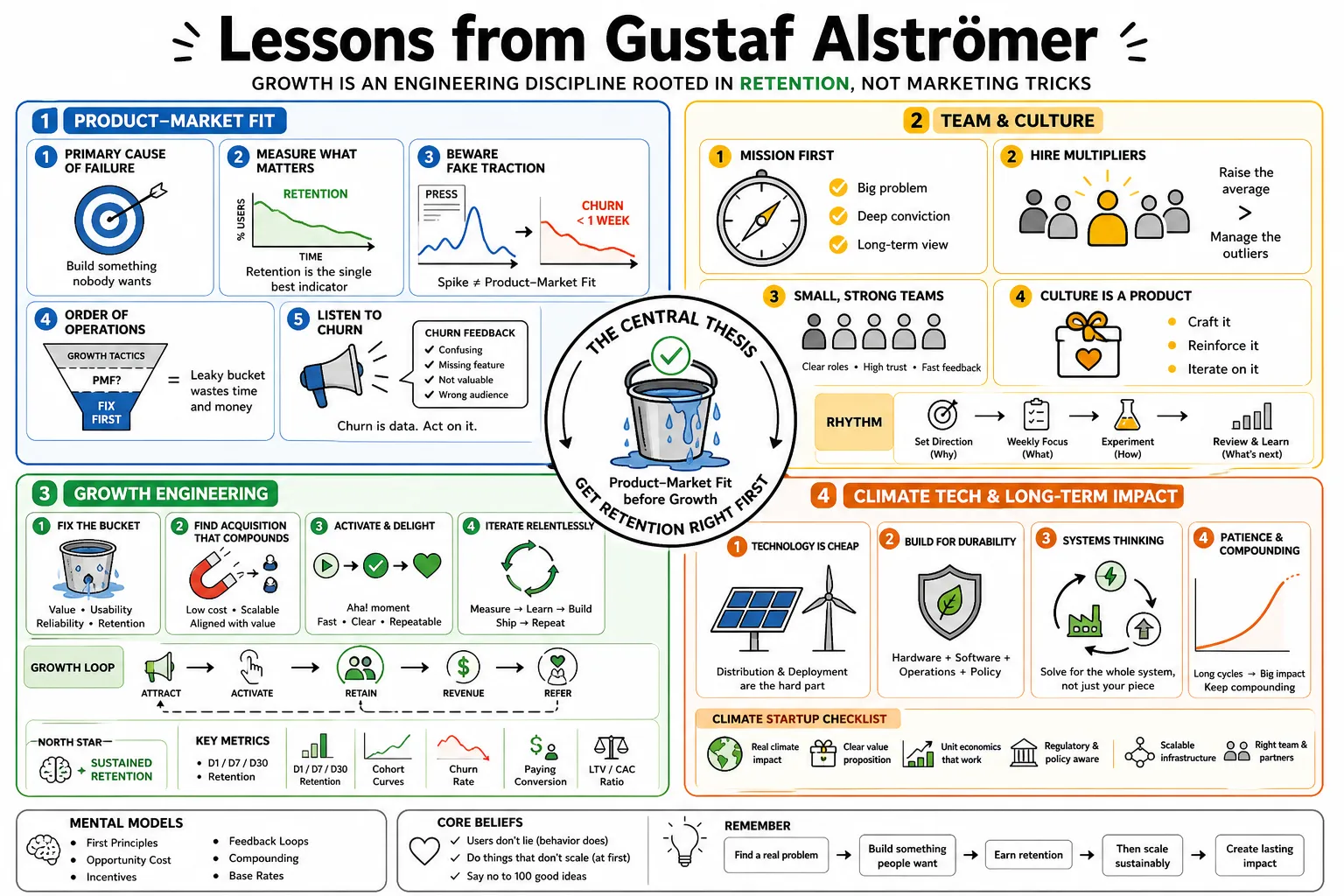
Lessons from Gustaf Alströmer
Gustaf Alströmer is a Y Combinator partner and former Airbnb growth lead who treats startup growth as an engineering and product discipline rooted in retention, not short-term marketing tricks. This collection gathers his frameworks on product-market fit, team building, and climate tech from his lectures, essays, and interviews.
Part 1: Product-Market Fit
- On the primary cause of failure: "Startups almost always fail because they build something nobody wants, not because the founders were unskilled or lacked a vision." — Source: Lenny's Podcast
- On measuring product-market fit: "Retention is the single best indicator that you have built something people want. If they come back without you paying them to, you are on the right track." — Source: YC Startup School
- On fake traction: "A sudden spike in signups from a press article feels like product-market fit, but if those users churn within a week, it is just noise." — Source: YC Library
- On the order of operations: "You cannot grow a product that doesn't have product-market fit. Putting growth tactics on top of a leaky bucket is a waste of time and money." — Source: Lenny's Podcast
- On listening to churn: "The users who leave tell you more about your lack of product-market fit than the users who stay tell you about your success." — Source: YC Startup School
- On founder delusion: "Founders often convince themselves they have product-market fit because they are afraid to admit they spent six months building the wrong thing." — Source: Lenny's Podcast
- On the baseline metric: "If you are building a consumer app, look for at least 20 to 30 percent of your users coming back in month two. Anything less means the core value isn't there." — Source: YC Startup School
- On early traction indicators: "When you have true product-market fit, the product starts breaking. Your servers crash, customer support is overwhelmed, and you cannot hire fast enough." — Source: YC Library
- On pivoting: "A pivot isn't a failure; it is the realization that your current path will never reach product-market fit, and acting on it before you run out of money." — Source: YC Library
- On the role of design in product-market fit: "Great design won't fix a product nobody wants, but poor design can hide product-market fit by confusing the users who actually need your solution." — Source: YC Startup School
Part 2: Defining and Measuring Growth
- On the definition of growth: "Growth is not marketing. Growth is connecting the value of your product to the people who need it, using engineering, data, and design." — Source: YC Startup School
- On the danger of growth hacking: "The term growth hacking implies there is a silver bullet or a shortcut. Real growth is a systemic, long-term investment in your product's core loop." — Source: Lenny's Podcast
- On picking a North Star metric: "Choose a single metric that perfectly aligns with the value your users receive. For Airbnb, it was nights booked, not app downloads." — Source: YC Startup School
- On metric simplicity: "If you have to explain how your primary growth metric is calculated in more than one sentence, it is too complicated for the team to rally behind." — Source: Lenny's Podcast
- On tracking the right data: "Start tracking data on day one, but only track the events that actually inform your product decisions. Data hoarding just creates noise." — Source: YC Startup School
- On funnel optimization: "Most startups focus on the top of the funnel to get people in the door. The best growth teams spend their time optimizing the bottom of the funnel to get people to the core action." — Source: YC Startup School
- On experimentation limitations: "You shouldn't run A/B tests if you only have a hundred users. Talk to them instead. Save the statistical significance for when you have the volume to measure it." — Source: YC Library
- On compounding math: "The goal isn't linear additions; it is compounding loops. A small weekly growth rate seems minor in week one, but it turns into a massive company in year three." — Source: YC Library
- On vanity metrics: "Registered users is a vanity metric. Active users who are performing the core action of your product is the only metric that pays the bills." — Source: Lenny's Podcast
Part 3: Growth Channels and Tactics
- On channel concentration: "You don't need five growth channels to build a billion-dollar company. You usually just need one channel that works incredibly well and scales." — Source: YC Startup School
- On paid acquisition: "Paid marketing is a great way to test messaging, but it is a dangerous dependency if it is your only way to acquire users in the early days." — Source: YC Startup School
- On search engine optimization: "Search Engine Optimization is a long-term play. If your product solves a problem people actively search for, you must invest in SEO, but expect results in months, not days." — Source: YC Library
- On word of mouth: "Word of mouth isn't magic; it is a byproduct of exceeding user expectations. If your product is just acceptable, no one will tell their friends about it." — Source: Lenny's Podcast
- On referral programs: "A successful referral program requires a double-sided incentive. Both the sender and the receiver must get genuine value for the loop to take off." — Source: Airbnb Engineering Medium
- On email marketing: "Email is still one of the highest returning channels because you own the list. Focus on delivering value in the inbox, not just asking for engagement." — Source: YC Startup School
- On virality: "Virality is rarely engineered after the fact. The most viral products have sharing inherently built into the core user experience." — Source: YC Startup School
- On content marketing: "Good content marketing answers the specific questions your ideal customers are asking before they even know your product exists." — Source: YC Library
- On B2B versus B2C channels: "B2B growth is often about outbound sales and targeted content, while B2C growth relies heavily on viral loops, referrals, and performance marketing." — Source: YC Library
- On channel fatigue: "Every growth channel eventually degrades over time. What works for you today will be copied by your competitors tomorrow, so you must always be testing the next channel." — Source: Lenny's Podcast
Part 4: Lessons from Airbnb
- On early persistence: "Airbnb launched three separate times because the first two attempts resulted in zero traction. The founders kept launching until the market finally cared." — Source: YC Startup School
- On doing things that do not scale: "Flying to New York to professionally photograph the early listings was unscalable, but it built the initial trust and quality baseline the platform needed." — Source: Lenny's Podcast
- On the core referral incentive: "We realized that users wanted to share Airbnb with their friends, but they needed an excuse. The financial incentive gave them the excuse to do what they already wanted to do." — Source: Airbnb Engineering Medium
- On international expansion: "Airbnb didn't grow internationally by opening offices everywhere. We grew by finding the specific nodes where travelers from one country wanted to visit another." — Source: YC Startup School
- On trust as a feature: "In a marketplace where strangers sleep in other strangers' homes, trust isn't a byproduct; it is the core feature you have to engineer into every interaction." — Source: Lenny's Podcast
- On cross-functional teams: "The growth team at Airbnb worked because it wasn't siloed. It was a dedicated mix of product managers, engineers, designers, and data scientists sitting together." — Source: YC Startup School
- On aligning metrics with value: "We rigorously tracked nights booked because if you tracked something secondary, you might optimize for search queries that never resulted in revenue for the hosts." — Source: YC Library
- On the power of the supply side: "We learned early on that acquiring a great host was exponentially more valuable than acquiring a single guest, because a great host brings in dozens of guests over time." — Source: Lenny's Podcast
- On navigating the trough of sorrow: "The period between the initial hype and actual sustainable growth is brutal. Airbnb survived it by relentlessly talking to the few users who actually cared." — Source: YC Startup School
Part 5: Customer Discovery and User Feedback
- On the frequency of user interviews: "You should be talking to your users every single week. If you go a month without a user conversation, you are building in a vacuum." — Source: YC Library
- On asking the right questions: "Never ask a user if they think your idea is good. Ask them how they currently solve the problem and how much money or time it costs them." — Source: Lenny's Podcast
- On interpreting feedback: "Users are incredibly good at telling you what their problems are, but they are usually terrible at telling you how to fix them." — Source: YC Startup School
- On finding early adopters: "Your first users shouldn't be your friends and family. They should be the people who are so desperate for a solution that they will use your buggy, half-finished prototype." — Source: YC Library
- On the danger of surveys: "Surveys are great for getting quantitative data from thousands of users, but they are useless for discovering the deep, emotional reasons why someone uses your product." — Source: YC Library
- On building for a single user: "Sometimes the best way to build a product for a million people is to build something that perfectly solves a problem for just one very specific user first." — Source: Lenny's Podcast
- On ignoring feature requests: "Just because a noisy subset of users demands a feature doesn't mean you should build it. You have to evaluate if that feature serves your core value proposition." — Source: YC Startup School
- On the onboarding experience: "Watch a new user try to sign up for your product in person, without helping them. You will immediately see where your user experience is broken." — Source: YC Library
- On the power of plain text: "A simple, plain-text email asking a user why they signed up will often get a higher response rate and better insights than an automated, heavily designed survey." — Source: YC Library
Part 6: Hiring and Team Building
- On when to hire: "Only hire when you are at a breaking point. If you hire before it physically hurts, you will end up creating make-work for people." — Source: Business Insider
- On vanity headcount: "Measuring your startup's success by the number of employees you have is a classic trap. Headcount is a cost, not an achievement." — Source: Business Insider
- On the first ten hires: "Your first ten employees shouldn't be managers. They need to be relentless individual contributors who are comfortable operating in complete ambiguity." — Source: Lenny's Podcast
- On hiring for growth: "You don't necessarily want a marketer to lead your growth team in the early days. You want a technical product manager or an engineer who understands user psychology." — Source: YC Startup School
- On founder involvement in hiring: "Founders must remain deeply involved in the hiring process for at least the first fifty employees to protect the company culture." — Source: YC Library
- On firing fast: "If you realize you made a hiring mistake, holding onto that person is unfair to them and detrimental to your team. Let them go quickly and respectfully." — Source: Lenny's Podcast
- On remote team dynamics: "Remote work can expand your talent pool globally, but it requires much stronger written communication skills and deliberate cultural rituals to succeed." — Source: YC Library
- On the transition to management: "Founders eventually have to transition from doing the work to managing the people doing the work, which is an entirely different skill set that many struggle to learn." — Source: YC Library
- On team alignment: "The easiest way to keep a team aligned is to make sure everyone in the company looks at the exact same core growth metric every single week." — Source: YC Startup School
Part 7: Y Combinator Philosophy
- On the core value of the accelerator: "YC doesn't build your company for you. It provides a deadline, peer pressure, and a dense network that accelerates whatever trajectory you are already on." — Source: Lenny's Podcast
- On demo day: "Demo day is not the finish line; it is just a fundraising event. The real work begins the day after, when you actually have to build the business you promised." — Source: YC Library
- On making things people want: "It sounds simplistic, but every failure mode in a startup eventually traces back to forgetting this one sentence." — Source: YC Startup School
- On founder disputes: "Most startups die from suicide, not homicide. Cofounder disputes kill more early-stage companies than competitors ever will." — Source: Lenny's Podcast
- On the purpose of fundraising: "Raising money is a tool to buy time to achieve product-market fit. It is not validation that your idea is correct." — Source: YC Library
- On the intensity of a batch: "The three months of a batch are designed to force founders to cut out all distractions and focus entirely on writing code and talking to users." — Source: YC Library
- On filtering advice: "There is a lot of generic startup advice on the internet. The best founders filter out the noise and only listen to advice from people who have actually built something similar." — Source: Lenny's Podcast
- On maintaining momentum: "Startups live on momentum. If you lose momentum, the team loses morale, investors lose interest, and it becomes incredibly hard to restart the engine." — Source: YC Startup School
- On mortality: "Knowing exactly when your company will run out of money forces you to make the hard, necessary decisions about revenue and expenses today." — Source: YC Library
- On ambition and scale: "Investors look for founders who are not just trying to build a feature, but who have a plausible path to building a massive, category-defining company." — Source: Lenny's Podcast
Part 8: The Shift to Climate Tech
- On the urgency of the problem: "Climate change is the defining problem of our generation. If the smartest founders and engineers aren't working on this, we are missing the biggest opportunity." — Source: My Climate Journey Podcast
- On hardware timelines: "Climate tech often requires physical infrastructure. Software investors have to adjust their timelines because building hardware takes longer and costs more upfront." — Source: My Climate Journey Podcast
- On climate product-market fit: "In climate, the demand is often driven by regulation and corporate net-zero pledges. Product-market fit looks different when your buyer is forced to change by external mandates." — Source: YC Library
- On capital intensity: "Climate startups will need massive amounts of capital to scale, which means founders need to be exceptionally good at storytelling and raising debt alongside equity." — Source: My Climate Journey Podcast
- On consumer behavior in climate: "You cannot rely entirely on consumers paying a green premium out of the goodness of their hearts. The sustainable product ultimately has to be cheaper and better." — Source: Lenny's Podcast
- On the next massive companies: "The next wave of generation-defining companies will not be social networks; they will be the companies that figure out how to decarbonize massive industries." — Source: My Climate Journey Podcast
- On policy and startup innovation: "Startups alone cannot solve climate change without supportive policy, but policy moves too slowly without startups demonstrating that the technology is actually viable." — Source: YC Library
- On ideal founder profiles: "We need a mix of deep domain experts, like material scientists, working alongside commercial founders who know how to sell and scale a business." — Source: My Climate Journey Podcast
- On operational optimism: "Despite the dire climate reports, spending time with early-stage founders building tangible solutions makes it impossible to be entirely pessimistic about the future." — Source: My Climate Journey Podcast