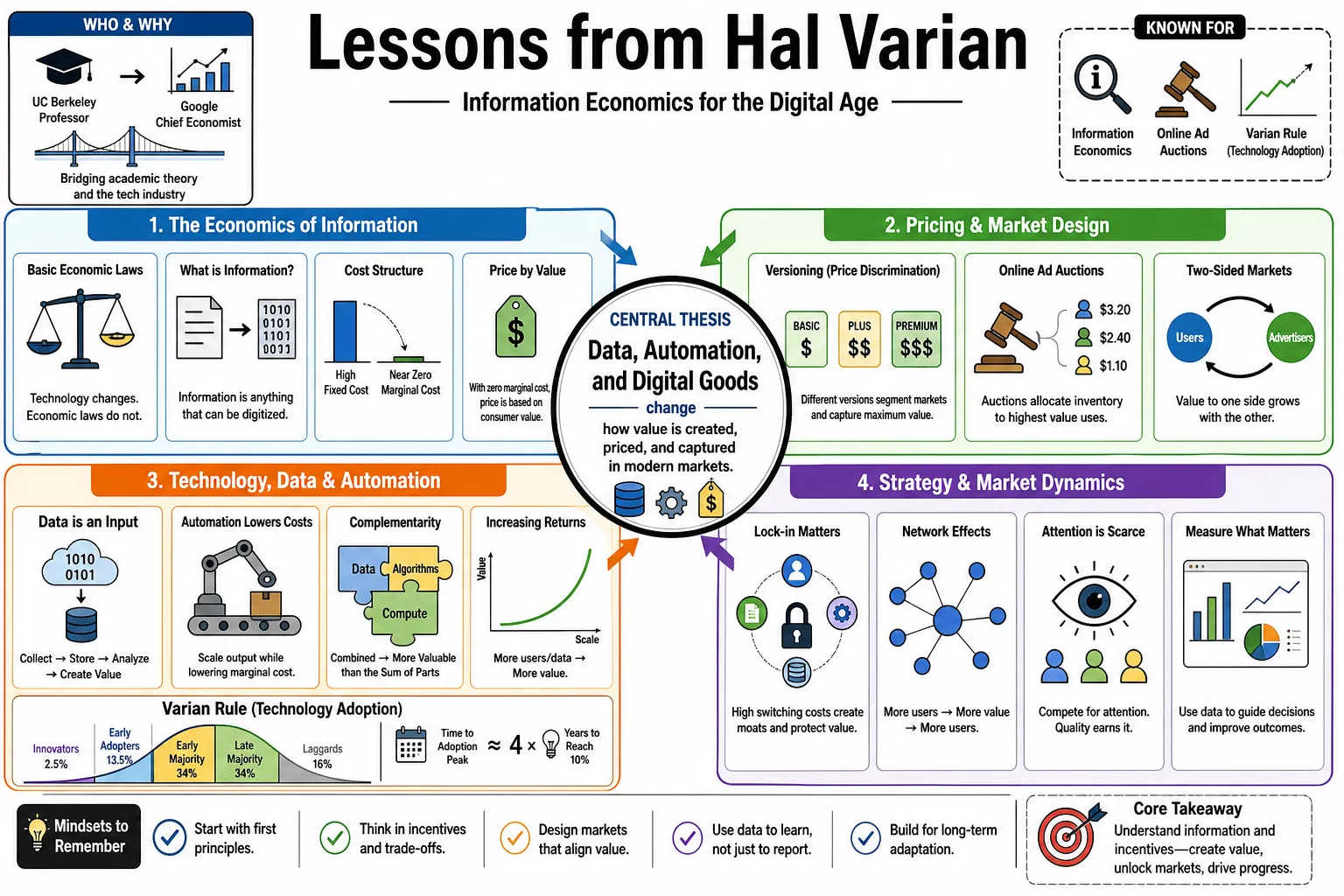
Lessons from Hal Varian
Hal Varian bridged academic theory and the tech industry during his tenures as a UC Berkeley professor and Google's Chief Economist. He is best known for his work on information economics, helping design online ad auctions and formulating the "Varian Rule" to forecast technology adoption. This profile collects his views on how data, automation, and digital goods change modern markets.
Part 1: The Economics of Information
- On basic economic laws: "Ignore basic economic principles at your own risk. Technology changes. Economic laws do not." — Source: Information Rules
- On information definition: "Information is anything that can be digitized," meaning it carries a high fixed cost of production but a nearly zero marginal cost of reproduction. — Source: Information Rules
- On pricing digital goods: Because the marginal cost of a digital good is zero, its price must be based on consumer value rather than production cost. — Source: UC Berkeley
- On versioning: Creating different versions of information goods allows businesses to segment markets and capture maximum value from different consumer types. — Source: Christian Sarkar
- On lock-in: The strategic importance of customer retention is paramount, as the present-value profit from a customer equals their total switching costs. — Source: Goodreads
- On information accessibility: "It isn't that information is exploding, but accessibility is. There's just about as much information this year as there was last year... It's just that now it's so much more accessible." — Source: AZQuotes
- On universal access: "Providing universal access to information will allow such people to realize their full potential, providing benefits to the entire world." — Source: AZQuotes
- On hidden talent: In a credited Pew/Elon survey response, Varian argued that universal access to human knowledge could unlock people who might otherwise remain "stuck behind a plow in India or China," improving literacy, numeracy, and global development. — Reference: Elon University credited survey response by Hal Varian on universal access to knowledge
- On complementary services: "If you are looking for a career... find something where you provide a scarce, complementary service to something that is getting ubiquitous and cheap." — Source: Econlib
- On data abundance: "We used to be calorie poor and now the problem is obesity. We used to be data poor, now the problem is data obesity." — Source: QuoteFancy
Part 2: Data and Statistics as a Profession
- On the future of statistics: "I keep saying the sexy job in the next ten years will be statisticians. People think I'm joking, but who would've guessed that computer engineers would've been the sexy job of the 1990s?" — Source: FlowingData
- On the value of analysis: As data becomes ubiquitous and cheap, the human ability to analyze and understand it becomes the scarce, complementary economic input. — Source: Econlib
- On data extraction: The explosion of free data has made the ability to process, extract value from, and communicate data a critically important skill. — Source: Harvard University
- On the rise of data science: The prediction of statistics as a high-demand field laid the conceptual groundwork for the explosion of the modern data scientist role. — Source: Kaggle
- On statistical modeling at scale: Simple things can go a long way in generating insight when dealing with massive datasets, as complex algorithms are not always necessary. — Source: EconTalk
- On data literacy: The ability to visualize and clearly communicate statistical findings is just as important as the mathematical analysis itself. — Source: Bookdown
- On organizational bottlenecks: The true bottleneck in modern business is not the availability of data, but the organizational capacity to process and act on it. — Source: Substack
- On the academic advantage: Academic training in statistics provides a distinct comparative advantage when applied to the rapid pace of the technology sector. — Source: Substack
- On data ubiquity: Data is no longer a scarce resource; the challenge has shifted entirely to sense-making and strategic application. — Source: Good Rebels
Part 3: Predicting the Present and Nowcasting
- On nowcasting: "Essentially what we're doing is predicting the present... giving people just a better sense of what's happening right now." — Source: Microsoft
- On Google Trends: Real-time search engine queries provide an immediate window into current economic behavior and consumer intent. — Source: Federal Reserve Bank of San Francisco
- On economic indicators: Search queries can accurately estimate immediate economic variables like unemployment claims and retail sales before official statistics are published. — Source: European Union
- On consumer intent: People search for information related to their immediate needs, making aggregate search data a highly accurate proxy for economic activity. — Source: Cornell University
- On breaking information: Real-time data analysis gives decision-makers greater confidence and understanding during rapidly changing macro situations. — Source: Microsoft
- On the speed of data: The value of nowcasting lies in eliminating the lag time inherent in traditional government economic reporting cycles. — Source: UC Berkeley
- On macroeconomics: High-frequency data transforms macroeconomic monitoring from a retrospective exercise into a real-time dashboard. — Source: RePEc
- On predictive confidence: Observing what people are actively searching for offers more reliable predictive power than asking them what they intend to do in a survey. — Source: Dean Eckles
- On real-time policy: Central banks and governments can leverage nowcasting models to make faster, more responsive monetary policy decisions. — Source: Financial Stability Board
Part 4: Automation, Labor, and Demographics
- On Bots and Tots: The labor market is shaped by two competing forces—the automation of tasks (bots) and the demographic shrinking of the workforce (tots). — Source: Edhat
- On labor supply: While much public anxiety focuses on robots replacing jobs, economists must equally consider the shrinking supply of labor due to declining birth rates. — Source: Council on Foreign Relations
- On demographic rescue: Digital tools and automation may arrive "just in time" to compensate for shrinking working-age populations in advanced economies. — Source: YouOnAI
- On the dominant force: For the foreseeable future, demographic shifts and aging populations will be a more significant economic force than AI-driven job displacement. — Source: Edhat
- On job displacement: "Everyone wants more jobs and less work," and historical displacements by appliances like washing machines have been overwhelmingly welcome. — Source: AZQuotes
- On technological augmentation: In a Council on Foreign Relations conversation, Varian argued that many heterogeneous service jobs are hard to automate completely, while tools that assist workers and improve how tasks are done are more plausible near-term gains. — Reference: Council on Foreign Relations conversation with Hal Varian on automation and labor augmentation
- On shifting demand: Automation and computerization shift the specific types of human labor demanded, rather than eliminating the need for human effort entirely. — Source: Council on Foreign Relations
- On historical precedents: Varian pointed to Jim Bessen's work on Census occupations and noted that automation usually changes task allocation rather than erasing whole jobs; even elevator-operator tasks largely moved to other roles. — Reference: Council on Foreign Relations conversation with Hal Varian on automation and occupational change
- On labor scarcity: As populations age, the primary economic challenge will shift from finding jobs for workers to finding enough workers for open jobs. — Source: YouOnAI
- On economic flexibility: Automation provides the necessary productivity boost to maintain living standards in a society with a high ratio of retirees to active workers. — Source: Council on Foreign Relations
Part 5: The Productivity Paradox
- On the mismeasurement of productivity: Traditional economic statistics fundamentally fail to capture the massive value and output of free digital goods and services. — Source: Bruegel
- On the zero-price problem: Because digital services often cost consumers nothing, their immense contributions to living standards do not properly register in GDP calculations. — Source: Naked Capitalism
- On the photography example: In 2000, 80 billion photos cost 50 cents each; in 2015, 1.6 trillion photos cost effectively zero—a massive productivity gain invisible to standard metrics. — Source: Bruegel
- On technological complements: To thrive in the modern economy, individuals must seek to be a scarce complement to increasingly abundant and cheap technological inputs. — Source: Stanford University
- On the dynamo analogy: Just as electrification required time to redesign factories before productivity soared, digital transformation requires structural business changes before yielding full benefits. — Source: Substack
- On structural adaptation: The true benefits of new technologies come not just from doing old things faster, but from entirely new organizational structures and capabilities. — Source: Substack
- On hardware stagnation: Innovation in certain hardware categories has slowed simply because the average consumer no longer requires a radically faster chip on their desktop. — Source: Centre for the Study of Living Standards
- On free goods: The proliferation of ad-supported and free digital utilities represents a massive, unmeasured consumer surplus in the modern economy. — Source: Reddit
- On the lag in statistics: Economic measurement frameworks designed for an industrial economy of physical goods are inherently ill-equipped for an economy of digital abundance. — Source: Centre for the Study of Living Standards
Part 6: Online Advertising and Auction Design
- On the rebirth of auctions: "Auctions, one of the oldest ways to buy and sell, have been reborn and revitalized on the Internet." — Source: GitHub Pages
- On auction balance: A successful online ad auction must meticulously reconcile and balance the competing interests of the advertiser, the user, and the platform itself. — Source: Zion & Zion
- On position auctions: The complex game-theoretic structures of online ad auctions accurately dictate equilibria and determine optimal ad placement pricing. — Source: UC Berkeley
- On modeling reality: An effective economic model should be aggressively reduced to only those essential pieces required to reveal the core mechanics of a system. — Source: arXiv
- On empirical accuracy: Abstract game-theoretic models of ad auctions can explain real-world bidding environments with an impressive error margin of only 4 to 5 percent. — Source: EconTalk
- On auction evolution: The strategic shift toward first-price auctions in display advertising was a necessary evolution to create a transparent, level playing field for ad sellers. — Source: Conversations with Tyler
- On ancient mechanisms: The fundamental mechanisms of digital ad auctions share deep structural roots with historical markets dating back to ancient Babylon. — Source: GitHub Pages
- On user experience: In search advertising, the relevance of the ad to the user is just as critical as the bid amount, ensuring high-quality long-term engagement. — Source: Google Blog
- On automated bidding: The transition from manual bidding to automated algorithmic bidding fundamentally changes the speed and efficiency of online market clearing. — Source: American Economic Association
- On market design: The internet has allowed economists to transition from merely studying abstract markets to actively designing and engineering them at scale. — Source: University of Texas at Arlington
Part 7: Forecasting and the Varian Rule
- On the Varian Rule: "A simple way to forecast the future is to look at what rich people have today; middle-income people will have something equivalent in 10 years, and poor people will have it in an additional decade." — Source: Wikipedia
- On technological democratization: Luxury conveniences—like personal drivers or private assistants—eventually become mass-market software solutions like ride-sharing and AI assistants. — Source: Wikipedia
- On predicting adoption: The trajectory of technological adoption follows a predictable economic path of decreasing costs and increasing scale. — Source: Wikipedia
- On the democratization of luxury: What begins as an exclusive, high-cost physical service inevitably transforms into an accessible, low-cost digital good. — Source: Wikipedia
- On the scaling of innovation: The initial high cost of development is subsidized by early wealthy adopters, paving the way for eventual mass market affordability. — Source: Wikipedia
- On observing the present: To understand the future of mass consumer technology, one only needs to carefully observe the current habits and tools of the affluent. — Source: Wikipedia
- On the inevitability of access: Economic forces naturally drive the producers of luxury technologies to seek the massive scale and volume of the middle and lower classes. — Source: Wikipedia
- On software eating services: The most significant technological leap occurs when a human-provided luxury service is successfully codified into scalable software. — Source: Wikipedia
- On the timeline of progress: The consistent ten-to-twenty-year lag in the Varian Rule provides a highly reliable heuristic for venture capital and product development. — Source: Wikipedia
Part 8: Academia, Industry, and Economic Modeling
- On the academic approach: Applying rigorous academic economic principles to real-world industrial organization yields massive strategic advantages. — Source: Conversable Economist
- On identifying margins: The core value of an economist in a tech company is the ability to identify relevant margins—what is scarce, what is cheap, and where bottlenecks lie. — Source: Substack
- On structural changes: The most important question about a new technology is not whether it matters, but how it fundamentally alters firm boundaries and market competition. — Source: Substack
- On academic publishing: "Having a successful textbook is like being married to a very wealthy person you don't like much anymore." — Source: Conversable Economist
- On continuous improvement: Digital environments allow for rapid continuous improvement through constant A/B testing, far outpacing the iteration cycles of physical industries. — Source: UC Berkeley
- On communicating research: "The more you can talk about your work, the better the final paper will be," as explaining an idea aloud forces clarity and simplicity. — Source: Bernoff
- On bridging worlds: Academic training in dissecting economic structures provides a unique, highly practical lens for navigating the chaotic pace of the technology sector. — Source: Xtalks
- On model reduction: In "How to Build an Economic Model in Your Spare Time," Varian argues that a model should reveal the essence of what is happening and be reduced to only the pieces required to make it work. — Reference: Josh Bernoff excerpt of Hal Varian's "How to Build an Economic Model in Your Spare Time"
- On the value of theory: Theoretical economics is not opposed to practical industry; rather, theory provides the foundational blueprint necessary to engineer entirely new digital marketplaces. — Source: American Statistical Association