Harshil Mathur and Shashank Kumar founded Razorpay to make online payments easier for Indian startups and small businesses. What began as a payments product grew into a broader platform for business money movement. — Y Combinator — Razorpay.
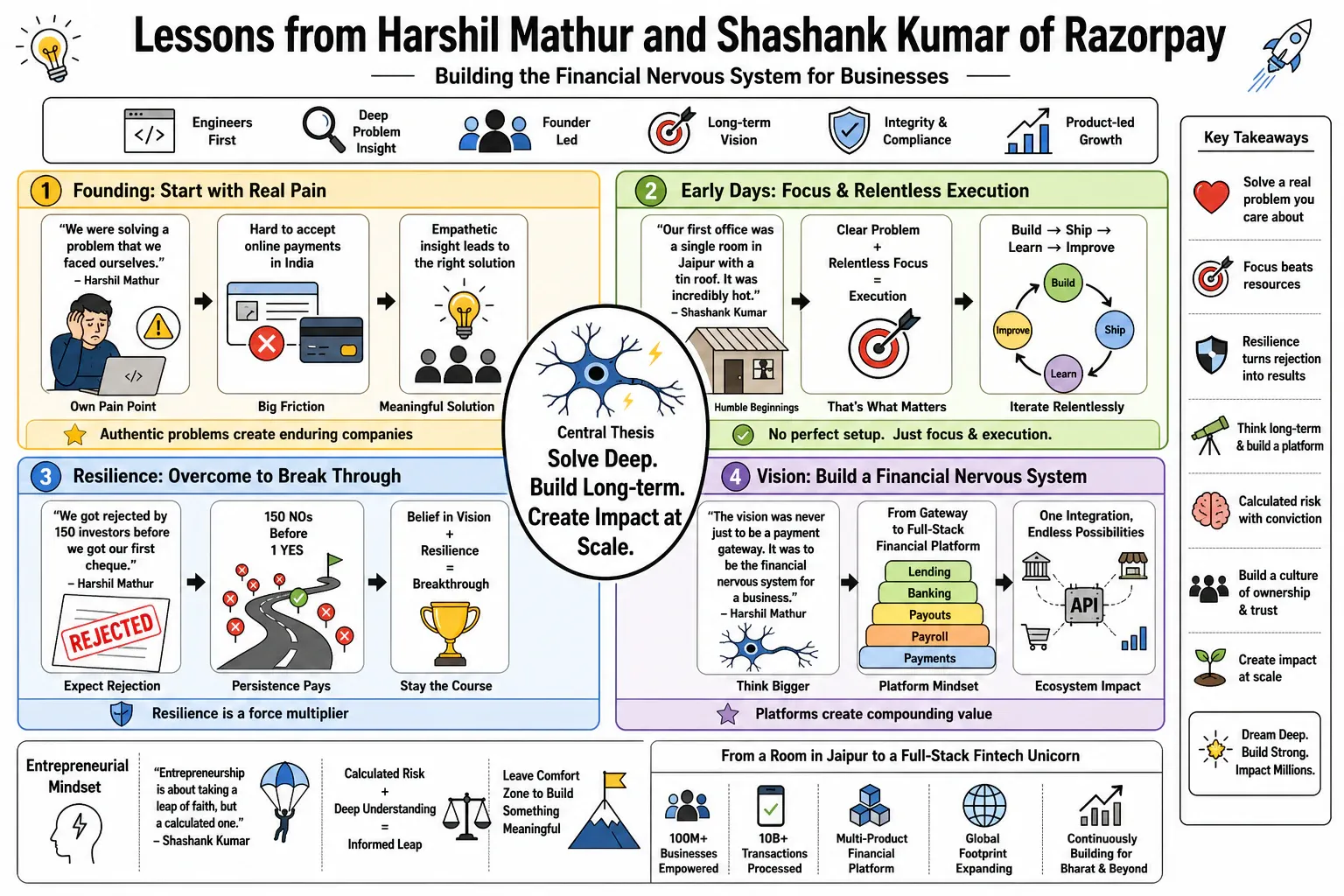
On Founding, Vision, and Entrepreneurship
- On Solving a Problem They Encountered: While building a crowdsourcing project, Mathur and Kumar struggled with existing payment gateways. Mathur said that experience led them to simplify online payment acceptance for Indian startups and small businesses. — Y Combinator — Razorpay Founding Story.
- On Keeping Early Costs Low: Mathur said he began Razorpay in Jaipur, working from his parents' house while bootstrapping, because that kept early costs near zero; the team moved closer to Bengaluru customers as it grew. — Harshil Mathur — Razorpay Founding Interview.
- On Building Before Fundraising: Kumar said Razorpay bootstrapped for almost a year and focused on improving its offering before raising outside capital; he treats funding as a way to scale, not validate the business. — Shashank Kumar — Founding Razorpay.
- On Expanding Around Business Transactions: Mathur described identifying the different transactions a business makes and bringing them onto one Razorpay platform, expanding beyond a payment gateway through customer-led product development. — Financial Express — Harshil Mathur Interview.
- On Starting Despite Uncertainty: Kumar wrote that he and Mathur discussed the idea for more than a year before Mathur left his job; only after starting did they grasp the full complexity of fintech. — Shashank Kumar — Founding Razorpay.
- On Developer-Friendly Payments: Kumar saw that integrating a payment gateway required lengthy documentation and argued that a startup should be able to set up payments quickly and simply; his team rebuilt the flow around that experience. — YourStory — Shashank Kumar Interview.
On Product, Engineering, and Technology
- Customer-Led Product: Mathur says Razorpay kept talking to customers during product development and used their feedback to decide what to build, including an eCOD service after merchants faced cash-on-delivery problems. — Razorpay — Harshil Mathur Interview.
- Engineering with Customer Contact: Kumar says that in Razorpay's early years he both wrote code and spoke with customers; he tested incomplete versions early to learn whether the product interested them and to iterate quickly. — YourStory — Shashank Kumar Interview.
- Test the Payment Flow with Users: Kumar says the first prototype left payers stranded on a gateway page, so he changed the flow to return them to the merchant site with fewer clicks; he also tested early versions with customers for rapid feedback. — YourStory — Shashank Kumar Interview.
- Rebuild Until the Core Works: Kumar says he discarded his first two versions of Razorpay's payments platform and moved forward with the third; he then kept improving the product to make payments more seamless. — YourStory — Shashank Kumar Interview.
- Simplify a Complex Integration: Kumar found that startup payment-gateway integration could require 10–20 pages of documentation and wanted setup to be simple enough to complete quickly. — YourStory — Shashank Kumar Interview.
- Give Self-Driven Hires Room to Act: Mathur says Razorpay prioritized self-driven employees who could take initiative rather than simply expanding headcount in proportion to company growth. — Razorpay — Harshil Mathur Interview.
On Building for India's Fintech Ecosystem
- Meet Fintech's Operational Requirements: Mathur describes spending Razorpay's first six months securing bank approvals and required certifications. For a payments product, navigating those requirements was part of building the service, not an afterthought. — Razorpay — Harshil Mathur Interview.
- Build on New Payment Rails: Mathur welcomed UPI because it made payments more seamless and lowered merchants' costs; he says Razorpay moved early to make UPI available through its payment processing. — Razorpay — Harshil Mathur Interview.
- Treat Regulation as a Design Constraint: Mathur says a fintech product must study India's regulatory ecosystem closely and build within its rules, which are intended in part to protect trust in banking. — Razorpay — Harshil Mathur Interview.
- Serve Overlooked Small Merchants: Mathur says incumbent payment providers focused on larger sellers, while Razorpay chose to help smaller merchants accept online payments rapidly and with less complexity. — Razorpay — Harshil Mathur Interview.
- Protect Trust in Payments: Mathur frames banking regulation as a way to protect consumer trust while people move into formal financial services. That makes compliance a core product consideration for a fintech founder. — Razorpay — Harshil Mathur Interview.
On Culture, Hiring, and Team Building
- Hire for Initiative as You Scale: Mathur says Razorpay looked for self-driven employees who would take initiative, allowing the company to grow without scaling headcount at the same rate. — Razorpay — Harshil Mathur Interview.
- Learn by Building: Kumar built a programming community at IIT-Roorkee around practical projects and later described testing Razorpay's early product with customers before it was fully developed. His account supports learning through hands-on work, not the attributed 'slope' hiring formula. — YourStory — Shashank Kumar Interview.
- Keep Customer Feedback in the Loop: Mathur says Razorpay maintained personal customer relationships and sat with users to learn what they needed, while filtering suggestions against product focus. — Razorpay — Harshil Mathur Interview.
- Build a Cofounder Partnership Through Shared Work: Mathur says he and Kumar collaborated on coding projects at IIT Roorkee, stayed in touch after graduation and later chose to tackle the payments problem together. — Y Combinator — Razorpay Founder Account.
- Keep Learning Through Experimentation: Kumar advises founders to keep learning while building a company; his own account of repeatedly reworking the first payments platform illustrates iteration without attributing the unverified failure-culture quotation to him. — Razorpay — Shashank Kumar Essay.
On Strategy, Growth, and the Future
- Prioritize Durable Economics: Mathur says he regarded the unicorn label as secondary to building a sustainable model, and preferred targets based on unit economics and scale to valuation targets. — Financial Express — Harshil Mathur Interview.
- Build Toward Sustainability: Mathur says Razorpay needed a sustainable model before going public and chose to focus on unit economics and scale. The interview does not establish the original claim that the company had already achieved profitability. — Financial Express — Harshil Mathur Interview.
- Expand Beyond Payment Acceptance: Razorpay's founder-supplied account describes a move from payment acceptance toward a platform covering business money movement, including disbursals and banking services. — Y Combinator — Razorpay Founder Account.
- Compete with Existing Payment Habits: Mathur says Razorpay set out to serve small merchants overlooked by incumbent payment providers and to make accepting online payments faster and simpler. — Razorpay — Harshil Mathur Interview.
- Use Acquisitions to Broaden the Offering: Razorpay's company-supplied YC profile lists acquisitions in offline payments, payroll, fraud detection and international payments as part of its wider business-payments platform. — Y Combinator — Razorpay Company Profile.
- Keep Innovating as Rivals Catch Up: Mathur says competitors copied early Razorpay features, so the company kept developing new products in response to customer needs rather than changing its vision. — Razorpay — Harshil Mathur Interview.
- Treat Expansion as Ongoing Work: Mathur says Razorpay has broadened its products and audience without abandoning its core aim of making digital payments easier for underserved businesses. — Razorpay — Harshil Mathur Interview.
Additional Key Learnings
- On the Early Pitch: Mathur says Razorpay applied to Y Combinator before launch because the application forced the founders to clarify differentiation, market size and how they would win customers. — Y Combinator — Razorpay Founder Account.
- On a Lean Early Team: Mathur advised hiring people willing to take initiative and wear multiple hats, rather than adding staff before the business needed them. — Razorpay — Harshil Mathur at RevUp Hyderabad.
- On the Long Journey: Kumar described Razorpay's 2020 funding round as a step toward simplifying business money movement, with a substantial financial ecosystem still to build. — Razorpay — Shashank Kumar Series D Essay.
- On Early Customer Advocacy: In the founders' YC account, early startups adopted Razorpay's gateway without an active sales push; word of mouth then served as its main marketing for almost a year. — Y Combinator — Razorpay Founders Q&A.
- On India's Digitization Window: Kumar wrote that mobile and internet adoption was accelerating when the founders moved to Bengaluru, while businesses still struggled to accept online payments. — Razorpay — Shashank Kumar Series D Essay.
- On Open Communication: The founders said they wanted employees to understand how the business was performing and encouraged questions, opinions and concerns to flow to management. — Y Combinator — Razorpay Founders Q&A.
- On Testing an Imperfect Product: Kumar says he tested Razorpay's early product with startups before it was fully built to gauge interest and iterate immediately. — YourStory — Shashank Kumar Interview.
- On Saying No: Kumar advised younger startups to resist distracting opportunities, strengthen the core product first and expand only when that core is established. — YourStory — Shashank Kumar at TechSparks.
- On an Economic Slowdown: A Razorpay recap of a founders' fireside chat says Mathur and Kumar urged founders to grow efficiently and keep building useful products and customer service through an economic slowdown. — Razorpay — Founders' Mixer Recap.
- On a Working Partnership: Mathur's founder account says he and Kumar worked on coding projects together at IIT Roorkee and continued collaborating after graduation, before jointly tackling the payments problem. — Y Combinator — Razorpay Founder Account.
- On Broader Financial Workflows: Kumar wrote that conversations with businesses revealed financial pain points beyond accepting payments, prompting Razorpay to develop tools for payroll, expenses and payouts. — Razorpay — Shashank Kumar Series D Essay.
- On Local Market Knowledge: Mathur says fintech solutions cannot simply be copied from other countries into India; founders must understand the local market and regulatory setting. — Razorpay — Harshil Mathur Interview.
- On Supporting New Founders: At TechSparks, Kumar said the founders had benefited from the startup community and wanted to help strengthen entrepreneurship in India. — YourStory — Shashank Kumar at TechSparks.
- On the Original Mission: Mathur's founder account identifies the aim as making online payments simpler, more affordable and more secure for Indian startups and small businesses. — Y Combinator — Razorpay Founder Account.