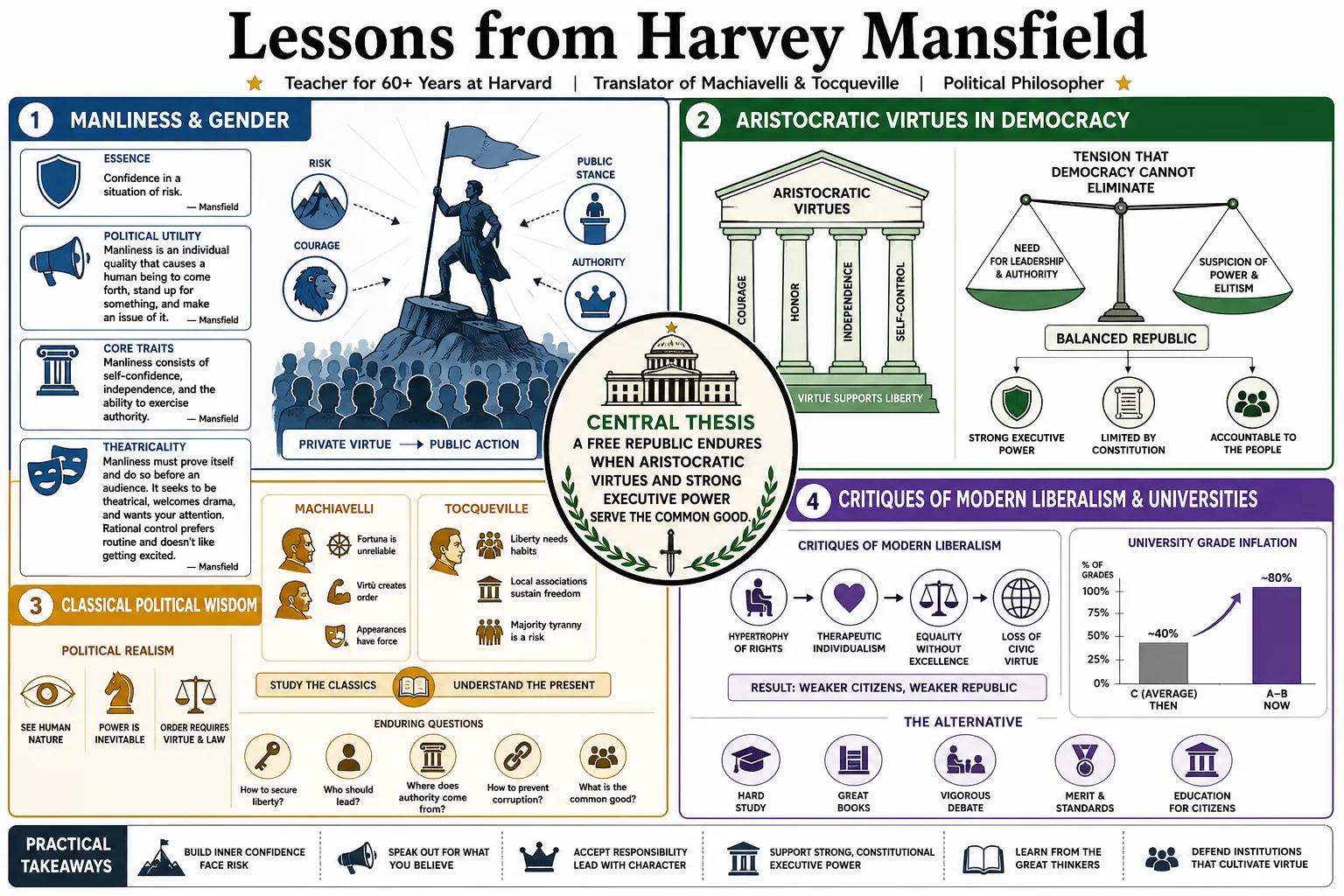
Lessons from Harvey Mansfield
Harvey Mansfield spent more than six decades teaching political philosophy at Harvard and translating the major works of Machiavelli and Tocqueville. He consistently argued that modern democracy relies on aristocratic virtues like manliness and strong executive power, even as society tries to outgrow them. This collection gathers his readings of classical political thought alongside his critiques of modern liberalism and university grade inflation.
Part 1: Manliness and Gender
- On the essence of manliness: "Confidence in a situation of risk." — Source: [Wikipedia)]
- On the political utility of manliness: "Manliness is an individual quality that causes a human being to come forth, stand up for something, and make an issue of it. It is a quality held by private persons that calls them forth into public, hence into politics." — Source: [Juniata College]
- On core traits: "Manliness consists of self-confidence, independence, and the ability to exercise authority." — Source: [Harvard Gazette]
- On theatricality: "Manliness must prove itself and do so before an audience. It seeks to be theatrical, welcomes drama, and wants your attention. Rational control prefers routine and doesn't like getting excited." — Source: [Yoest.com]
- On its dual nature: "Manliness is a quality both bad and good, mostly male, often intolerant, irrational, and ambitious." — Source: [Bibliocommons]
- On modern gender neutrality: "Today the very word 'manliness' seems quaint and obsolete. We are in the process of making the English language gender neutral, and manliness seems to describe the essence of the enemy we are attacking." — Source: [AZ Quotes]
- On feminism: "That is why I have called feminism nihilism. It says that being a woman is nothing definite and that the duty of women is to advance that nothingness as a cause." — Source: [AZ Quotes]
- On transcending manliness: "Efforts to transcend manliness have led to more justice and less happiness." — Source: [YouTube]
- On rationality and heroics: "Rational control aims to replace the drama and heroics of manliness with routine and predictable outcomes." — Source: [Yoest.com]
- On society's need for manliness: "While contemporary society seeks to eradicate manliness, the quality remains necessary for defending against physical threats." — Source: [Centro Machiavelli]
Part 2: Machiavelli
- On the founder of modernity: "Machiavelli is the founder of modern political philosophy because he intentionally broke from classical and Christian traditions." — Source: [Conversations with Bill Kristol]
- On the effectual truth: "Machiavelli replaced moral virtue with effectual truth, focusing on how things actually are rather than how they ought to be." — Source: [NEH]
- On imaginary republics: "Machiavelli deliberately departed from classical imaginary republics and principalities in favor of a political science based on reality, necessity, and power." — Source: [Wikipedia]
- On redefining virtue: "Machiavelli’s version of virtue is not moral goodness but a form of flexibility and audacity that allows a leader to conquer fortune." — Source: [WordPress]
- On fortune: "Machiavelli treats fortune as an entity that must be mastered through an impetuous quality rather than passively accepted." — Source: [WordPress]
- On Christianity as decadent: "Machiavelli viewed Christianity as a decadent force that sapped human honor and made the world weak by turning attention toward the afterlife." — Source: [Conversations with Bill Kristol]
- On subtle subversion: "Machiavelli was an ironic and revolutionary thinker who intentionally disguised his true intentions to avoid persecution while reshaping Western thought." — Source: [Conversations with Bill Kristol]
- On necessary evil: "A ruler must learn how not to be good, using the techniques of tyranny when necessary to secure order and freedom." — Source: [NEH]
- On indirect rule: "Machiavelli innovated the concept of indirect rule, where leaders act in the name of the people or God to effectively wield power." — Source: [Johnathan Bi]
- On ambition: "Machiavelli recognized that ambition is inevitable in politics, meaning the goal is to channel it effectively rather than fruitlessly trying to suppress it." — Source: [YouTube]
Part 3: Alexis de Tocqueville
- On a new liberalism: "Alexis de Tocqueville was a liberal, but, as he once wrote, a 'new kind of liberal.'" — Source: [Claremont Review of Books]
- On defending liberalism: "Tocqueville remains the greatest resource we have for defending a defensible liberalism." — Source: [YouTube]
- On political versus theoretical liberalism: "Tocqueville’s work provides a political version of liberalism focused on the practice of self-government, unlike the abstract theories of Hobbes or Locke." — Source: [YouTube]
- On Machiavelli's great truth: "Tocqueville's single reference to Machiavelli in Democracy in America is a nicely located misquotation that signals his deep understanding and subtle challenge to the Italian thinker." — Source: [Delba Winthrop Archive]
- On saving the aristocratic element: "Tocqueville sought to replace Machiavelli in his role of captain-philosopher and to save the aristocratic element in democracy that Machiavelli believed should be dispensed with." — Source: [Delba Winthrop Archive]
- On the definitive book on America: "Democracy in America is the best book ever written on democracy and the best ever written on America." — Source: [NEH]
- On individualism: "Tocqueville identified individualism as a unique danger of democratic ages, threatening to isolate citizens and make them vulnerable to soft despotism." — Source: [YouTube]
- On associations: "Voluntary associations are essential in a democracy because they teach citizens how to act together and prevent the state from absorbing all social power." — Source: [The Great Thinkers]
- On translating carefully: "We would rather attract readers to Tocqueville than bring him to them, and make him too cheaply available for our purposes today." — Source: [Claremont Review of Books]
- On religion and liberty: "Religion is necessary for sustaining liberty in a democracy because it provides moral boundaries that prevent freedom from descending into license." — Source: [The Great Thinkers]
Part 4: Conservatism
- On the temporary label: "The label conservative is problematic because it is merely political or temporary in nature, and traditions often contain contradictory elements." — Source: [Contemporary Thinkers]
- On his origins on the right: "I became a conservative primarily due to the anti-communist cause, later expanding my focus to domestic issues." — Source: [Conversations with Bill Kristol]
- On conservative tolerance: "Conservatives are often more tolerant than their liberal counterparts because they possess the realism to recognize they cannot simply eliminate their opponents." — Source: [The Point Magazine]
- On liberal prejudice: "There is a tendency among some modern liberals to view conservatism as illegitimate or based on prejudice rather than principle." — Source: [The Point Magazine]
- On being a friend of liberalism: "Despite my reputation, I am a friend of liberalism seeking to defend a defensible version of it against modern extremes." — Source: [Substack]
- On constitutional friction: "Democracy is not meant to be simple or easy to operate, and friction and the separation of powers are essential conservative constitutional principles." — Source: [The Point Magazine]
- On political philosophy and partisanship: "Political philosophy is essential for self-knowledge, examining the conditions under which thinkers can think, beyond mere partisanship." — Source: [Contemporary Thinkers]
- On the crux of thinking: "Political philosophy sits at the crux where thinking meets non-thinking." — Source: [Contemporary Thinkers]
- On the American Constitution: "The American Constitution is the greatest achievement of modern political science because it successfully balances power to prevent tyranny." — Source: [Conversations with Bill Kristol]
- On human nature: "Conservatism realistically accepts that human nature is flawed and resistant to utopian engineering." — Source: [NEH]
Part 5: Education and Grade Inflation
- On the Two-Grade experiment: "To protest declining standards, I gave students two marks: the official inflated grade for their transcript, and the actual grade they truly deserved." — Source: [Washington Post]
- On the nickname Harvey C-Minus: "My reputation for rigorous grading and my crusade against inflation earned me the famous moniker Harvey C-Minus among Harvard students." — Source: [Chronicles Magazine]
- On the origins of grade inflation: "Grade inflation began during the Vietnam War era when high grades were used to help students maintain draft deferments." — Source: [Washington Post]
- On feeling good versus excellence: "The cultural shift toward wanting education to make students feel good about themselves has superseded the priority of rigorous academic excellence." — Source: [Washington Post]
- On faculty inaction: "I spent decades speaking out against grade inflation at faculty meetings, lamenting that my concerns were met with silence or apathy." — Source: [City Journal]
- On true viewpoint diversity: "The most important form of diversity in a university is not found in identity characteristics like sex or class, but in a true diversity of opinion." — Source: [Harvard Magazine]
- On institutional conformity: "Modern universities have drifted toward ideological conformity, making it difficult for conservative or dissenting voices to be heard or respected." — Source: [Harvard Magazine]
- On the purpose of grading: "Grades should reflect objective achievement and intellectual rigor, not serve as a self-esteem booster." — Source: [Harvard Magazine]
- On the danger of easy success: "When top grades are handed out universally, true excellence becomes indistinguishable from mediocrity, harming the students in the long run." — Source: [City Journal]
Part 6: Executive Power
- On the ambivalent executive: "Executive power is intended to secure the difference between free government and tyranny by giving the former some of the power and techniques of the latter." — Source: [Reason]
- On power exercised in another's name: "Executive power is power exercised in the name of someone or something else: God or the people or the law." — Source: [NEH]
- On the necessity of independent energy: "While the executive is nominally a subordinate agent meant to execute laws, the office inherently requires an independent, extralegal energy." — Source: [Claremont Review of Books]
- On handling emergencies: "The rule of law is often insufficient in times of crisis, requiring an executive with the flexibility and strength to act outside strict legal confines." — Source: [Reason]
- On the Machiavellian root: "The concept of a strong executive who acts on behalf of the people to maintain order is a modern innovation rooted directly in Machiavelli's political thought." — Source: [Johnathan Bi]
- On the taming of the prince: "Modern republics have attempted to tame the Machiavellian prince by channeling his ambition into a constitutional executive office." — Source: [University of Richmond]
- On the limits of law: "Law cannot anticipate every contingency; therefore, a strong executive is required to fill the gaps left by legislative foresight." — Source: [Reason]
- On republican strength: "A republic can only survive if it possesses an executive capable of wielding the sharp, decisive power typically associated with monarchies." — Source: [NEH]
- On the paradox of execution: "The paradox of the executive is that in order to faithfully execute the law, the executive must sometimes act independently of it." — Source: [Claremont Review of Books]
Part 7: Edmund Burke
- On the respectability of parties: "Burke transformed the perception of political parties from a dangerous faction into a respectable and necessary component of free government." — Source: [Goodreads]
- On unequal capacity: "Statesmanship is an unequal capacity, meaning that the wisdom required to govern well is not evenly distributed among the populace." — Source: [Law & Liberty]
- On partisanship as a substitute: "Burke viewed partisanship as a taming alternative to statesmanship, allowing ordinary politicians to govern effectively through party structures when great statesmen are absent." — Source: [Law & Liberty]
- On matchless penetration: "Burke was a politician who looked at public issues with matchless penetration, acting as a modern statesman without ever holding the highest offices of command." — Source: [The Great Thinkers]
- On natural law and modernity: "Burke's conservatism represents a complex continuity of natural law, adapting traditional moral frameworks to the realities of modern political life." — Source: [Harvard University]
- On prescriptive wisdom: "Burke understood that society relies on inherited wisdom and prescription, warning against the arrogant assumption that a single generation can remake the world from scratch." — Source: [The Imaginative Conservative]
- On the danger of speculative theory: "Burke famously warned that applying abstract, speculative theories to complex human societies almost always results in destruction rather than improvement." — Source: [The Great Thinkers]
- On acting when necessary: "Burke recognized that political actors cannot afford speculative despair and have a moral duty to act even in uncertain circumstances." — Source: [AZ Quotes]
Part 8: Modern Liberalism
- On the crisis of liberalism: "Liberalism is in crisis because it could not prevent the skepticism it applied to traditional principles from being applied to its own principles." — Source: [Hoover Institution]
- On standing for nothing: "A liberal is no longer someone who stands up for liberty. It is now a person who stands for nothing and takes umbrage at anyone who defends any principle at all." — Source: [Hoover Institution]
- On the expansion of state power: "In modern liberalism, the government's power is vastly expanded in the name of liberal diversity, which translates to the toleration of any person or principle except those that assert objective truth." — Source: [The Dartmouth]
- On the lack of manliness: "Contemporary liberals are often unwilling to fight for liberalism really, lacking the necessary manliness to defend their own civilization." — Source: [Conversations with Bill Kristol]
- On the bracketing of custom: "Modernity involves the systematic bracketing of custom and the divine in an attempt to maximize human freedom and rational control." — Source: [Acton Institute]
- On the mixed regime: "Liberal democracy is best understood as an Aristotelian mixed regime that must balance democratic equality with aristocratic excellence." — Source: [YouTube]
- On the denial of virtue: "Modern citizens often deny the aristocratic elements of their own society, underestimating the virtue required to maintain a healthy political order." — Source: [YouTube]
- On classical versus modern liberalism: "While seventeenth-century liberalism held that government must be strictly limited to protecting individual rights, modern liberalism uses the state to actively reshape society." — Source: [The Dartmouth]
- On defending liberty as betrayal: "In the modern liberal framework, to defend liberty vigorously is seen as betraying it, because asserting any superiority is viewed as inherently intolerant." — Source: [Hoover Institution]